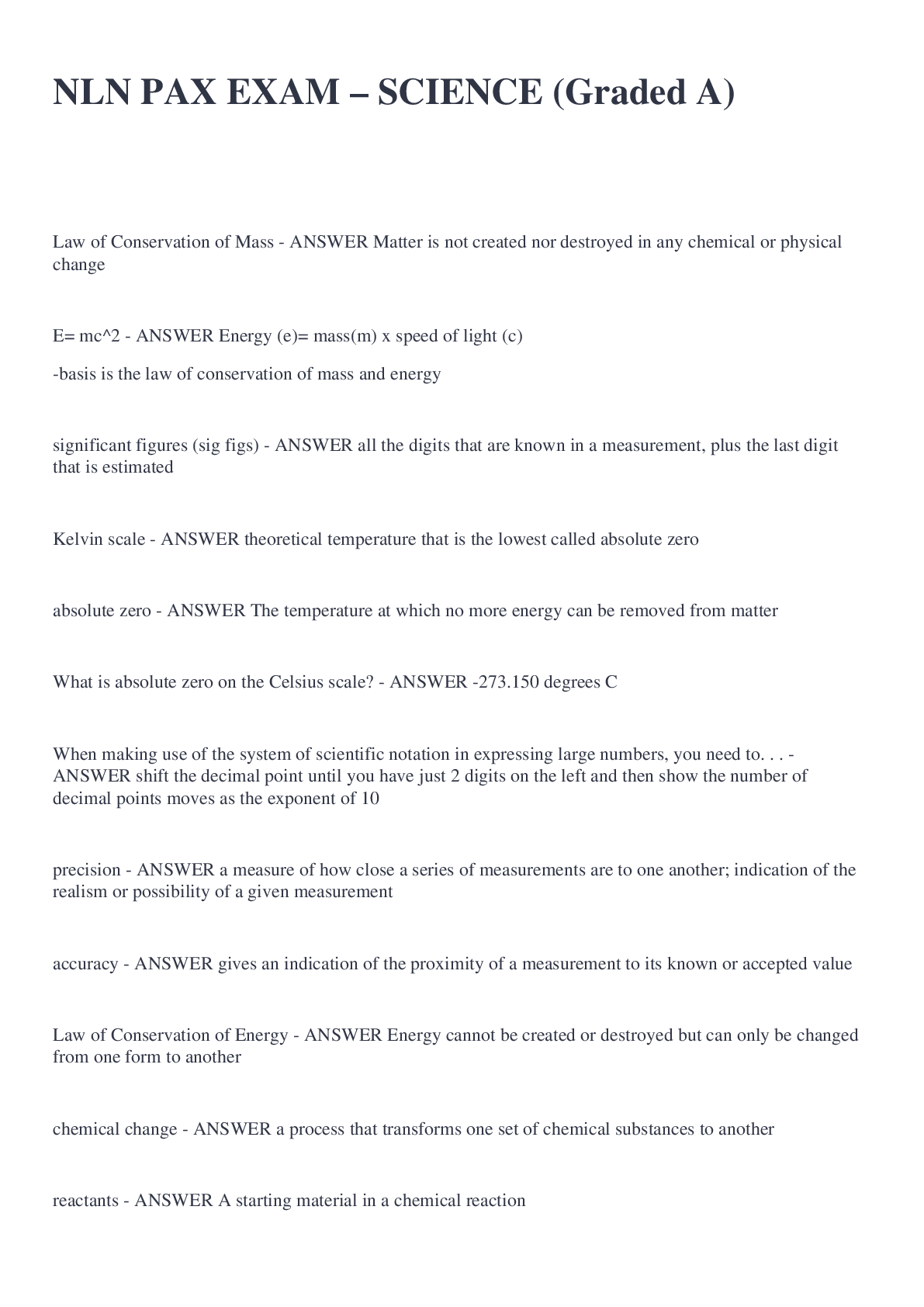
Law of Conservation of Mass - ANSWER Matter is not created nor destroyed in any chemical or physical change
E= mc^2 - ANSWER Energy (e)= mass(m) x speed of light (c)
-basis is the law of conservation of mass and ener
...
Law of Conservation of Mass - ANSWER Matter is not created nor destroyed in any chemical or physical change
E= mc^2 - ANSWER Energy (e)= mass(m) x speed of light (c)
-basis is the law of conservation of mass and energy
significant figures (sig figs) - ANSWER all the digits that are known in a measurement, plus the last digit that is estimated
Kelvin scale - ANSWER theoretical temperature that is the lowest called absolute zero
absolute zero - ANSWER The temperature at which no more energy can be removed from matter
What is absolute zero on the Celsius scale? - ANSWER -273.150 degrees C
When making use of the system of scientific notation in expressing large numbers, you need to. . . - ANSWER shift the decimal point until you have just 2 digits on the left and then show the number of decimal points moves as the exponent of 10
precision - ANSWER a measure of how close a series of measurements are to one another; indication of the realism or possibility of a given measurement
accuracy - ANSWER gives an indication of the proximity of a measurement to its known or accepted value
Law of Conservation of Energy - ANSWER Energy cannot be created or destroyed but can only be changed from one form to another
chemical change - ANSWER a process that transforms one set of chemical substances to another
reactants - ANSWER A starting material in a chemical reaction
products - ANSWER The elements or compounds produced by a chemical reaction.
anabolism - ANSWER Constructive metabolism; the process of building up larger molecules from smaller ones.
Catabolism - ANSWER Metabolic pathways that break down molecules, releasing energy.
catalyst - ANSWER a chemical involved in, but not changed by, a chemical reaction by which chemical bonds are weakened and reactions accelerated.
-speeds up
What is most abundant element in Earth's crust? - ANSWER Oxygen
law of definite proportions - ANSWER the elements that make up a single chemical compound have weight proportions that are fixed and constant
Pauli Exclusion Principle - ANSWER in any particular molecule, two electrons CANNOT have a different four-quantum-number set
Atomic theory - ANSWER a theory that states that all matter is composed of tiny particles called atoms.
An element's atoms. . . - ANSWER are similar in weight, and the weight depends on the type of atom
atoms of various elements. . . - ANSWER combine in ratios of whole numbers that are simple to form chemical compounds
Atoms are made up of - ANSWER protons and neutrons within a central or main nucleus that electrons surround
What makes up the nucleus - ANSWER protons and neutrons
Electrons - ANSWER they exist within levels of energy that are fixed around the atoms nucleus
Newton's First Law - ANSWER An object at rest stays at rest and an object in motion stays in motion with the same speed and in the same direction unless acted upon by an unbalanced force.
Newton's Second Law - ANSWER Force = mass x acceleration
Newton's Third Law - ANSWER For every action there is an equal and opposite reaction
electric potential - ANSWER basic interaction that takes place between a given magnetic field and the existence of an electric charge plus its motion
Ohm's Law - ANSWER V=IR
Any conductor restricting electron flow internally has the property of. . . - ANSWER resistance
Friction - ANSWER A force that opposes motion between two surfaces that are in contact
kinetic energy - ANSWER energy of motion
potential energy - ANSWER stored energy
4 basic forces in nature - ANSWER gravitational, electromagnetic, strong nuclear, and weak nuclear forces
4 Basic forces in nature, in order from strong to weak - ANSWER strong nuclear force
electromagnetic force
weak nuclear force
gravity
strong nuclear force - ANSWER the powerful attractive force that binds protons and neutrons together in the nucleus
weak nuclear force - ANSWER plays a role in the radioactive beta decay of some nuclei
Law of Conservation of Mass states - ANSWER as chemical reactions take place, there is no gain or loss that one can detect
convection - ANSWER The transfer of heat by the movement of a fluid
thermal radiation - ANSWER electromagnetic waves produced by objects because of their temperature
Non-metal that will stay in its fluid state when exposed to room temperature - ANSWER Bromine
Central metal of chlorophyll as a nature chelate compound - ANSWER Magnesium
Metal that when combined with other types of metals will form an amalgam - ANSWER Mercury
Which gas is often used to fill electric bulbs? - ANSWER Nitrogen
Washing soda is - ANSWER sodium carbonate
Quartz crystals are made of - ANSWER silicon dioxide
Hydrogen - ANSWER known as a greenhouse gas
Bromine - ANSWER red liquid
Hardest substance on Earth - ANSWER diamond
Peat - ANSWER type of coal that has its deposit containing marks of parent plant material
Major use of tetraethyl lead? - ANSWER gas additive
[Show More]