1. Which action is an accepted tactic when engaged in a negotiation?
A) Being willing to win at any cost
B) Communicating only when asked direct questions
C) Compromising only as a last resort
D) Beginning with a hig
...
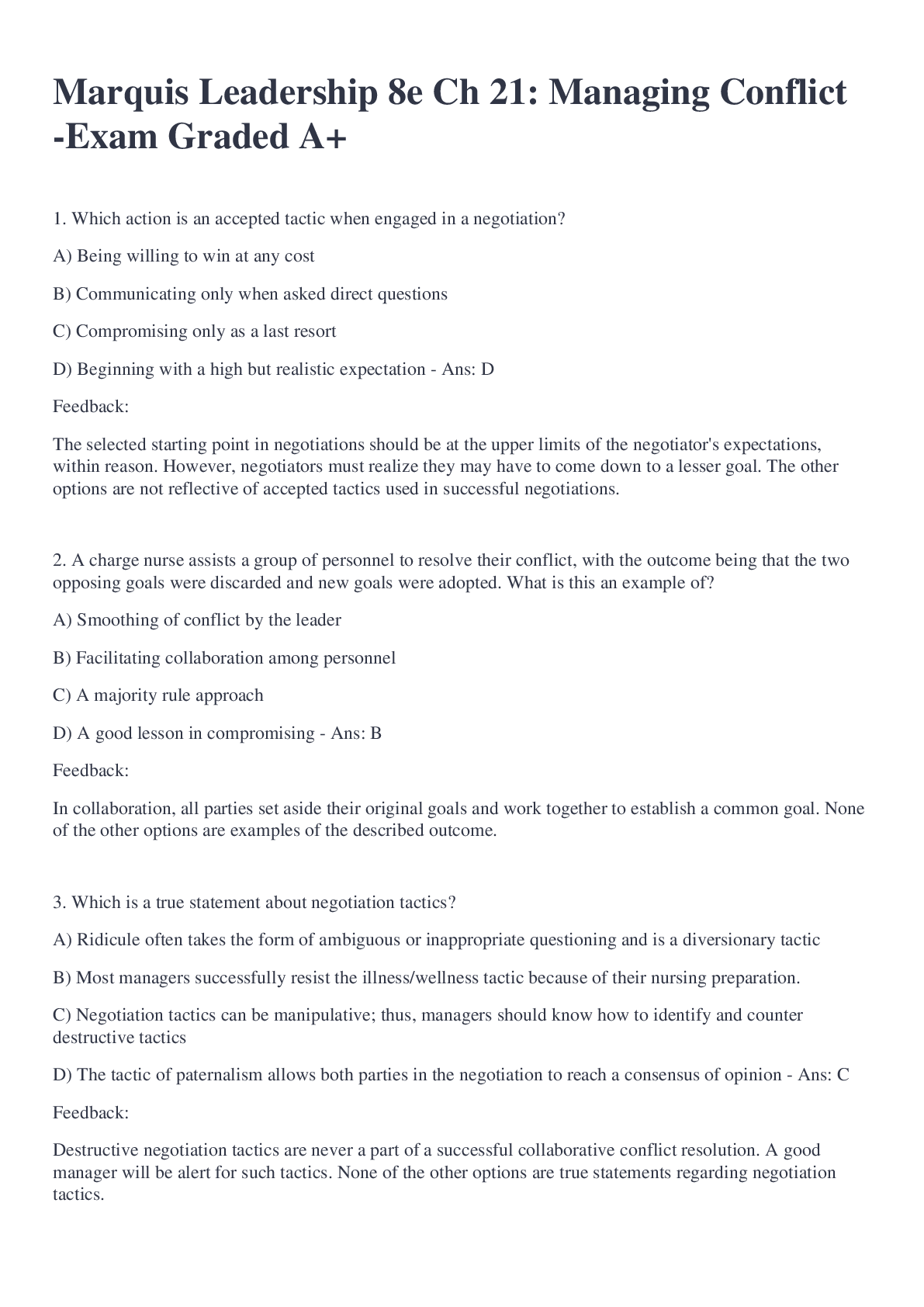
1. Which action is an accepted tactic when engaged in a negotiation?
A) Being willing to win at any cost
B) Communicating only when asked direct questions
C) Compromising only as a last resort
D) Beginning with a high but realistic expectation - Ans: D
Feedback:
The selected starting point in negotiations should be at the upper limits of the negotiator's expectations, within reason. However, negotiators must realize they may have to come down to a lesser goal. The other options are not reflective of accepted tactics used in successful negotiations.
2. A charge nurse assists a group of personnel to resolve their conflict, with the outcome being that the two opposing goals were discarded and new goals were adopted. What is this an example of?
A) Smoothing of conflict by the leader
B) Facilitating collaboration among personnel
C) A majority rule approach
D) A good lesson in compromising - Ans: B
Feedback:
In collaboration, all parties set aside their original goals and work together to establish a common goal. None of the other options are examples of the described outcome.
3. Which is a true statement about negotiation tactics?
A) Ridicule often takes the form of ambiguous or inappropriate questioning and is a diversionary tactic
B) Most managers successfully resist the illness/wellness tactic because of their nursing preparation.
C) Negotiation tactics can be manipulative; thus, managers should know how to identify and counter destructive tactics
D) The tactic of paternalism allows both parties in the negotiation to reach a consensus of opinion - Ans: C
Feedback:
Destructive negotiation tactics are never a part of a successful collaborative conflict resolution. A good manager will be alert for such tactics. None of the other options are true statements regarding negotiation tactics.
4. What did the interactionist theorists of the 1970s believe about organizational conflict?
A) It should be dealt with immediately
B) It should be encouraged
C) It was an indication of poor management
D) It should be avoided - Ans: B
Feedback:
The interactionist movement encouraged organizations to promote conflict as a means of producing growth. The remaining options were not necessarily supported by the interactionist theorists.
5. Which statement reflects the contemporary thinking about conflict?
A) It can lead to new ideas
B) It leads to decreased motivation
C) It should be avoided whenever possible
D) It is neither qualitative nor quantitative - Ans: A
Feedback:
Some level of conflict in an organization appears to be desirable since it appears to prevent organizational stagnation. None of the other options reflect contemporary thinking about conflict.
6. What term is used when two or more people have conflict about values or goals?
A) Intergroup conflict
B) Common control
C) Intrapersonal conflict
D) Interpersonal conflict - Ans: D
Feedback:
Interpersonal conflict happens between two or more people with differing values, goals, and beliefs. No other option is used to describe this situation.
7. Which statement is true concerning perceived conflict?
A) It develops during the first stage of the conflict process
B) It is sometimes referred to as antecedent conflict
C) It occurs if the conflict is intellectualized
D) It occurs when the conflict is emotionalized - Ans: C
Feedback:
Perceived or substantive conflict is intellectualized and often involves issues and roles. The person recognizes it logically and impersonally as occurring. None of the other options are true statements concerning perceived conflict.
8. When is the competing approach to resolving conflict used?
A) When fair play is important to all involved parties
B) When one party wins at the expense of the others
C) When managers need to control a volatile situation
D) When an appropriate political strategy is necessary - Ans: B
Feedback:
The competing approach is used when one party pursues what it wants at the expense of the others. Because only one party typically wins, the competing party seeks to win regardless of the cost to others. Neither manager control nor political strategy is necessarily associated with the competing approach to resolving conflict.
9. What is the most important criterion for success for health-care providers collaborate on patient care?
A) Having mutual respect for one another's knowledge and expertise
B) Having the skills to negotiate successfully
C) Liking each other enough to want to collaborate
D) Being willing to cooperate with each other - Ans: A
Feedback:
In collaboration, problem solving is a joint effort with no superior/subordinate relationships. Mutual respect is required for its success. While the other options identify factors that add to the collaborative process, its foundation is mutual respect.
10. A registered nurse reports to the nurse-manager that the team's nursing assistant regularly fails to complete assigned tasks. The nurse-manager responds that it is the nurse's responsibility to talk with the nursing assistant about this problem. The manager is engaged in what aspect of conflict?
A) Conflict avoidance
B) Conflict smoothing
C) Encouraging competitive conflict
D) Facilitating conflict resolution - Ans: D
Feedback:
Managers should not intervene in every conflict, but should urge subordinates to handle their own problems. This is an example of supporting conflict resolution. The action of the manager is not reflective of any of the other options.
11. Which statement best defines conflict?
A) It involves an internal struggle resulting from value-related discord
B) Its basis is the violation of personal rights or values
C) It centers on either internal or external discord between individuals
D) It is the outcome of a visible struggle between individuals - Ans: C
Feedback:
Conflict is generally defined as the internal or external discord that results from differences in ideas, values, or feelings between two or more people. The remaining options describe only limited aspects of conflict.
12. What is a critical goal in negotiation?
A) That gains for each party are different but equal
B) That the hidden agendas of all parties be exposed
C) That each party willingly reveals their negotiated limits
D) That both parties perceive that they have won something they value - Ans: D
Feedback:
A successful negotiation leaves both parties feeling like they have gained something they want and/or value. None of the other options are considered a goal of negotiation.
[Show More]