ATI mental health practice B
Correct Answers with Explanation
A nurse in an emergency department is caring for a femail adolescent who has a diagnosis of bulimia nervose and has a fainting episode during a ballet perfo
...
ATI mental health practice B
Correct Answers with Explanation
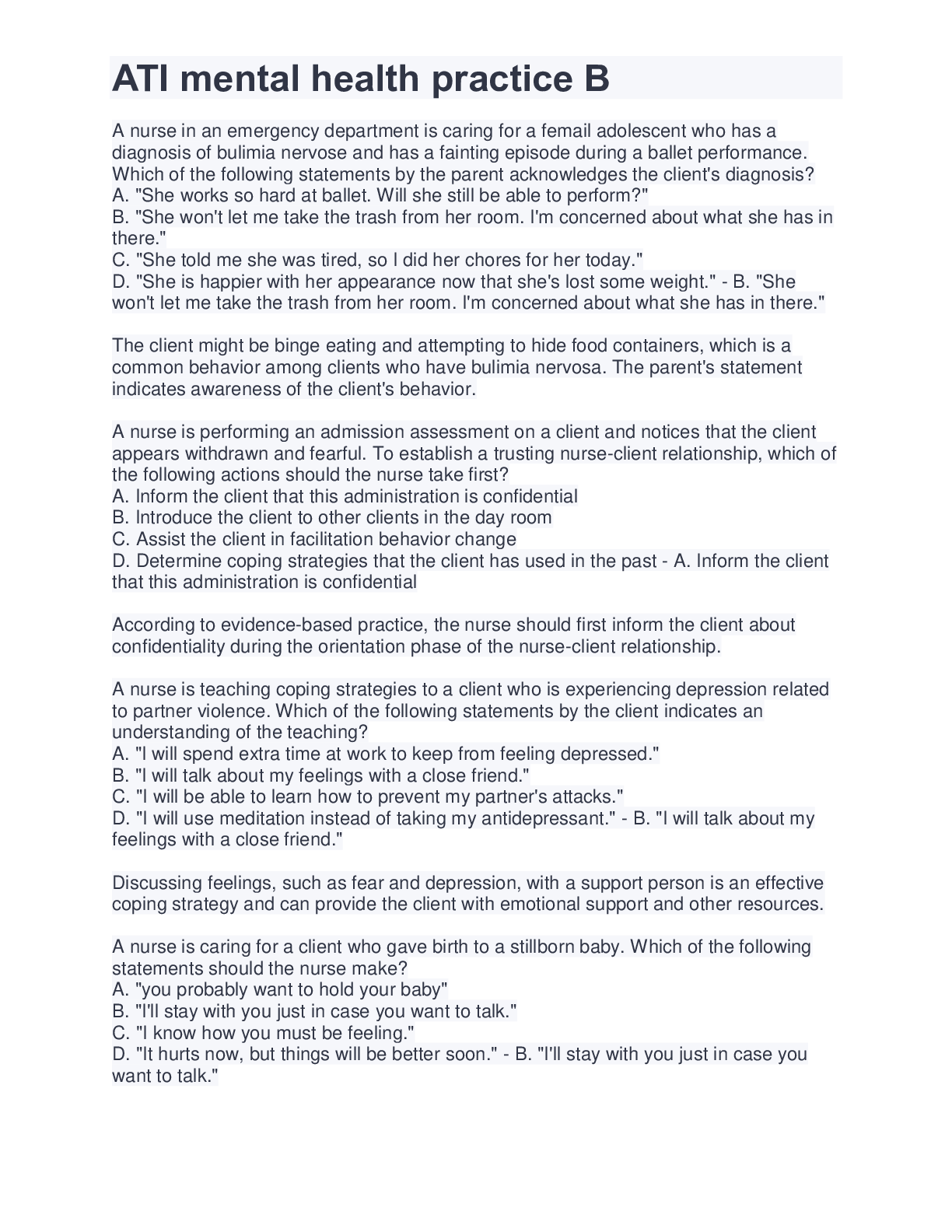
A nurse in an emergency department is caring for a femail adolescent who has a diagnosis of bulimia nervose and has a fainting episode during a ballet performance. Which of the following statements by the parent acknowledges the client's diagnosis?
A. "She works so hard at ballet. Will she still be able to perform?"
B. "She won't let me take the trash from her room. I'm concerned about what she has in there."
C. "She told me she was tired, so I did her chores for her today."
D. "She is happier with her appearance now that she's lost some weight." - correct answer--B. "She won't let me take the trash from her room. I'm concerned about what she has in there."
The client might be binge eating and attempting to hide food containers, which is a common behavior among clients who have bulimia nervosa. The parent's statement indicates awareness of the client's behavior.
A nurse is performing an admission assessment on a client and notices that the client appears withdrawn and fearful. To establish a trusting nurse-client relationship, which of the following actions should the nurse take first?
A. Inform the client that this administration is confidential
B. Introduce the client to other clients in the day room
C. Assist the client in facilitation behavior change
D. Determine coping strategies that the client has used in the past - correct answer--A. Inform the client that this administration is confidential
According to evidence-based practice, the nurse should first inform the client about confidentiality during the orientation phase of the nurse-client relationship.
A nurse is teaching coping strategies to a client who is experiencing depression related to partner violence. Which of the following statements by the client indicates an understanding of the teaching?
A. "I will spend extra time at work to keep from feeling depressed."
B. "I will talk about my feelings with a close friend."
C. "I will be able to learn how to prevent my partner's attacks."
D. "I will use meditation instead of taking my antidepressant." - correct answer--B. "I will talk about my feelings with a close friend."
Discussing feelings, such as fear and depression, with a support person is an effective coping strategy and can provide the client with emotional support and other resources.
A nurse is caring for a client who gave birth to a stillborn baby. Which of the following statements should the nurse make?
A. "you probably want to hold your baby"
B. "I'll stay with you just in case you want to talk."
C. "I know how you must be feeling."
D. "It hurts now, but things will be better soon." - correct answer--B. "I'll stay with you just in case you want to talk."
This response demonstrates the therapeutic communication techniques of offering self and indicates the nurse's interest in the client and a desire to understand the client's feelings.
A charge nurse on a mental health unit is discussing client rights with a newly licensed nurse. Which of the following statements should the charge nurse make?
A. "Clients can't refuse to take medications if they are admitted involuntarily."
B. "You can notify a client's family if they are admitted involuntarily."
C. "Clients who are admitted involuntarily maintain the right to give informed consent for procedures."
D. "You can remove a client's privileges if they are admitted involuntarily and refuse to attend therapy sessions." - correct answer--C. "Clients who are admitted involuntarily maintain the right to give informed consent for procedures."
Clients who are admitted involuntarily maintain the right to give informed consent for treatment. They also have the right to give informed consent for procedures.
A nurse is caring for a child who has conduct disorder and is behaving in a destructive manner, throwing objects, and kicking orders. Which of the following therapeutic nursing interventions is the priority?
A. Encourage expression of feelings
B. Support the child's attendance at an assertiveness training group
C. Assist the child to perform relaxation breathing
D. Reduce environmental stimuli - correct answer--D. Reduce environmental stimuli
[Show More]





.png)
![Preview of [NGN] ATI Mental Health Exam Questions and Answers Latest Update 2023 Rated A+](https://browseimages.nyc3.digitaloceanspaces.com/paper-images/2023/May/23/MOvfFDGo2023-05-23-06-21646cd9e4e2a9c.png)