All of the following activities are prohibited during the "cooling off" period EXCEPT:
a. accepting an indication of interest from the customer for part of the issue
b. recommending the purchase of the issue to potenti
...
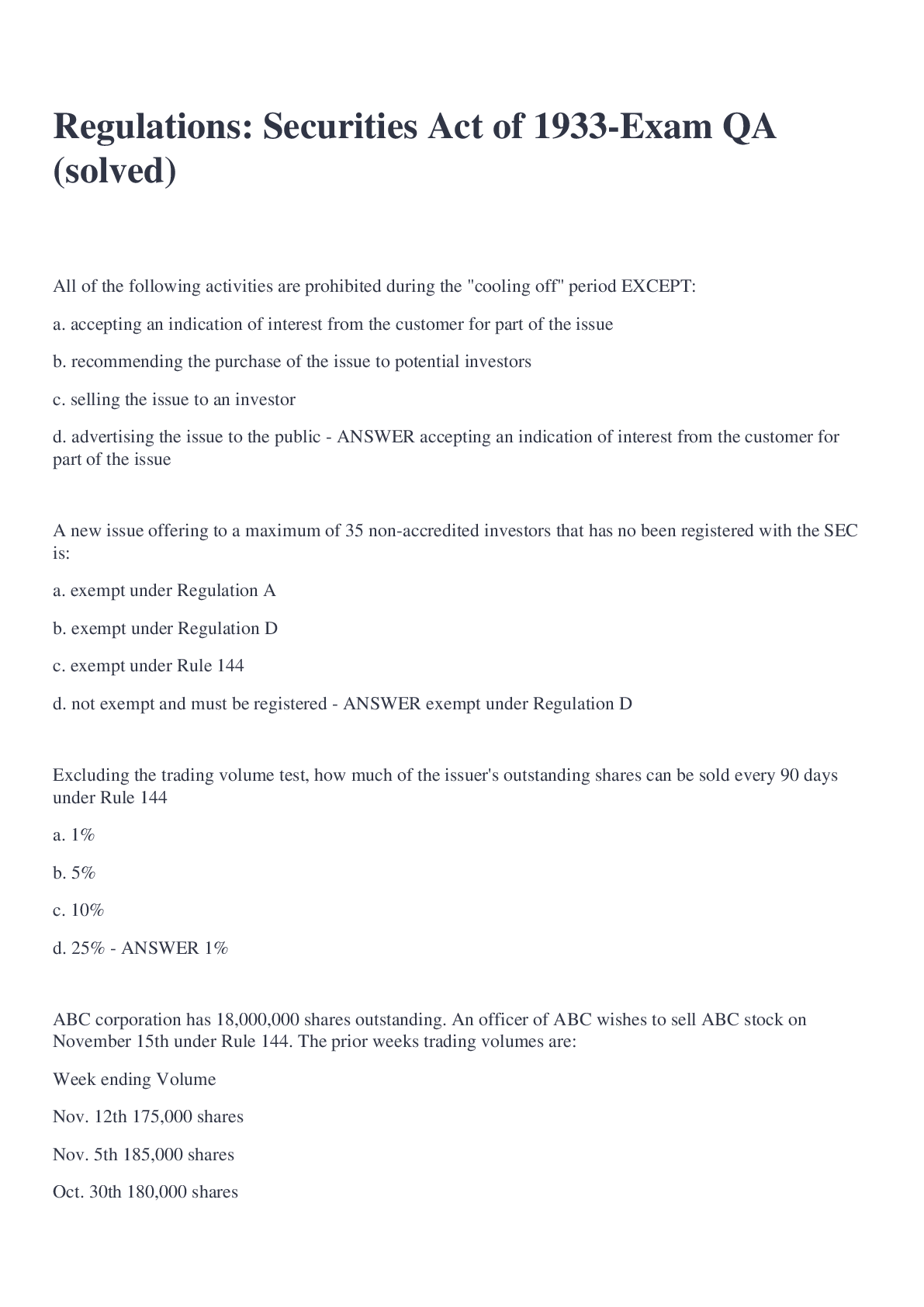
All of the following activities are prohibited during the "cooling off" period EXCEPT:
a. accepting an indication of interest from the customer for part of the issue
b. recommending the purchase of the issue to potential investors
c. selling the issue to an investor
d. advertising the issue to the public - ANSWER accepting an indication of interest from the customer for part of the issue
A new issue offering to a maximum of 35 non-accredited investors that has no been registered with the SEC is:
a. exempt under Regulation A
b. exempt under Regulation D
c. exempt under Rule 144
d. not exempt and must be registered - ANSWER exempt under Regulation D
Excluding the trading volume test, how much of the issuer's outstanding shares can be sold every 90 days under Rule 144
a. 1%
b. 5%
c. 10%
d. 25% - ANSWER 1%
ABC corporation has 18,000,000 shares outstanding. An officer of ABC wishes to sell ABC stock on November 15th under Rule 144. The prior weeks trading volumes are:
Week ending Volume
Nov. 12th 175,000 shares
Nov. 5th 185,000 shares
Oct. 30th 180,000 shares
Oct. 23rd 170,000 shares
Oct. 16th 205,000 shares
If the Form 144 is filed on Nov 15th, the maximum sale is:
a. 175,000
b. 177,500
c. 180,000
d. 185,000 - ANSWER 180,000
1% of 18,000,000 shares = 180,000
ABC corporation has 18,000,000 shares outstanding. An officer of ABC wishes to sell ABC stock on November 15th under Rule 144. The prior weeks trading volumes are:
Week ending Volume
Nov. 12th 175,000 shares
Nov. 5th 185,000 shares
Oct. 30th 180,000 shares
Oct. 23rd 170,000 shares
Oct. 16th 205,000 shares
If the Form 144 had been filed the preceding week, how many shares could have been sold?
a. 175,000
b. 177,500
c. 180,000
d. 185,000 - ANSWER 185,000
1% of 18,000,000 shares = 180,000
OR
185,000 + 180,000 + 170,000 + 205,000 =
740,000 / 4 weeks = 185,000
USE THE LARGER NUMBER
Under Rule 144, no filing is required if the sale amount every 90 days does not exceed:
a. 5,000 shares worth a maximum of $50,000
b. 5,000 shares worth a maximum of $500,000
c. 10,000 shares worth a maximum of $100,000
d. 10,000 shares worth a maximum of $1,000,000 - ANSWER 5,000 shares worth a maximum of $50,000
The president of PDQ Corporation donates restricted PDQ shares to the United Way after holding them for three years fully paid. United Way can sell the stock without restriction:
a. immediately
b. after holding the securities for 90 days
c. after holding the securities for 2 years
d. after holding the securities for 3 years - ANSWER immediately
Which of the following activities are allowed prior to the filing of the registration statement?
I. Sending a customer a "red herring" preliminary prospectus
II. accepting an indication of interest from the customer
III. accepting a deposit from the customer
IV. accepting a firm order from the customer - ANSWER None of the above
Restricted shares subject to sale under Rule 144 are most commonly acquired through:
a. private placements
b. registered secondary distributions
c. tender offers
d. ESOPs (Employee stock ownership plans) - ANSWER private placements
Which of the following are exempt issues under the Securities Act of 1933?
I. government bonds
II. municipal bonds
III. state chartered bank issues
IV. small business investment companies - ANSWER All of them
Under Rule 144, a customer wishing to sell must file the 144 "Notice of Sale" with the SEC:
a. 10 business days prior to the placement of the sell order
b. at, or prior to, the placement of the sell order
c. 10 business days after the placement of the sell order
d. 90 days after the placement of the sell order - ANSWER at, or prior to, the placement of the sell order
Restricted securities can be sold under Rule 144 if:
I. they are sold on a dealer basis
II. they are sold on an agency basis
III. solicitation of orders to buy is restricted to customers expressing interest within the past 10 days
IV. the issuer is reporting currently to the SEC - ANSWER they are sold on an agency basis
solicitation of orders to buy is restricted to customers expressing interest within the past 10 days
the issuer is reporting currently to the SEC
If the SEC sends a deficiency letter to the issuer regarding an issue in registration:
a. it disapproves of registering the issue
b. disclosure is not considered to be adequate
c. the underwriters have failed to establish the Public Offering Price
d. due diligence has not been performed by the underwriters - ANSWER disclosure is not considered to be adequate
A registered representative has prepared a research report about a new stock issue that is currently in registration. The registered representative wishes to send the report to customers. Which statement is TRUE?
a. the report can be mailed without restriction
b. the report constitutes an "offer" under the 1933 Act and cannot be sent
c. the report can only be mailed is approved or prepared by a Supervisory Analyst
d. the report can only be sent if accompanied or preceded by a preliminary prospectus - ANSWER the report constitutes an "offer" under the 1933 Act and cannot be sent
Under Rule 147, intrastate offerings cannot be resold out of state for how long after the initial sale date?
a. 9 months
b. 12 months
c. 18 months
d. 24 months - ANSWER 9 months
The Securities Act of 1933:
I. requires the registration of non-exempt securities
II. does not require the registration of non-exempt securities
III. requires the registration of exempt securities
IV. does not require the registration of exempt securities - ANSWER requires the registration of non-exempt securities
does not require the registration of exempt securities
The Securities Act of 1933 requires registration of non-exempt securities - these are issues that are not exempt from the registration provisions of the Act. Exempt securities do not have to be registered under the 1933 Act.
Which of the following Securities Acts define(s) exempt issuers and exempt transactions?
I. The Securities Act of 1933 defines exempt issuers
II. The Securities Exchange Act of 1934 defines exempt issuers
III. The Securities Act of 1933 defines exempt transactions
IV. The Securities Exchange Act of 1934 defines exempt transactions - ANSWER The Securities Act of 1933 defines exempt issuers
The Securities Act of 1933 defines exempt transactions
The Securities Act of 1933 covers the new issue (primary market) and defines exempt issuers and exempt transactions. If an issuer is exempt or if a new non-exempt issue is sold in an exempt transaction, that new issue does not have to be registered under the Act. Otherwise, registration is required. The Act of 1934 consists of a variety of rules covering the secondary (trading) market.
Exempted issuers are defined under the:
A. Securities Act of 1933
B. Securities Exchange Act of 1934
C. Trust Indenture Act of 1939
D. Investment Company Act of 1940 - ANSWER Securities Act of 1933
The Securities Act of 1933 defines exempt issuers and exempt transactions. If an issuer is exempt or if a new non-exempt issue is sold in an exempt transaction, that new issue does not have to be registered under the Act. Otherwise, registration is required.
U.S. Government agency securities:
A. trades settle same day
B. are guaranteed by the U.S. Government
C. are exempt securities under the Securities Act of 1933
D. are sold through competitive bid at the weekly Treasury Auction - ANSWER are exempt securities under the Securities Act of 1933
Under the 1933 Act, Agency securities are exempt and are not required to be registered with the SEC, nor are they required to be sold with a prospectus. Generally, agency securities trades settle in 1 business day, not the same day (for the purpose of the exam, though, because of the complexity of Agency settlements, these are NOT tested). Agencies are not guaranteed by the U.S. Government (with the sole exception of GNMA). Agencies are not sold through competitive bid. They are sold though selling groups on a negotiated basis.
Banker's Acceptances are:
A. money market instruments subject to the Securities Act of 1933
B. capital market instruments subject to the Securities Act of 1933
C. money market instruments exempt from the Securities Act of 1933
D. capital market instruments exempt from the Securities Act of 1933 - ANSWER money market instruments exempt from the Securities Act of 1933
Bankers Acceptances are a money market instrument used to finance imports and exports. They are an exempt security under the Securities Act of 1933 and can be sold without a prospectus.
Commercial Paper is a:
A. money market instrument subject to the Securities Act of 1933
B. capital market instrument subject to the Securities Act of 1933
C. money market instrument exempt from the Securities Act of 1933
D. capital market instrument exempt from the Securities Act of 1933 - ANSWER money market instrument exempt from the Securities Act of 1933
Commercial paper is a money market instrument issued by corporations. It is an exempt security under the Securities Act of 1933 as long as its maturity does not exceed 270 days and can be sold without a prospectus.
The maximum maturity on commercial paper is:
A. 30 days, because a longer maturity would cause the issue to be non-exempt
B. 90 days, because a longer maturity would cause the issue to be non-exempt
C. 270 days, because a longer maturity would cause the issue to be non-exempt
D. 360 days, because a longer maturity would cause the issue to be non-exempt - ANSWER 270 days, because a longer maturity would cause the issue to be non-exempt
Commercial paper issued by corporations is an exempt security under the Securities Act of 1933, as long as its maturity does not exceed 270 days. If commercial paper were issued with a longer maturity, it would have to be registered and sold with a prospectus (a time consuming and expensive process, so this does not happen).
Which statement is TRUE regarding Commercial Paper?
A. Commercial Paper may be sold without a prospectus
B. Commercial Paper must be sold with a prospectus
C. Commercial Paper must be sold with an Official Statement
D. Commercial Paper must be sold with an Offering Memorandum - ANSWER Commercial Paper may be sold without a prospectus
Since Commercial Paper is an exempt security under the Securities Act of 1933, it may be sold without a prospectus. The prospectus is the disclosure document for new issues that are not exempt from registration. The Official Statement is the disclosure document for municipal bonds (which are an exempt issue). An Offering Memorandum is the disclosure document for a private placement - which is a security sold in an exempt transaction.
Common carrier issues are:
I. exempt from the Securities Act of 1933
II. subject to the Securities Act of 1933
III. required to be sold with a prospectus
IV. not required to be sold with a prospectus - ANSWER exempt from the Securities Act of 1933
not required to be sold with a prospectus
Common carrier issues such as railway issues are exempt under the Securities Act of 1933 because they were regulated by the Interstate Commerce Commission (I.C.C.) before the Act was written; and Congre
[Show More]