Identify the guidelines that assist the nurse with incorporating vital sign measurement into practice. (12) - ANSWER a. The nurse may delegate the measurement of vital signs but is responsible for analyzing and interpret
...
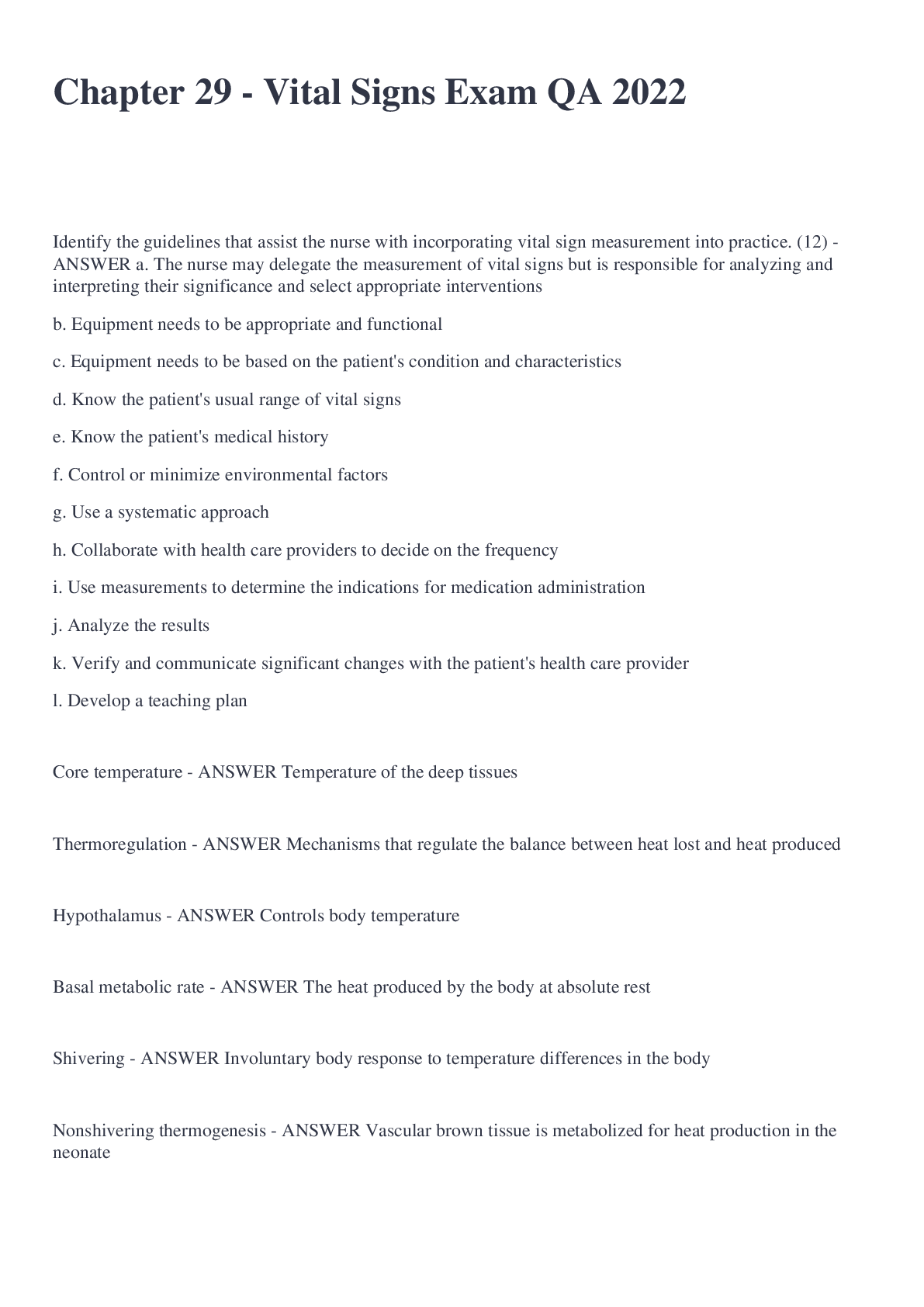
Identify the guidelines that assist the nurse with incorporating vital sign measurement into practice. (12) - ANSWER a. The nurse may delegate the measurement of vital signs but is responsible for analyzing and interpreting their significance and select appropriate interventions
b. Equipment needs to be appropriate and functional
c. Equipment needs to be based on the patient's condition and characteristics
d. Know the patient's usual range of vital signs
e. Know the patient's medical history
f. Control or minimize environmental factors
g. Use a systematic approach
h. Collaborate with health care providers to decide on the frequency
i. Use measurements to determine the indications for medication administration
j. Analyze the results
k. Verify and communicate significant changes with the patient's health care provider
l. Develop a teaching plan
Core temperature - ANSWER Temperature of the deep tissues
Thermoregulation - ANSWER Mechanisms that regulate the balance between heat lost and heat produced
Hypothalamus - ANSWER Controls body temperature
Basal metabolic rate - ANSWER The heat produced by the body at absolute rest
Shivering - ANSWER Involuntary body response to temperature differences in the body
Nonshivering thermogenesis - ANSWER Vascular brown tissue is metabolized for heat production in the neonate
Radiation - ANSWER Transfer of heat from the surface of one object to the surface of another with our direct contact
Conduction - ANSWER Transfer of heat from one object to another with direct contact
Convection - ANSWER Transfer of heat away by air movement
Evaporation - ANSWER Transfer of heat energy when a liquid is changed to a gas
The ability to control body temperature depends on: (4) - ANSWER a. The degree of temperature extreme
b. The person's ability to sense feeling comfortable
c. Thought processes or emotions
d. Person's mobility or ability to remove or add clothes
Identify the factors that affect body temperature. (7) - ANSWER a. Age
b. Exercise
c. Hormone level
d. Circadian rhythm
e. Stress
f. Environment
g. Temperature alterations (fever, hyperthermia, heat stroke, heat exhaustion, hypothermia)
Pyrexia - ANSWER Fever
Pyrogens - ANSWER Bacteria and viruses that elevate body temperature
Hyperthermia - ANSWER The body's inability to promote heat loss or reduce heat production
Malignant hyperthermia - ANSWER Hereditary condition of uncontrolled heat production
Heatstroke - ANSWER A dangerous heat emergency
Heat exhaustion - ANSWER Profuse diaphoreses with excess water and electrolyte loss
Hypothermia - ANSWER Cold that overwhelms the body's ability to produce heat
Frostbite - ANSWER Occurs when the body is exposed to subnormal temperatures
List at least one advantage and one disadvantage of each of the following temperature sites.
Oral - ANSWER A~
a. Easily accessible - requires no position change
b. Comfortable for patient
c. Provides accurate surface temperature reading
d. Reflects rapid change in core temperature
e. Reliable route to measure temperature in patients who are intubated
D~
a. Causes delay in measurement if patient recently ingested hot/cold fluids or foods, smoked, or is receiving oxygen by mask/cannula
b. Not for patients who had oral surgery, trauma, history of epilepsy, or shaking chills
c. Not for infants, small children, or patients who are confused, unconscious, or uncooperative
d. Risk of body fluid exposure
List at least one advantage and one disadvantage of each of the following temperature sites.
Tympanic - ANSWER A~
a. Easily accessible site
b. Minimal patient repositioning required
c. Obtained without disturbing, waking, or repositioning patients
d. Used for patients with tachypnea without affecting breathing
e. Provides accurate core reading because eardrum close to hypothalamus; sensitive to core temperature changes
f. Very rapid measurement (2 to 5 seconds)
g. Unaffected by oral intake of food or fluids or smoking
h. Used in newborns to reduce infant handling and heat loss
D~
a. More variability of measurement than with other core temperature devices
b. Requires removal of hearing aids before measurement
c. Requires disposable sensor cover with only one size available
d. Otitis media and cerumen impaction distorts readings
e. Not used in patients who have had surgery of the ear or tympanic membrane
f. Does not accurately measure core temperature changed during and after exercise
g. Does not obtain continuous measurement
h. Affected by ambient temperature devices such as incubators, radiant warmers, and facial fans
i. When used in neonates, infants, and children under 3 years old, use care to position device correctly because anatomy of ear canal makes it difficult to position
j. Inaccuracies reported caused by incorrect positioning of handheld unit
List at least one advantage and one disadvantage of each of the following temperature sites.
Rectal - ANSWER A~
a. Sometimes considered to be more reliable when oral temperature cannot be obtained
D~
a. Lags behind core temperature during rapid temperature changes
b. Not for patients with diarrhea, rectal disorders, or bleeding tendencies or those who had rectal surgery
c. Requires positioning and is often source of patient embarrassment and anxiety
d. Risk of body fluid exposure
e. Requires lubrication
f. Not for routine vital signs in newborns
g. Readings influenced by impacted stool
List at least one advantage and one disadvantage of each of the following temperature sites.
Axilla - ANSWER A~
a. Safe and inexpensive
b. Used with newborns and unconscious patients
D~
a. Long measurement time
b. Underestimates core temperature
c. Requires continuous positioning by nurse
d. Measurement lags behind core temperature during rapid temperature changes
e. Not recommended to detect fever in infants and young children
f. Requires exposure of thorax, which results in temperature loss, especially in newborns
g. Affected by exposure to environment, including time to place thermometer
List at least one advantage and one disadvantage of each of the following temperature sites.
Skin - ANSWER A~
a. Inexpensive
b. Provides continuous reading
c. Safe and noninvasive
d. Used for neonates
[Show More]