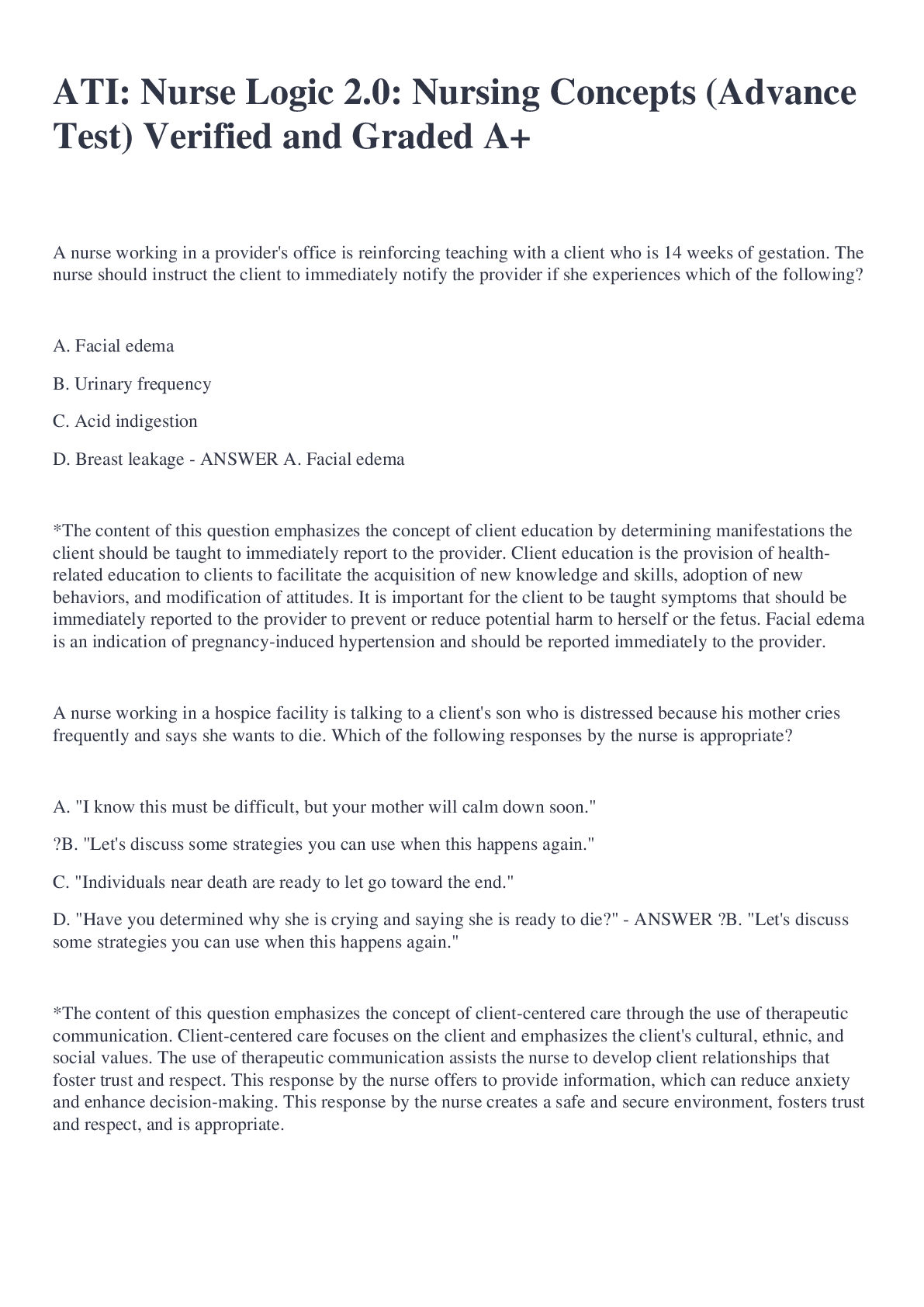
Do not delegate - ANSWER What you can EAT E-evaluate A-assess T-teach
Addison's & Cushings - ANSWER Addison's = down down down up down
Cushings= up up up down up
hypo/hypernatremia, hypo/hypertension, blood volume,
...
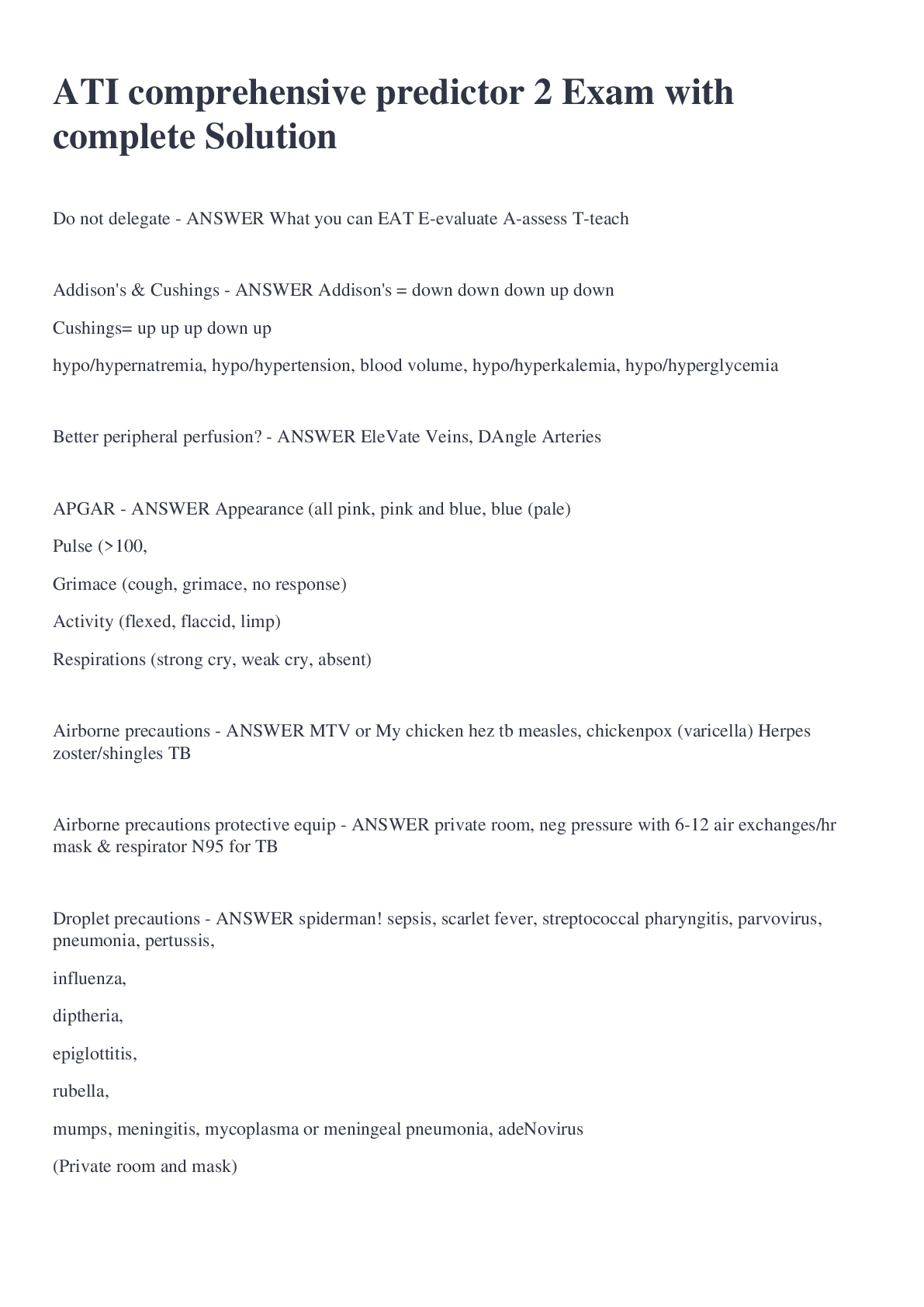
Do not delegate - ANSWER What you can EAT E-evaluate A-assess T-teach
Addison's & Cushings - ANSWER Addison's = down down down up down
Cushings= up up up down up
hypo/hypernatremia, hypo/hypertension, blood volume, hypo/hyperkalemia, hypo/hyperglycemia
Better peripheral perfusion? - ANSWER EleVate Veins, DAngle Arteries
APGAR - ANSWER Appearance (all pink, pink and blue, blue (pale)
Pulse (>100, <100, absent)
Grimace (cough, grimace, no response)
Activity (flexed, flaccid, limp)
Respirations (strong cry, weak cry, absent)
Airborne precautions - ANSWER MTV or My chicken hez tb measles, chickenpox (varicella) Herpes zoster/shingles TB
Airborne precautions protective equip - ANSWER private room, neg pressure with 6-12 air exchanges/hr mask & respirator N95 for TB
Droplet precautions - ANSWER spiderman! sepsis, scarlet fever, streptococcal pharyngitis, parvovirus, pneumonia, pertussis,
influenza,
diptheria,
epiglottitis,
rubella,
mumps, meningitis, mycoplasma or meningeal pneumonia, adeNovirus
(Private room and mask)
Contact precaution - ANSWER MRS WHISE
protect visitors & caregivers when 3 ft of the pt.
Multidrug-resistant organisms
RSV, Shigella, Wound infections, Herpes simplex, Impetigo, Scabies, Enteric diseases caused by micro-organisms (C diff),
Gloves and gowns worn by the caregivers and visitors
Disposal of infectious dressing material into a single, nonporous bag without touching the outside of the bag
PMGG= Private room/ share same illness, mask, gown and gloves
Skin infection - ANSWER VCHIPS
Varicella zoster
Cutaneous diptheria
Herpes simplez
Impetigo
Peduculosis
Scabies
Air or Pulmonary Embolism - ANSWER S/S chest pain, dyspnea, tachycardia, pale/cyanotic, sense of impending doom. (turn pt to LEFT side and LOWER the head of bed.)
Woman in labor (un-reassuring FHR) - ANSWER (late decels, decreased variability, fetal bradycardia, etc) Turn pt on Left side, give O2, stop pitocin, Increase IV fluids!
Tube feeding with decreased LOC - ANSWER Pt on Right side (promotes emptying of the stomach) Head of bed elevated (prevent aspiration)
After lumbar puncture and oil based myelogram - ANSWER pt is flat SUPINE (prevent headache and leaking of CSF)
Pt with heat stroke - ANSWER flat with legs elevated
during Continuous Bladder Irrigation (CBI) - ANSWER catheter is taped to the thigh. leg must be kept straight.
After Myringotomy - ANSWER position on the side of AFFECTED ear, allows drainage.
After Cateract surgery - ANSWER pt sleep on UNAFFECTED side with a night shield for 1-4 weeks
after Thyroidectomy - ANSWER low or semi-fowler's position, support head, neck and shoulders.
Infant with Spina Bifida - ANSWER Prone so that sac does not rupture
Buck's Traction (skin) - ANSWER elevate foot of bed for counter traction
After total hip replacement - ANSWER don't sleep on side of surgery, don't flex hip more than 45-60 degress, don't elevate Head Of Bed more than 45 degrees. Maintain hip abduction by separating thighs with pillows.
Prolapsed cord - ANSWER Knee to chest or Trendelenburg
oxygen 8 to 10 L
Cleft Lip - ANSWER position on back or in infant seat to prevent trauma to the suture line. while feeding hold in upright position.
To prevent dumping syndrome - ANSWER (post operative ulcer/stomach surgeries) eat in reclining position. Lie down after meals for 20-30 min. also restrict fluids during meals, low CHO and fiber diet. small, frequent meals.
AKA (above knee amputation) - ANSWER elevate for first 24 hours on pillow. position prone daily to maintain hip extension.
BKA (below knee amputation) - ANSWER foot of bed elevated for first 24 hours. position prone to provide hip extension.
detached retina - ANSWER area of detachment should be in the dependent position
administration of enema - ANSWER pt should be left side lying (Sim's) with knee flexed.
After supratentorial surgery - ANSWER (incision behind hairline on forhead) elevate HOB 30-40 degrees
After infratentorial surgery - ANSWER (incision at the nape of neck) position pt flat and lateral on either side.
During internal radiation - ANSWER on bed rest while implant in place
Autonomic Dysreflexia/Hyperreflexia - ANSWER S/S pounding headache, profuse sweating, nasal congestion, chills, bradycardia, hypertension. Place client in sitting position (elevate HOB) FIRST!
Shock - ANSWER bedrest with extremities elevated 20 degrees. knees straight, head slightly elevated (modified Trendelenberg)
Head Injury - ANSWER elevate HOB 30 degrees to decrease ICP
Peritoneal Dialysis (when outflow is inadequate) - ANSWER turn pt from side to side BEFORE checking for kinks in tubing
Lumbar Puncture - ANSWER After the procedure, the pt should be supine for 4-12 hours as prescribed.
Myesthenia Gravis - ANSWER worsens with exercise and improves with rest
Myesthenia Gravis - ANSWER a positive reaction to Tensilon---will improve symptoms
Cholinergic Crisis - ANSWER Caused by excessive medication ---stop giving Tensilon...will make it worse.
Liver biopsy (prior) - ANSWER must have lab results for prothrombin time
Myxedema/ hypothyroidism - ANSWER slowed physical and mental function, sensitivity to cold, dry skin and hair.
Grave's Disease/ hyperthyroidism - ANSWER accelerated physical and mental function. Sensitivity to heat. Fine/soft hair.
Thyroid storm - ANSWER increased temp, pulse and HTN
Post-Thyroidectomy - ANSWER semi-fowler's. Prevent neck flexion/hyperextension. Trach at bedside
Hypo-parathyroid - ANSWER CATS---Convulsions, Arrhythmias, Tetany, Spasms, Stridor. (decreased calcium) give high calcium, low phosphorus diet
Hyper-parathyroid - ANSWER fatigue, muscle weakness, renal calculi, back and joint pain (increased calcium) give a low calcium high phosphorous diet
Hypovolemia - ANSWER increased temp, rapid/weak pulse, increase respiration, hypotension, anxiety. Urine specific gravity >1.030
Hypervolemia - ANSWER bounding pulse, SOB, dyspnea, rales/crackles, peripheral edema, HTN, urine specific gravity <1.010. semi fowler's
Diabetes insipidus (decreased ADH) - ANSWER excessive urine output and thirst, dehydration, weakness, administer Pitressin
SIADH (increased ADH) - ANSWER change in LOC, decreased deep tendon reflexes, tachycardia. N/V HA administer Declomycin, diuretics
hypokalemia - ANSWER muscle weakness, dysrhythmias, increase K (rasins bananas apricots, oranges, beans, potatoes, carrots, celery)
Hyperkalemia - ANSWER MURDER Muscle weakness, Urine (olig, anuria) Resp depression, decreased cardiac contractility, ECG changes, reflexes
Hyponatremia - ANSWER nausea, muscle cramps, increased ICP, muscular twitching, convulsions. give osmotic diuretics (Mannitol) and fluids
Hypernatremia - ANSWER increased temp, weakness, disorientation, dilusions, hypotension, tachycardia. give hypotonic solution.
Hypocalcemia - ANSWER CATS Convulsions, Arrythmias, Tetany, spasms and stridor
Hypercalcemia - ANSWER muscle weakness, lack of coordination, abdominal pain, confusion, absent tendon reflexes, shallow respirations, emergency!
Hypo Mg - ANSWER Tremors, tetany, seizures, dysthythmias, depression, confusion, dysphagia, (dig toxicity)
Hyper Mg - ANSWER depresses the CNS. Hypotension, facial flushing, muscle weakness, absent deep tendon reflexes, shallow respirations. EMERGENCY
Addison's - ANSWER Hypo Na, Hyper K, Hypoglycemia, dark pigmentation, decreased resistance to stress fx, alopecia, weight loss. GI stress.
Cushings - ANSWER Hyper Na, Hypo K, hyperglycemia, prone to infection, muscle wasting, weakness, edema, HTN, hirsutism, moonface/buffalo hump
Addesonian crisis - ANSWER N/V confusion, abdominal pain, extreme weakness, hypoglycemia, dehydration, decreased BP
Pheochromocytoma - ANSWER hypersecretion of epi/norepi. persistent HTN, increased HR, hyperglycemia, diaphoresis, tremor, pounding HA; avoid stress, frequent bathing and rest breaks, avoid cold and stimulating foods (surgery to remove tumor)
Tetrology of Fallot - ANSWER DROP (Defect, septal, Right ventricular hypertrophy, Overriding aortas, Pulmonary stenosis)
Autonomic Dysreflexia - ANSWER (potentially life threatening emergency!) HOB elevate 90 degrees, loosen constrictive clothing, assess for full bladder or bowel impaction, (trigger) administer antihypertensives (may cause stroke, MI, seizure)
FHR patterns for OB - ANSWER Think VEAL CHOP!
V-variable decels; C- cord compression caused
E-early decels; H- head compression caused
A-accels; O-okay, no problem
L- late decels; P- placental insufficiency, can't fill
what to check with pregnancy - ANSWER Never check the monitor or machine as a first action. Always assess the patient first. Ex.. listen to fetal heart tones with stethoscope.
Position of the baby by fetal heart sounds - ANSWER Posterior --heard at sides
Anterior---midline by unbilicus and side
Breech- high up in the fundus near umbilicus
Vertex- by the symphysis pubis.
Ventilatory alarms - ANSWER HOLD
High alarm--Obstruction due to secretions, kink, pt cough etc
Low alarm--Disconnection, leak, etc
[Show More]


.png)