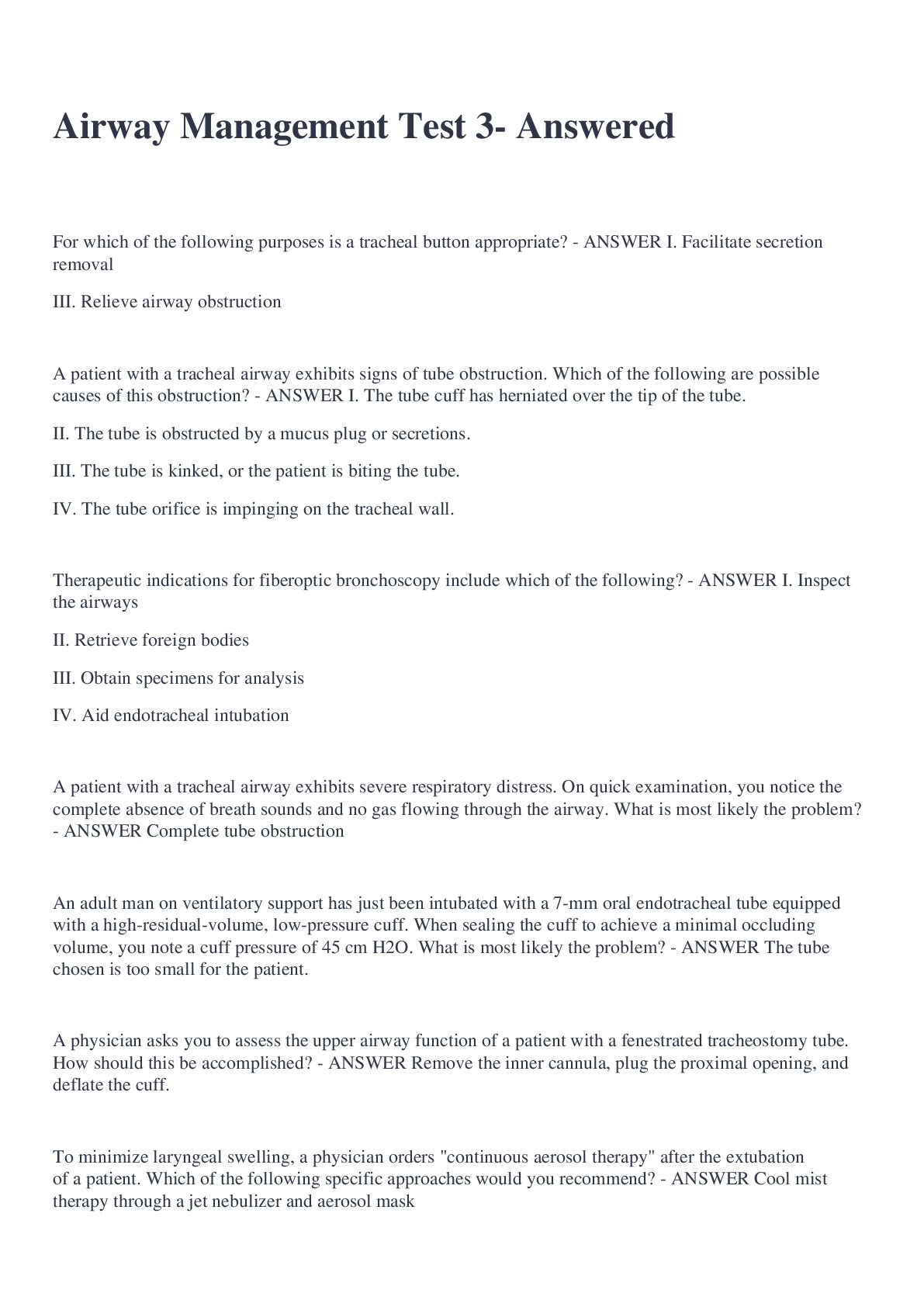
For which of the following purposes is a tracheal button appropriate? - ANSWER I. Facilitate secretion removal
III. Relieve airway obstruction
A patient with a tracheal airway exhibits signs of tube obstruction. Whi
...
For which of the following purposes is a tracheal button appropriate? - ANSWER I. Facilitate secretion removal
III. Relieve airway obstruction
A patient with a tracheal airway exhibits signs of tube obstruction. Which of the following are possible causes of this obstruction? - ANSWER I. The tube cuff has herniated over the tip of the tube.
II. The tube is obstructed by a mucus plug or secretions.
III. The tube is kinked, or the patient is biting the tube.
IV. The tube orifice is impinging on the tracheal wall.
Therapeutic indications for fiberoptic bronchoscopy include which of the following? - ANSWER I. Inspect the airways
II. Retrieve foreign bodies
III. Obtain specimens for analysis
IV. Aid endotracheal intubation
A patient with a tracheal airway exhibits severe respiratory distress. On quick examination, you notice the complete absence of breath sounds and no gas flowing through the airway. What is most likely the problem? - ANSWER Complete tube obstruction
An adult man on ventilatory support has just been intubated with a 7-mm oral endotracheal tube equipped with a high-residual-volume, low-pressure cuff. When sealing the cuff to achieve a minimal occluding volume, you note a cuff pressure of 45 cm H2O. What is most likely the problem? - ANSWER The tube chosen is too small for the patient.
A physician asks you to assess the upper airway function of a patient with a fenestrated tracheostomy tube. How should this be accomplished? - ANSWER Remove the inner cannula, plug the proximal opening, and deflate the cuff.
To minimize laryngeal swelling, a physician orders "continuous aerosol therapy" after the extubation of a patient. Which of the following specific approaches would you recommend? - ANSWER Cool mist therapy through a jet nebulizer and aerosol mask
A patient exhibits persistent mild hypoxemia after a fiberoptic bronchoscopy procedure. Which of the following would you recommend? - ANSWER Continue oxygen therapy and reassess in 4 hours.
Which of the following approaches may be used in "weaning" a patient from a tracheostomy tube? - ANSWER I. Using progressively smaller tubes
II. Using a fenestrated tube
III. Using a tracheostomy button
Which of the following are goals of airway preparation before conducting fiberoptic bronchoscopy? - ANSWER I. To decrease cough and gagging.
II. To decrease pain.
III. To prevent bleeding.
A patient with a tracheostomy tube is receiving positive-pressure ventilation through a volume ventilator. Over the past 5 minutes, the peak inspiratory pressure has risen, and the pressure limit alarm is now sounding. On quick examination, you notice a generalized decreased in breath sounds. Which of the following problems is most likely? - ANSWER Partial obstruction of the tracheostomy tube
Although different techniques are used to actually remove the endotracheal tube during an extubation procedure, all aim to ensure which of the following? - ANSWER Maximal abduction of the vocal cords.
In which of the following conditions should fiberoptic bronchoscopy NOT be performed if the risks outweigh the potential benefits? - ANSWER I. Uncorrected bleeding disorders
III. Refractory hypoxemia
IV. Unstable hemodynamic status
Which of the following equipment would you gather before assisting in extubation of a patient? - ANSWER I. Suctioning apparatus
II. Oxygen or aerosol therapy equipment
III. Manual resuscitator and mask
IV. Nebulizer with racemic epinephrine
V. Intubation tray
Complications of fiberoptic bronchoscopy include all of the following except: - ANSWER Hypocapnia
What does a positive cuff leak test indicate? - ANSWER The patient is at minimal risk for upper airway obstruction.
An adult patient receiving cool mist therapy after extubation begins to develop stridor. Which of the following actions would you recommend? - ANSWER Administer a racemic epinephrine treatment.
Lower airway anesthesia for fiberoptic bronchoscopy can be achieved via which of the following routes of administration? - ANSWER I. Bronchoscopic instillation
III. nebulization (aerosol delivery)
To minimize the problems associated with pharyngeal aspiration in intubated patients, which of the following could you recommend? - ANSWER I. Position patients in semirecumbent position.
II. Insert the feeding tube into the duodenum.
III. Suction above the tracheal tube cuff.
IV. Provide continuous aspiration of subglottic secretions.
Which of the following drugs can be used to prevent bleeding during fiberoptic bronchoscopy? - ANSWER I. Phenylephrine
II. Dopamine HCl
III. Cocaine HCl
For which of the following reasons is atropine often used during fiberoptic bronchoscopy? - ANSWER I. To dry the patient's airway.
II. To decrease vagal responses.
A patient exhibits persistent stridor after a fiberoptic bronchoscopy procedure. Which of the following would you recommend? - ANSWER Aerosol therapy with racemic epinephrine
Which of the following statements is false about the potential for aspiration in patient with cuffed tracheal tubes? - ANSWER Aspiration is least likely in spontaneously breathing patients.
Repeated connecting and disconnecting of a cuff pressure manometer to the pilot tube of a cuffed tracheal airway will do which of the following? - ANSWER Decrease cuff pressure
Key points to consider in planning fiberoptic bronchoscopy include which of the following? - ANSWER I. Equipment preparation
II. Premedication
III. Airway preparation
IV. Monitoring
What is the most common problem with fenestrated tracheostomy tubes? - ANSWER Poor positioning of the tube fenestration
To avoid the risk of aspiration after a fiberoptic bronchoscopy procedure, what would you recommend that the patient do? - ANSWER Remain in a sitting position and NPO until sensation returns
Tracheal airways increase the incidence of pulmonary infections for all of the following reasons except: - ANSWER lower levels of humidification.
Which of the following tracheal tube cuff designs are used as alternatives to cuff pressure measurement? - ANSWER I. Kamen-Wilkinson foam cuff
III. Lanz pressure-regulated cuff
What is a rare but serious complication associated with endotracheal tube extubation? - ANSWER Laryngospasm
[Show More]











![Preview of THE TEFL ACADEMY LEVEL 5 - ASSIGNMENT C - AUTHENTIC MATERIAL [2026]](https://browseimages.nyc3.digitaloceanspaces.com/paper-images/2026/04/10/HpVkRcWV2026-04-10-11-5769d96426bd64f.png)