NUR 513 Topic 1 Discussion Question 1 & 2
Week 5 Discussion Question 1
How do the nursing conceptual theoretical models relate to theory-driven, evidence-based practice?
The theories are defined & explained in
...
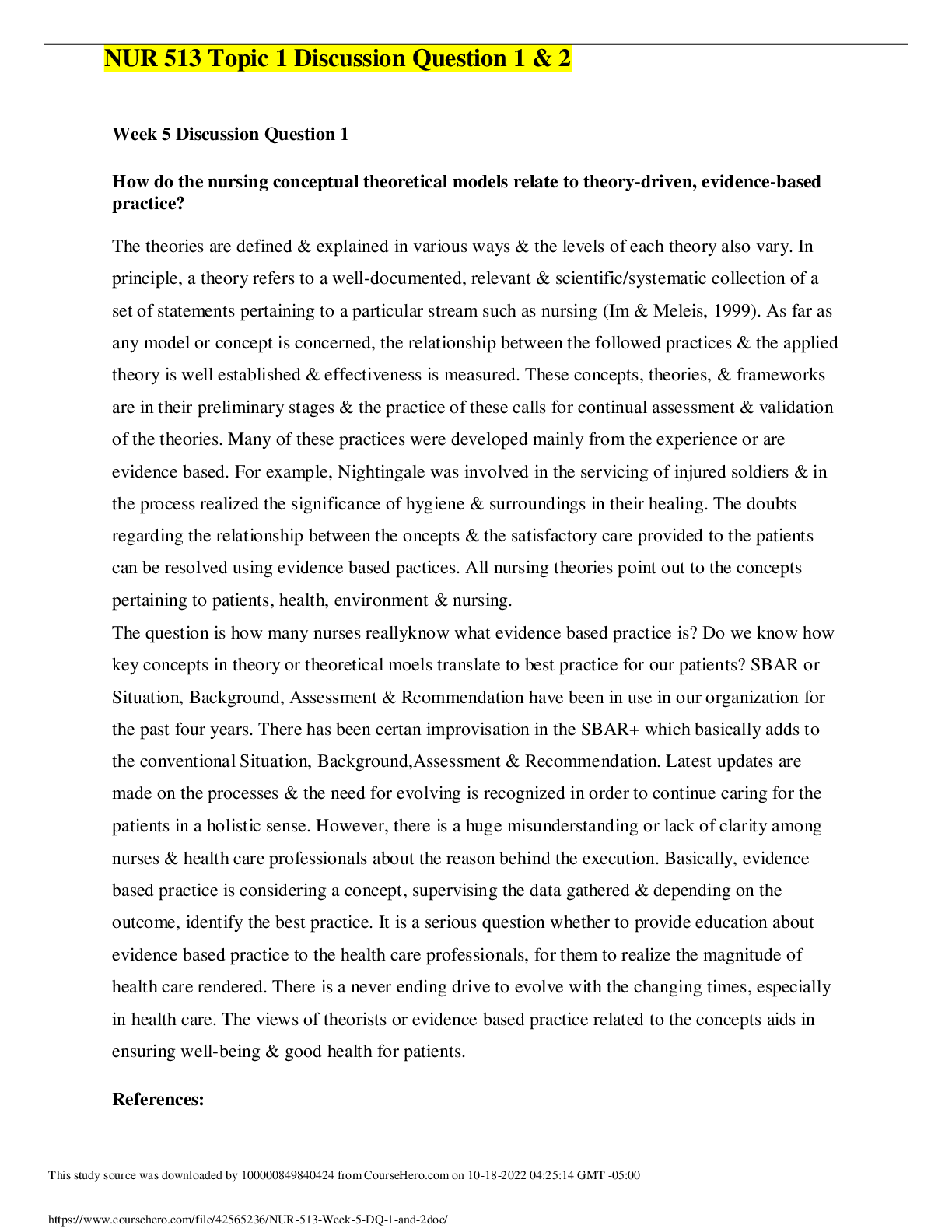
NUR 513 Topic 1 Discussion Question 1 & 2
Week 5 Discussion Question 1
How do the nursing conceptual theoretical models relate to theory-driven, evidence-based practice?
The theories are defined & explained in various ways & the levels of each theory also vary. In principle, a theory refers to a well-documented, relevant & scientific/systematic collection of a set of statements pertaining to a particular stream such as nursing (Im & Meleis, 1999). As far as any model or concept is concerned, the relationship between the followed practices & the applied theory is well established & effectiveness is measured. These concepts, theories, & frameworks are in their preliminary stages & the practice of these calls for continual assessment & validation of the theories. Many of these practices were developed mainly from the experience or are evidence based. For example, Nightingale was involved in the servicing of injured soldiers & in the process realized the significance of hygiene & surroundings in their healing. The doubts regarding the relationship between the oncepts & the satisfactory care provided to the patients can be resolved using evidence based pactices. All nursing theories point out to the concepts pertaining to patients, health, environment & nursing.
The question is how many nurses reallyknow what evidence based practice is? Do we know how key concepts in theory or theoretical moels translate to best practice for our patients? SBAR or Situation, Background, Assessment & Rcommendation have been in use in our organization for the past four years. There has been certan improvisation in the SBAR+ which basically adds to the conventional Situation, Background,Assessment & Recommendation. Latest updates are made on the processes & the need for evolving is recognized in order to continue caring for the patients in a holistic sense. However, there is a huge misunderstanding or lack of clarity among nurses & health care professionals about the reason behind the execution. Basically, evidence based practice is considering a concept, supervising the data gathered & depending on the outcome, identify the best practice. It is a serious question whether to provide education about evidence based practice to the health care professionals, for them to realize the magnitude of health care rendered. There is a never ending drive to evolve with the changing times, especially in health care. The views of theorists or evidence based practice related to the concepts aids in ensuring well-being & good health for patients.
References:
Author Unknown, 2010. Development of Nursing Theories. Retrieved on February 22, 2011 from website: http://currentnursing.com
Fitzpatrick, J., & Whall, A., (2005). Conceptual Models of Nursing: Analysis & Application (4th ed.). Upper Saddle, NJ: Pearson Prentice Hall.
Im, W., & Meleis, A., (1999). Situation-Specific Theories: Philosophical Roots, Properties & Approach. Philadelphia: Aspen Publishers.
Week 5 Discussion Question 1
What are the relationships between the key nursing theoretical framework & nursing education? How do the nursing conceptual & theoretical models relate to theory-driven, evidence-based practice?
What are the relationships between the key nursing theoretical framework & nursing education?
Nursing theory is recognized as the anchor of nursing practice. Nursing Theory (n.d, para. 2) states “The knowledge of nursing is the comprehensive total of the philosophies, theories, research & application of th same. As a full-fledged professional stream, this cognition is necessary for streamlining pactice.” It is the general opinion of students that nursing theory be included or diversified in th & programs. The theories have been carefully designed by their respective theorists by visualizing & conceptualizing the four key concepts of person, nurse, environment & health. Due o the high unpredictability & variations in the nursing practice based on the setting, the nurses ouht to decide the method of implementation of corresponding models in their practice & provide quality care. Every theory has its characteristic high point, for instance Nightingale’s simplicity, Roger’s complexity or Watson’s spirituality (Fitzpatrick & Whall, 2005).
Kleinmann (n.d.) states:
There is a great value for personalized relationship with patients in the process of providing quality nursing care. This relationship between nurse & patients is mutually beneficial & the nurses realize their prominence & experience their actions as important nursing care resulting in
personal growth & satisfactory working. It is of utmost importance that every step is taken to guarantee coordination & integration in agenda between nursing education & practice. This is relevant to promote to technological drive & desire to build human caring centered relationships. (para. 1).
In line with the above mentioned ideas, a good level of integration must also be present between theoretical models & education. The practice itself is enriched by the dimensions added to it by the different perspectives added by each nurse. The presence of numerous theories & focuses is of import in the process of merging a nurse’s core values in to the framework followed.
References:
Fitzpatrick, J. & Whall, A. (2005). Theoretical Foundations in Nursing. Prentice Hall.
Kleinman, S. (n.d.) Humanistic Nursing. Retrieved at http://www.humanistic-nursing.com/
Nursing Theories. (n.d.). Introduction to Nursing Theories. Retrieved at http://currentnursing.com/nursing_theory/
[email protected]
Week 2, Discussion Question 3
How do conceptual models & theories apply to research practice?
I strongly feel that conceptual models & theories are implemented in research frequently. There are literature related to research & conceptual models/theories. It is my inference that conceptual models & theories have a significant impact in health research & the nursing practice. Health education is a major application of conceptual models. Based on research, it is also my opinion that these conceptual models & theories are heavily incorporated in planning interventions by healthcare trainers.
The writer of an article in the Nursing Science Quarterly states “Nursing research is fueled by the reforms in thinking brought about by conceptual models of nursing.” (Fawcett, 2007). The writer points out the Neuman systems as an illustration & indicated the five steps involved in the model that drives conceptual model based research.
In my readings for this week, apart from the above mentioned article, in chapter 6: Johnson’s Behavioral System Model Fitzpatrick & Whall (2005) stated “The scientific reasoning behind nursing has been made possible with research & validation of conceptual models. According to Johnson (1974), there is no scientific base for nursing which provided the researchers plenty of options that are not readily available in other fields of study.”
My research for this week DQ has made me arrive at the conclusion that nursing models, nursing theories, research, practice, & education have a very complementary relationship. It is also my conclusion that in many situations conceptual models & theories are employed to direct research work. All three work in harmony.
Reference:
Fawcett, J. (2007,October). Using Conceptual Models of Nursing to Guide Nursing Research: The Case of the Neuman System Model. Nursing Science Quarterly, 20(4), 324-329. doi:10.1177/0894318407307159
Fitzpatrick, J., & Whall, A. (2005). Conceptual Models of Nursing: Analysis & Adaptation. Prentice Hall.