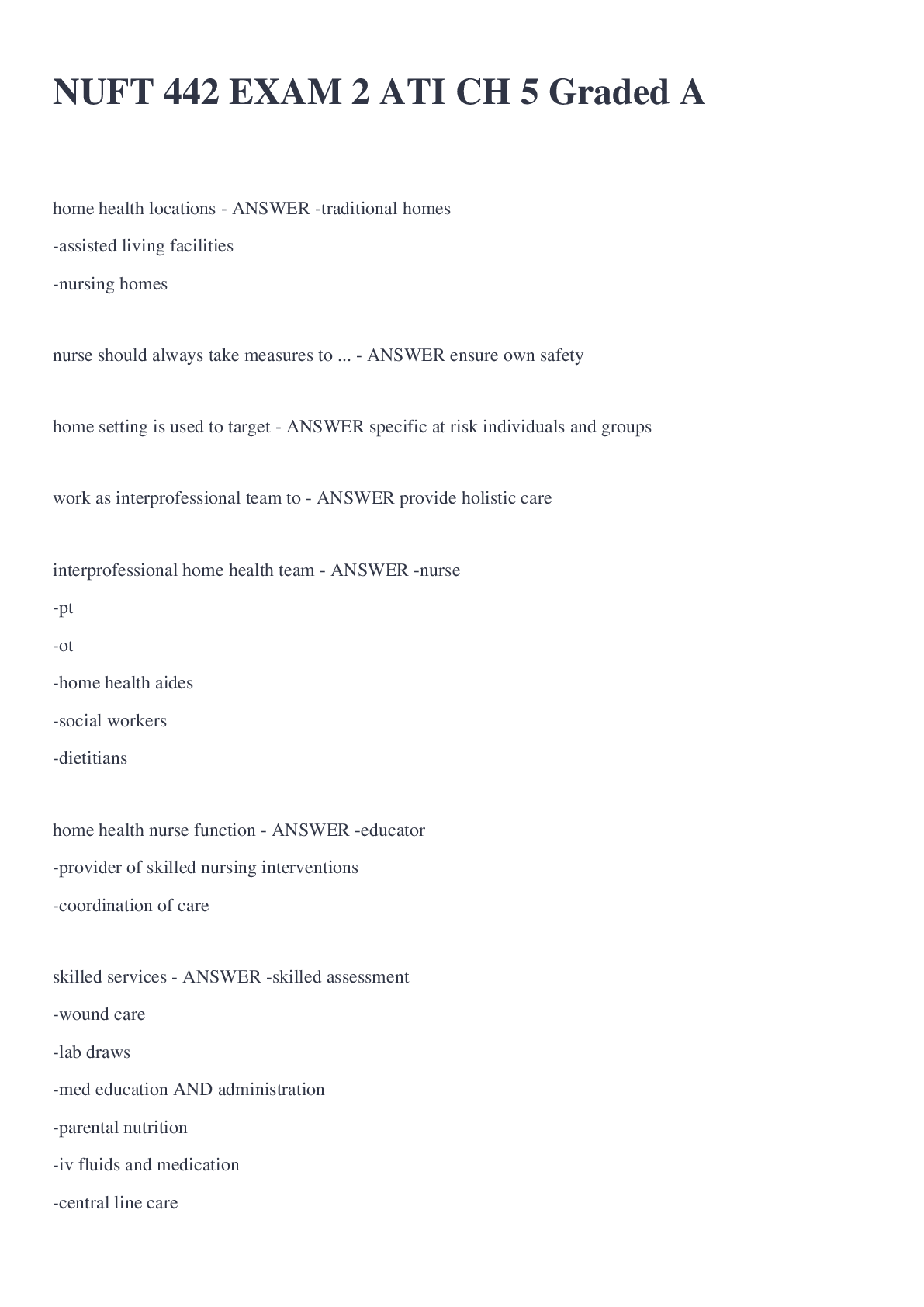
home health locations - ANSWER -traditional homes
-assisted living facilities
-nursing homes
nurse should always take measures to ... - ANSWER ensure own safety
home setting is used to target - ANSWER specific a
...
home health locations - ANSWER -traditional homes
-assisted living facilities
-nursing homes
nurse should always take measures to ... - ANSWER ensure own safety
home setting is used to target - ANSWER specific at risk individuals and groups
work as interprofessional team to - ANSWER provide holistic care
interprofessional home health team - ANSWER -nurse
-pt
-ot
-home health aides
-social workers
-dietitians
home health nurse function - ANSWER -educator
-provider of skilled nursing interventions
-coordination of care
skilled services - ANSWER -skilled assessment
-wound care
-lab draws
-med education AND administration
-parental nutrition
-iv fluids and medication
-central line care
-urinary cath insertion and maintenance
-coordination, delegation, supervision of other participants
omaha system model - ANSWER - Nurses caring for individuals, families, and communities under home health and hospice care often used this to implement the nursing process
- Used in many electronic health record systems
Steps of Omaha system - ANSWER - collecting and assessing data
- stating the problem
- identifying an admission problem rating using a problem classification scheme
- planning and intervening
- re-rating problems during the span of care delivery and at discharge
- evaluating the end problem outcome
home health prioritization - ANSWER those discharged from hospital are still very ill.
-need skilled services and education about disease process, medications and future implications of their illness
criteria for receiving medicare - ANSWER must have skilled services in order to be reimbursed
evaluation home safety - ANSWER -food security
-help w/ household activities
-live alone/ with family
-support system
-med administration
-access to health care
-follow up care post discharge
-empowerment
assessing ADLS - ANSWER -hygiene
-mail from mail box
-organizing meds
-ambulating
hospice nurse - ANSWER -focus is quality of life/ relief of pain/ suffering
-less than 6 months to live
-bereavement support to family
-done in home, hospice center, hospital, long-term care
-medical care toward cure is stopped: COMFORT
-care for pt and family can be up to 1 year
-volunteers for non medical help
included in hospice care - ANSWER -skilled direct services
-indirect care coordination
priority of hospice care - ANSWER controlling manifestations of the medical problem and dying process
important aspect of hospice care - ANSWER helping family transition from an expectation of recovery to acceptance of death
Palliative care - ANSWER -more than 6 months to live
-not end of life care or hospice
-try to improve quality of life
-investigate causes of discomfort
-alternative interventions that can be handled
patients that can benefit from palliative care - ANSWER -cancer
-end stage liver disease
-end stage renal disease
-COPD
-CHF
-severe cardiomyopathy
home health education - ANSWER -encourages clients to be independent and involved in their own care
-when to contact agency, emergency room or provider
-information and resources to provide support
evaluating home safety - ANSWER -nonsecure rugs
-electrical outlets
-extension cords
-use of oxygen
-low lighting
-need for safety devices in bathroom
public health nurses - ANSWER -employed at federal, state and local levels
-purpose is to impact health of populations through disease prevention, health promotion and actions that protect population health
10 essential public health services - ANSWER 1. Monitor health status to identify and solve problems.
2. Diagnose and investigate health risks
3. Inform, educate, and empower people about health issues.
4. facilitate community partnerships
5. Develop policies and plans
6. Enforce laws and regulations
7. promote access to health care and services
8. Assure competent health care workforce.
9. Evaluate personal and population-based health services
10. Research solutions to health problems.
occupational health goal - ANSWER -prevent injury and illness in workplace
-create healthy work environment
-foster the health and safety of workers
Nightingale theory in occupational health - ANSWER -lack of ventilation, warmth, light causes people to become ill more often missing more work
-focus on promoting health and preventing injury and illness
improvement and maintenance of health - ANSWER -decreased workplace expenditures
-less sick time used
-fewer workers comps claims
-decrease use of group health coverage
nurses function in occupational health - ANSWER -provide cost-effective and high quality care
-develop partnerships with administration, hygienists, safety specialists, occupational medicine physicians, HR, union reps and health insurance agencies
-assess risks of injury and illness
-plan and deliver health and safety services
-collab with providers
-facilitate health promotion activities
host factors - ANSWER worker characteristics, such as job inexperience, age and pregnancy
agent factos - ANSWER -biological agents: viruses, bacteria, fungi, blood-borne, airborne pathogens
-chemical agents: asbestos, smoke
-mechanical: muscle strains (repetitive motion), poor workstation, lifting heavy loads
-physical: temp extremes, vibrations, noise, radiation, lighting
-psychological: threats to social well being causing stress, burnout, violence
environmental factors - ANSWER -physical: heat, odor, ventilation, pollution (nightingale)
-social: sanitation, overcrowding
-psychological: addiction, stress
primary prevention occupational health - ANSWER -teach good nutrition
-teach health hazards
-provide info on immunizations
-use protective equipment
secondary prevention occupational health - ANSWER -identify workplace hazards
-early detection through health surveillance and screening
-prompt treatment
-counseling and referral
-prevention of further limitations
tertiary prevention occupational health - ANSWER -restoration of health through rehab strategies and limited-duty programs
exposure to hazards - ANSWER -goal is to identify agents and host factors that place worker at risk, identify ways to eliminate or minimize exposure, prevent potential health problems
[Show More]











![Preview of THE TEFL ACADEMY LEVEL 5 - ASSIGNMENT C - AUTHENTIC MATERIAL [2026]](https://browseimages.nyc3.digitaloceanspaces.com/paper-images/2026/04/10/HpVkRcWV2026-04-10-11-5769d96426bd64f.png)