EMT B QUESTION BANK 2022
Question Bank 2022
Questions 1 to 3 pertain to the following scenario:
You and your partner are called to the home of a 75-year-old man complaining of severe pain in the chest and nausea. As t
...
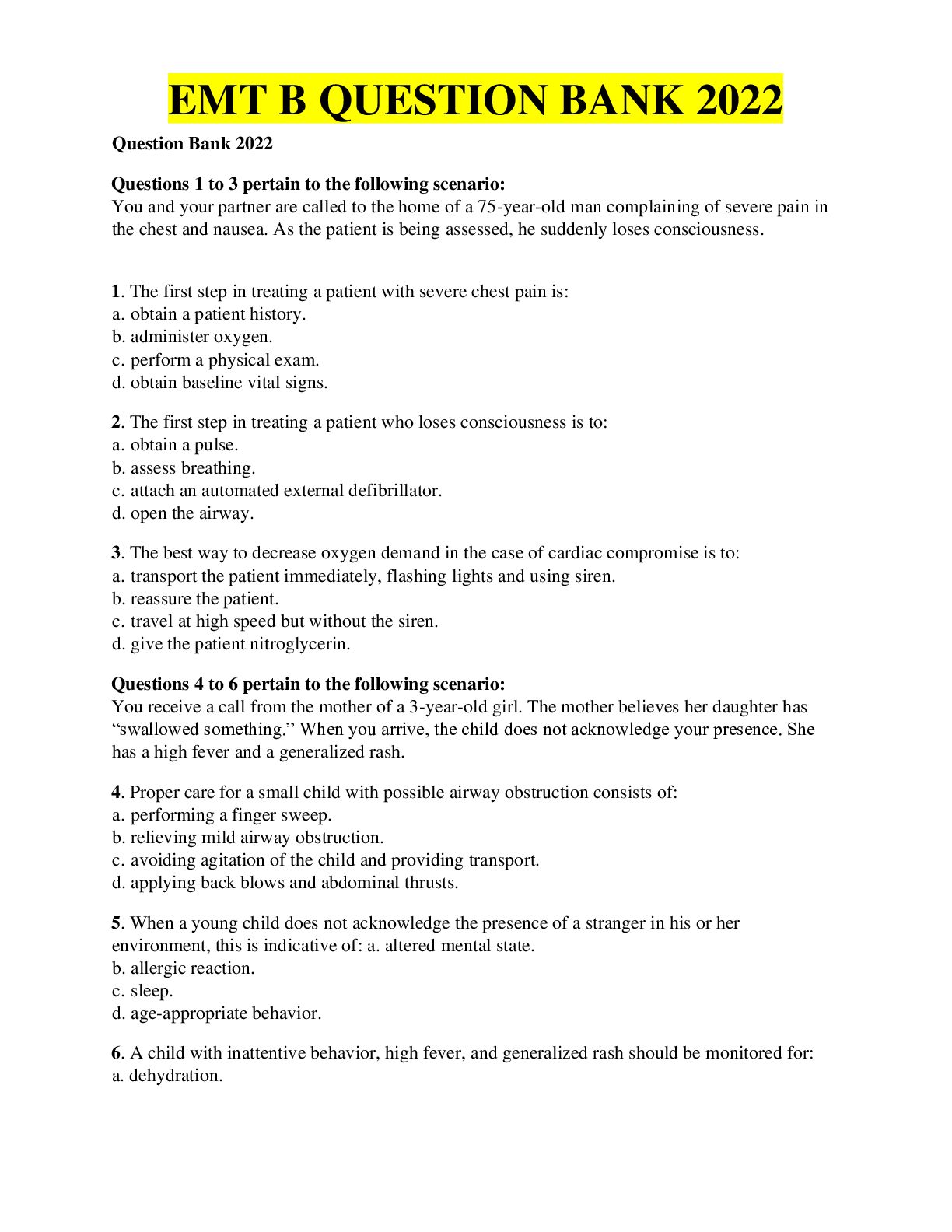
EMT B QUESTION BANK 2022
Question Bank 2022
Questions 1 to 3 pertain to the following scenario:
You and your partner are called to the home of a 75-year-old man complaining of severe pain in the chest and nausea. As the patient is being assessed, he suddenly loses consciousness.
1. The first step in treating a patient with severe chest pain is: a. obtain a patient history.
b. administer oxygen.
c. perform a physical exam.
d. obtain baseline vital signs.
2. The first step in treating a patient who loses consciousness is to: a. obtain a pulse.
b. assess breathing.
c. attach an automated external defibrillator.
d. open the airway.
3. The best way to decrease oxygen demand in the case of cardiac compromise is to: a. transport the patient immediately, flashing lights and using siren.
b. reassure the patient.
c. travel at high speed but without the siren.
d. give the patient nitroglycerin.
Questions 4 to 6 pertain to the following scenario:
You receive a call from the mother of a 3-year-old girl. The mother believes her daughter has “swallowed something.” When you arrive, the child does not acknowledge your presence. She has a high fever and a generalized rash.
4. Proper care for a small child with possible airway obstruction consists of: a. performing a finger sweep.
b. relieving mild airway obstruction.
c. avoiding agitation of the child and providing transport.
d. applying back blows and abdominal thrusts.
5. When a young child does not acknowledge the presence of a stranger in his or her environment, this is indicative of: a. altered mental state.
b. allergic reaction.
c. sleep.
d. age-appropriate behavior.
6. A child with inattentive behavior, high fever, and generalized rash should be monitored for: a. dehydration.
[Show More]