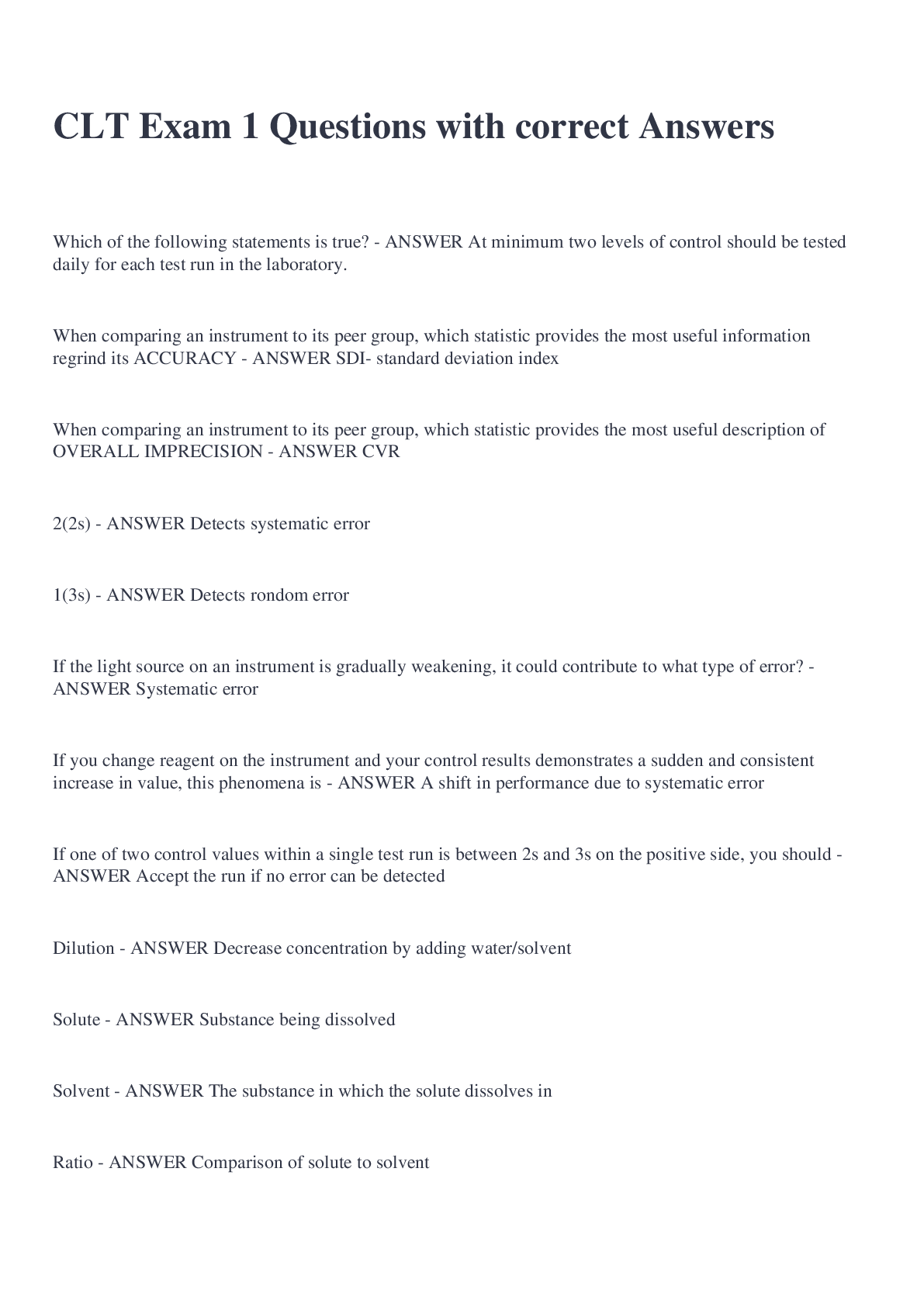
Which of the following statements is true? - ANSWER At minimum two levels of control should be tested daily for each test run in the laboratory.
When comparing an instrument to its peer group, which statistic provides
...
Which of the following statements is true? - ANSWER At minimum two levels of control should be tested daily for each test run in the laboratory.
When comparing an instrument to its peer group, which statistic provides the most useful information regrind its ACCURACY - ANSWER SDI- standard deviation index
When comparing an instrument to its peer group, which statistic provides the most useful description of OVERALL IMPRECISION - ANSWER CVR
2(2s) - ANSWER Detects systematic error
1(3s) - ANSWER Detects rondom error
If the light source on an instrument is gradually weakening, it could contribute to what type of error? - ANSWER Systematic error
If you change reagent on the instrument and your control results demonstrates a sudden and consistent increase in value, this phenomena is - ANSWER A shift in performance due to systematic error
If one of two control values within a single test run is between 2s and 3s on the positive side, you should - ANSWER Accept the run if no error can be detected
Dilution - ANSWER Decrease concentration by adding water/solvent
Solute - ANSWER Substance being dissolved
Solvent - ANSWER The substance in which the solute dissolves in
Ratio - ANSWER Comparison of solute to solvent
Example of ratios to dilutions (3/27) - ANSWER Dilution- 1/9
Dilution factor- 9
Serum needed to make dilution- 1
Saline needed to make dilution- 8
Tube dilution - ANSWER Dilution ratio in that tube alone
Solution dilution - ANSWER Actual concentration of the solvent in each tube (dependent on the previous dilutions)
Final concentration - ANSWER The solution dilution of the last tube
%w/w - ANSWER (Unit weights of solute = grams of solute) / (100 ml of solution = 1dL of solution)
%w/v - ANSWER (Grams of solute = grams of solute) / (100 mL of solution = 1 dL of solution)
%v/v - ANSWER (mL of concentration = mL of concentrate) / 100 mL of solution = 1 dL of solution)
Molarity - ANSWER The number of moles of solute per liter of solution
Normality - ANSWER (Grams of solute/G eqw) / L
Anticoagulants - ANSWER Prevent blood clot formation
EX- EDTA, sodium citrate, and heparin
Additive - ANSWER A substance added to something in small quantities, typically to improve or preserve it.
EX- thrombin, sodium fluoride, gel
1. Yellow - ANSWER Blood cultures SPS
2. Light blue - ANSWER Citrate tube
3. Gold or Red/gray - ANSWER BD vacutainer SST gel separator tube
Clot activator
4. Light green or green/gray - ANSWER Light green- lithium heparin
Dark green- sodium heparin
5. Lavender - ANSWER EDTA
6. White - ANSWER BD vacutainer PPT separator tube
K2, EDTA with gel
7. Gray - ANSWER Fluoride (glucose) tube
Mohr Pipette - ANSWER The graduation always ends before the tip
Serological Pipette - ANSWER The graduation marks continue to the tip
TD pipettes - ANSWER To deliver large amounts
Absence of the ring
More common than TC pipette
TC pipette - ANSWER To contain
The number 1 test to run on a lavender top tube - ANSWER Complete blood count
Ability of blood to form and dissolve clots - ANSWER Coagulation
If you have a tube with an additive and centrafuse it, what will you get? - ANSWER Plasma
What department do we send a light blue top tube? - ANSWER Coagulation
The breakdown or metabolism of glucose by blood cells - ANSWER Glycolysis
A thin, fluid-filled sac surrounding the heart - ANSWER Pericardium
What additive is in a lavender top tube? - ANSWER Potassium EDTA
A substance that prevents blood from clotting - ANSWER Anticoagulant
Small veins that join capillaries - ANSWER Venules
Where do you send a sterile tube? - ANSWER Microbiology
A substance that enhances the coagulation process - ANSWER Clot activator
The blood clotting process - ANSWER Coagulation
What is sterile, light blue, red, gold, light green, dark green, lavender, gray? - ANSWER Order of draw
No substance added to tube - ANSWER Non-additive
If I have a green top tube and don't centrifuge it, what do I get? - ANSWER Whole blood
Plasma separator tube - ANSWER PST
If I have a red top tube and centrafuse it, what do I get? - ANSWER Serum
An under filled or partially filled tube - ANSWER Short draw
What prevents blood from flowing back into the ventricles? - ANSWER Valves
What is arterial pressure during relaxation of ventricles? - ANSWER Disastole
Biosafety - ANSWER The application of safety precautions that reduce a laboratorian's risk of exposure to a potentially infection microbe and limit contamination of the work environment and, ultimately, the community
Biosafety levels - ANSWER Specific controls for containment of microbes and biological agents
Standard microbiological practices - ANSWER Common to all laboratories
BSL-1 - ANSWER Microbes are nonpathogenic
BSL-2 - ANSWER The microbes are typically indigenous and are associated with diseases of varying severity
BSL-3 - ANSWER Microbes can be indigenous or exotic, and cause serious or potentially lethal disease through respiratory transmission
BSL-4 - ANSWER Microbes are dangerous and exotic, high risk of aerosol-transmitted infections
Volumetric pipette - ANSWER Delivers a single, specified volume
Not completely drained or blown out
Tip never comes in contact with the fluid in the container
Most accurate pipette and should be used when diluting or preparing standards and controls
Air displacement micropipettes - ANSWER Vacuum is generated by the metal or ceramic piston in an airtight sleeve
Very precise and accurate
Must be maintained and calibrated
Positive displacement pipette - ANSWER Similar to air displacement
Used for viscous substances like DNA
The disposable tip is a micro syringe composed of a plunger which directly displaces the liquid.
Notes for pipetting - ANSWER Hold the pipette in a vertical position to increase accuracy and precision
Pipette solutions that are at room temperature to avoid errors caused by contraction and/or expansion of fluids
Any air bubble will invalidate the volume of liquid
Micro-volume pipette procedure - ANSWER Depress the plunger knob
The plastic pipette tip must be properly fitted
Pre-rinse
Hold in vertical position
Never allow the plunger knob to snap back
Depress the knob BEFORE inserting the pipette to avoid air bubbles
Don't drown the tip- try to insert the tip into the sample around the same depth each time
Do not touch the inside wall of the receiving vessel
MLA pipette - ANSWER TD pipette
Only 1 plunger stop position
[Show More]









![Preview of THE TEFL ACADEMY LEVEL 5 - ASSIGNMENT C - AUTHENTIC MATERIAL [2026]](https://browseimages.nyc3.digitaloceanspaces.com/paper-images/2026/04/10/HpVkRcWV2026-04-10-11-5769d96426bd64f.png)