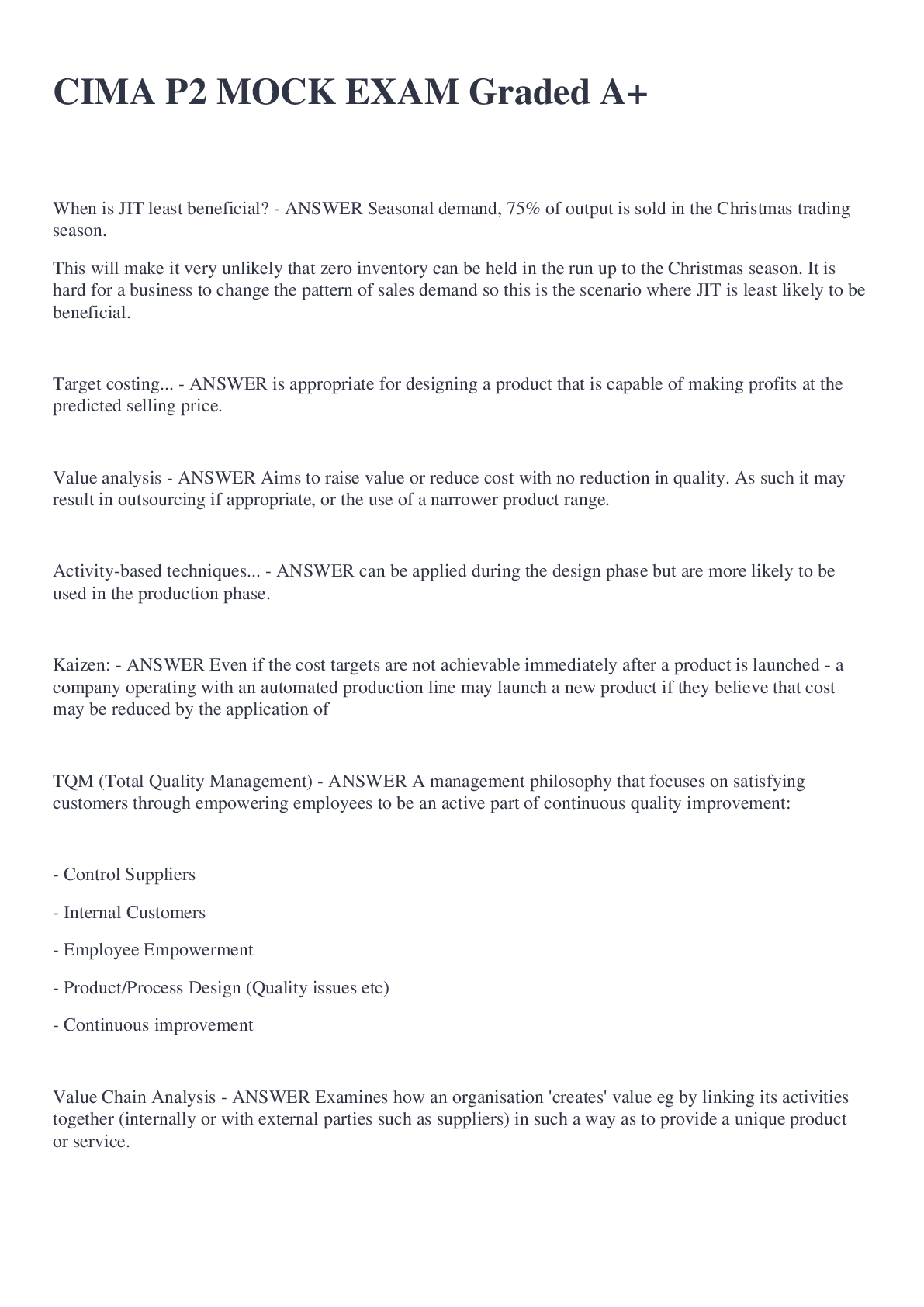
When is JIT least beneficial? - ANSWER Seasonal demand, 75% of output is sold in the Christmas trading season.
This will make it very unlikely that zero inventory can be held in the run up to the Christmas season. It i
...
When is JIT least beneficial? - ANSWER Seasonal demand, 75% of output is sold in the Christmas trading season.
This will make it very unlikely that zero inventory can be held in the run up to the Christmas season. It is hard for a business to change the pattern of sales demand so this is the scenario where JIT is least likely to be beneficial.
Target costing... - ANSWER is appropriate for designing a product that is capable of making profits at the predicted selling price.
Value analysis - ANSWER Aims to raise value or reduce cost with no reduction in quality. As such it may result in outsourcing if appropriate, or the use of a narrower product range.
Activity-based techniques... - ANSWER can be applied during the design phase but are more likely to be used in the production phase.
Kaizen: - ANSWER Even if the cost targets are not achievable immediately after a product is launched - a company operating with an automated production line may launch a new product if they believe that cost may be reduced by the application of
TQM (Total Quality Management) - ANSWER A management philosophy that focuses on satisfying customers through empowering employees to be an active part of continuous quality improvement:
- Control Suppliers
- Internal Customers
- Employee Empowerment
- Product/Process Design (Quality issues etc)
- Continuous improvement
Value Chain Analysis - ANSWER Examines how an organisation 'creates' value eg by linking its activities together (internally or with external parties such as suppliers) in such a way as to provide a unique product or service.
BPR (Business process re-engineering) - ANSWER Involves fundamental process redesign to achieve dramatic improvements, and this is happening in this case.
Reverse engineering - ANSWER Relates to stripping down the components of a product and working out how this product has been put together and has not been specifically employed here
Throughput Accounting Ratio involves - ANSWER Return per hour (SP-Material Cost)
OVER
Cost per hour in the bottleneck (total $ for number of hours) / (Individual process for year).
Difference between Price Differentiation and Price Discrimination - ANSWER Price discrimination involves selling the SAME product to different market segments at different prices. Where Price differentiation involves selling a different product to different market segments at different prices.
In order to carry out Market-Penetration Pricing, a firm requires.. - ANSWER High levels of liquidity as this will require high set up costs in order to build capacity.
When to choose IRR (% measure) over NPV (absolute measure) - ANSWER - Managers understand IRR better than NPV as it is a % measure
- There is uncertainty over the appropriate cost of capital to use
What should guide investment decisions? - ANSWER NPV should guide the investment decision, unless there is capital rationing with divisible projects, in which case the profitability index should be used.
Is the linear interpolation method more/less/same accurate if estimated using NPV rates that are far apart? - ANSWER Less Accurate
A project's MIRR cannot be calculated if what is unknown? - ANSWER Cost of Capital
Division Economic Performance is judged on reveue that is traceable. This therefore means... - ANSWER Non-controllable costs should still be included in an assessment of a division's economic performance if these can be traced to the division, but would need to be adjusted for if the current management team's performance was being evaluated
Responsibility Centre - ANSWER Is a functional entity within a business that has its own goals and objectives, dedicated staff, policies and procedures, and financial reports. It is used to give managers specific responsibility for revenues generated, expenses incurred, and/or funds invested.
If divisions have responsibility for suggesting additions and disposals in their investment, even if authorisation is required from Head Office.
RI - ANSWER Difficult to use to compare as is an absolute measure
EVA - ANSWER Difficult to use to compare as is an absolute measure & complicated to calculate but the measure itself has a clear unambiguous meaning that is easy to interpret.
Which one includes Depreciation Cost in its investment appraisal method? ARR or others? - ANSWER Depreciation costs are included in ARR method but not a DCF investment appraisal method.
Kaizen vs Standard - ANSWER Both approaches involve comparing actuals to a target.
For standard costing this is variance analysis, for Kaizen the target is the existing actual cost.
Kaizen is part of a cross-departmental philosophy of continual improvement, which is at the heart of TQM. Standard costing is about cost control.
Only standard costing revises cost targets on an annual or semi-annual basis (normally). Kaizen will do this more often, normally on a monthly basis.
Standard costing is about cost control compared to the budget, Kaizen is about cost reduction
Kaizen Characteristics - ANSWER - Kaizen aims use employee participation as the key to reducing waste.
- Kaizen standardises activities to include planned improvements, these standards are regularly undated.
- Excessive inventory is an example of waste, and Kaizen would focus on this (Kaizen is often seen as being a part of a JIT philosophy).
If IRR = cost of capital - ANSWER Then NPV = 0 which is the minimum acceptable value for NPV
Conformance vs. Non-conformance - ANSWER Non-Conformance = costs after the issue has arisen. I.e. Admin cost of customer complaint department, or reviewing products after failure.
What Risk type should I be to use a Decision Tree? - ANSWER Risk Neutral
ERP (Enterprise Resource Planning) - ANSWER Enterprise resource planning (ERP) is a process used by companies to manage and integrate the important parts of their businesses. Many ERP software applications are important to companies because they help them implement resource planning by integrating all of the processes needed to run their companies with a single system.
Benefits of using Non-Financial Information - ANSWER - Quicker availability of information
- Information will be easier to understand
- Better quality and therefore future revenues should improve.
Benefits from ERPS - ANSWER - Reduced production lead times
- Improved data visualisation as report formats will be common and aligned to best practice.
[Show More]