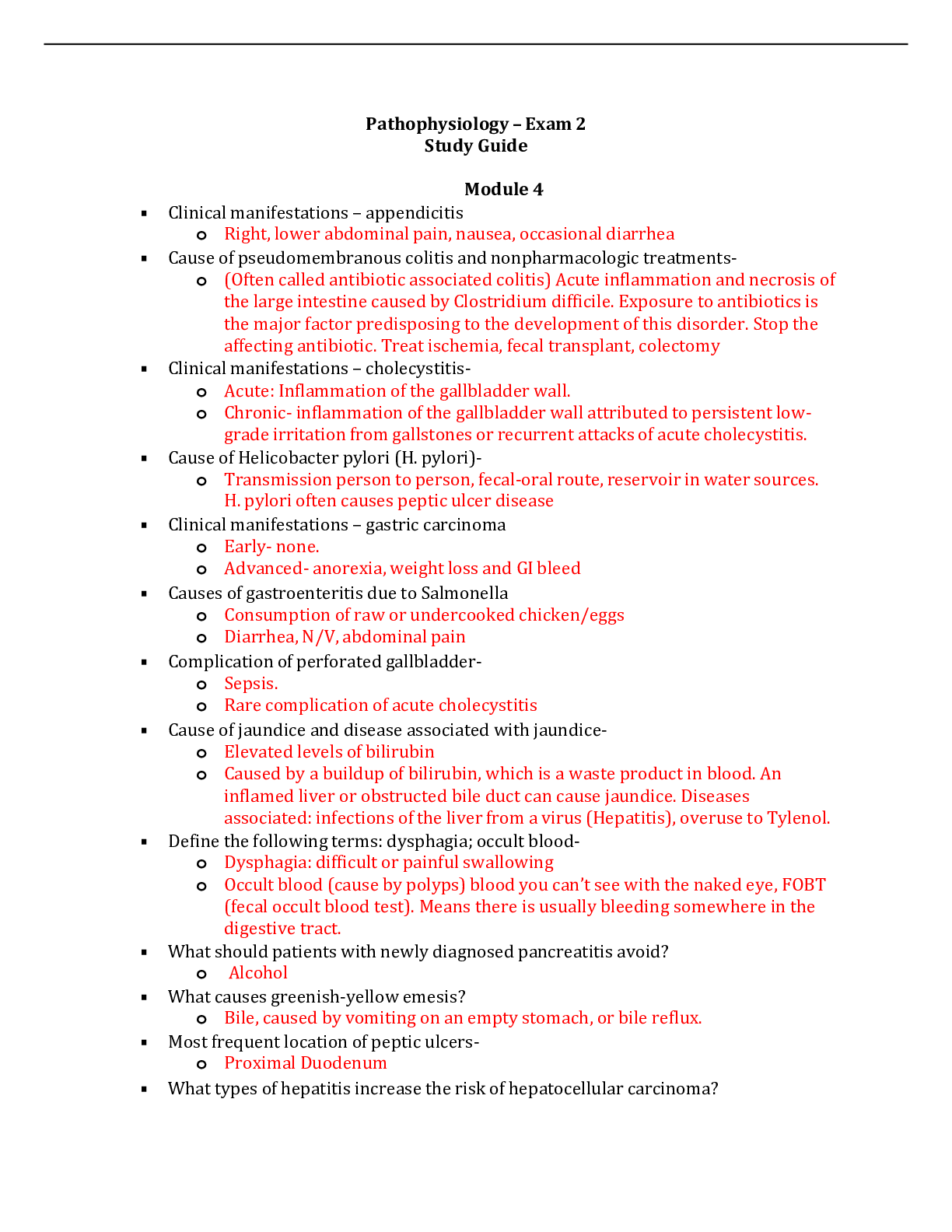
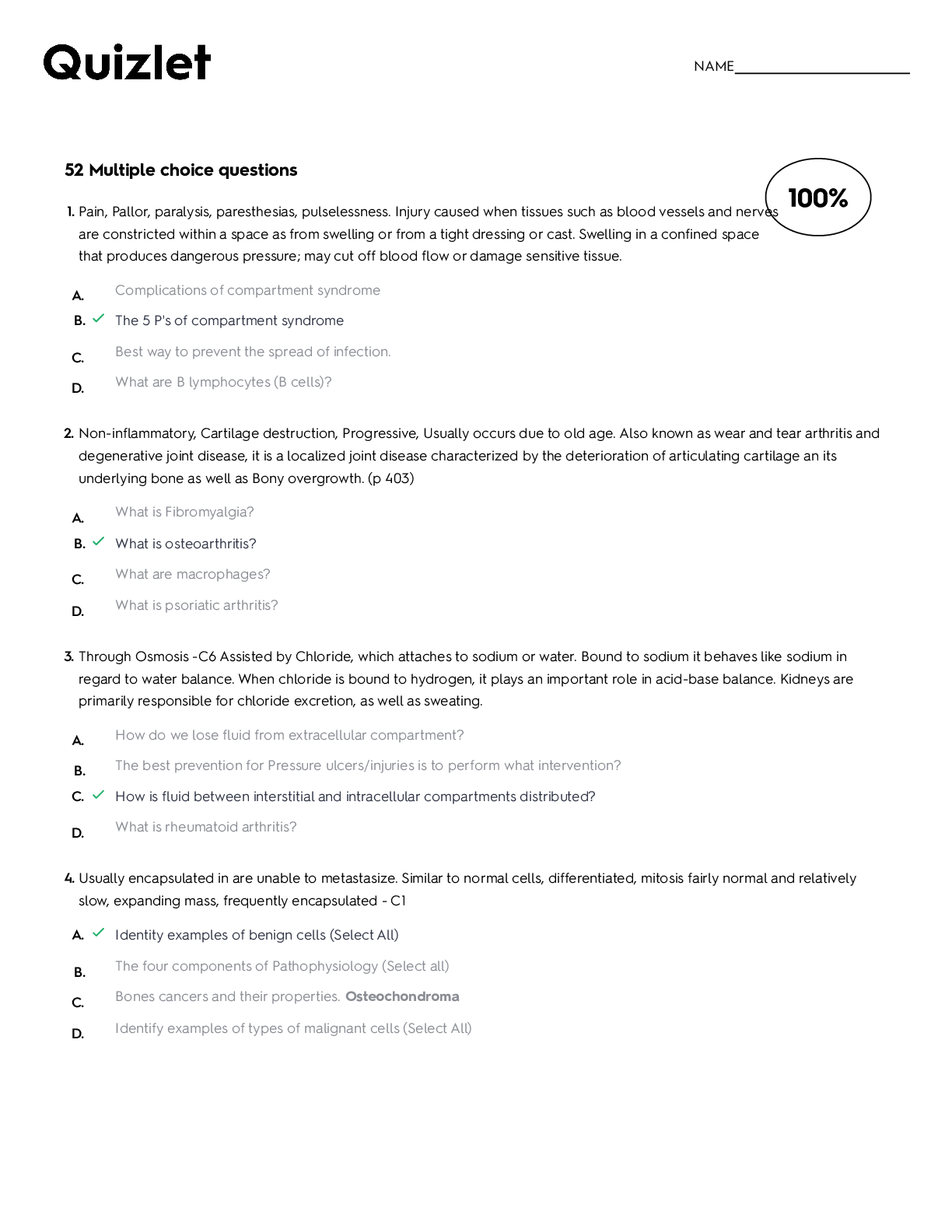
Medical Surgical 1 TERM 2 Final
EXAM STUDY GUDE WITH
RATIONALE
lOMoAR cPSD|18041796
TERM 2 FINAL!!
1. What does a stage 1 pressure ulcer look like? What to do to help
in that area?
- Localized skin area, over bony
...
Medical Surgical 1 TERM 2 Final
EXAM STUDY GUDE WITH
RATIONALE
lOMoAR cPSD|18041796
TERM 2 FINAL!!
1. What does a stage 1 pressure ulcer look like? What to do to help
in that area?
- Localized skin area, over bony prominence, intact with non
blanchable redness. Characteristics: painful, firm, warm,
soft sometimes, cold.
- NEVER massage the reddened area
- Providing protein helps with wound healing, and vitamin C
and Zinc.
- Pt. should be hydrated all the time.
- Turn the pt. EVERY 2 HOURS
- No donut-shaped cushions on the chair
2. A nurse caring for a patient who has been prescribed bed rest for
1 week notices a reddened area on the pt’s left hip. The skin is
intact, but when the nurse presses on the area, the redness does
not fade. How should this area be classified?
- Stage 1
3. What intervention is most appropriate to prevent respiratory
complications resulting from immobility? What should you do to
the patient? What is the immobilized patient at risk for?
Pneumonia Ask the patient to COUGH, DEEP BREATHE,
REPOSITION at least every 2 hours What intervention is most
appropriate to prevent respiratory complications resulting from
immobility?
- Pneumonia- reposition the pt every 2 hrs, and encourage
him or her to cough and deep breathe.
4. What causes constipation in patients who have pressure injuries?
(SATA)
-Immobility
lOMoAR cPSD|18041796
-Dehydration
-Poor diet
*provide high fiber diet to pt experiencing constipation
5. Which statement by the patient indicated more teaching needed?
-I’m never constipated. I take gentle laxatives every night.
6. How would you describe a pt. to do isometric exercises?
- Causes increase in muscle tension or muscle work but no
shortening or active movement of muscle
7. Pt. has erythema around the sacrum area due to immobility.
What is the nurse’s first priority?
- Prevent skin impairment
- Reposition the pt.
8. Walking older pt. to the bathroom and they feel lightheaded,
dizzy, and faint. What would the nurse understand these
symptoms are?
- Vasovagal reflex or vasovagal syncope caused by straining
to have a bowel movement.
9. The care plan of an older adult patient states that the pt should
be monitored while in the bathroom because of a history of
vasovagal reflex. What should the nurse assess with this patient?
- Lightheadedness and fainting during defecation.
- Vasovagal reflex or syncope causes BP to lower causing
hypotension.
10. When differentiating between delirium and dementia in a pt,
what would a pt with dementia exhibit?
lOMoAR cPSD|18041796
11.Pt is confused and the onset is fast and suddenly they become
flaring, hypermania lasted for week.
- Delirium (acute confusion lasts 1 week)
12. Mother of a child asks if their child can get chickenpox more
than once. What kind of immunity would be most accurate?
- Active acquired immunity
13. During the inflammatory process when the body capillary
beds dilate and this is responsible for what kind of response?
- Red and warm
14. What vitamins can enhance wound healing?
- Vitamin C and zinc
15. What should you administer after a pt. experiences
anaphylaxis?
- Oxygen
16. Best way to prevent communicable diseases?
- Aseptic technique
- HAND WASHING
17. What do we call different animals that carry germs?
- Vector borne illness
18. What is the nursing priority for a pt who is
immunocompromised?
- Protect them from infection or illness
19. What illnesses would require you to take airborne
precautions?
- TB, MUMPS, VARICELLA, HERPES ZOSTER
lOMoAR cPSD|18041796
20. What kind of diagnostic test do you think we would use to
diagnose a fungal infection of the skin and the nails?
- KOH (potassium hydroxide microscopic test)
[Show More]