MRSA - ANSWER Red, swollen, may look like a boil with pus. Also skin rash or sore. Transmitted usually skin to skin.
Malaria - ANSWER Fever, chills, sweating and other flu like symptoms. Transmitted by Mosquito
Sta
...
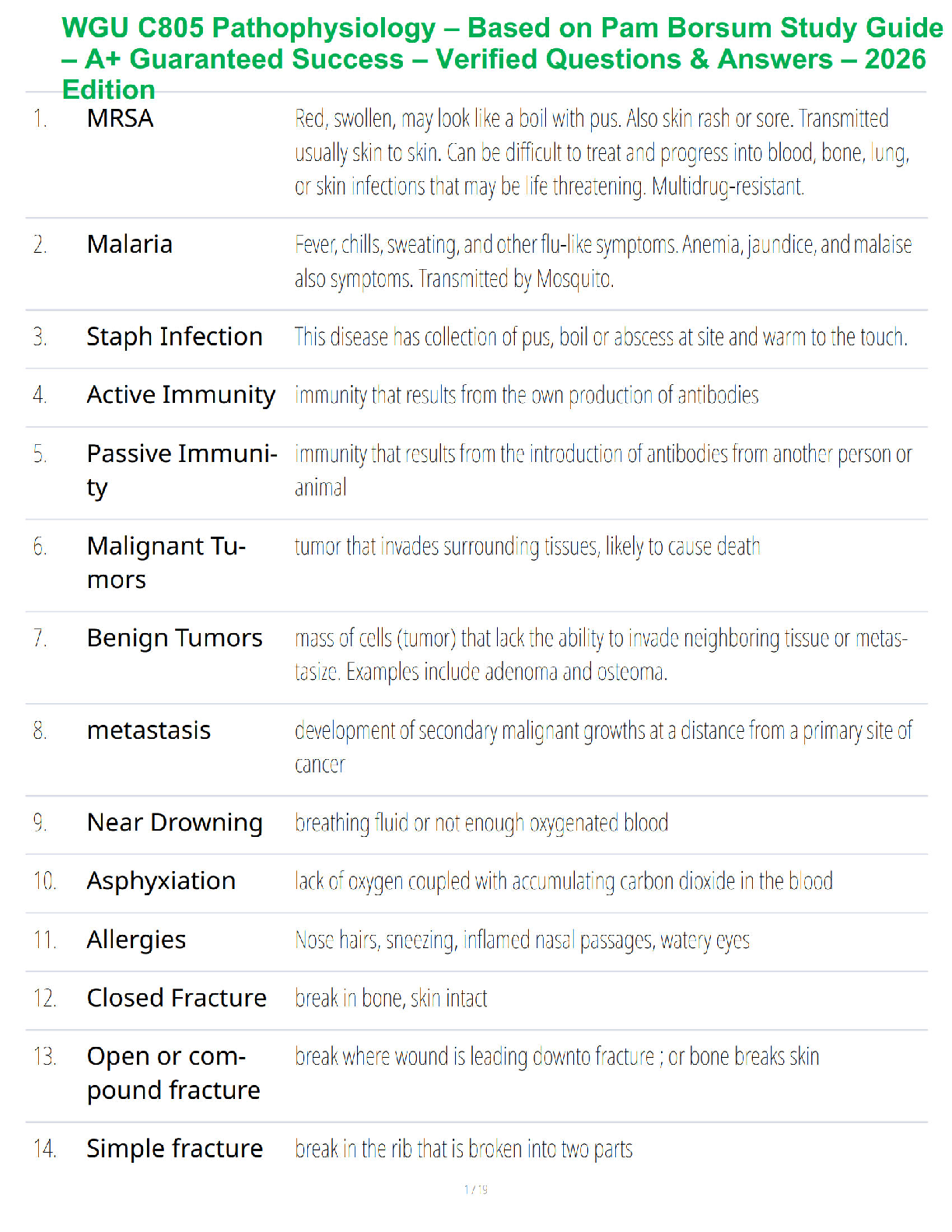
MRSA - ANSWER Red, swollen, may look like a boil with pus. Also skin rash or sore. Transmitted usually skin to skin.
Malaria - ANSWER Fever, chills, sweating and other flu like symptoms. Transmitted by Mosquito
Staph Infection - ANSWER This disease has collection of pus, boil or abscess at site
Active Immunity - ANSWER immunity that results from the own production of antibodies
Passive Immunity - ANSWER immunity that results from the introduction of antibodies from another person or animal
Malignant Tumors - ANSWER tumor that invades surrounding tissues, likely to cause death
Benign Tumors - ANSWER mass of cells (tumor) that lack the ability to invade neighboring tissue or metastasize
metastasis - ANSWER development of secondary malignant growths at a distance from a primary site of cancer
Near Drowning - ANSWER breathing fluid or not enough oxygenated blood
Asphyxiation - ANSWER lack of oxygen coupled with accumulating carbon dioxide in the blood
Allergies - ANSWER Nose hairs, sneezing, inflamed nasal passages, watery eyes
Closed Fracture - ANSWER break in bone, skin intact
Open or compound fracture - ANSWER break where wound is leading downto fracture ; or bone breaks skin
Simple fracture - ANSWER break in the rib that is broken into two parts
Comminuted fracture - ANSWER shattering break
Impacted fracture - ANSWER bone is broken with one end forced into the interior of the other
Incomplete partial fracture - ANSWER fraction line does not include the whole bone (stress fracture)
Greenstick fracture - ANSWER bone partially bent or split; occurs with soft bones
Colles fracture - ANSWER break in the end of the radius in wrist; often occurs when the wrist is extended to break a fall
Common Dislocations - ANSWER shoulder, hip, jaw, knee, spine and elbow
Sprain - ANSWER stretching/tearing of ligaments
Strain - ANSWER stretching/tearing of muscle or tendon
Rickets - ANSWER bow legs, delayed growth
Osteomalacia - ANSWER softening and weakening of bones in children, usually due to inadequate vitamin D.
Gout - ANSWER Disease of uric acid metabolism, typically joint pain in big toe. Deposits will build up around joints. Characterized by , kidney stones, urea in blood and renal dysfunction.
Herniated disk - ANSWER Common on site L4-L5, disc pushes on nerve causing discomfort in low back. Symptoms to include severe back pain, parasthesia.
Plantar fasciitis - ANSWER inflammation of a thick band of tissue that connects the heel bone to the toes.
Paget's Disease - ANSWER High rate of bone turnover, bone is replaced by coarse, irregular bone.
Lordosis - ANSWER curving inward of the lower back. also called sway back. Affects lumbar / lower spine
Kyphosis - ANSWER forward rounding of the back. also called hunchback, affects upper thoracic
Scoliosis - ANSWER sideways curvature of the spine.
Osteoporosis - ANSWER bones become brittle and fragile
Osteoarthritis - ANSWER flexible tissue at the ends of bones wears down. Bone on bone sound can be heard, minimal inflammation
Fibromyalgia - ANSWER Widespread pain in muscles, ligaments or tendons. There will be tender points on body
Myasthenia gravis - ANSWER weakness and rapid fatigue of muscles under voluntary control. Drooping eyelids, diffuculty swallowing, difficluty speaking.
rheumatoid Arthritis - ANSWER chronic inflammatory disorder affecting many joints, including those in the hands and feet.
Acne Vulgaris - ANSWER occurrence of inflamed or infected sebaceous glands, characterized by red pimples or black heads
Fever blisters - Herpes - ANSWER Infection with the herpes simplex virus; pale vesicles appearing individually or in clusters
Impetigo - ANSWER highly contagious skin infection that causes red sores on the face.
Herpes Zoster - ANSWER aka shingles, reactivation of the chickenpox virus in the body
Eczema - ANSWER patches of skin become rough and inflamed, with blisters that cause itching and bleeding, sometimes resulting from a reaction to irritation
Decubitus Ulcers - ANSWER bed sores, from lying in one position too long so that the circulation in the skin is compromised by the pressure
Keratosis Pilaris - ANSWER skin colored bumps that may form rough patches, typically cosmetic condition
Furuncle - ANSWER painful, pus-filled bump under the skin caused by infected, inflamed hair follicles.
Warts - ANSWER small, fleshy bump on the skin or mucous membrane caused by human papillomavirus.
Urticaria (wheal) - ANSWER hives, generally caused by allergic immune response. Round and red, can cover small area or large.
Rosacea - ANSWER condition that causes redness and often small, red, pus-filled bumps on the face.
Scabies - ANSWER contagious, intensely itchy skin condition caused by a tiny, burrowing mite.
Skin cancer - ANSWER Can be either basal (most common, rarely metastisize) or squamos (uncommon metsastisize)
Tinea pedis - ANSWER fungal infection that usually begins between the toes, aka athletes foot
Vitiligo - ANSWER disease that causes the loss of skin color in blotches.
Transients CVA's - ANSWER temporary blockage of blood flow to the brain, mini stroke
Hemorrhagic CVA's - ANSWER ruptured blood vessel causes bleeding inside the brain
Hematoma - ANSWER solid swelling of clotted blood within the tissues
Subdural Hematoma - ANSWER pool of blood between the brain and its outermost covering
Concussion - ANSWER brain injury caused by a blow to the head or a violent shaking of the head and body
Contusion - ANSWER tissue beneath surface of brain is bruised. Blood will accumulate
Head Trauma - ANSWER any sort of injury to your brain, skull, or scalp
Amyotrophic Lateral Sclerosis - ANSWER ALS/ Lou Gherig's, nervous system disease that weakens muscles and impacts physical function
Alzheimer Disease - ANSWER progressive disease that destroys memory and other important mental functions
Bells Palsy - ANSWER Sudden weakness in the muscles on one half of the face
[Show More]

.png)