Chapter 3 EMT Questions and answers,
Graded A+. 2022 update
1. To minimize the risk of litigation, the EMT should always:
A. transport patients to the hospital of their choice.
B. provide competent care that meets cu
...
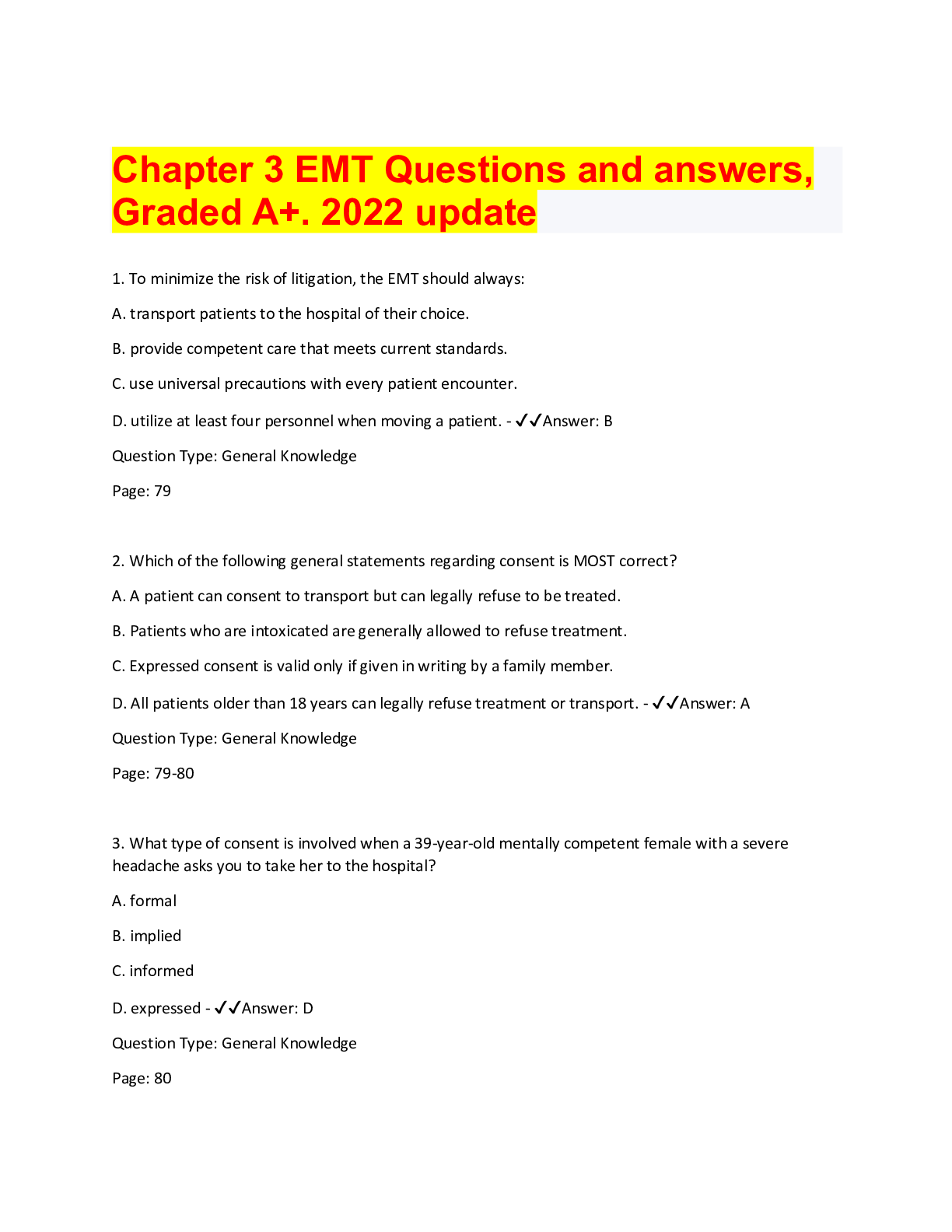
Chapter 3 EMT Questions and answers,
Graded A+. 2022 update
1. To minimize the risk of litigation, the EMT should always:
A. transport patients to the hospital of their choice.
B. provide competent care that meets current standards.
C. use universal precautions with every patient encounter.
D. utilize at least four personnel when moving a patient. - ✔✔Answer: B
Question Type: General Knowledge
Page: 79
2. Which of the following general statements regarding consent is MOST correct?
A. A patient can consent to transport but can legally refuse to be treated.
B. Patients who are intoxicated are generally allowed to refuse treatment.
C. Expressed consent is valid only if given in writing by a family member.
D. All patients older than 18 years can legally refuse treatment or transport. - ✔✔Answer: A
Question Type: General Knowledge
Page: 79-80
3. What type of consent is involved when a 39-year-old mentally competent female with a severe
headache asks you to take her to the hospital?
A. formal
B. implied
C. informed
D. expressed - ✔✔Answer: D
Question Type: General Knowledge
Page: 804. Which of the following scenarios MOST accurately depicts informed consent?
A. A patient advises an EMT of why he or she is refusing care.
B. An EMT advises a patient of the risks of receiving treatment.
C. An EMT initiates immediate care for an unconscious adult.
D. A patient is advised by an EMT of the risks of refusing care. - ✔✔Answer: B
Question Type: General Knowledge
Page: 80
5. Which of the following types of consent allows treatment of a patient who is unconscious or mentally
incapacitated?
A. actual
B. implied
C. informed
D. expressed - ✔✔Answer: B
Question Type: General Knowledge
Page: 80
6. You are dispatched to an office building for a 49-year-old male with chest pain. When you arrive at
the scene, you find the patient to be conscious and alert, but in obvious pain. He tells you that he did
not call 9-1-1; a coworker did. He further states that he does not want to be treated or transported to
the hospital. You should:
A. ensure that he is aware of the risks of refusing medical care.
B. err in the best interest of the patient and transport him at once.
C. have him sign a refusal of care form and then return to service.
D. tell him that he is having a heart attack and needs medical care. - ✔✔Answer: A
Question Type: Critical Thinking
Page: 807. You suspect that a pregnant 16-year-old girl has a broken leg after she was hit by a car. You explain
that you plan to splint her leg, and she agrees to treatment. What type of consent is her agreement
considered?
A. implied
B. informed
C. expressed
D. minor's - ✔✔Answer: C
Question Type: General Knowledge
Page: 80
8. In many states, a minor may be treated as an adult for the purpose of consenting to or refusing
medical treatment if the minor:
A. possesses a valid driver's license.
B. is mentally competent and able to refuse.
C. has a poor relationship with his or her parents.
D. is self-supporting and lives by him- or herself. - ✔✔Answer: D
Question Type: General Knowledge
Page: 81
9. You arrive at the scene of a motor vehicle versus pedestrian accident. The patient, a 13-year-old male,
is unconscious and has multiple injuries. As you are treating the child, a law enforcement officer advises
you that the child's parents will be at the scene in approximately 15 minutes. What should you do?
A. Transport the child immediately and have the parents meet you at the hospital.
B. Treat the child at the scene and wait for the parents to arrive and give consent.
C. Begin transport at once and have the parents meet you en route to the hospital.
D. Withhold treatment until the parents arrive and give you consent for treatment. - ✔✔Answer: A
Question Type: Critical Thinking
Page: 8110. You are dispatched to a middle school for a 16-year-old female experiencing an asthma attack. She is
conscious and alert, but in severe respiratory distress. The school nurse informs you that she has tried
several times to contact the patient's parents but has not been successful. You should:
A. provide treatment up to your level of training and transport the child at once.
B. recognize that you cannot begin treatment without expressed parental consent.
C. transport the child to the closest hospital and let them provide any treatment.
D. administer oxygen only until you receive parental consent for further treatment. - ✔✔Answer: A
Question Type: Critical Thinking
[Show More]