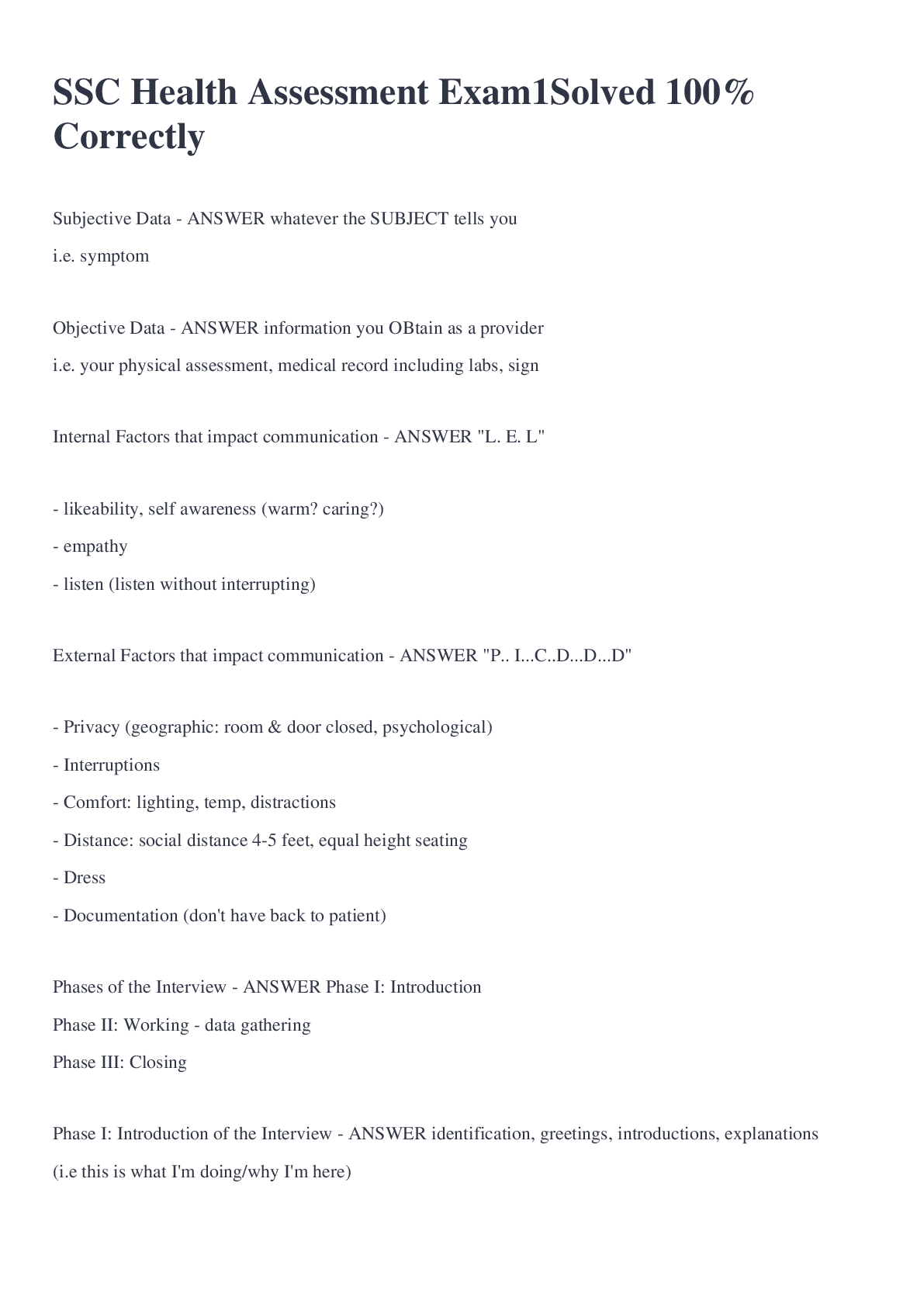
Subjective Data - ANSWER whatever the SUBJECT tells you
i.e. symptom
Objective Data - ANSWER information you OBtain as a provider
i.e. your physical assessment, medical record including labs, sign
Internal Factor
...
Subjective Data - ANSWER whatever the SUBJECT tells you
i.e. symptom
Objective Data - ANSWER information you OBtain as a provider
i.e. your physical assessment, medical record including labs, sign
Internal Factors that impact communication - ANSWER "L. E. L"
- likeability, self awareness (warm? caring?)
- empathy
- listen (listen without interrupting)
External Factors that impact communication - ANSWER "P.. I...C..D...D...D"
- Privacy (geographic: room & door closed, psychological)
- Interruptions
- Comfort: lighting, temp, distractions
- Distance: social distance 4-5 feet, equal height seating
- Dress
- Documentation (don't have back to patient)
Phases of the Interview - ANSWER Phase I: Introduction
Phase II: Working - data gathering
Phase III: Closing
Phase I: Introduction of the Interview - ANSWER identification, greetings, introductions, explanations
(i.e this is what I'm doing/why I'm here)
Phase II: Working -data gathering- of the Interview - ANSWER open and closed ended questions
Phase III: Closing of the Interview - ANSWER - final opportunity for self-expression
- summarize findings
(i.e. anything else I missed?)
Responses to the Interview - ANSWER - Facilitation
- Silence
- Reflection
- Empathy
- Clarification
- Confrontation
- Interpretation
- Explanation
- Summary
first 5 are your reactions to what they said --> last 4 are your own thoughts and views
Facilitation - ANSWER "go on...continue"
Silence - ANSWER Don't interrupt
Reflection - ANSWER Echo client's words/repeat verbatim
Empathy - ANSWER "this must be hard for you"
- names a feeling
Clarification - ANSWER "can you tell me, what you mean by..."
ensures you understood the symptoms correctly
Confrontation - ANSWER discordance between words and signs
"you said you weren't in pain, but you seem to be..."
Interpretation - ANSWER -repeat in your own words, association symptoms and events
-what you have summarized
"I can't seem to tell dr I'm ready to stop..." "Could it be that you're afraid of her reaction?"
Explanation - ANSWER connection through information
"you can't do this because of ____"
Summarize - ANSWER condenses, validates
Space Distances - ANSWER Intimate: 0-1.5 feet
Personal: 1.5-4 feet
Social: 4-12 feet *much of interview
Public: 12+ feet
10 traps of interviewing - ANSWER 1. Providing false assurance or reassurance
2. Giving unwanted advice
3. Using authority
4. Using avoidance language
5. Engaging in distancing -- using "the" instead of "your"
6. Using professional jargon
7. Using leading or biased questions -- "you're not drinking while pregnant...?"
8. Talking too much
9. Interrupting
10. Using "why" questions
Interviewing: Infants and Toddlers - ANSWER stranger anxiety
-- keep child with parent as long as possible
Interviewing: Pre-School - ANSWER animism -- puppet, etc. are real
-- let play with equipment; if possible
Interviewing: School Age - ANSWER logical, functional
-- if no choice exists, don't ask
Adolescents - ANSWER imaginary audience,
why are you here? how is school? ---> to develop rapport
Interviewing: Older Adults - ANSWER - Illness may threaten existence or purpose intergrity vs despair
- History will be of greater length
- Physical limitations -- impairment visual/hearing
Health History: Adult - ANSWER 1. Biographical data
2. Source of history
3. Reason for seeking care
4. Present health or history of present illness
5. Past health
6. Family history
7. Review of systems
8. Functional assessment including activities of daily living (ADLs)
What are the 8 characteristics we assess for History of Present Illness (HPI)? - ANSWER 1. LOCATION -- be specific, LRQ (R)
2. CHARACTER or QUALITY -- what does it feel like? achy? stabbing? (Q)
3. QUANTITY or SEVERITY -- use scale 1-10, amount or effect on activities or severity scale for pain or symptom (Q)
4. TIMING -- onset (when did it start?), duration (last), frequency (happens 2x a day) (T)
5. SETTING -- what are you doing when it happens? (P)
6. AGGRAVATING and RELIEVING FACTORS -- what seems to help? (P)
7. ASSOCIATED FACTORS (R)
8. PATIENT'S PERCEPTION -- how has this affected you? (U)
P,P - ANSWER provocative and palliative
i.e. what makes it worse, what makes it better
Q,Q - ANSWER quality and quantity
i.e. describe and explain, what kind or how much
R,R - ANSWER region and radiation
i.e. where is it and does it go anywhere else
S - ANSWER severity scale (1-10), pain and symptom severity related
T - ANSWER timing including onset, duration, and frequency
U - ANSWER understand patients perception of problem
Obstetric history - ANSWER Gravida (total pregnancies) : 3
Term: 2
Preterm: 1
Ab (aborted, miscarried, otherwise) : 0
Living: 3
Name 3 stages of Health Promotion during Review of Systems and what they mean. - ANSWER - PRIMARY -- preventing problem from occurring in the first place (immunizations, exercise)
- SECONDARY --detection of early disease (screening --> annual exams)
- TERTIARY -- treating disease to minimize worsening or complications
Define Functional Assessment and what are the subcomponents. - ANSWER measures person's ability to take care of one self
- self-esteem, self-concept
- activity and exercise (what are you doing?)
- sleep and rest (sleeping habits, bed/chair?)
- nutrition and elimination (can they stand at stove for food?)
- interpersonal relationships and resources (someone to help care?)
- spiritual resources (worship?)
- coping and stress management (kickboxing? smoke?)
- personal habits (tobacco-pack year, drug dependencies)
- intimate partner violence
- occupational and environmental health
- perception of health
Children/Teens Developmental Care - ANSWER Adapted health history
i.e. adaptive to their age, are they eating solid foods?, toilet trained? etc
Older persons Developmental Care - ANSWER - chronic problems
- general health means last 5 years
- possibly on multiple medications
What makes up evidence based research? - ANSWER - best evidence from research and evidence-based theories
- physical examination and assessment of patient
- clinician's own experience/expertise
- patient preferences and values
What are the 4 types of database? - ANSWER - Complete (Total Health)
- Focused (Problem-Centered)
- Follow-Up
- Emergency
What is the database? - ANSWER - totality of information available about patient
- may contain labs, objective and subjective data, medical records
- databases are situational-based on the situation
Complete Database - ANSWER a complete health history and full physical examination
coping, functional ability, interaction patterns, health goals
at drs office; ER if being admitted
Focused Database - ANSWER limited or short-term problem --> concerning one body system, mainly one problem
Follow-up Database - ANSWER Reassess a short term or chronic problem
ie. diagnosed HBP, then focus on blood pressure
Emergent Database - ANSWER rapid collection; possible life-threatening problem
ie. chest pain: when did it start? how strong?
What forms the core of nursing? - ANSWER health promotion and disease prevention
What are examples of expanded assessment factors? - ANSWER lifestyle, culture, family roles, self-care behaviors, job-related stress, developmental tasks
Holisic - ANSWER mind, body and spirit are interdependent and function as a whole
What is culture? - ANSWER shared beliefs, values, customs, behaviors, and artifacts that the members of society use in their life that are learned from birth
transmitted from generation to generation through learning (parent to child --> etc)
adapted through environmental needs and so is dynamic (changing)
influences how healthcare is perceived, how symptoms are perceived, etc.
Related concepts of culture - ANSWER - four basic concepts of culture
- race and ethnicity
- acculturation process
What are the four basic concepts of culture? - ANSWER learned, shared, adapted, and dynamic
Race and ethnicity - ANSWER self-identification and social group
race is category you're put in
ethnicity is cultural practice and nationality
Acculturation process - ANSWER occurrence of social changes
assimilation and biculturalism
assimilation - ANSWER you have adapted to many American practices
ie. Japanese person may not speak it anymore
biculturalism - ANSWER remain with native culture and traditions
Implicit bias - ANSWER what you believe about certain groups --> how it affects work
Acculturative stress - ANSWER the losses and changes that occur when adjusting to or integrating to new system of beliefs, routines, and social roles
What are the 3 types of acculturative stress? - ANSWER - Instrumental/Environmental (language barriers, unemployment)
- Social/Interpersonal (family separation, loss of social status)
- Societal (discrimination/political/historical forces)
What is the difference between religion and spirituality? - ANSWER religion: "belief in a divine or superhuman power or powers to be obeyed and worshipped as the creator or ruler of the universe." Is a shared experience of spirituality
spirituality: each person's unique life experience and his or her personal effort to find purpose and meaning in life. May be used to find the meaning and purpose for
What is health? - ANSWER health is defined as the balance of the person, both within one's being (physical, mental, or spiritual) and in the outside world
What are health-related beliefs and practices? - ANSWER must understand the logic of traditional belief systems
grasp the nature and meaning from the person's cultural perspective
try to learn and honor their belief system
some people believe disease have a certain beginning ie. epilepsy untreatable (Ghanians)
What are the 3 causations of disease? - ANSWER 1. Biomedical or scientific
2. Naturalistic or holisitic
3. Magicoreligious perspective
Biomedical or scientific - ANSWER - all events in life have a cause and effect, human body functions mechanically
- all life can be reduced to smaller parts
- reality can be observed and measured
- most education of health care providers embrace biomedical or scientific theories
Naturalistic or Holistic - ANSWER human life is only one aspect of nature and a part of the general order of the cosmos
nature must be kept in natural balance and harmony
ie. yin/yang theory -- health exists when all aspects of person are in balance
Magicoreligious - ANSWER the world is an arena in which supernatural forces dominate
fate of the world depends on action of supernatural forces for good or evil
ie. voodoo or witchcraft, faith healing.
"if you got a disease --> you may have done something wrong"
Heritage Consistency - ANSWER Degree to which a person's lifestyle reflects his or her traditional heritage
ie. lab questions p.13
[Show More]