Under the concept of controllability, it is appropriate to evaluate the profitability of each investment center ______. - ANSWER in relation to the level of capital invested in the center
Relevant criteria for evaluat
...
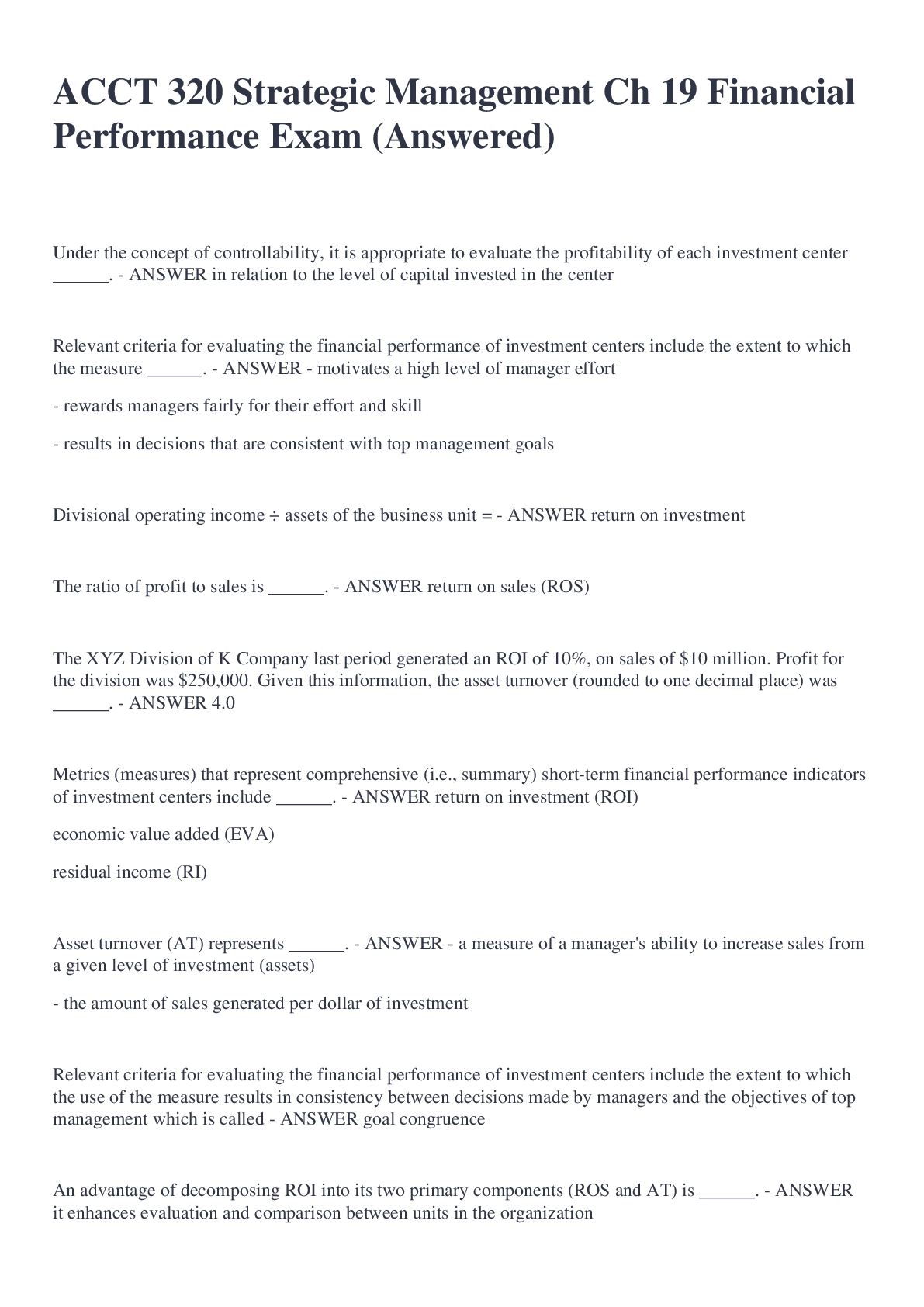
Under the concept of controllability, it is appropriate to evaluate the profitability of each investment center ______. - ANSWER in relation to the level of capital invested in the center
Relevant criteria for evaluating the financial performance of investment centers include the extent to which the measure ______. - ANSWER - motivates a high level of manager effort
- rewards managers fairly for their effort and skill
- results in decisions that are consistent with top management goals
Divisional operating income ÷ assets of the business unit = - ANSWER return on investment
The ratio of profit to sales is ______. - ANSWER return on sales (ROS)
The XYZ Division of K Company last period generated an ROI of 10%, on sales of $10 million. Profit for the division was $250,000. Given this information, the asset turnover (rounded to one decimal place) was ______. - ANSWER 4.0
Metrics (measures) that represent comprehensive (i.e., summary) short-term financial performance indicators of investment centers include ______. - ANSWER return on investment (ROI)
economic value added (EVA)
residual income (RI)
Asset turnover (AT) represents ______. - ANSWER - a measure of a manager's ability to increase sales from a given level of investment (assets)
- the amount of sales generated per dollar of investment
Relevant criteria for evaluating the financial performance of investment centers include the extent to which the use of the measure results in consistency between decisions made by managers and the objectives of top management which is called - ANSWER goal congruence
An advantage of decomposing ROI into its two primary components (ROS and AT) is ______. - ANSWER it enhances evaluation and comparison between units in the organization
Return on Investment (ROI) for an investment center is ______. - ANSWER the ratio of some measure of profit to some measure of investment in the business unit
Return on Investment (ROI) equals ______. - ANSWER return on sales (ROS) × asset turnover (AT)
The ABC Division of K Company last period generated an ROI of 20%, on sales of $10 million. Average assets of the division last year were $250,000. Given this information, the return on sales (ROS) realized by XYZ during the period (in percentage terms, rounded to one decimal place) was ______. - ANSWER 0.5%
Return on sales (ROS) is ______. - ANSWER - also called profit margin
- a measure of a manager's ability to control expenses and increase revenues
- profit per sales dollar
Firms with high operating leverage tend to have _________ asset turnover and _________ return on sales. - ANSWER low
high
Measurement issues associated with the use of return on investment (ROI) for evaluating the relative performance of investment centers within an organization include ______. - ANSWER - whether each unit uses the same criteria for expensing vs. capitalizing (and subsequently depreciating) certain expenditures
- different inventory cost-flow assumptions across business units
A key criterion for including an asset in a business unit's ROI calculation is ______. - ANSWER the degree to which the unit controls the asset
When calculating ROI, the general principle for shared assets is that they should be ______. - ANSWER allocated to business units on the basis of the relative usage of each asset by the various business units "sharing" the asset
For any given division (investment center) in an organization, the book value of current assets plus the net book value (NBV) of long-lived assets is the ______ of divisional assets. - ANSWER historical cost
Measurement issues when ROI is used to evaluate the relative performance of such units include ______. - ANSWER - use of different depreciation methods
- the use of NBV for assets
True or false: A unit's cash balance should always be included in its ROI calculation, even if cash is controlled at the firmwide level. - ANSWER False
The amount of sales dollars generated per dollar of invested capital is referred to as - ANSWER asset turnover
A common way to allocate shared asset costs across business units is to allocate these costs based on ______. - ANSWER relative peak demand for the assets by the various business units
The book value of current assets plus the net book value (NBV) of long-lived assets is defined as __________ cost. - ANSWER historical
The difference between the original cost of the asset and accumulated depreciation on that asset is __________ __________ value. - ANSWER net book
Potential deficiencies of using historical cost to calculate divisional return on investment (ROI) include ______. - ANSWER - failure to identify decreasing profitability of certain business units in a timely manner
- significantly overstated ROI relative to ROI based on the current value of assets
- it can create an illusion of profitability
The estimated price that could be received from the sale of an asset is the ______. - ANSWER liquidation value
For a depreciable asset, the difference between the original cost of the asset and accumulated depreciation on that asset is the ______. - ANSWER net book value (NBV) of the asset
A key question to address in calculating ROI is "which assets to include in the asset base." Which of the following assets should generally be included in the asset base for purposes of calculating the ROI of an investment center? - ANSWER - Long-lived assets traceable to the business unit
- Idle fixed assets that have an alternative use or that are readily salable
The advantages of using the current value of assets in the calculation of ROI include ______. - ANSWER - a reduction in distortions in ROI across divisions based on the average age of assets in each division
- this approach removes the tendency of biased ROI figures in favor of divisions (business units) with older assets, relative to other divisions
Methods for estimating the current value of assets include ______. - ANSWER - liquidation value
- gross book value (GBV)
- replacement cost
The book value of current assets plus the net book value (NBV) of long-lived assets is defined as ________ cost. - ANSWER historical
For purposes of evaluating the on-going performance of a division, it is generally recommended that assets in the ROI calculation be measured at ______. - ANSWER replacement cost
The return on investment (ROI) performance indicator was developed originally for use by ______. - ANSWER companies whose primary value centered on physical assets (plant, property, and equipment)
A key limitation of ROI is that this measure (metric) ______. - ANSWER is subject to managerial manipulation in the short-run
Historical cost without a reduction for accumulated depreciation is ______. - ANSWER gross book value
When objectively and reliability are at issue, ______ is probably the best choice for measuring the current value of divisional assets. - ANSWER gross book value (GBV)
For organizations operating today in the knowledge-based economy, value is created largely by ______. - ANSWER managing tangible and intangible assets
To manipulate short-run financial performance (e.g., ROI), a manager could ______. - ANSWER - delay needed maintenance expenses to the following accounting period
- delay planned expenditures on employee training or research & development
- inappropriately manipulate revenues
A divisional manager (whose performance is measured by ROI) may reject an investment with a positive NPV because ______. - ANSWER the investment has a negative impact on short-term ROI
There can be negative managerial incentive effects when NPV (net present value) is used for long-term decision making, and ROI is used for subsequent performance evaluation. A strategy for dealing with this problem is to ______. - ANSWER calculate depreciation for ROI purposes on a present value basis
Problems with ROI include ______. - ANSWER - projects that are attractive to the organization as a whole may be rejected
- business units with the highest current ROI often have a disincentive to invest
The difference between a division's operating income and an imputed charge for the level of investment in the division is referred to as - ANSWER residual income
Given a minimum rate of return of 12% and a current ROI of 14%, residual income will be ______. - ANSWER positive
The use of ROI (Return on Investment) to evaluate the short-run financial performance of business-unit managers might not motivate decisions that enhance the value of the firm as a whole. This situation is most apt to exist ______. - ANSWER for highly profitable business units, as measured by ROI
Assume a company's threshold rate of return is 14%. The top division in the company has a current ROI of 18% and has been offered an investment that offers a return of 15%. Which of the following statements are true? - ANSWER From a firm-wide perspective, the investment should be accepted because the return is greater than 14%.
The manager of the division will likely want to reject the investment because the return is less than 18%.
The imputed charge in a residual income (RI) calculation is determined by multiplying the level of investment in the business unit (or division) by ______. - ANSWER a desired minimum rate of return
If a business unit's existing ROI exceeds the unit's minimum desired rate of return (divisional cost of capital), the ______. - ANSWER residual income (RI) of the division > $0
Relative to ROI, RI has certain advantages, including ______. - ANSWER - it motivates managers to make new investments as long as the expected ROI on those investments > divisional cost of capital
- the firm can use a different required rate of return for different types of assets
- the firm can capture risk differences across business units by adjusting the divisional cost of capital
True or false: Including multiple years in the ROI and RI evaluation window increases the incentive to engage in dysfunctional short-term behaviors. - ANSWER False
Advantages of using residual income (RI) rather than ROI for evaluating business-unit financial performance include that RI ______. - ANSWER - motivates managers to take investment opportunities with expected returns over the firm's minimum acceptable return
- can adjust required rates of return to compensate for risk
Both EVA and residual income (RI) ______. - ANSWER - motivate goal-congruent behavior on the part of managers
- are absolute performance indicators (i.e., both are expressed in terms of dollars)
- include a deduction for an imputed charge for capital (assets) used during the period
By including multiple-years in the ROI and residual income (RI) evaluation window ______. - ANSWER - there is less incentive to engage in short-term dysfunctional behaviors
- the disconnect between NPV (net present value) and RI for subsequent financial performance is reduced
Which of the following is an approach to value-based management? - ANSWER EVA
A key limitation of residual income (RI) as a measure of divisional financial performance is that RI ______. - ANSWER is not useful for comparing the relative performance of business units that differ significantly in size
An indicator of financial performance of business units (investment centers) that is designed to approximate the unit's economic profit generated by the unit during a given period is called ______. - ANSWER economic value added (EVA)
EVA for a given business unit (investment center) during a given period can be estimated as NOPAT (after-tax cash operating income, less depreciation) ______. - ANSWER minus (k x average invested capital), where k = WACC
True or false: EVA can be described as one approach to value-based management of an enterprise. - ANSWER True
The two approaches that can be used in practice to estimate EVA for a business unit (or company as a whole) are the ______ approach. - ANSWER financing approach and the operating
For purposes of evaluating the relative financial performance of investment centers, residual income (RI) (relative to ROI) is limited in terms of ______. - ANSWER comparing the performance of units of significantly different sizes
Under the financing approach to estimating EVA, EVA NOPAT is estimated by building up to the rate of return on capital (r) from the standard return on equity (ROE) that is calculated using reported accounting data. Steps include ______. - ANSWER - eliminate accounting distortions
- eliminate financial distortions
- eliminate financial leverage
One of the components of EVA is "NOPAT" (net operating profit after tax). In this specification, the word "net" is used because ______. - ANSWER operating profit is reported net of depreciation expense
Two alternative ways to estimate an entity's EVA are the _______ approach and the _______ approach. - ANSWER financing
operating
In the financing approach to estimating EVA the return on capital (r) is estimated by ______. - ANSWER adjusting the standard return on equity (ROE) calculation
The approach to estimating EVA that begins with cash sales and subtracts depreciation and recurring cash economic expenses and cash operating taxes is the ______ approach. - ANSWER operating
When estimating EVA or residual income (RI) or return on investment (ROI)
[Show More]