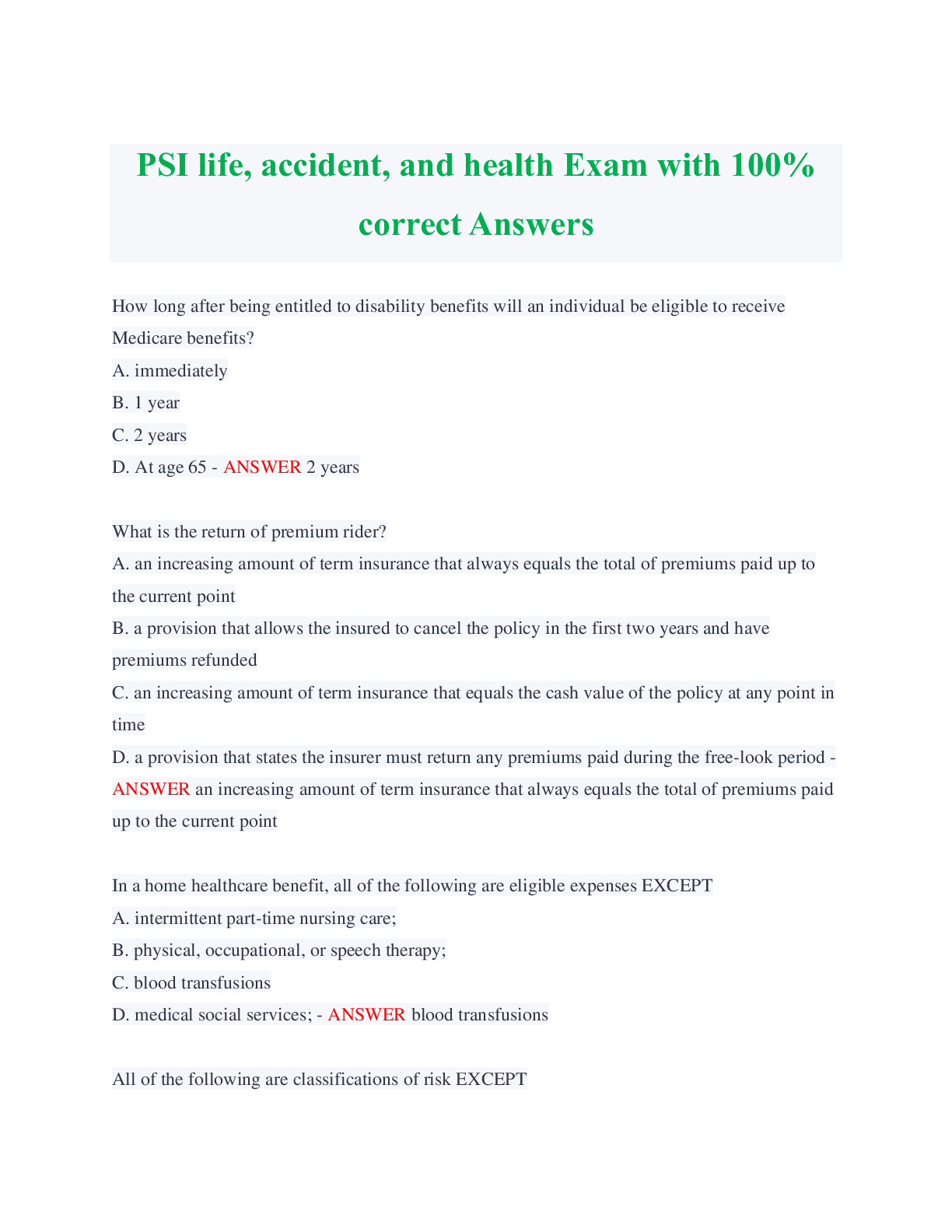
Average urine output per hour is approximately? - ANSWER 40 mL
According to the Berlin Criteria, a patient is classified with severe ARDS when his Pao2/Fio2 ratio is? - ANSWER Less than 100
A patient is admitted to
...
Average urine output per hour is approximately? - ANSWER 40 mL
According to the Berlin Criteria, a patient is classified with severe ARDS when his Pao2/Fio2 ratio is? - ANSWER Less than 100
A patient is admitted to the ED with a possible CVA. Which diagnostic test is most appropriate for identification of an acute cerebral infarction? - ANSWER CT Scan: checks chest, abdomen and brain (2-3 dimensions)
Cerebral angiography - ANSWER measures abnormal cerebral circulation
PET scan - ANSWER checks for cancer, brain disorders and heart diseases
A patient has been intubated in the ED and has a end tidal CO2 reading of 4%. The specialist should suspect that the:
A. patient has a pulmonary embolus
B. ET tube is in the correct position
C. ET tube is in the esophagus
D. ET tube is in the right main stem bronchus - ANSWER B. ET tube is in the correct position
*etco2 will be > if in the esophagus
Post-operatively, Mr. Hart has a 2-3 mm ST segment elevation on his 12 lead electrocardiograph. This is indicative of - ANSWER Myocardial injury
Which of the following would most accurately provide necessary information regarding fluid management in the care of a critically ill patient with pulmonary edema?
A. Bedside PFT
B. Intake and Output measurements
C. Daily weights
D. Pulmonary artery catheter - ANSWER D. Pulmonary artery catheter
A patient who was struck in the head with a blunt object is recovering in the ICU. He is angry, combative, and irritable. He opens his eyes, grunts, and withdraws when the sole of his foot is stimulated with a sharp object. What is his score on the Glasgow Coma scale? - ANSWER 8
Chest radiograph changes associated with congestive heart failure include:
1. Bilateral radiolucency
2. Increased pulmonary Vasculature
3. Cardiomegaly
A. 1 & 2 only
B. 2&3 only
C. 1& 3 only
D. All of the above - ANSWER B. 2 & 3
1 is normal
2 and 3 indicates CHF
A 57 year old male is admitted to the ICU with chest pain radiating down his left arm. Which of the following lab tests would best confirm the diagnosis of myocardial infarction?
A. PvO2
B. Phosphate
C. Troponin
D. Lactate - ANSWER C. Troponin
A 67 year old male with chest pain and shortness of breath is placed on a cardiac monitor in the intensive care unit. The following rhythm is observed on the monitor - what is the correct interpretation of a 3rd degree AV block? - ANSWER No PR interval
Describe a 2nd degree AV block - ANSWER P wave longer and skips a beat
Describe a Multifocal PVC - ANSWER it's unidentifiable = treat with O2 and amiodarone
Which of the following tests should the adult critical care specialist recommend in order to confirm the diagnosis of pulmonary artery hypertension?
A. pulmonary functions tests
B. high resolution CT scan
C. Right heart catheterization
D. Six minute walk test - ANSWER C. Right heart catheterization
A 76 y.o. male presents to the ED with shortness of breath. Upon entering the room the adult critical care specialist determines that the patient is alert and anxious on oxygen at 5L/min by nasal cannula. He is seated in the tripod position and using accessory muscles to breathe. He has audible crackles bilaterally, jugular venous distension, and +2 peripheral edema. The following patient data is obtained:
HR 110/min
RR 31/min
BP 154/92 mmHg
Spo2 90%
Which of the following tests should the specialist recommend to confirm a suspicion of congestive heart failure?
A. troponin
B. brain natriuretic peptide
C. magnesium level
D. MB fraction of creatinine phosphokinase - ANSWER B. Brain natriuretic peptide
The adult critical care specialist assigned to the cardiovascular intensive care unit hears an alarm sound in Room 4. Upon entering the room, the specialist notes that the pulmonary artery pressure tracing is dampened. The specialist should: - ANSWER flush the catheter
* dampening means it's wet and not reading
Mrs. Smith is in her third postoperative day following repair of fractured hip. A chest radiograph obtained tis morning reveals a left lower lobe infiltrate. Patient assessment data includes:
Temp: 102*F (39*C)
HR 100, RR 24, Sat 92%, BP 90/70
RBC 4, Hb 11
Hct 39, WBC 20000, Platelets 250,000
What therapy should the specialist recommend?
A. anti-infective agent
B. beta agonist aerosol
C. sustained maximal inspiration
D. oral expectorant - ANSWER A. anti-infective agent
A mildly obese 48 year old female presented to the ED complaining of chest discomfort. She denied any cough, fever, night seats, or weight loss. Her physical examination revealed: Temp 37.8*C, HR 100, RR 14, BP 110/70. She reported that she had a transthoracic echocardiogram two days previously that demonstrated a positive bubble study and an estimated peak pulmonary arterial systolic pressure of 59. Chest examination revealed bilateral vesicular breath sounds and resonance to percussion. Cardiac examination revealed a regular rhythm with normal heart sounds and no murmurs or pericardial friction rub. The abdomen was soft, non-tender, an without hepatosplenomegaly. There was no cyanosis, clubbing or edema. The specialist should recommend initial therapy for.
A. a left to right cardiac shunt
B. refractory hypoxemia
C. increased system vascular resistance
D. pulmonary arterial hypertension. - ANSWER D. pulmonary arterial hypertension
A 17 year old male is admitted to the ED after a MVA in which he sustained blunt chest trauma. While being transported to radiology, he complains of shortness of breath and severe chest pain. The adult critical care specialist is asked to assess the patient. The following CT image shows increased aeration on the left side, the specialist should recommend: - ANSWER insertion of a left chest tube
A 66 year old woman presents to the ED with shortness of breath. She appears alert and anxious on oxygen via nasal cannula at 5L/min. She is seated in the tripod position and using accessory muscles to breathe. Further assessment reveals bilateral audible crackles, jugular venous distension and +3 peripheral edema. The following patient data is available:
HR 110, RR 31, BP 154/92, Spo2 90%, BNP 1100 (Brain Natriuretic Peptide)
The specialist should recommend initiation of therapy for - ANSWER Congestive heart failure
Mr. Jones is admitted to the critical care unit with a 2-day history of vomiting and abdominal pain. His admission lab results include:
Glucose 256
Na+ 133
K+ 5.8
Cl- 95
Hco3 15
ABG: 7.28, 35 co2, 88 Pao2, 98%, 16
The specialist should initially recommend administration of: - ANSWER Insulin
Norma values:
Glucose <100
Na+ 135-145
K+ 35-45
Cl- 95-105
HCO3 22-26
Ms. Brown presents with acute shortness of breath and chest pain during the last trimester of her pregnancy. She complains of dizziness and anxiety with a heart rate of 125/min and blood pressure of 80/50 mmHg. Which of the following diagnostic procedures should the adult critical care specialist recommend?
1. Cerebral angiogram
2. Ventilation-perfusion scan
3. Arterial blood gas
4. PET scan - ANSWER 2 & 3
The adult critical care specialist is summoned to the ICU where a male patient with a past history of tobacco abuse and tuberculosis recently coughed up approximately 1 cup of bright red blood. He appears uncomfortable and in respiratory distress. Auscultation reveals rhonchi that are more pronounced on the right than the left. The chest radiograph demonstrates diffuse bilateral infiltrates. During the physical exam, the patient coughs up 450 mL of bright red blood.
Vital signs:
BP 110/65
HR 115
RR 33
Sat 92
O2 NRB at 12lpm
Lab results are:
WBC 12,00
HCT 12%
Platelets 375,00
BUN 48
Creatinine 1.1
Electrolytes, serum glucose, INR, and PTT are within normal limits. What further testing should the specialist recommend?
A. Transesophageal echocardiography
B. Pulmonary angiography
C. Carotid ultrasound
D. Bronchial artery embolization - ANSWER *D. Bronchial artery embolization
A refers to heart
B. refers to lungs
C. refers to artery
D. refers to bronchioles
Normal:
WBC 5,000-10,000
Hct 10-50%
Platelets 150,000-400,000
BUN 7-20
Creatinine 0.7-1.3
A 45 y.o. female is transported to the ED following a MVA. She suffered massive abdominal injuries and a fractured femur. She is now one day postoperative repair of a lacerated liver and perforated ileum. Her urine output is 15-20mL/hr with a net fluid balance of +8L. Chest radiograph reveals bilateral, large pleural effusions. The following patient data is available:
Hr 125
BP 90/45
Creatinine 4
BUN 70
Bilirubin Normal
The critical care specialist should recommend initation of treatment for:
A. acute renal failure
B. Congestive heart failure
C. Hypervolemia
D. Hepatic failure - ANSWER A. acute renal failure
A 23y.o. man was admitted to the ED following a high - speed motor vehicle crash. He is exhibiting transient hypotension and tachycardia. The patient has multiple orthopedic injuries in addition the trauma to the right chest, pelvis and head. The radiologist noted the presence of a deep sulcus sign on the patient's AP supine chest radiograph. the nurse asks the critical care specialist the significance of this finding. The specialist should explain that the deep sulcus sign is indicative of: - ANSWER pneumothorax
A 74 y.o. man with a history of atrial fibrillation presents to the D with Hemoccult-positive stools. He is on multiple medications for diabetes and hypertension, as well as warfarin but he has been noncompliant. He has mild mitral valve regurgitation and an ejection fraction of 32% and has had episodes of transient cerebral ischemia in the past. The specialist should report which of the following results that indicate active bleeding?
1. INR of 3.0
2. platelet count of 300,000
3. Prothrombin time of 35 sec
4. hematocrit of 42% - ANSWER B. 3 only
Hint: "active bleeding"
Normal:
INR 0.8-1.2 or 2-3
Platelet 150,000-400,000
Prothrombin Time 12-15 secs
Hematocrit 40-50%
A 50 year old male present to the Ed with syncope and shock. He is admitted to the intensive care and pulmonary artery catheter is inserted. patient data is as follows:
BP 70/40
MAP 50
CVP 20
RV 45/0
PAP 45/15
Mean PAP 25
PCWP 7
QT 2.5
SVR 18 (1440 dynes)
PVR 8.4 (670 dynes)
Arterial blood gas results on room air are as follows:
7.32, 32, 59 o2, 89%. Mixed venous blood gas results are: 7.28, 38, 28 O2, 49%. Ca-vO2 difference is 8.0 vol%.
The adult critical care specialist should recommend that the patient be treated quickly for:
A. acute pulmonary embolism
B. left heart failure
C. right heart failure
D. hypervolemia - ANSWER A. acute pulmonary embolism (>PAP, >CVP)
Normal:
BP 120/80
MAP 90
CVP 10
RV 25/0
PAP 25/8
Mean PAP 14
PCWP 8-10
Qt 4-8
SVR <20 or 1600dynes (Left heart system)
PVR <2.5 or 200 dynes (Right heart - pulmonary sytem)
Left heart failure (>PCWP,
CVP, )
An 82 year old man is admitted to the ICU with tachypnea, confusion, and hypotension. Initial assessment reveals:
BP 80/50
MAP 60
RV 42/0
PAP 45/20
PCWP 8
Qt 6.5
SVR 7.4 (590 dynes)
PVR 2.6 (210 dynes)
ABG on RA are: 7.45, 32, 50 o2, Sat 85%
VBG on RA are: 7.40, 38, 37o2, Svo2 70%. Ca-Vo2. Difference is 3.0 vol%
The adult critical care specialist should recommend that the patient be treated quickly for:
A. pulmonary hypertension
B. mitral valve stenosis
C. septic shoc
D. hypervolemia - ANSWER Pulmonary hypertension due to >PAP and >CVP
Indications for:
Mitral Valve stenosis= Lt heart, >PCWP,
[Show More]
Last updated: 3 years ago
Preview 1 out of 28 pages


.png)