Normal:
Heart Rate
Respiratory Rate
Temperature
Blood Pressure
(Patient Assessment) - ANSWER Heart Rate: 60-100/minute
Respiratory Rate: 12-20/minute
Temperature:
Oral - 97.0 - 99.5*F or 36.5 - 37.5*C
Rect
...
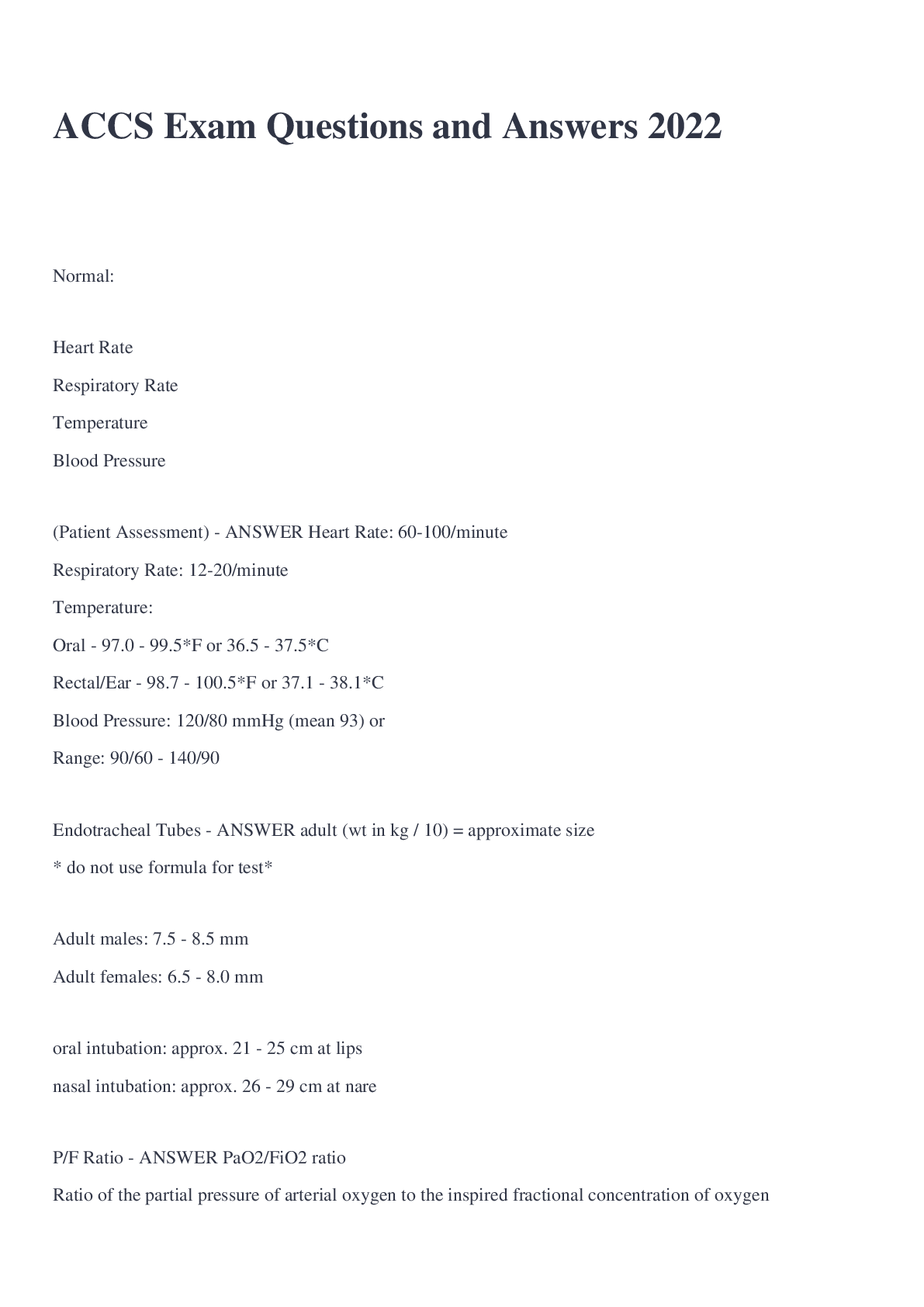
Normal:
Heart Rate
Respiratory Rate
Temperature
Blood Pressure
(Patient Assessment) - ANSWER Heart Rate: 60-100/minute
Respiratory Rate: 12-20/minute
Temperature:
Oral - 97.0 - 99.5*F or 36.5 - 37.5*C
Rectal/Ear - 98.7 - 100.5*F or 37.1 - 38.1*C
Blood Pressure: 120/80 mmHg (mean 93) or
Range: 90/60 - 140/90
Endotracheal Tubes - ANSWER adult (wt in kg / 10) = approximate size
* do not use formula for test*
Adult males: 7.5 - 8.5 mm
Adult females: 6.5 - 8.0 mm
oral intubation: approx. 21 - 25 cm at lips
nasal intubation: approx. 26 - 29 cm at nare
P/F Ratio - ANSWER PaO2/FiO2 ratio
Ratio of the partial pressure of arterial oxygen to the inspired fractional concentration of oxygen
- used in determination of acute lung injury (ALI) or acute respiratory distress syndrome (ARDS)
- Measures the efficiency of oxygen transfer across the lung
Normal is 380 torr or greater
Classification of Severity
ATS/ERS Criteria (Old School)
- P/F ratio < 300 ACUTE LUNG INJURY
- P/F ratio < 200 + PCWP < 18 mmHg +Diffuse bilateral infiltrates ARDS
Berlin Criteria (New School)
- P/F < 200-300 MILD ARDS
- P/F < 100-200 MODERATE ARDS
- P/F <100 + diffuse bilateral infiltrates SEVERE ARDS
Rate - ANSWER Normal: 60-100
Bradycardia: < 60
Tachycardia: > 100
Flutter: > 200
Fibrillation: too fast to count
Patients without cardiopulmonary pathology who have a sudden or recent onset of cyanosis that is unresponsive to 100% oxygen - ANSWER Suspect MetHb
Those with hx of particular drug therapy or ingestion
Nitrates and nitrites
- nitroglycerine
- nitroprusside (nipride)
- inhaled nitric oxide
Topical Anesthetics
- Benzocaine spray
- Lidocaine (xylocaine)
- Novocaine
- Catecaine
Dapsone (Aczone)
- used to treat acne
- most common cause of MetHb poisoning in ED
Acetaminophen (tylenol) e.g. overdose
treatment: methylene blue or ascorbic acid
Advanced Directives - ANSWER Set of instructions documenting what treatment a patient would want if he was unable to make medical decisions
Types of advance directives - ANSWER DNR - request to not have cardiopulmonary resuscitation performed
DNI -request not to be intubated - may use non invasive mechanical ventilation if necessary
Living Will - describes treatment patient would want if he becomes terminally ill (terminally ill is defined as less than six months to live
Durable Power of Attorney for Health care- Legal document that names a health care proxy (agent, person) responsible for making health care decisions for the patient
If intake exceeds output, what could it result in? - ANSWER - weight gain
- electrolyte imbalance (potassium most common)
- increased hemodynamic pressures
- decreased lung compliance
End Tidal CO2
(Patient Assessment) - ANSWER 34-36 torr or 3-5%
about 5 less than arterial PCO2
Increased = ventilatory failure
Decreased = increased ventilation or decreased perfusion (deadspace disease: pulmonart embolism, hypovolemia)
Reading of zero or low, reconnect patient to ventilator
Low readings immediately following intubation would indicate that the ET tube is in the esophagus
During CPR, the reading should increase
Moisture and secretions can cause false readings and obstruct the sample tube (will read zero)
(ROSC - return of spontaneous circulation - abrubt increase in end tidal)
(Patient Assessment)
Normal SpO2 - ANSWER 93 - 98%
(Patient Assessment)
Normal Value
Right Atrial Pressure - ANSWER 2-6 mm Hg
4-12 cm H2O
(Patient Assessment)
Normal Value
Right Ventricle Pressure - ANSWER 25/0
(Patient Assessment)
Normal Value
Pulmonary Arteries - ANSWER 25/8 mm Hg
Mean 13-14 mm Hg
(Patient Assessment)
Normal Value
Pulmonary Capillary Pressure - ANSWER 8-10 mm Hg
(Patient Assessment)
Normal Value
Pulmonary Capillary Wedge Pressure (PCWP) - ANSWER 4-12 mm Hg
(Patient Assessment)
Normal Value
Left Atrial Pressure - ANSWER 2-6 mm Hg
(Patient Assessment)
Normal Value
Left Ventricle Pressure - ANSWER 120/0
(Patient Assessment)
Normal Value
Red Blood Cell Count (RBC) - ANSWER 4-6 mill/mm3
a. contain hemoglobin necessary for oxygen transport
b. High RBC (polycythemia) = occurs with chronic tissue hypoxemia (i.e. COPD, high altitude)
C. Low RBC (anemia) = occurs with blood loss, hemorrhage
Polycythemia - ANSWER High RBC
occurs with chronic tissue hypoxia such as in COPD and being in high altitude
(Patient Assessment)
Normal Value
Hemoglobin (Hb) - ANSWER 12-16 g/100 mL blood
a. carries oxygen (1.34 mL per gram Hb)
b. Low Hb - anemia
c. High Hb - Polycythemia
(Patient Assessment)
Normal Value
Hematocrit (Hct) - ANSWER 40-50%
a. spin the whole blood and measure the % of RBC in the original blood volume
b. low HCT - anemia
c. high HCT - polycythemia
(Patient Assessment)
Normal Value
White Blood Cell Count (WBC) - ANSWER 5,000-10,000 per mm3
a. WBC are used by the body to fight infections
b. increased WBC - leukocytosis = bacterial infection
c. decreased WBC - leukopenia = viral infection
Neutrophils - ANSWER A major type of WBCs
associated with chronic infections
Eosinophils - ANSWER type of WBCs
associated with asthma, increased with allergic reactions
Monocytes - ANSWER type of WBCs
associated with tuberculosis
Electrolyte Imbalance - ANSWER can cause muscle weakness, soreness, nausea, and mental changes such as lethargy, dizziness and drowsiness
(Patient Assessment)
Potassium (K+) - ANSWER 4.0 mEq/L
Range: 3.5 - 4.5 mEq/L
a. important for acid-base balance and muscle function, including cardiac muscle
b. Hypokalemia = occurs with metabolic alkalosis (most common), excessive excretion, renal loss, vomiting, diarrhea, nasogastric suction, and malnutrition
c. Hyperkalemia = acidemia, kidney failure, and excessive intake
Hypokalemia - ANSWER Low K+
occurs with metabolic alkalosis, excessive excretion, renal loss, vomiting, diarrhea, nasograstric suction, and malnutrition
Hyperkalemia - ANSWER High K+
occurs with acidemia, kidney failure, and excessive intake
(Patient Assessment)
Sodium (Na+) - ANSWER 140 mEq/L
Range: 135 - 145 mEq/L
a. major extracellular cation controlled by kidneys
b. hyponatremia = fluid loss from: diuretics, vomiting, diarrhea, fluid gain from CHF, IV therapy
c. Hypernatremia = dehydration
Hypernatremia - ANSWER High Na+
dehydration
Hyponatremia - ANSWER Low Na+
fluid loss from diuretics, vomiting, diarrhea, fluid gain from CHF, IV therapy
(Patient Assessment)
Chloride (Cl-) - ANSWER 90 mEq/L
Range: 80 - 100 mEq/L
a. Hypochloremia = metabolic alkalosis
b. Hyperchloremia = metabolic acidosis
Magnesium (Mg 2+) - ANSWER 1.7 - 2.4 mEq/L or 1.7 - 2.1 mg/dL
- is important to the body for energy transfer and electrical stability
- Hypomagnesium: Magnesium < 1.7 mg/dL may be caused by renal disease, hypokalemia, malabsorption, diarrhea, nasogastric suction, and malnutrition
- clinical manifestation include cardiovascular, neuromuscular, and electrolyte abnormalities
Calcium (Ca2+) - ANSWER 4.5 - 5.25 mEq/L or 8.7 - 10.4 mg/dL
- calcium is required for muscle contraction, nerve impulse transmission, hormone secretion, blood clotting, cell division, cell motility and wound healing
-Hypocalemia (total calcium <8.7 mg/dL) is common in critically ill patients and results from impairment of the parathyroid and/or vitmamin D systems
- Most common clinical manifestations of hypocalcemia includes hypotension, bradycardia, arrhythmias, heart failure, cardiac arrest, and digitalis insensitivity
Troponin - ANSWER Normal <0.04 ng/mL
a protein found in myocardial cells
a. specific indicator to heart damage
b. patients who suffered a myocardial infarction would have elevated troponin levels
c. troponin levels > 0.1 ng/mL place the patient at high risk for death from MI
(Patient Assessment)
Brain Natriuretic Peptide (BNP) - ANSWER Normal <100 pg/mL
a. secreted by the cardiac muscle when heart failure develops or worsens
b. measurement of serum BNP is helpful to determine if the patient's symptoms are the result of CHF or another condition, such as COPD (CHF and COPD patients usually look the same)
c. Elevated levels (>100 pg/mL) indicate CHF
(Patient Assessment)
Lactate Levels - ANSWER Normal 4.5 - 19.8 mg/dl
0.5 - 2.2 mmol/L (>4mmol/L = sepsis)
a. an indicator of overall oxygen delivery to the tissue
b. elevated lactate levels during shock and hypo perfusion indicated inadequate oxygen supply to the tissue
c. falling lactate levels may be useful in determining the success of treatment
(Patient Assessment)
Serum Glucose - ANSWER Measurement of sugar (glucose) in the blood
Normal 70-100 mg/dL
a. Elevated levels (hyperglycemia) could be the result of diabetes or excess glucose administration - administer insulin
b. Reduced levels (hypoglycemia) could be the result of diabetes or starvation - administer glucose
(Patient Assessment)
Platelet Count - ANSWER Normal 150,000 - 400,000/mm3
Decreased values are associated with decreased bone marrow function
Platelets are important for blood coagulation by forming blood clots. An analysis of the number of size, and shape of the platelets should be done if a coagulation defect is suspected
(Patient Assessment)
Creatinine - ANSWER Waste product that is filtered by the kidneys
Normal 0.7 - 1.3 mg/dL
- evaluates kidney function
- elevated levels indicate renal failure
- best indicator of renal function
(creatinine is more specific to kidney damage)
(Patient Assessment)
Blood Urea Nitrogen (BUN) - ANSWER waste product that is synthesized by the kidneys
Normal 7 - 20 mg/dL
- evaluates kidney function
- Increased BUN may indicate kidney failure
- increased BUN along with increased creatinine level indicates kidney failure
(creatinine is more specific to kidney damage)
(Patient Assessment)
[Show More]





![Preview of AORN PERIOP 101 FINAL EXAM 2026 QUESTIONS AND VERIFIED ANSWERS [LATEST UPDATE]](https://browseimages.nyc3.digitaloceanspaces.com/paper-images/2026/04/07/sGJvJ3aH2026-04-07-04-5869d464cbba16f.png)