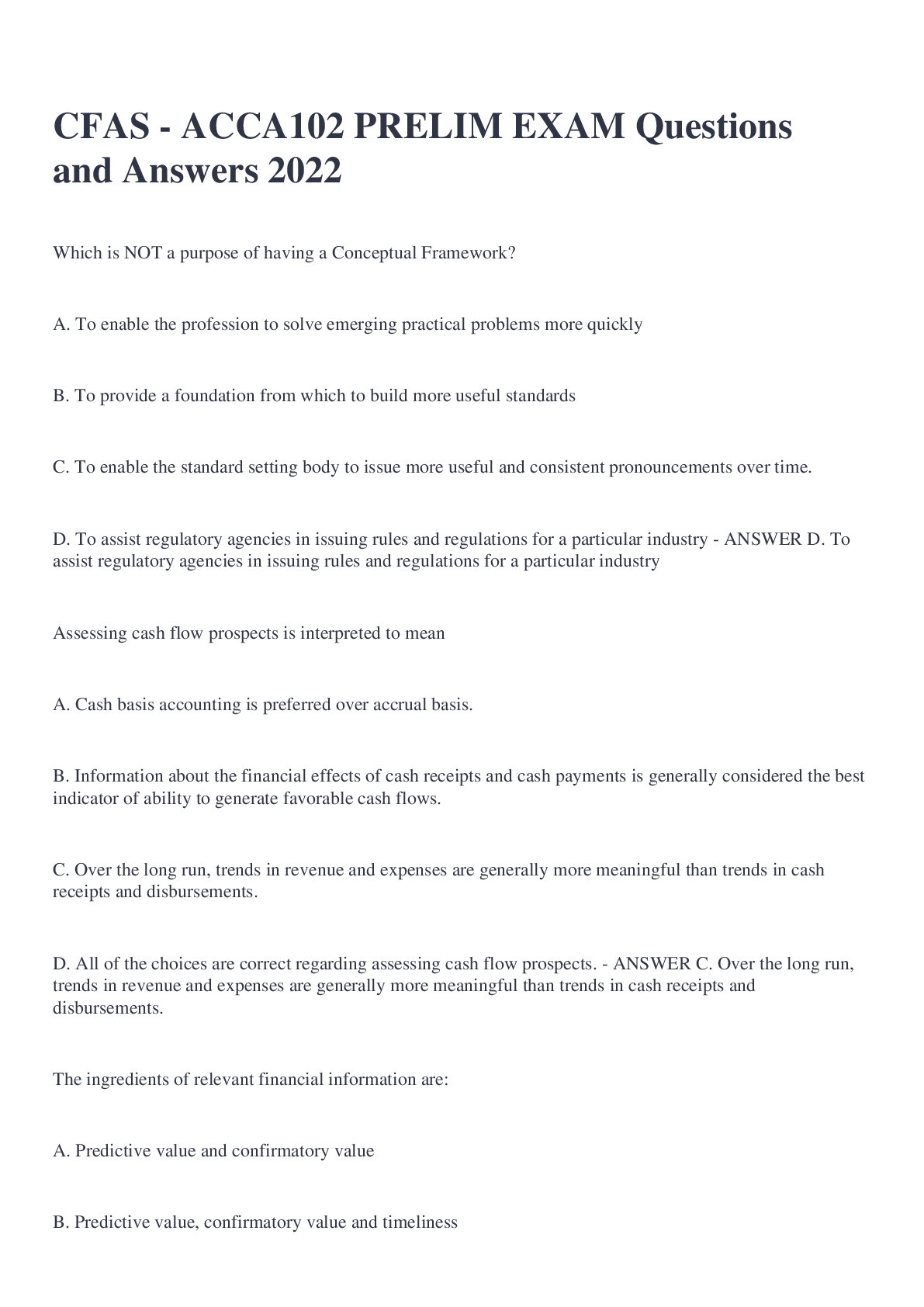
Which is NOT a purpose of having a Conceptual Framework?
A. To enable the profession to solve emerging practical problems more quickly
B. To provide a foundation from which to build more useful standards
C. To e
...
Which is NOT a purpose of having a Conceptual Framework?
A. To enable the profession to solve emerging practical problems more quickly
B. To provide a foundation from which to build more useful standards
C. To enable the standard setting body to issue more useful and consistent pronouncements over time.
D. To assist regulatory agencies in issuing rules and regulations for a particular industry - ANSWER D. To assist regulatory agencies in issuing rules and regulations for a particular industry
Assessing cash flow prospects is interpreted to mean
A. Cash basis accounting is preferred over accrual basis.
B. Information about the financial effects of cash receipts and cash payments is generally considered the best indicator of ability to generate favorable cash flows.
C. Over the long run, trends in revenue and expenses are generally more meaningful than trends in cash receipts and disbursements.
D. All of the choices are correct regarding assessing cash flow prospects. - ANSWER C. Over the long run, trends in revenue and expenses are generally more meaningful than trends in cash receipts and disbursements.
The ingredients of relevant financial information are:
A. Predictive value and confirmatory value
B. Predictive value, confirmatory value and timeliness
C. Predictive value, confirmatory value and
materiality
D. Predictive value, confirmatory value, timeliness and materiality - ANSWER A. Predictive value and confirmatory value
Which of the following statements is incorrect concerning materiality?
A. Information is material if its omission or misstatement could influence the economic decisions that users make on the basis of the financial information about entities.
B. Materiality depends on the relative size of the item or error judged in the particular circumstances of its omission or misstatement.
C. Materiality is dependent on professional judgement because no threshold limit is defined in the Conceptual Framework.
D. Materiality is a fundamental qualitative characteristic rather than a threshold or cut off point in determining useful information. - ANSWER D. Materiality is a fundamental qualitative characteristic rather than a threshold or cut off point in determining useful information.
Which of the following is the best description of "faithful representation" in relation to information in financial statements?
A. Influence on the economic decisions of users
B. Inclusion of degree of caution
C. Freedom from material error
D. Comprehensibility to users - ANSWER C. Freedom from material error
The ingredients of faithful representation are
A. Completeness and neutrality
B. Completeness and free from error
C. Completeness, neutrality and free from error
D. Completeness, neutrality, free from error and conservatism - ANSWER C. Completeness, neutrality and free from error
In the event of conflict between the economic substance of a transaction and its legal form, the economic substance shall prevail. This concept is known as:
A. Form over substance
B. Substance over form
C. Faithful representation
D. Completeness - ANSWER B. Substance over form
The financial accounting information is directed toward the common needs of users and is independent of presumptions about particular needs and desires of specific users,
A. Relevance
B. Verifiability
C. Neutrality
D. Completeness - ANSWER C. Neutrality
Financial information exhibits consistency when
A. Accounting procedures are adopted which smooth net income and make results consistent between years.
B. Accounting entities give similar events the same accounting treatment each period.
C. Gains and losses are shown separately in the income statement.
D. Expenditures are reported as expense and netted against revenue in the period in which they are paid. - ANSWER B. Accounting entities give similar events the same accounting treatment each period.
The Conceptual Framework sets out certain enhancing qualitative characteristics of accounting information. Which of the following is not an enhancing qualitative characteristic?
A. Understandability
B. Profit-oriented
C. Timeliness
D. Comparability - ANSWER B. Profit-oriented
Allowing entities to estimate rather than physically count inventory at interim periods is an example of a tradeoff between
A. Verifiability and comparability
B. Timeliness and verifiability
C. Timeliness and Relevance
D. Neutrality and consistency - ANSWER B. Timeliness and verifiability
Which of the following statements is true in relation to the enhancing qualitative characteristic of "understandability" of financial information?
A. Users have a reasonable knowledge of business and economic activities and review the information with reasonable diligence.
B. Users are expected to have significant business knowledge.
C. Financial statements shall exclude complex matters.
D. Financial statements shall be free from material error. - ANSWER A. Users have a reasonable knowledge of business and economic activities and review the information with reasonable diligence.
The overriding qualitative characteristic of accounting information is
A.Relevance
B. Understandability
C. Faithful representation
D. Decision usefulness - ANSWER D. Decision usefulness
Which of the following terms best describes information that influences the economic decisions of users?
A. Reliable
B. Prospective
C. Relevant
D. Understandability - ANSWER C. Relevant
Conservatism is best described as selecting an accounting alternative that
A. Understates assets and net income
B. Has the least favorable impact on owners' equity
C. Overstates liabilities
D. Is least likely to mislead users of financial information - ANSWER B. Has the least favorable impact on owners' equity
Which of the following accounting concepts states that an accounting transaction shall be supported by sufficient evidence to allow two or more qualified individuals to arrive at essentially similar conclusions?
A. Conservatism
B. Objectivity
C. Periodicity
D. Stable monetary unit - ANSWER B. Objectivity
The consistency standard of reporting requires that
A. Expenses be reported as charges against the period in which they are incurred
B. The effect of changes in accounting upon income be properly disclosed
C. Gains and losses should not appear on the income statement.
D. Accounting procedures be adopted which give a consistent rate of return. - ANSWER B. The effect of changes in accounting upon income be properly disclosed
Which of the following relates to both relevance and faithful representation?
A. Consistency
B. Feedback value
C. Verifiability
D. Timeliness - ANSWER A. Consistency
Which of the following situations violates the concept of faithful representation?
A. Financial statements were issued nine months late.
B. Data on segments having the same expected risks and growth rates are reported to analysts estimating future profits.
C. Financial statements included an item of property, plant and equipment with carrying amount increased to management's estimate of market value.
D. Management reports to shareholders regularly refer to new projects undertaken, but the financial statements never report project results. - ANSWER C. Financial statements included an item of property, plant and equipment with carrying amount increased to management's estimate of market value.
According to the Conceptual Framework, the usefulness of providing information in financial statements is subject to the constraint of
A. Consistency
B. Cost-benefit
C. Reliability
D. Representational Faithfulness - ANSWER B. Cost-benefit
If there is undue delay in the reporting of information, it may lose its
A. Relevance
B. Relevance and Faithful Representation
C. Usefulness
D. Faithful Representation - ANSWER A. Relevance
Consistency is an important factor in comparability within a single entity. Consistency requires that
A. Some costs should be recognized as expense on the basis of presumed direct association with specific revenue
B. Assets whose prices or utility are increased by external events other than transfers should be retained in the accounting records at their recorded amounts until they are exchanged
C. Historical cost should be the primary basis used in measuring inventory, intangible assets and property, plant and equipment
D. Changes in circumstances or in the nature of the underlying transactions should be disclosed - ANSWER D. Changes in circumstances or in the nature of the underlying transactions should be disclosed
Application of the full disclosure principle
A. Is theoretically desirable but not practical because the cost of complete disclosure exceeds the benefit.
B. Is violated when important financial information is buried in the notes to the financial statements
C. Is demonstrated by the use of supplementary information presenting the effects of changing prices.
D. Requires that the financial statements be consistent and comparable. - ANSWER C. Is demonstrated by the use of supplementary information presenting the effects of changing prices.
Which of the following is an application of the principle of conservatism?
A. A provision for a temporary decline in value of a debt security classified as "financial asset at amortized cost" is recognized
B. A liability is accrued for a guarantee of the indebtedness of others
C. An expected loss on a long-term construction-type contract is recognized on full immediately
D. A dollar-denominated note payable is adjusted for a peso devaluation that occurs after the end of the reporting period. - ANSWER C. An expected loss on a long-term construction-type contract is recognized on full immediately
Which of the following in the most precise sense means the process of converting noncash resources and rights into cash or claims to cash?
A. Allocation
B. Collection
C. Recognition
D. Realization - ANSWER D. Realization
The basic purpose of accounting is:
A. To provide the information that the manager of an economic entity need to control its operations
B. To provide information that the creditors of an economic entity can use in deciding whether to make additional loans to the entity
C. To measure the periodic income of the economic entity
D. To provide quantitative financial information about an entity that is useful in making rational economic decision - ANSWER D. To provide quantitative financial information about an entity that is useful in making rational economic decision
What is the law regulating the practice of accountancy in the Philippines?
A. R.A. No. 9298
B. R.A. No. 9198
C. R.A. No. 9928
D. R.A. No. 9892 - ANSWER A. R.A. No. 9298
It is the body authorized by law to promulgate rules and regulations affecting the practice of the accountancy profession in the Philippines
A. Board of Accountancy
B. Philippine Institute of Certified Public Accountants
C. Securities and Exchange Commission
D. Financial Reporting Standards Council - ANSWER A. Board of Accountancy
Proper application of accounting principles is most dependent upon the
A. Existence of specific guidelines
B. Oversight of regulatory bodies
C. External audit function
D. Professional judgement of the accountant - ANSWER D. Professional judgement of the accountant
The ability through consensus among measurers to ensure that information represents what it purports to represent is an example of the concept of
A. Relevance
B. Verifiability
C. Comparability
D. Feedback value - ANSWER B. Verifiability
The purpose of the International Financial Reporting Standards is to
A. Issue standards to be applied by all countries in the world
B. Eliminate all the differences in financial reporting between countries in the world
C. Promote a uniform basis of financial reporting among countries of the world
D. Issue enforceable standards to be applied by all international accountants. - ANSWER B. Eliminate all the differences in financial reporting between countries in the world
The foundation of the Conceptual Framework is formed from
A. The qualitative characteristics that makes information useful to users
B. The objective of general purpose financial reporting
C. The concept of reporting entity
D. The various measurement requirements which results to fair presented financial information - ANSWER B. The objective of general purpose financial reporting
What is the objective of financial statements according to the Conceptual Framework?
A. To provide information about the financial position, performance, and changes in financial position of an entity that is useful to a wide range of users in making economic decisions.
B. To prepare and present a balance sheet, an income statement, a cash flow statement, and a statement of changes in equity.
C. To prepare and present comparable, relevant, reliable, and understandable information to investors and creditors
D. To prepare financial statements in accordance with all applicable Standards and Interpretations. - ANSWER A. To provide information about the financial position, performance, and changes in financial position of an entity that is useful to a wide range of users in making economic decisions.
Which of the following statements correctly relates to the provisions of the Conceptual Framework?
A. Financial statements are prepared and presented at least annually and are directed toward the common information needs of a limited range of users.
B. Financial statements do not include items such as reports by directors, statements by the chairman, discussion and analysis by management and similar items that may be included in a financial or annual report.
C. The Conceptual Framework applies only to the financial statements of all commercial, industrial and business reporting entities, which are in the private sector
D. Special purpose financial reports, for example, prospectuses and computations prepared for taxation purposes, are within the scope of the Conceptual Framework. - ANSWER B. Financial statements do not include items such as reports by directors, statements by the chairman, discussion and analysis by management and similar items that may be included in a financial or annual report.
Which of the following statements correctly relates to the provisions of the Conceptual Framework?
A. Financial statements do not form part of the process of financial reporting.
B. The statement of changes in financial position may be presented in a variety of ways such as classified or unclassified statement of financial position.
C. All of the information needs of users cannot be met by financial statements.
D. The shareholders of an entity have the primary responsibility for the preparation and presentation of the financial statements of the entity. - ANSWER C. All of the information needs of users cannot be met by financial statements.
It refers to the availability of cash in the near future after taking account of financial commitments over this period
A. Financial structure
B. Liquidity
C. Solvency
D. Performance - ANSWER B. Liquidity
It refers to the availability of cash over the longer term to meet financial commitments as they fall due
A. Financial structure
B. Liquidity
C. Solvency
D. Performance - ANSWER C. Solvency
Comparability is sometimes sacrificed for
A. Reliability
B. Conservatism
C. Objectivity
[Show More]