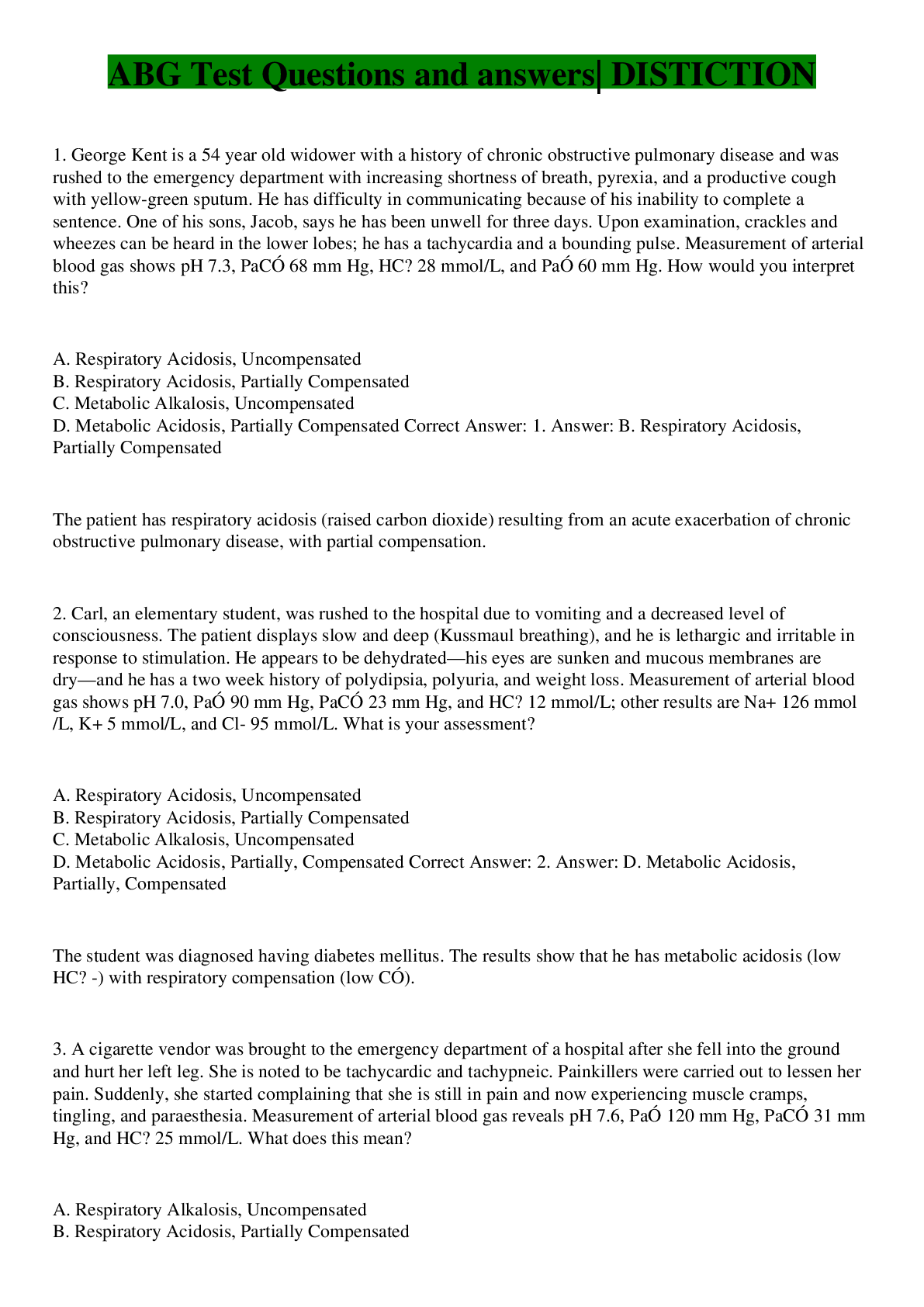
1. George Kent is a 54 year old widower with a history of chronic obstructive pulmonary disease and was rushed to the emergency department with increasing shortness of breath, pyrexia, and a productive cough with yellow-
...
1. George Kent is a 54 year old widower with a history of chronic obstructive pulmonary disease and was rushed to the emergency department with increasing shortness of breath, pyrexia, and a productive cough with yellow-green sputum. He has difficulty in communicating because of his inability to complete a sentence. One of his sons, Jacob, says he has been unwell for three days. Upon examination, crackles and wheezes can be heard in the lower lobes; he has a tachycardia and a bounding pulse. Measurement of arterial blood gas shows pH 7.3, PaCÓ 68 mm Hg, HCǑ 28 mmol/L, and PaÓ 60 mm Hg. How would you interpret this?
A. Respiratory Acidosis, Uncompensated
B. Respiratory Acidosis, Partially Compensated
C. Metabolic Alkalosis, Uncompensated
D. Metabolic Acidosis, Partially Compensated Correct Answer: 1. Answer: B. Respiratory Acidosis, Partially Compensated
The patient has respiratory acidosis (raised carbon dioxide) resulting from an acute exacerbation of chronic obstructive pulmonary disease, with partial compensation.
2. Carl, an elementary student, was rushed to the hospital due to vomiting and a decreased level of consciousness. The patient displays slow and deep (Kussmaul breathing), and he is lethargic and irritable in response to stimulation. He appears to be dehydrated—his eyes are sunken and mucous membranes are dry—and he has a two week history of polydipsia, polyuria, and weight loss. Measurement of arterial blood gas shows pH 7.0, PaÓ 90 mm Hg, PaCÓ 23 mm Hg, and HCǑ 12 mmol/L; other results are Na+ 126 mmol/L, K+ 5 mmol/L, and Cl- 95 mmol/L. What is your assessment?
A. Respiratory Acidosis, Uncompensated
B. Respiratory Acidosis, Partially Compensated
C. Metabolic Alkalosis, Uncompensated
D. Metabolic Acidosis, Partially, Compensated Correct Answer: 2. Answer: D. Metabolic Acidosis, Partially, Compensated
The student was diagnosed having diabetes mellitus. The results show that he has metabolic acidosis (low HCǑ -) with respiratory compensation (low CÓ).
3. A cigarette vendor was brought to the emergency department of a hospital after she fell into the ground and hurt her left leg. She is noted to be tachycardic and tachypneic. Painkillers were carried out to lessen her pain. Suddenly, she started complaining that she is still in pain and now experiencing muscle cramps, tingling, and paraesthesia. Measurement of arterial blood gas reveals pH 7.6, PaÓ 120 mm Hg, PaCÓ 31 mm Hg, and HCǑ 25 mmol/L. What does this mean?
A. Respiratory Alkalosis, Uncompensated
B. Respiratory Acidosis, Partially Compensated
C. Metabolic Alkalosis, Uncompensated
[Show More]