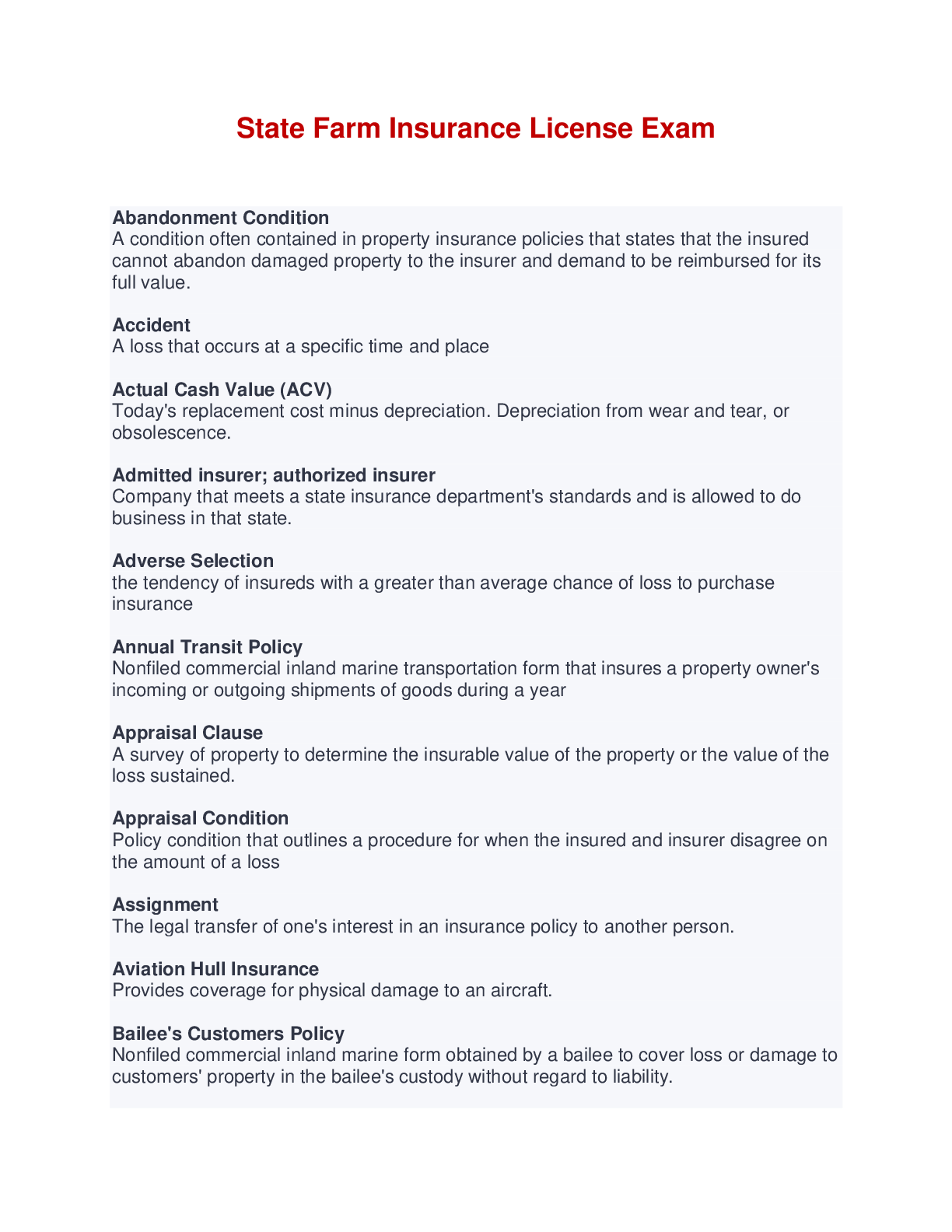
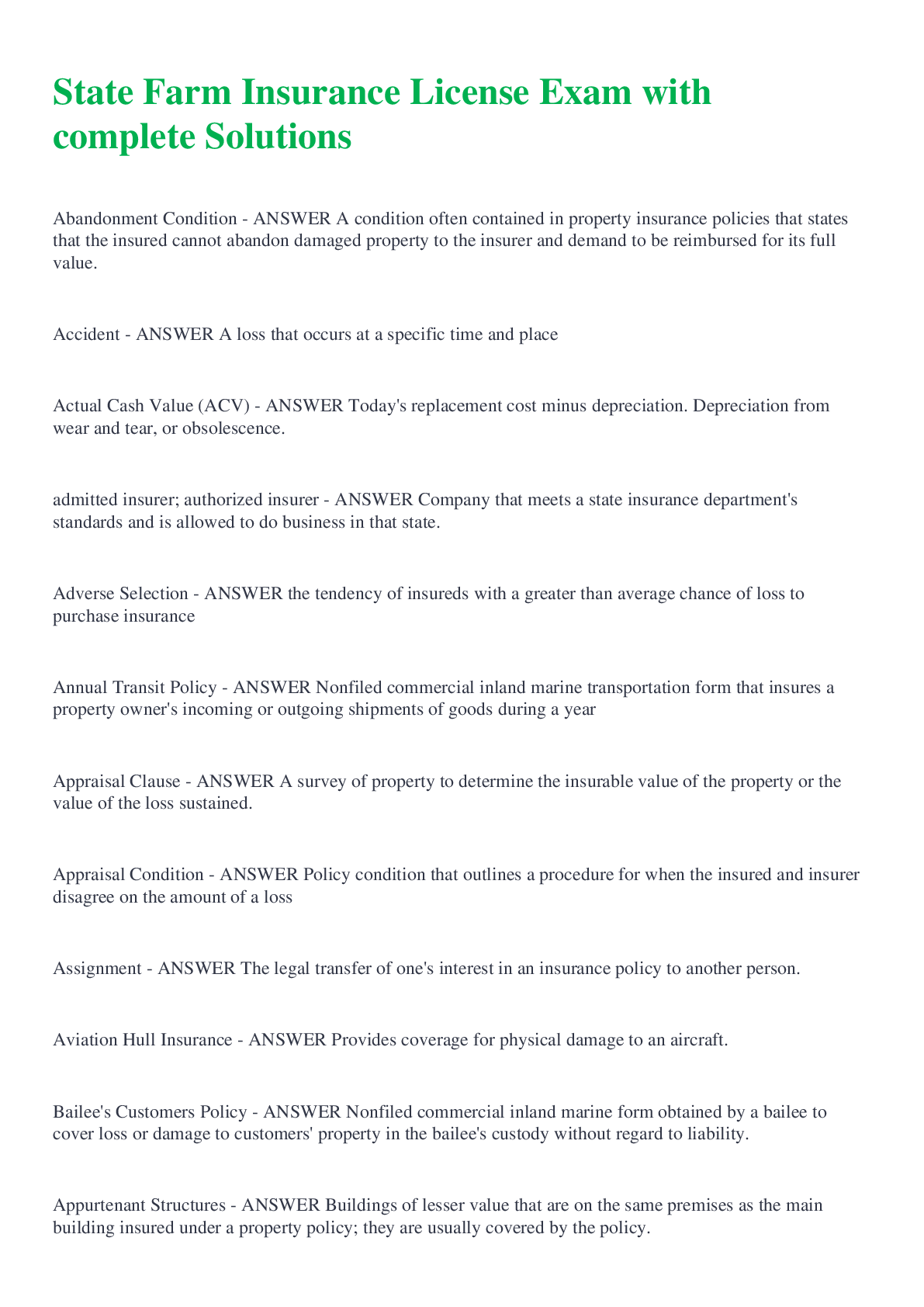
Abandonment Condition - ANSWER A condition often contained in property insurance policies that states that the insured cannot abandon damaged property to the insurer and demand to be reimbursed for its full value.
Acc
...
Abandonment Condition - ANSWER A condition often contained in property insurance policies that states that the insured cannot abandon damaged property to the insurer and demand to be reimbursed for its full value.
Accident - ANSWER A loss that occurs at a specific time and place
Actual Cash Value (ACV) - ANSWER Today's replacement cost minus depreciation. Depreciation from wear and tear, or obsolescence.
admitted insurer; authorized insurer - ANSWER Company that meets a state insurance department's standards and is allowed to do business in that state.
Adverse Selection - ANSWER the tendency of insureds with a greater than average chance of loss to purchase insurance
Annual Transit Policy - ANSWER Nonfiled commercial inland marine transportation form that insures a property owner's incoming or outgoing shipments of goods during a year
Appraisal Clause - ANSWER A survey of property to determine the insurable value of the property or the value of the loss sustained.
Appraisal Condition - ANSWER Policy condition that outlines a procedure for when the insured and insurer disagree on the amount of a loss
Assignment - ANSWER The legal transfer of one's interest in an insurance policy to another person.
Aviation Hull Insurance - ANSWER Provides coverage for physical damage to an aircraft.
Bailee's Customers Policy - ANSWER Nonfiled commercial inland marine form obtained by a bailee to cover loss or damage to customers' property in the bailee's custody without regard to liability.
Appurtenant Structures - ANSWER Buildings of lesser value that are on the same premises as the main building insured under a property policy; they are usually covered by the policy.
Assignment Condition - ANSWER Condition in insurance policies that specifies that the policy cannot be transferred to another unless the company consents to the transfer in writing.
Bailee - ANSWER A person or organization that has temporary possession of someone else's personal property.
Basic Perils in Homeowners Policy - ANSWER There are 14 perils. Fire, lightening, riot, explosion, vehicles, volcanic eruption, civil commotion, smoke, hail, aircraft, windstorm, vandalism, malicious mischief, theft.
Basic Property Policy Structure (DICEE) - ANSWER D - Declarations
I - Insuring agreement
C - Conditions
E - Exclusions
E - Endorsements
Blanket Insurance - ANSWER Type of insurance policy that covers more than one item of property at a single location or one or more items of property at multiple locations
Builders Risk Coverage Form - ANSWER Commercial property coverage forms that covers commercial, residential, or farm buildings that are under construction or during remodeling.
Cargo Insurance - ANSWER Type of ocean marine insurance that covers goods while they are in transit over water.
Binder - ANSWER Oral or written statement that provides immediate insurance protection for a specified period; designed to provide temporary coverage until a policy is issued or denied.
BOP - ANSWER Package policy designed to provide broad property and liability coverage for small businesses; eligibility requirements are stricter than the CPP.
Business Income Policy - ANSWER Pays for loss of income that the insured sustains due to a direct physical loss from a covered peril that forces the insured to suspend operations until the property can be repaired, rebuilt, or replaced with reasonable speed; available with or without extra expense coverage.
Causes of Loss Form - ANSWER Separate form used with the commercial property coverage part of the commercial package policy that lists covered perils and exclusions. Several different versions provide increasingly broader coverage from basic to broad to special.
Condominium Association Coverage Form - ANSWER Commercial Property coverage form that covers the buildings in a condominium complex. Does not cover condominium owner's personal property.
Coverage D on a HO Policy - Loss of Use - ANSWER If property loss makes the residence premises uninhabitable, the additional living expenses are covered; or if a covered loss to the insured's property makes a part of the residence premises uninhabitable that is rented to others or held for rental by the insured, this coverage will pay the fair rental value.
coverages excluded on dwelling policy - ANSWER Theft, vandalism, and malicious mischief excluded on basic policy. Liability excluded on all policies.
Coverage B of homeowners policy - ANSWER Other structures; covers building and structures on the premises other than the dwelling set apart by a clear space from the dwelling; 10% of Coverage A.
Coverage D on a dwelling policy - ANSWER Fair rental value is covered on a dwelling policy.
Coverage limit on money in HO - ANSWER $200 limit on personal property with special limits
Coinsurance Clause on Property - ANSWER Insurance carried/Insurance required X amount of loss
Coverage F on homeowners policy - ANSWER Medical payments to others; pays all necessary medical expenses for up to three years after an accident.
Deductible - ANSWER The amount of expenses that must be paid out of pocket before an insurer will pay any expenses from a covered loss.
Direct Loss - ANSWER Financial loss resulting directly from a loss to property
Equipment Breakdown Coverage; boiler and machinery coverage - ANSWER Part of the commercial package policy that covers a loss due to breakdown of business equipment due to direct or indirect loss.
Excess Insurance - ANSWER When two or more policies or coverage apply to the same loss, the one that applies only after the limits of the primary coverage have been exhausted.
Difference in Conditions Insurance (DIC) - ANSWER Type of commercial property policy that covers most insurable perils but excludes basic fire and extended coverage perils.
[Show More]

.png)