First users were the engineers who built and programmed computers, then employees who had received specialized training were users, and now today, anyone and everyone can be a user. - ANSWER Evolution of Users
Sends f
...
First users were the engineers who built and programmed computers, then employees who had received specialized training were users, and now today, anyone and everyone can be a user. - ANSWER Evolution of Users
Sends files over the network at the request of clients. Responds over LAN, within one location/site. Support both application software and data files. - ANSWER FILE SERVER
Turns a user-friendly domain name, like Google.com, into an Internet Protocol (IP) address like ((( 70.42.251.42 ))) that computers use to identify each other on the network. - ANSWER Domain Name Server (DNS)
Uses TWO KEYS a public and private key for performing encryption and decryption - ANSWER Public Key Encryption
PROVING you are who you say you are which can be done by: what you know, what you have! - ANSWER Authentication
TIER WHERE THE USER interface for the system is developed; SHIELDS THE USER from the underlying logic of the systems as well as the underlying data structures - ANSWER Presentation Tier
SYSTEMS DEPLOYMENT Steps 1. System Conversion 2. Final Documentation 3. End User Training - ANSWER System Deployment
CONNECTS MULTIPLES networks together; can be used to directly connect computers to a network; will relay messages to computers with APPROPRIATE IP ADDRESS - ANSWER ROUTER
Requires that data is KEPT secure so that they are not accidentally provided or obtained by unauthorized users - ANSWER Confidentiality
Protecting EVERY LAYER that SURROUNDS ((( DATA ))) - ANSWER Defense in Depth
Can take on DIFFERENT FORMS depending on the complexity of the application; in certain instances, it is AN ACTUAL OBJECT that is an ACTUAL IMPLEMENTATION of the application - ANSWER THE MODEL
Creates a subset of the data by reducing the data from multiple dimensions to one dimension - ANSWER Slicing Data
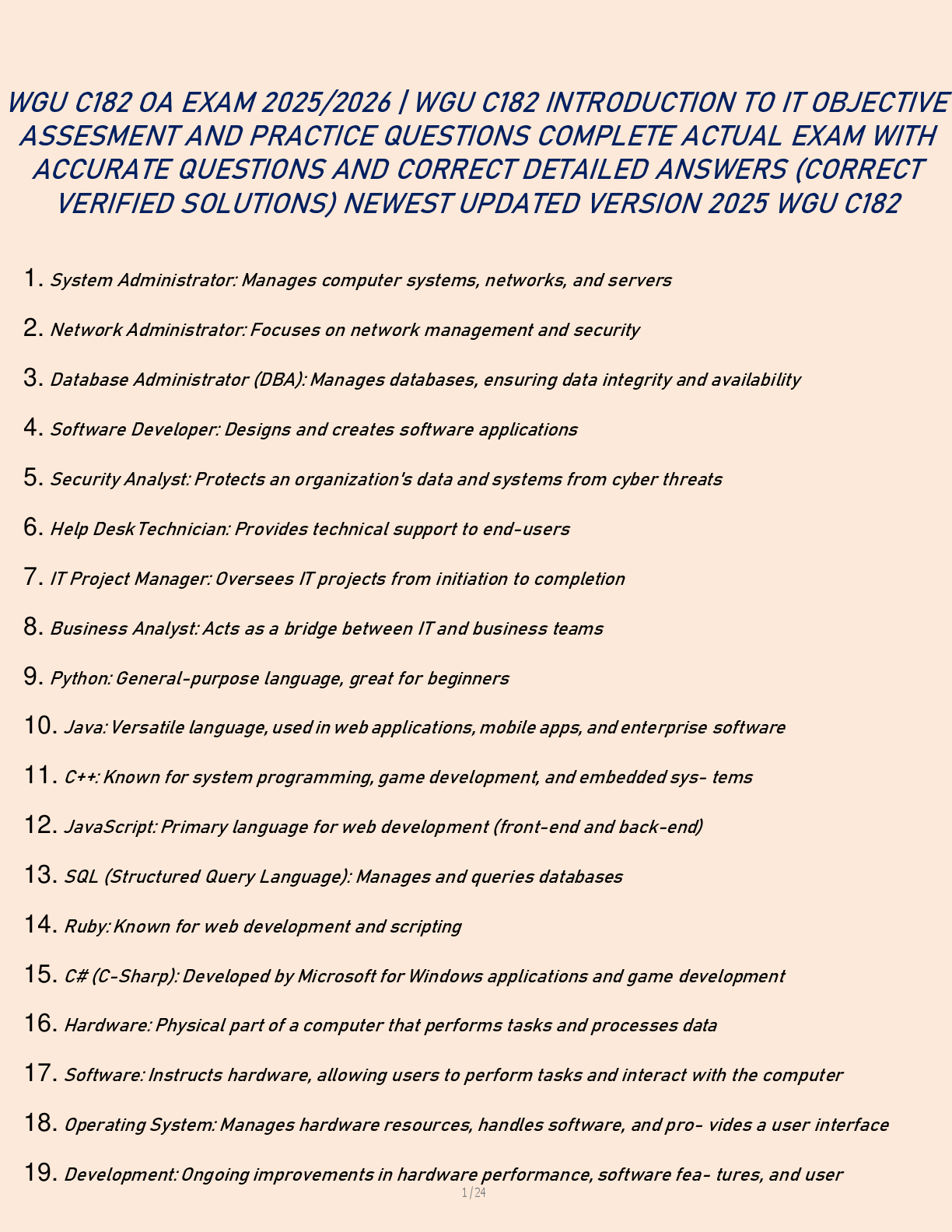
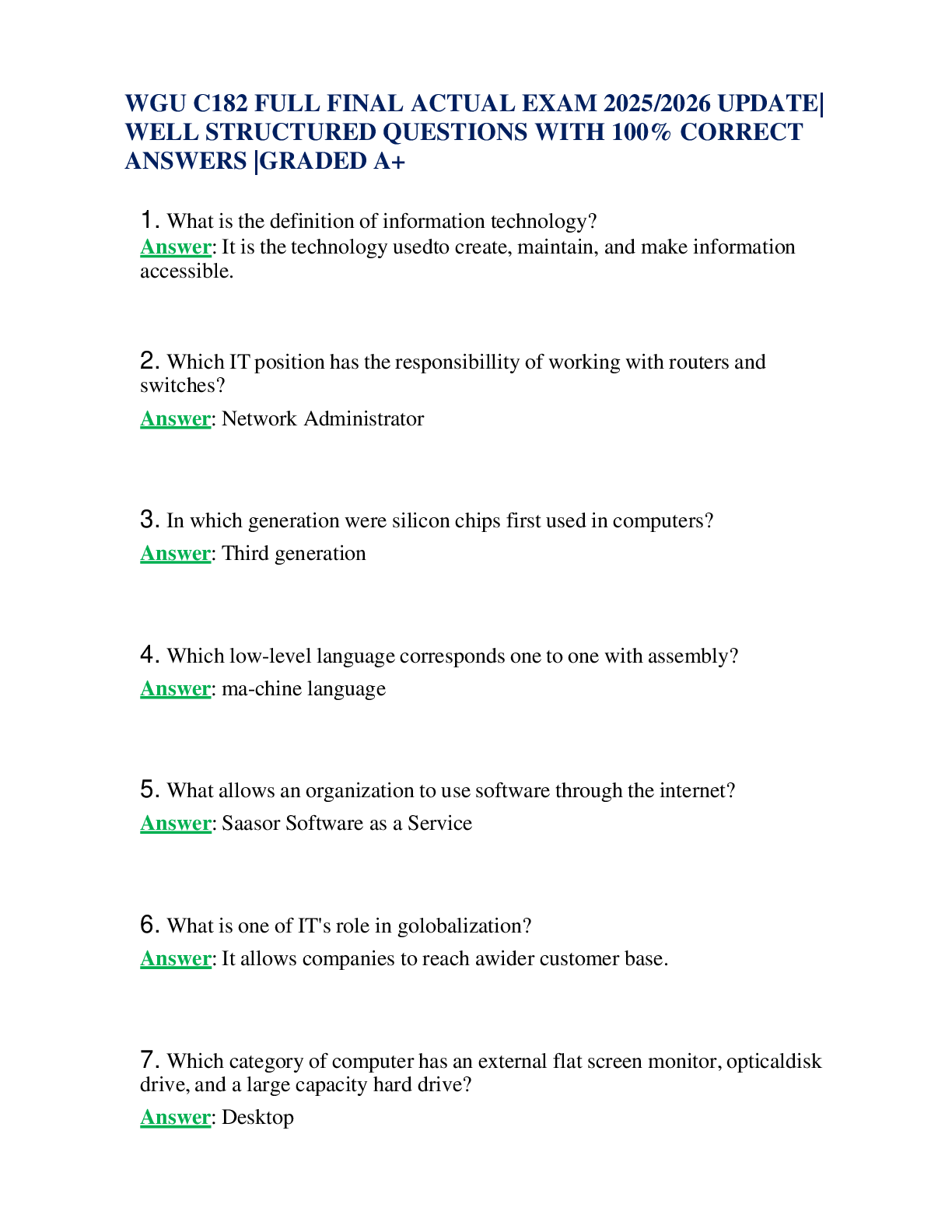
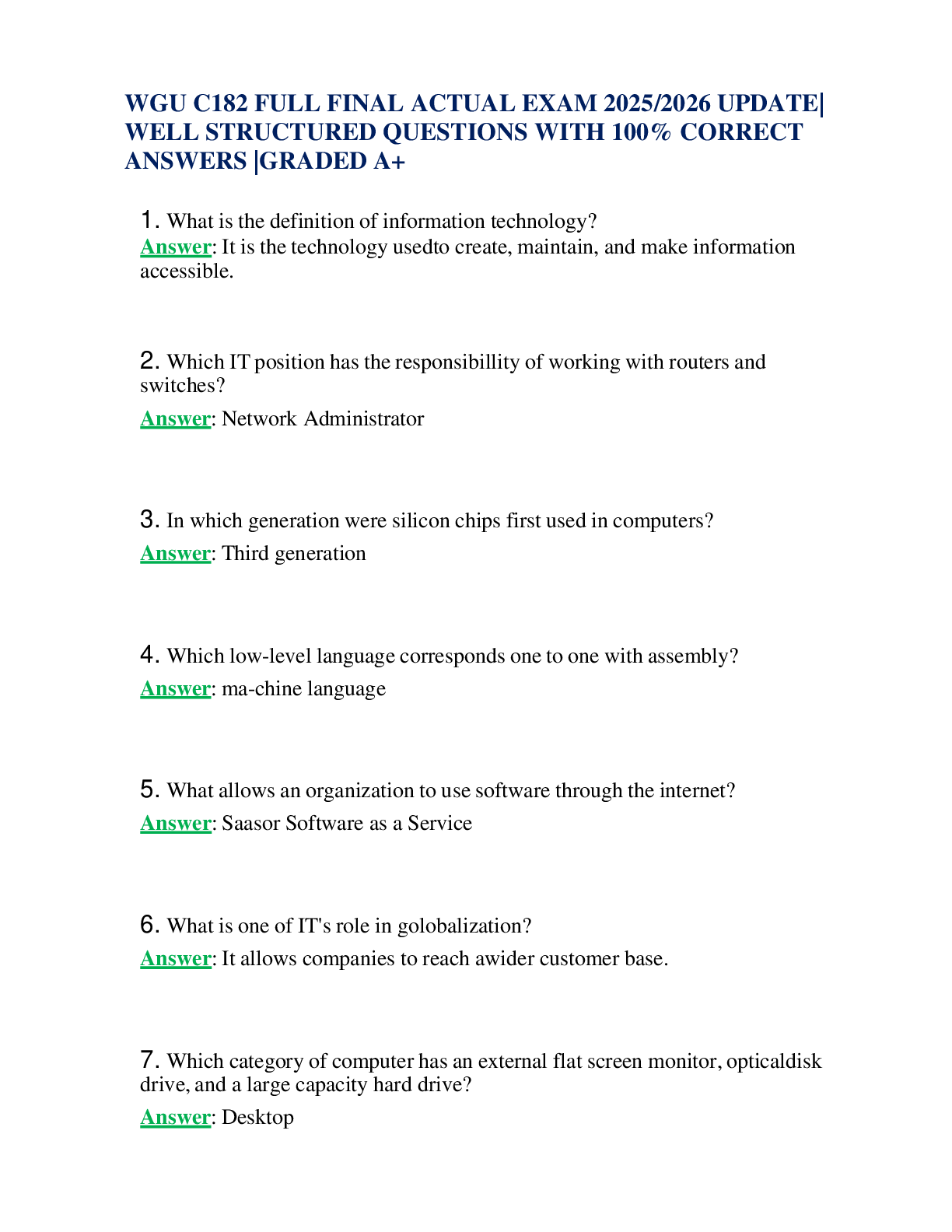
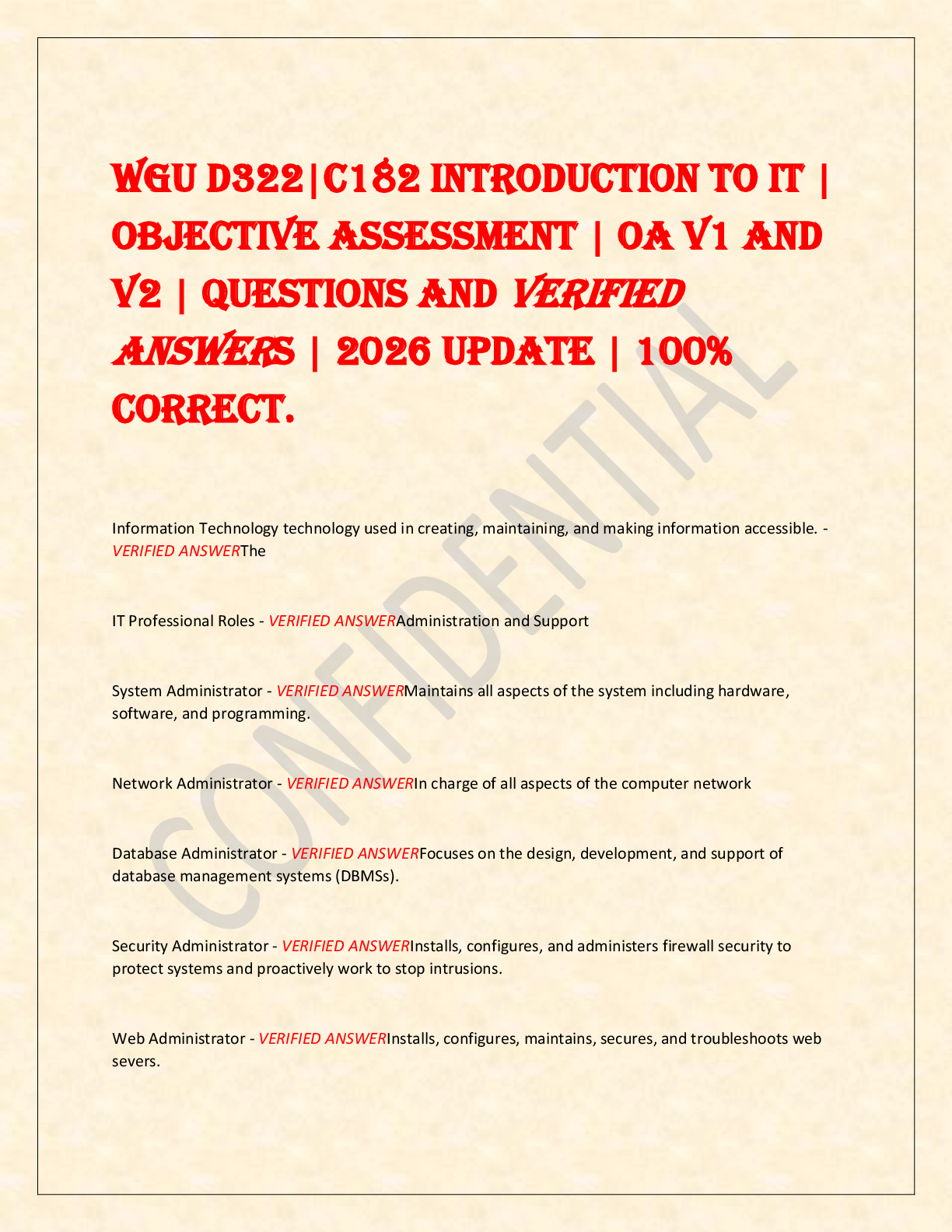
The technology used in creating, maintaining, and making information accessible. - ANSWER Information Technology
In charge of all aspects of the COMPUTER NETWORKS - ANSWER Network Administrator
Focuses on the design, development, and support of DATABASE MANAGEMENT systems (DBMSs). - ANSWER Database Administrator
Installs, configures, maintains, secures, and troubleshoots web severs - ANSWER Web Administrator
Processed data. - ANSWER Information
INFORMATION THAT HAS BEEN PUT TO USE information placed into a context. Refined information such that the user of the knowledge is able to call forth only relevant portions of information when needed. - ANSWER Knowledge in DIKW
Provides a social setting to knowledge; AN UNDERSTANDING OF THE ((( WHY ))) Can only come by having BOTH KNOWLEDGE and EXPERIENCE - ANSWER WISDOM
The INPUT Processing, OUTPUT, STORAGE Cycle - ANSWER I.P.O.S.
Raw data is organized or structured for usefulness. - ANSWER PROCESSED DATA
Information is output so user can see results. - ANSWER OUTPUT DATA
Processed information is stored for permanent record. - ANSWER STORAGE
A collection of components that work together to meet the needs of the user; typically : CATEGORIZED AS EITHER HARDWARE, SOFTWARE, NETWORKS AND USERS - ANSWER COMPUTER SYSTEM
Physical components of a computer system which include the system unit and its components and peripheral devices; TANGIBLE ASPECTS OF THE COMPUTER - ANSWER HARDWARE
A collection of computers and resources CONNECTED by various media so that they can COMMUNICATE WITH EACH OTHER. - ANSWER NETWORK
Systems Software and Applications Software - ANSWER SOFTWARE CATEGORIES
RULES provided by WHICH NETWORKS communicate with each other - ANSWER IP PROTOCOL
STORES the programs BEING EXECUTED and the data they are using. - ANSWER COMPUTER MEMORY
Controls THE SPEED at which instructions are processed. - ANSWER SYSTEM CLOCK
Stands for Random Access Memory. It temporarily stores data before it is processed and sent to your screen or printer. IT IS VOLATILE (means data or information stored disappears when the computer is turned off or loses power). - ANSWER RAM
Transistor components, magnetic core memory, smaller size, easier to program, disk drives and drums, called mainframe computers - ANSWER 2nd Generation of Computers
Silicon chips (known as ICs - integrated circuits), reduced cost, called mini computers, networks introduced via dumb terminals - ANSWER 3rd Generation of Computers
Written for a specific machine by the engineers who built and ran the computers; no need for OS since only one program could run at a time - ANSWER Low-level Language
Easier than machine but still required detailed, precise LOW LEVEL instructions - ANSWER Assembly Language
Function is to TRANSLATE ONE LANGUAGE TO ANOTHER; take source code and convert it to another form; source code by itself cannot be read by a computer - ANSWER Language Translator Programs
Programmer is limited to high level control constructs such as while loops, for loops, and if/else statements and not allowed to use primitive GOTO statements - ANSWER Structured Programming
A type of programming language for which most of its implementations EXECUTES INSTRUCTIONS DIRECTLY AND FREELY, without previously compiling a program into machine-language instructions. - ANSWER Interpreted Language (Code)
Small programs that place Linux commands or DOS batch files into a file - ANSWER Shell Scripting
The computer that the user is using; physically present with - ANSWER Local Computer
Connects computers to each other with NO REAL UNDERSTANDING OF WHAT IS BEING TRANSFERRED Used for private networks with local computers. - ANSWER Network Hub
Like a hub, but this will only send data that is INTENDED FOR SPECIFIC COMPUTER - ANSWER Network Switch
Can be connected to hub, switch, or router; many routers now also act as a wireless access point; sends out a wireless signal so computers on the network can connect without a cable - ANSWER Wireless Access Point
Contains one or more servers; client is a computer that will request information from another computer; server is a computer that takes requests and responds with the requested information; the software used facilitates communication with remote servers - ANSWER Client-server Network
Stores data files (web pages) and programs (scripts). Responds from anywhere on the Internet. - ANSWER Web Server
Monitors print jobs - ANSWER Print Server
Like web server or file server in that REQUEST ARE FILES and RESPONDED ARE THE FILES data delivered between client and server. - ANSWER FTP Server
Devices connected along a SINGLE CABLE Size of network is restricted - ANSWER Bus Network
Each device is connected to a CENTRAL DEVICE such as a hub or switch. - ANSWER Star Network
Each device is connected DIRECTLY TO ITS NEIGHBOR and messages are forwarded from device to device until the proper destination is reached. - ANSWER Ring Network
Every device is connected directly to every other device in the network. - ANSWER Mesh Network
Identifies the server on which the web page can be found - ANSWER Domain Name
Always ends with a period and a THREE or TWO LETTER EXTENSION which signifies the TYPE of organization or country associated with the page - ANSWER TLD (Top Level Domain) Name Exam: www.yourname.com .edu .net . gov .org
Indicates the name of the file you are accessing, or the location of the document on the server - ANSWER Resource/ Filename ID
Confidentiality, Integrity, Availability - ANSWER CIA
1st - Must include a component that ensures the accuracy of the collected data 2nd - Must be entered into the system accurately 3rd - Data modification must be tracked - ANSWER Data Integrity Efforts
1. Identify the organization's information assets 2. Identify vulnerabilities of each asset 3. Determine threats 4. Prioritizing risks 5. Develop and enact policies that will reduce threats - ANSWER Risk Management & Strategic Risk Analysis
An attacker issues a SQL command to a web server as part of the URL or as input to a form on a company's website; web server might pass the command onto the database which then allows potentially anything to be done to the database - ANSWER SQL Injection
Placing malicious code into the buffer so that it can be executed once stored in memory; oldest and most well known software exploit; software engineers can protect against this when writing code - ANSWER Buffer Overflow
Informs companies of potential problems with software HACK ATTACKS so companies can fix the problems. - ANSWER White Hat Hacker
Individuals with MALICIOUS INTENT WHO VIOLATE SECURITY in order to commit crimes or acts of terrorism - ANSWER Black Hat Hacker
Engage in BOTH WHITE and BLACK hat types of hacking activities - ANSWER Grey Hat Hacker
Type of virus that completely replaces an existing application and takes the name of the taken over file - ANSWER Trojan Horse
Attempts to identify if a file contains a virus or some form of malware - ANSWER Anti-virus Software
Ensures proper storage of data by providing a means so that data is available even when storage devices are damaged or offline - ANSWER Data Redundancy
Uses the same key for performing the encryption and decryption - ANSWER Symmetric Key Encryption
Ensures that the user gains access only to the resources that the user should be able to access - ANSWER Role-based Access Control
1. Cost savings benefits 2. Increased efficiency and productivity 3. Increased facilitation of communication - ANSWER Computer Network Advantages
Consists of programs that END USERS RUN to accomplish tasks - ANSWER Application Software
Consists of programs that MAKE UP THE OS software that directly supports the computer system itself - ANSWER System Software
[Show More]


.png)





.png)
.png)

.png)