What is the current recommended dose of intravenous or intraosseous epinephrine in adult patients with cardiac arrest?
10 mg every 10 minutes
1 mg every 3-5 minutes
1 mg every 7 minutes
0.1 mg every 2 minutes - ANSWE
...
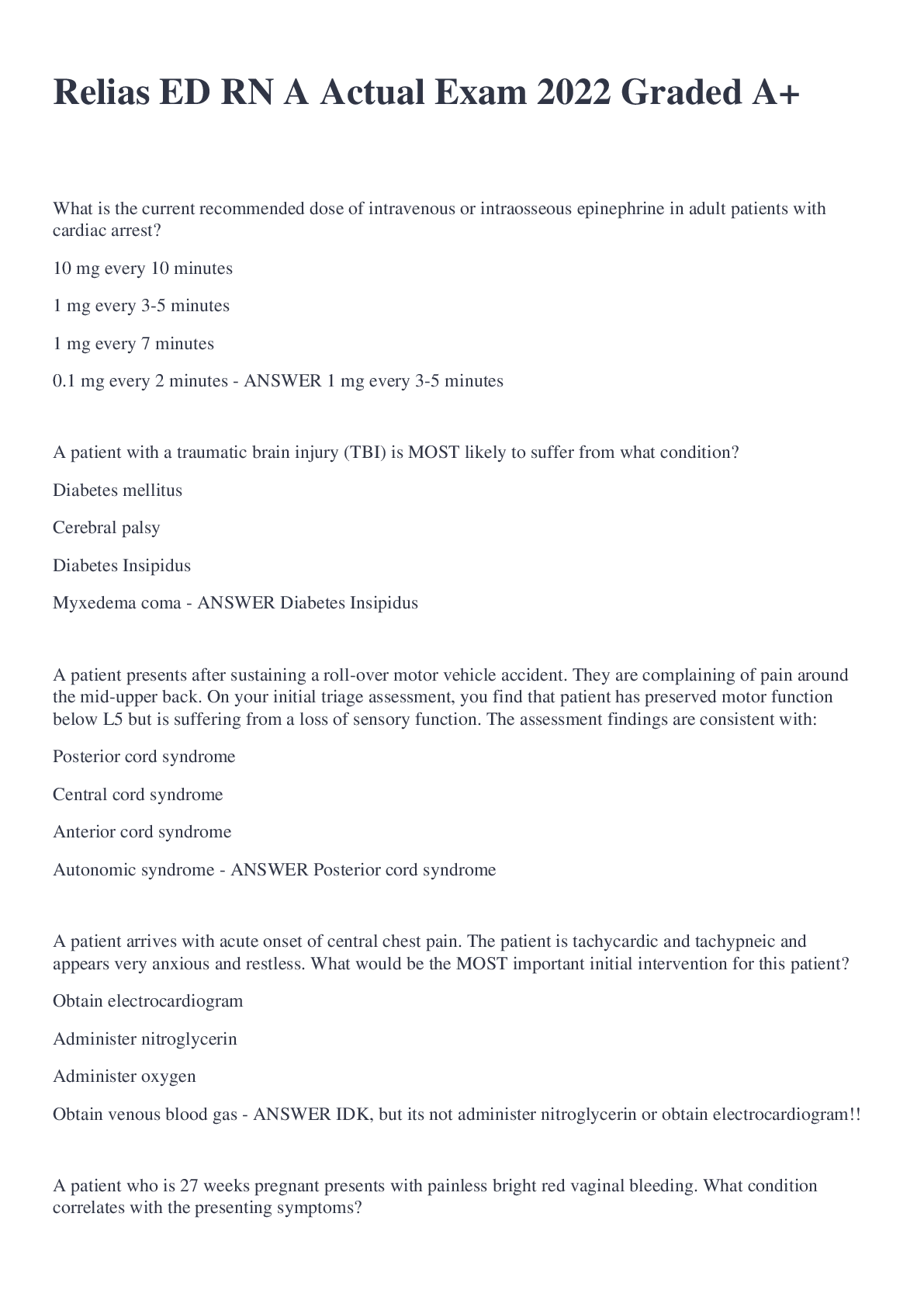
What is the current recommended dose of intravenous or intraosseous epinephrine in adult patients with cardiac arrest?
10 mg every 10 minutes
1 mg every 3-5 minutes
1 mg every 7 minutes
0.1 mg every 2 minutes - ANSWER 1 mg every 3-5 minutes
A patient with a traumatic brain injury (TBI) is MOST likely to suffer from what condition?
Diabetes mellitus
Cerebral palsy
Diabetes Insipidus
Myxedema coma - ANSWER Diabetes Insipidus
A patient presents after sustaining a roll-over motor vehicle accident. They are complaining of pain around the mid-upper back. On your initial triage assessment, you find that patient has preserved motor function below L5 but is suffering from a loss of sensory function. The assessment findings are consistent with:
Posterior cord syndrome
Central cord syndrome
Anterior cord syndrome
Autonomic syndrome - ANSWER Posterior cord syndrome
A patient arrives with acute onset of central chest pain. The patient is tachycardic and tachypneic and appears very anxious and restless. What would be the MOST important initial intervention for this patient?
Obtain electrocardiogram
Administer nitroglycerin
Administer oxygen
Obtain venous blood gas - ANSWER IDK, but its not administer nitroglycerin or obtain electrocardiogram!!
A patient who is 27 weeks pregnant presents with painless bright red vaginal bleeding. What condition correlates with the presenting symptoms?
Abruptio placenta
Placenta Previa
Ectopic pregnancy
Premature rupture of membranes (PROM) - ANSWER Placenta Previa
What is a common assessment finding in a patient with a tension pneumothorax?
Petechial chest rash
Distended neck veins
Equal chest wall expansion
Flattened neck veins - ANSWER Distended Neck Veins
A patient presents with a two-day history of fever, cough, mild shortness of breath (SOB), sore throat, myalgia, and new onset of loss of taste and smell. What is the patient MOST likely suffering from?
Giardia
Microsporidia
COVID 19
Tuberculosis - ANSWER COVID 19
The deficiency of anti-diuretic hormone (ADH) can lead to what endocrine disorders?
Diabetes Insipidus
Diabetes Mellitus
Adrenal Insufficiency
Syndrome of inappropriate secretion of ADH (SIADH) - ANSWER Diabetes Insipidus
A patient presents after an intentional overdose of propranolol approximately 2 hours ago. The patient has severe hypotension and bradycardia. IV fluids and vasopressors are initiated. What nursing assessment findings indicate the treatment has been effective?
Decreasing pulse pressure
Decreasing central venous pressure
Increasing serum glucose
Increasing serum cortisol - ANSWER Increasing serum glucose
A patient presents with acute onset of chest pain and goes into cardiac arrest immediately upon arrival. What is a possible reversible cause of cardiac arrest?
Hypervolemia
Alkalosis
Hyperthermia
Tension Pneumothorax - ANSWER Tension Pneumothorax
Which of the following represent categories utilized to triage patients during a mass casualty incident (MCI)?
Green, orange, black, purple
Green, blue, red, black
Red, black, pink, yellow
Green, yellow, red, black - ANSWER Green, yellow, red, black
A 22-year old female who is 8 weeks pregnant presents with a sudden onset of left lower abdominal pain and vaginal bleeding. The patient's family member stated that she had a syncopal episode shortly after that. What is the MOST likely diagnosis for her?
Ruptured appendix
Placenta previa
Abruptio placenta
Ruptured ectopic pregnancy - ANSWER Ruptured ectopic pregnancy
A patient with a history of chronic alcohol use is brought in with possible esophageal varices. What medication is used to stop upper gastrointestinal (GI) bleeding in patients with this condition?
Octreotide (Sandostatin®)
Acetaminophen (Tylenol®)
Warfarin (Jantoven®)
Ibuprofen (Motrin®) - ANSWER Octreotide (Sandostatin)
A patient has sustained multiple traumatic injuries after a fall from a height. What is considered an important component of the primary survey assessment?
Complete set of vital signs
Neurological assessment
Head to toe assessment
Patients allergy history - ANSWER Neurological Assessment
What do you anticipate is the BEST indicator of adequate hydration in an adult patient with 30% body surface area burn during initial fluid resuscitation?
Blood pressure of 110/60 mm Hg
Urine output of 0.5 mL/kg/hr
Central venous pressure of 25 mm Hg
Urine output of 0.2 mL/kg/hr - ANSWER Urine output 0.5mL/kg/hr
What staff member would you ask to accompany you when transporting an intubated patient to imaging for a CT?
Lift team
Respiratory therapist
Physician's assistant
Nursing assistant - ANSWER RT
An elderly patient is brought in with new onset of confusion and gradual onset of headache in the last 48hours. The patient states that they had a fall 3 days ago. Based on the history and presenting complaints, what diagnostic test do you anticipate the provider to order?
MRI of the brain
Complete Blood Count
Finger stick blood sugar
CT scan of the brain - ANSWER CT scan of the brain
A patient arrives with suspected appendicitis. What action, if observed, would require additional training for the unlicensed assistive personnel (UAP)?
The UAP offers the patient a ginger ale.
The UAP allows the patient to move to a position of comfort.
The UAP helps the patient with a bedpan.
The UAP reminds the patient to stay in bed. - ANSWER The UAP offers the patient a ginger ale.
What laboratory value would you monitor closely if your patient is vomiting coffee-ground emesis?
White blood cells
Serum potasgium
Arterial Blood Gas
Hemoglobin - ANSWER Hemoglobin
A patient who is 32 weeks pregnant presents with a three-day history of headache and significant swelling of the lower extremities and face. The patient's vital signs are BP: 160/90, HR: 105/min, RR:19/min, Spo2: 94% on RA, Temp: 97.3 F. What medication do you anticipate the provider to order FIRST?
Furosemide (Lasix)
Magnesium Sulfate
Labetalol (Trandate)
Acetaminophen (Tylenol) - ANSWER Magnesium Sulfate
You are caring for a patient who has a history of alcohol use and seizures. You suddenly notice the patient becoming diaphoretic, anxious, tachycardic, and has clammy skin. What would you do NEXT?
Check their blood glucose
Turn them on their side
Auscultate their lungs
Administer propranolol - ANSWER Check their blood glucose
A patient who is 24 weeks pregnant presents with fever and right upper quadrant pain. The patient states that the pain is radiating to the right shoulder blade, and started an hour after having a pizza for lunch. She is tachycardic, tachypneic, and diaphoretic on the initial triage assessment. What is the MOST likely diagnosis for this patient?
Pericarditis
Cholecystitis
Diverticulitis
Pancreatitis - ANSWER Cholecystitis
A patient presents after falling from a height and fracturing their right tibia and fibula. What symptom would be reported to the provider IMMEDIATELY?
Bounding pulse
Warm extremity
Paresthesia of the foot
Capillary refill pf toes <2 sec - ANSWER Paresthesia of the foot
You are assisting a novice nurse with a blood draw. You observe the nurse draw the blood, place the specimen tubes in a biohazard bag, and leave the room with the unlabeled specimen tubes. What would you do
[Show More]