Compensation and Benefits - C236 WGU
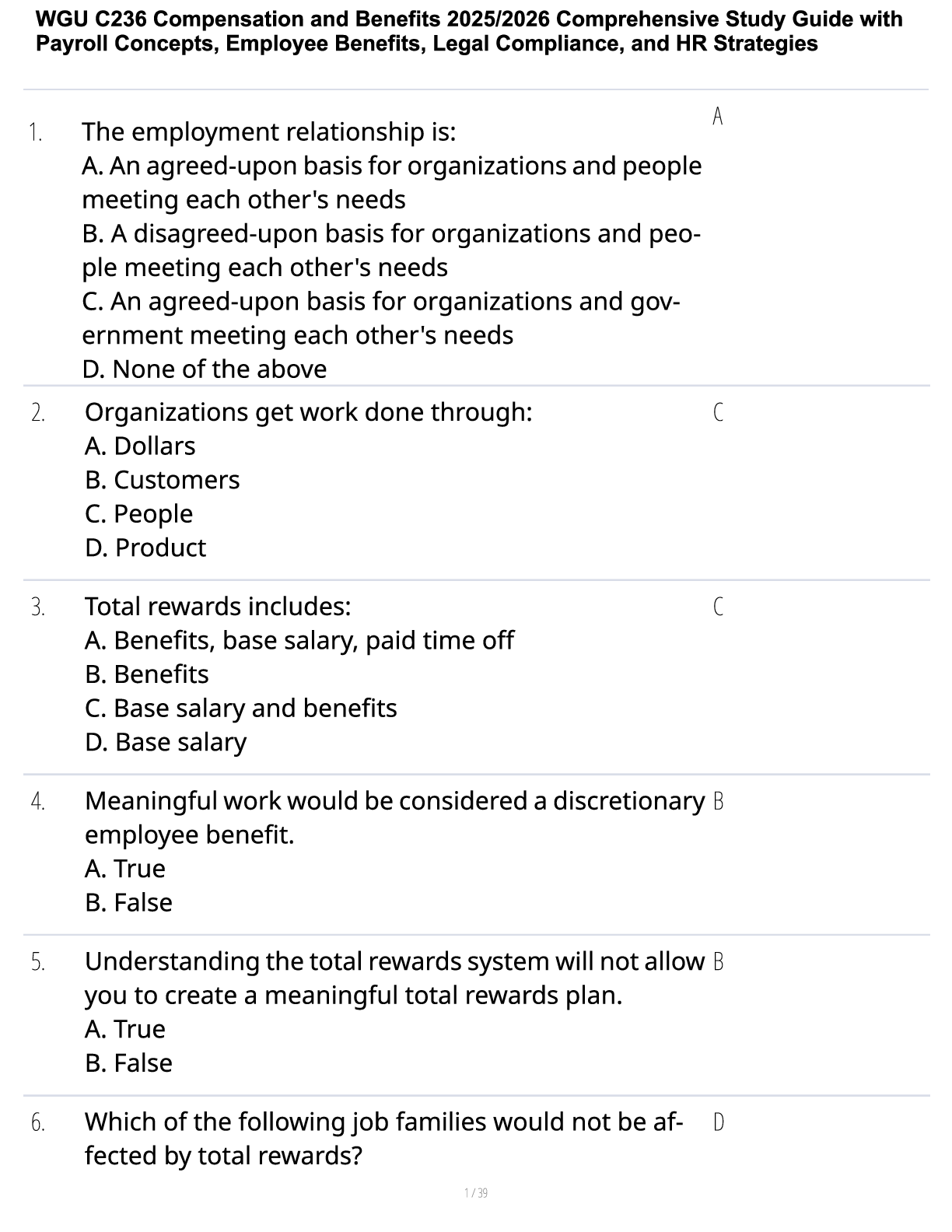
The primary reasons that organizations use performance-based pay - ✔✔is to provide an
incentive for the types of behaviors and outcomes that enable higher performance
The most popu
...
Compensation and Benefits - C236 WGU
The primary reasons that organizations use performance-based pay - ✔✔is to provide an
incentive for the types of behaviors and outcomes that enable higher performance
The most popular need theory is the Hierarchy of Needs Theory proposed by Abraham Maslow.
- ✔✔Physiological needs,Safety and security needs,Social needs,Ego and esteem needs,Selfactualization needs
The Reinforcement Principle - ✔✔states that when positive consequences (rewards) follow a
behavior, that behavior becomes more likely to be seen in the future
The Timing Principle - ✔✔specifies that the smaller the time gap between the behavior and the
reward or punishment, the greater impact on behavior.
The Variability Principle - ✔✔points out that new behaviors are most quickly acquired when
employees receive the reward every time a behavior is exhibited -will need to have more
frequent payouts in the beginning of the rollout and will want to taper those to variable over
time.
According to Expectancy Theory - ✔✔motivation is a function not only of the perceived
contingency of the rewards, but also of how much the employee values the reward, and whether
or not they believe that they can perform at the required level.
The Expectancy Perception asks - ✔✔"Can I perform at the level required for the reward"?
The Instrumentality Perception asks - ✔✔"If I perform, will I receive the reward"?
The Valence Perception asks - ✔✔"Do I value the reward"?
Law of Unintended Consequences - ✔✔this principle states that not all of the consequences of a
reward system change are foreseeable.
Tournament Theory - ✔✔advises that creating larger differences in pay between levels in the
organization will create a workforce highly motivated to move up in the organization.
Distributive Justice - ✔✔It is also known as Equity Theory, and is based on comparisons
between the ratio of employees' inputs and rewards to the ratio of inputs and rewards of others.
Justice Theory - ✔✔highlights the importance of reward comparisons, process evaluations, and
the interactions that lead to fairness perceptions.
Procedural Justice - ✔✔focuses on the process by which the reward distribution was determined.
For example, an employee who does not receive the pay raise that his peer received will likely
have low Distributive Justice perceptions. This employee would then consider how the decision
was made to arrive at perceptions of Procedural Justice.
organizations can do to enhance Procedural Justice - ✔✔Voice, Explanation,Multiple Sources ,
Correcting Mechanism
Interactional Justice - ✔✔refers to perceptions of the extent to which the employee was treated
with due respect.
Intrinsic Motivation Theory - ✔✔Intrinsic Motivation Theory suggests that care should be taken
with contingent rewards because they can distract employees from more intrinsic motivations for
doing the work.
(2) Intrinsic Motivation Theory.... - ✔✔employees attribute their own behavior to being selfchosen (intrinsic) or imposed (extrinsic), and that attribution has implications for their attitudes
and their motivation when the external factors are reduced. For example, when an employee
works in a contingent bonus rewards system, that employee is more likely to attribute their
efforts to the presence of the bonus instead of to intrinsic love for the work. If this bonus
program is removed, the employee's motivation would then be reduced because he/she attributed
his/her own behavior to the presence of the reward
Individual-based Variable Pay - ✔✔bonuses, spot awards, commissions, and piece rate are based
on individual performance and are not added to an employee's base wage
merit pay - ✔✔is a change to future base wages or salary.
Group-based Variable Pay - ✔✔non-base pay rewards to the performance of teams,
improvements in unit productivity, or the market valuation of the entire organization.
Team-based Bonuses - ✔✔are like Individual-based bonuses in that they provide a lump sum
reward that does not get added into future base pay,
Gain sharing - ✔✔attempts to align the interests of the organization with the interests of the
employees by creating a system in which they both benefit from productivity gains, service
improvements, or cost savings.
A portion of this savings is then distributed back to the employees who helped create the
improvement.
Job Analysis - ✔✔
1.Identify Job - ✔✔The first step is to identify the job being analyzed
2.Observe and Interview Leadership - ✔✔second step is to observe the workplace and interview
the organizational leadership connected to the new job. Attention should be placed on
understanding how the job interfaces with other jobs in the workplace.
3.Observe and Interview Incumbents - ✔✔conduct more in-depth interviews with job
incumbents to ascertain the tasks, duties, and responsibilities.
4.Consolidate Information into Job Description Draft - ✔✔review the information gathered from
the interviews to create the draft of the job description.
5.Obtain Feedback and Revise Job Description - ✔✔The fifth step is to use a survey or
interview-based process to have the subject matter experts review the job description to ensure
that it adequately captures the job. For jobs involving numerous incumbents, a survey can often
be used with this step. Finally, a mechanism for resolving conflicts and for keeping the
description updated should also be established, this is commonly done during annual
performance reviews.
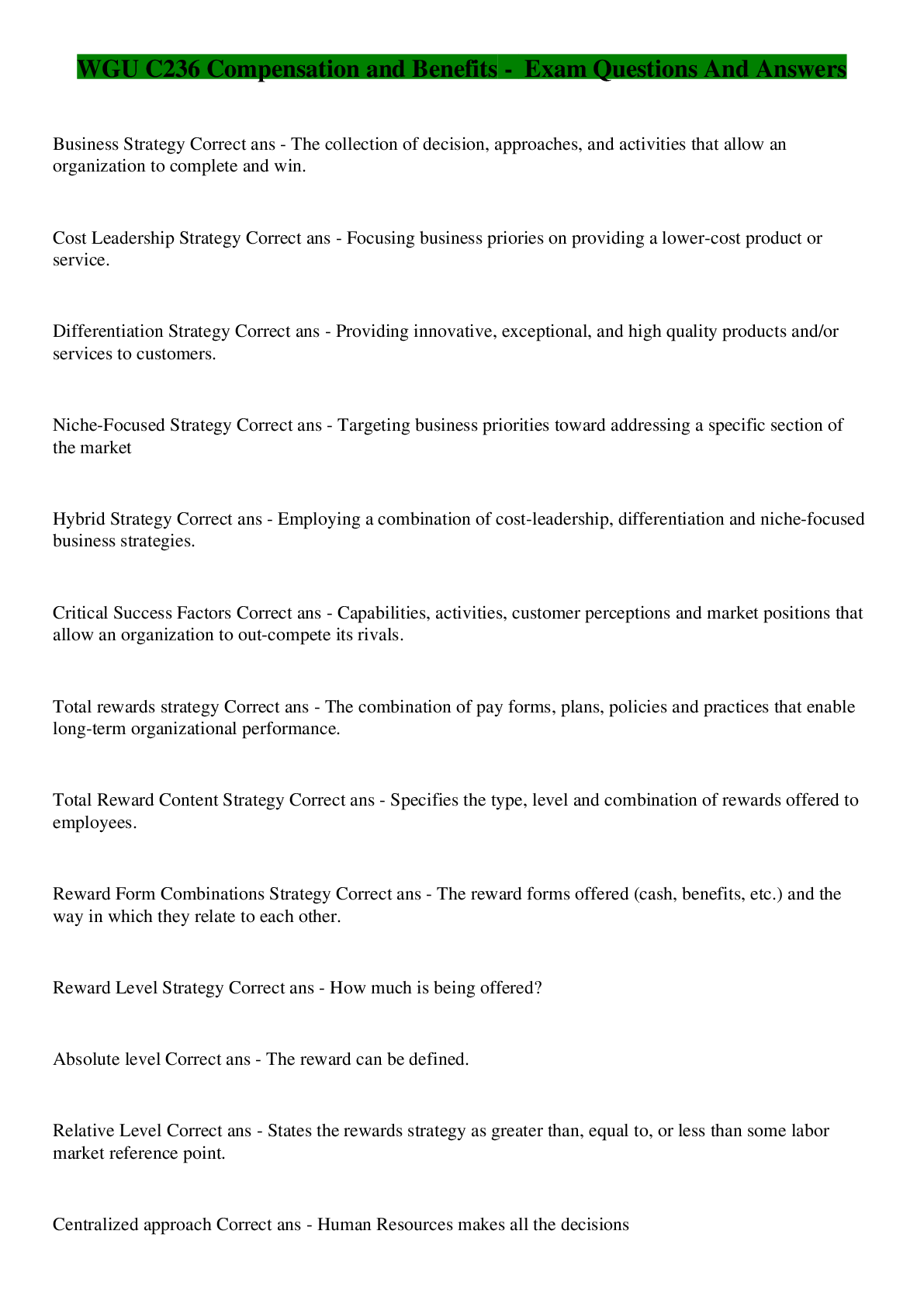
Decentralized - ✔✔On the other extreme, a Decentralized approach allows such decisions to be
made by the employee's immediate supervisor or manager
Central Tendency - ✔✔is simply to find one single number that best represents a whole group of
numbers. in compensation we often need a single number that best represents how many people
are paid, or how many organizations pay. There are three basic ways to arrive at this number.
three basic ways to arrive Central Tendency - ✔✔Mean (or Average)So, calculating a mean is
simply done by adding up the digits in a column and then dividing by the number of digits.
The Weighted Mean, or Weighted Average, is calculated by 1) multiplying each company salary
by the number of accountants in that company and adding them up
The Median is simply the middle number of a group of numbers when they are arranged from
lowest to highest. The median helps address the outlier problem.
Centralized - ✔✔Centralized approach in which the Human Resources department makes all
decisions relating to pay strategy
[Show More]


.png)



.png)