NBCOT Exam Test Questions & Answers
(3 latest Versions)
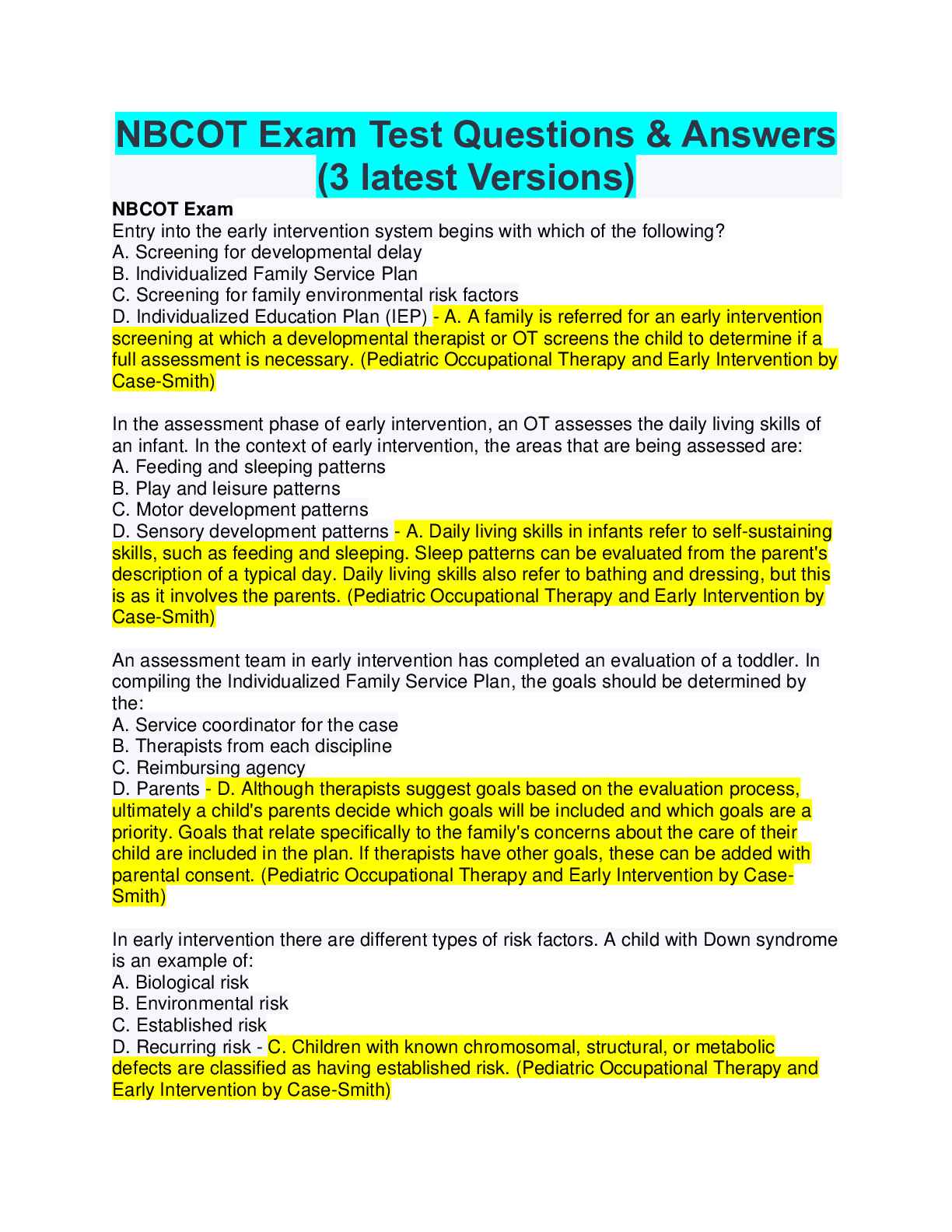
NBCOT Exam
Entry into the early intervention system begins with which of the following?
A. Screening for developmental delay
B. Individualized Family Service P
...
NBCOT Exam Test Questions & Answers
(3 latest Versions)
NBCOT Exam
Entry into the early intervention system begins with which of the following?
A. Screening for developmental delay
B. Individualized Family Service Plan
C. Screening for family environmental risk factors
D. Individualized Education Plan (IEP) - A. A family is referred for an early intervention
screening at which a developmental therapist or OT screens the child to determine if a
full assessment is necessary. (Pediatric Occupational Therapy and Early Intervention by
Case-Smith)
In the assessment phase of early intervention, an OT assesses the daily living skills of
an infant. In the context of early intervention, the areas that are being assessed are:
A. Feeding and sleeping patterns
B. Play and leisure patterns
C. Motor development patterns
D. Sensory development patterns - A. Daily living skills in infants refer to self-sustaining
skills, such as feeding and sleeping. Sleep patterns can be evaluated from the parent's
description of a typical day. Daily living skills also refer to bathing and dressing, but this
is as it involves the parents. (Pediatric Occupational Therapy and Early Intervention by
Case-Smith)
An assessment team in early intervention has completed an evaluation of a toddler. In
compiling the Individualized Family Service Plan, the goals should be determined by
the:
A. Service coordinator for the case
B. Therapists from each discipline
C. Reimbursing agency
D. Parents - D. Although therapists suggest goals based on the evaluation process,
ultimately a child's parents decide which goals will be included and which goals are a
priority. Goals that relate specifically to the family's concerns about the care of their
child are included in the plan. If therapists have other goals, these can be added with
parental consent. (Pediatric Occupational Therapy and Early Intervention by CaseSmith)
In early intervention there are different types of risk factors. A child with Down syndrome
is an example of:
A. Biological risk
B. Environmental risk
C. Established risk
D. Recurring risk - C. Children with known chromosomal, structural, or metabolic
defects are classified as having established risk. (Pediatric Occupational Therapy and
Early Intervention by Case-Smith)
The parent of a child that is being treated in therapy describes how the child covers their
ears when riding in the car with the windows down. The parent does not understand
why the child persists in this behavior. The OT explains that this behavior could be the
result of:
A. Sensory defensiveness
B. Gravitational insecurity
C. Underresponsiveness
D. Aversion to movement - A. A child experiencing sensory defensiveness has a
tendency to respond negatively to sensation that is considered by most people to be
noninvasive or nonirritating. This frequently includes hyperresponsiveness to light or
unexpected touches, high-frequency noises, certain visual stimulation, or certain smells
and tastes. (Sensory Integration: Theory and Practice by Bundy)
An OT is using the Peabody Developmental Motor Scales to evaluate a child. The
therapist is assessing the child's:
A. Performance of tasks that support school participation
B. Visual perception skills in community settings
C. Gross and fine motor skills
D. Performance in everyday tasks - C. The Peabody assesses a child's abilities with
gross and fine motor skills. (Occupational Therapy for Children by Case-Smith)
A patient diagnosed with insulin dependent diabetes mellitus is referred to occupational
therapy for splinting. A primary area that must be assessed before prescribing a splint
is:
A. Edema
B. Sensation
C. Pain
D. Fine motor manipulation - B. Persons with long-standing diabetes frequently have
increased incidences of other conditions, such as peripheral neuropathies. Therefore, a
sensory evaluation is necessary to determine if sensation is diminished. A person with
diminished sensation secondary to peripheral neuropathy may not be able to perceive
or gauge pressure when wearing a splint. This can lead to skin breakdown. (Introduction
to Splinting: A Clinical Reasoning & Problem Solving Process by Coppard and Lohman)
An OT is asked to administer a test to a child and compare the assessment results or
scores to the sample population of children that have similar characteristics as this
child. The BEST type of evaluation to administer would be:
A. Criterion-referenced test
B. Norm-referenced test
C. Skilled observation
D. Checklist - B. A norm-referenced test is developed by giving the test in question to a
large number of children, usually several hundred or more. This group is the more
normative group and norms or averages are derived from this sample. When a normreferenced test is administered, the performance of the child being tested is compared
to the normative sample. (Occupational Therapy for Children by Case-Smith
[Show More]