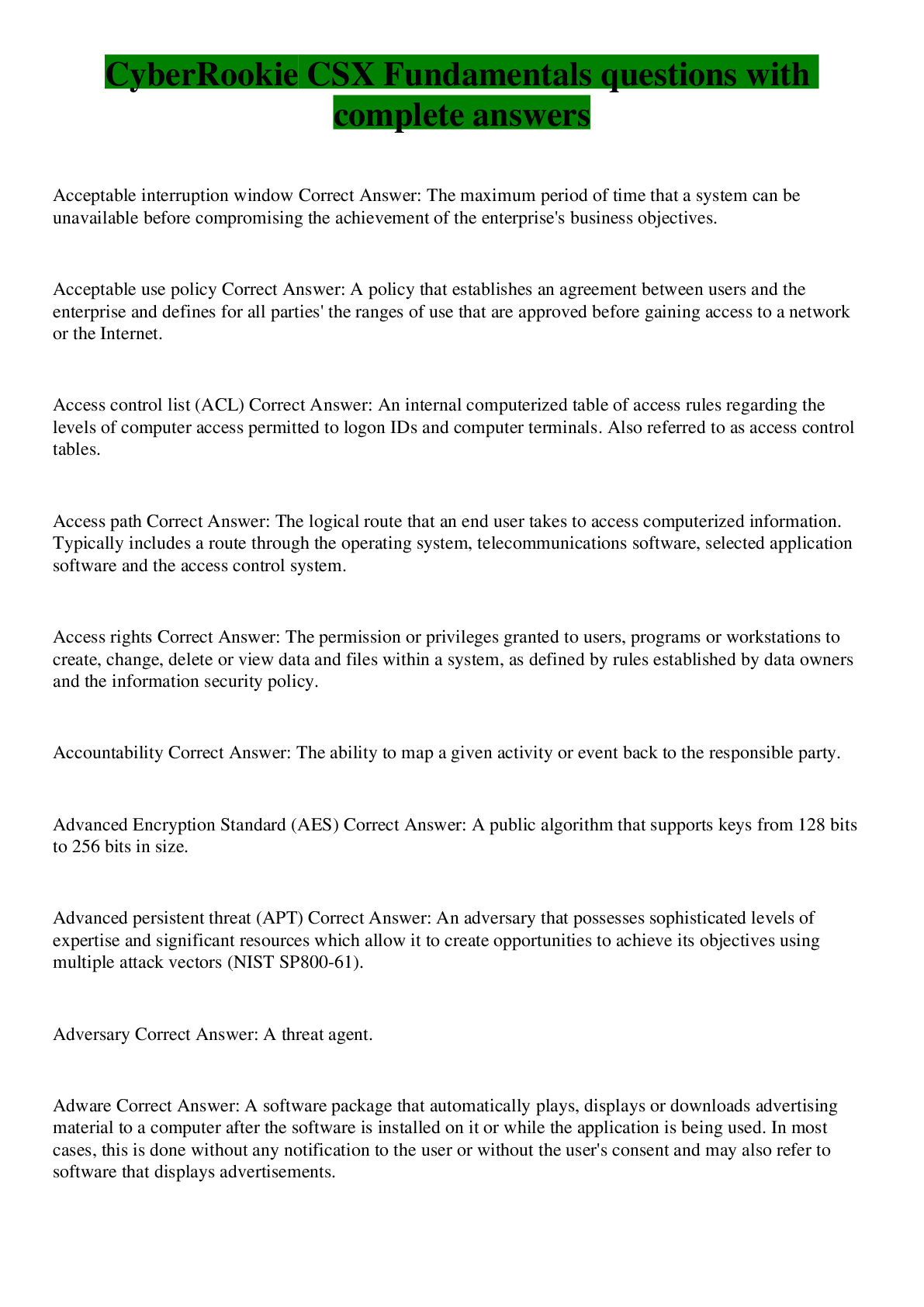
Acceptable interruption window Correct Answer: The maximum period of time that a system can be unavailable before compromising the achievement of the enterprise's business objectives.
Acceptable use policy Correct An
...
Acceptable interruption window Correct Answer: The maximum period of time that a system can be unavailable before compromising the achievement of the enterprise's business objectives.
Acceptable use policy Correct Answer: A policy that establishes an agreement between users and the enterprise and defines for all parties' the ranges of use that are approved before gaining access to a network or the Internet.
Access control list (ACL) Correct Answer: An internal computerized table of access rules regarding the levels of computer access permitted to logon IDs and computer terminals. Also referred to as access control tables.
Access path Correct Answer: The logical route that an end user takes to access computerized information. Typically includes a route through the operating system, telecommunications software, selected application software and the access control system.
Access rights Correct Answer: The permission or privileges granted to users, programs or workstations to create, change, delete or view data and files within a system, as defined by rules established by data owners and the information security policy.
Accountability Correct Answer: The ability to map a given activity or event back to the responsible party.
Advanced Encryption Standard (AES) Correct Answer: A public algorithm that supports keys from 128 bits to 256 bits in size.
Advanced persistent threat (APT) Correct Answer: An adversary that possesses sophisticated levels of expertise and significant resources which allow it to create opportunities to achieve its objectives using multiple attack vectors (NIST SP800-61).
Adversary Correct Answer: A threat agent.
Adware Correct Answer: A software package that automatically plays, displays or downloads advertising material to a computer after the software is installed on it or while the application is being used. In most cases, this is done without any notification to the user or without the user's consent and may also refer to software that displays advertisements.
Alert situation Correct Answer: The point in an emergency procedure when the elapsed time passes a threshold and the interruption is not resolved and initiates a series of escalation steps.
Alternate facilities Correct Answer: Locations and infrastructures from which emergency or backup processes are executed, when the main premises are unavailable or destroyed; includes other buildings, offices or da
[Show More]