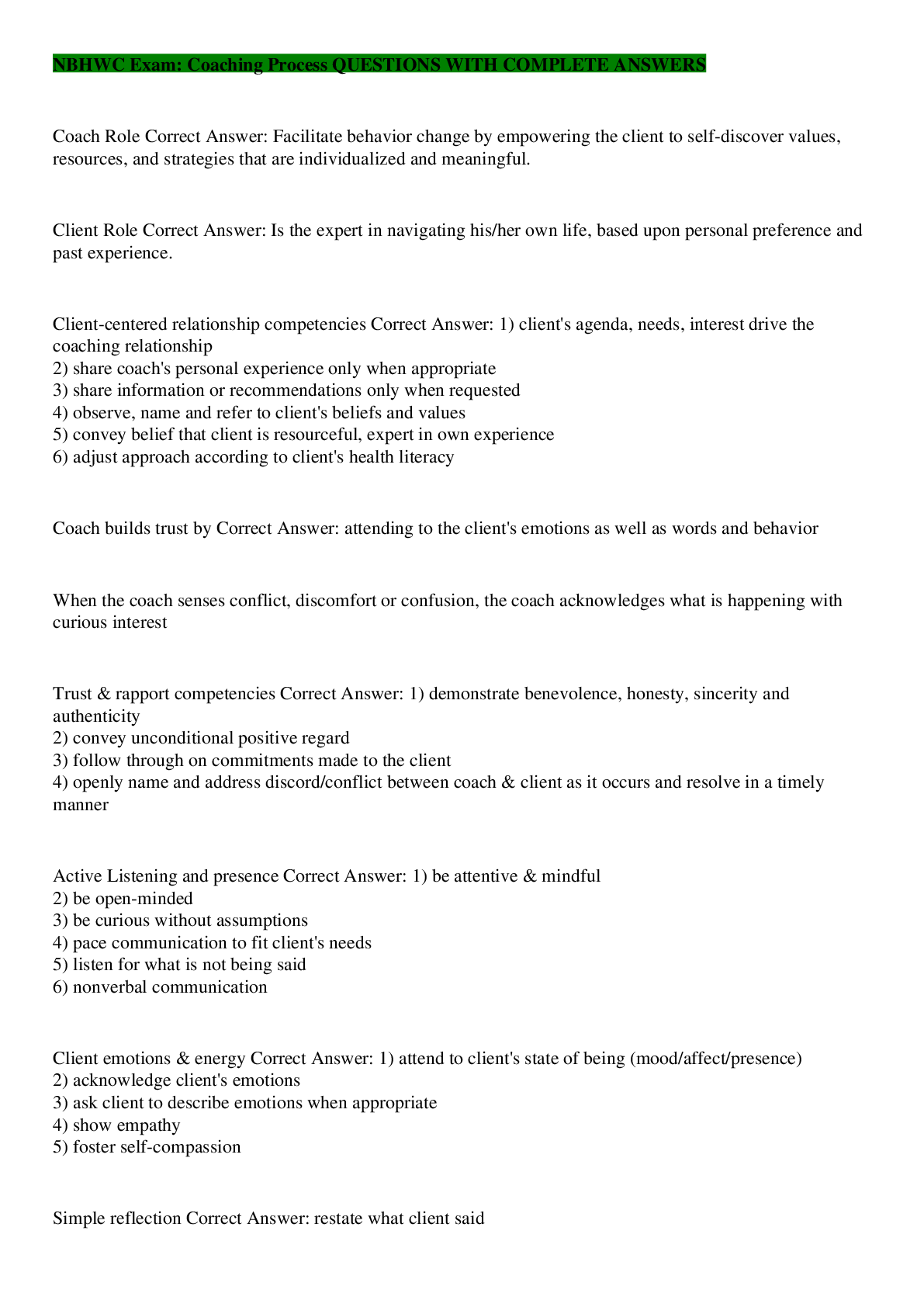
Coach Role Correct Answer: Facilitate behavior change by empowering the client to self-discover values, resources, and strategies that are individualized and meaningful.
Client Role Correct Answer: Is the expert in
...
Coach Role Correct Answer: Facilitate behavior change by empowering the client to self-discover values, resources, and strategies that are individualized and meaningful.
Client Role Correct Answer: Is the expert in navigating his/her own life, based upon personal preference and past experience.
Client-centered relationship competencies Correct Answer: 1) client's agenda, needs, interest drive the coaching relationship
2) share coach's personal experience only when appropriate
3) share information or recommendations only when requested
4) observe, name and refer to client's beliefs and values
5) convey belief that client is resourceful, expert in own experience
6) adjust approach according to client's health literacy
Coach builds trust by Correct Answer: attending to the client's emotions as well as words and behavior
When the coach senses conflict, discomfort or confusion, the coach acknowledges what is happening with curious interest
Trust & rapport competencies Correct Answer: 1) demonstrate benevolence, honesty, sincerity and authenticity
2) convey unconditional positive regard
3) follow through on commitments made to the client
4) openly name and address discord/conflict between coach & client as it occurs and resolve in a timely manner
Active Listening and presence Correct Answer: 1) be attentive & mindful
2) be open-minded
3) be curious without assumptions
4) pace communication to fit client's needs
5) listen for what is not being said
6) nonverbal communication
Client emotions & energy Correct Answer: 1) attend to client's state of being (mood/affect/presence)
2) acknowledge client's emotions
3) ask client to describe emotions when appropriate
4) show empathy
5) foster self-compassion
Simple reflection Correct Answer: restate what client said
[Show More]