main themes in the field of stress. Correct Answers 1. Stress involves psycho-physiological arousal
2. Stress is a process that follows a characteristic pattern
3. Stress affects performance and health.
concept of s
...
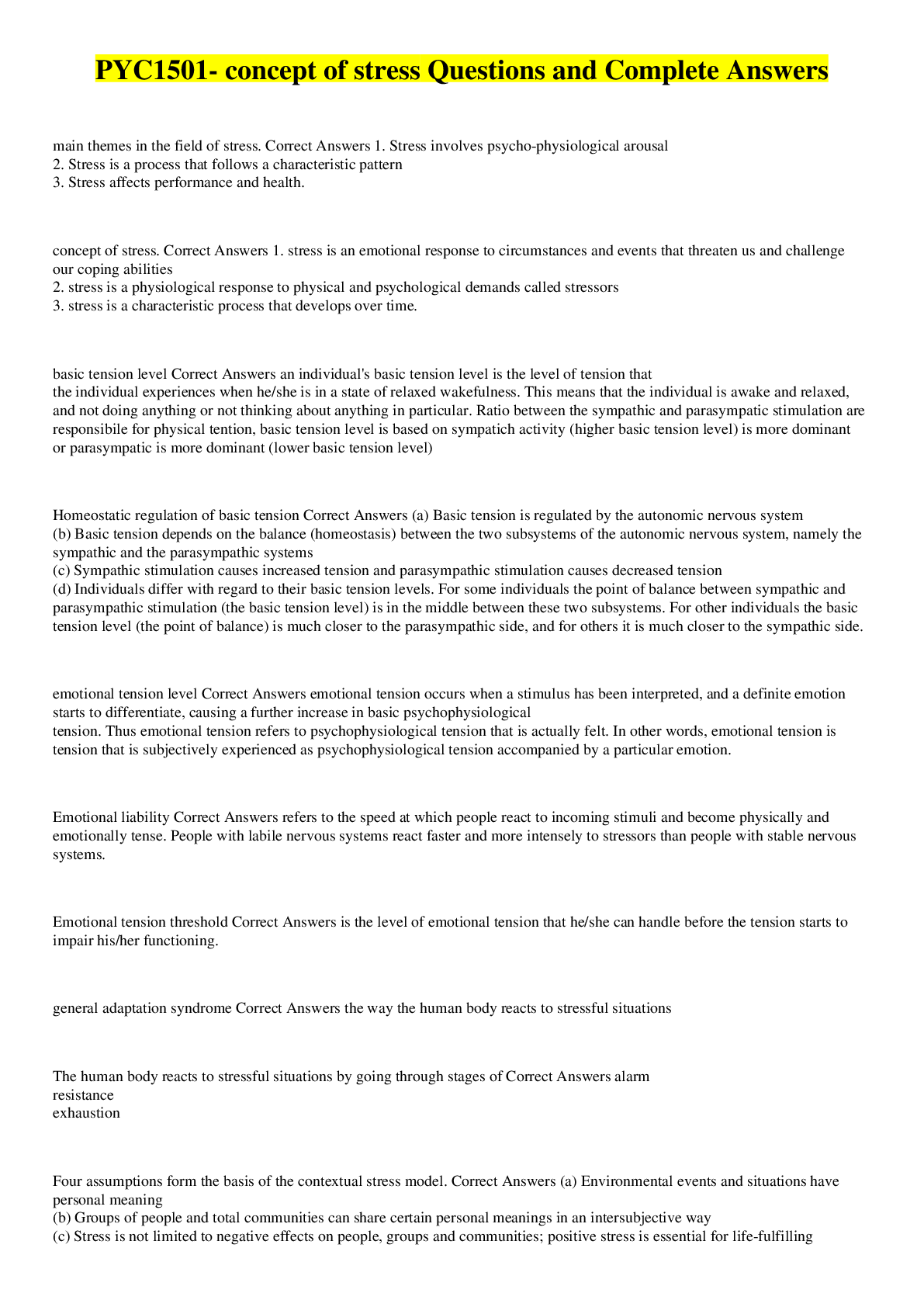
main themes in the field of stress. Correct Answers 1. Stress involves psycho-physiological arousal
2. Stress is a process that follows a characteristic pattern
3. Stress affects performance and health.
concept of stress. Correct Answers 1. stress is an emotional response to circumstances and events that threaten us and challenge
our coping abilities
2. stress is a physiological response to physical and psychological demands called stressors
3. stress is a characteristic process that develops over time.
basic tension level Correct Answers an individual's basic tension level is the level of tension that
the individual experiences when he/she is in a state of relaxed wakefulness. This means that the individual is awake and relaxed, and not doing anything or not thinking about anything in particular. Ratio between the sympathic and parasympatic stimulation are responsibile for physical tention, basic tension level is based on sympatich activity (higher basic tension level) is more dominant or parasympatic is more dominant (lower basic tension level)
Homeostatic regulation of basic tension Correct Answers (a) Basic tension is regulated by the autonomic nervous system
(b) Basic tension depends on the balance (homeostasis) between the two subsystems of the autonomic nervous system, namely the sympathic and the parasympathic systems
(c) Sympathic stimulation causes increased tension and parasympathic stimulation causes decreased tension
(d) Individuals differ with regard to their basic tension levels. For some individuals the point of balance between sympathic and parasympathic stimulation (the basic tension level) is in the middle between these two subsystems. For other individuals the basic tension level (the point of balance) is much closer to the parasympathic side, and for others it is much closer to the sympathic side.
emotional tension level Correct Answers emotional tension occurs when a stimulus has been interpreted, and a definite emotion starts to differentiate, causing a further increase in basic psychophysiological
tension. Thus emotional tension refers to psychophysiological tension that is actually felt. In other words, emotional tension is tension that is subjectively experienced as psychophysiological tension accompanied by a particular emotion.
Emotional liability Correct Answers refers to the speed at which people react to incoming stimuli and become physically and emotionally tense. People with labile nervous systems react faster and more intensely to stressors than people with stable nervous systems.
Emotional tension threshold Correct Answers is the level of emotional tension that he/she can handle before the tension starts to impair his/her functioning.
general adaptation syndrome Correct Answers the way the human body reacts to stressful situations
The human body reacts to stressful situations by going through stages of Correct Answers alarm
resistance
exhaustion
Four assumptions form the basis of the contextual stress model. Correct Answers (a) Environmental events and situations have personal meaning
(b) Groups of people and total communities can share certain personal meanings in an intersubjective way
(c) Stress is not limited to negative effects on people, groups and communities; positive stress is essential for life-fulfilling behaviour
(d) events gain meaning through perceptio
5 phases of the stress process. Correct Answers 1. exist as potential stressors
2. are appraised as primarily negative, neutral (or ambivalent) or positive in nature
3. are experienced as stressful
4. are appraised in terms of one's ability to cope with them
5. are consciously and actively coped with.
Biological aspects: Correct Answers Basic tension level
Psychological aspects: Correct Answers Emotional tension, temperamental traits, moods (prevailing emotive perceptions)
Social aspects: Correct Answers Psychosocial dynamics and cultural rules.
The Yerkes-Dodson law of the relationship between stress and performance indicates three variables: Correct Answers arousal, performance and the nature of the task. In other words, the Yerkes-Dodson law states that: Performance = f (Arousal level and Task type).
A psychosomatic illness has the following elements: Correct Answers (a) cumulative emotional tension over a protracted period of time
(b) physical damage or harmful bodily changes in the presence of stressors
(c) the eventual manifestation of physical symptoms.
Response specificity Correct Answers means that certain people consistently respond to all stressors with a specific physiological reaction pattern.
personal symptoms of burnout Correct Answers emotional emptiness, feeling alienated from others, and feelings of inadequacy
[Show More]