Describe evolution of endomembrane system—include why it is important. Contrast this with the
evolution of the endosymbiotic origin of mitochondria and chloroplasts. - ✔✔The
endomembrane system created a new type of pr
...
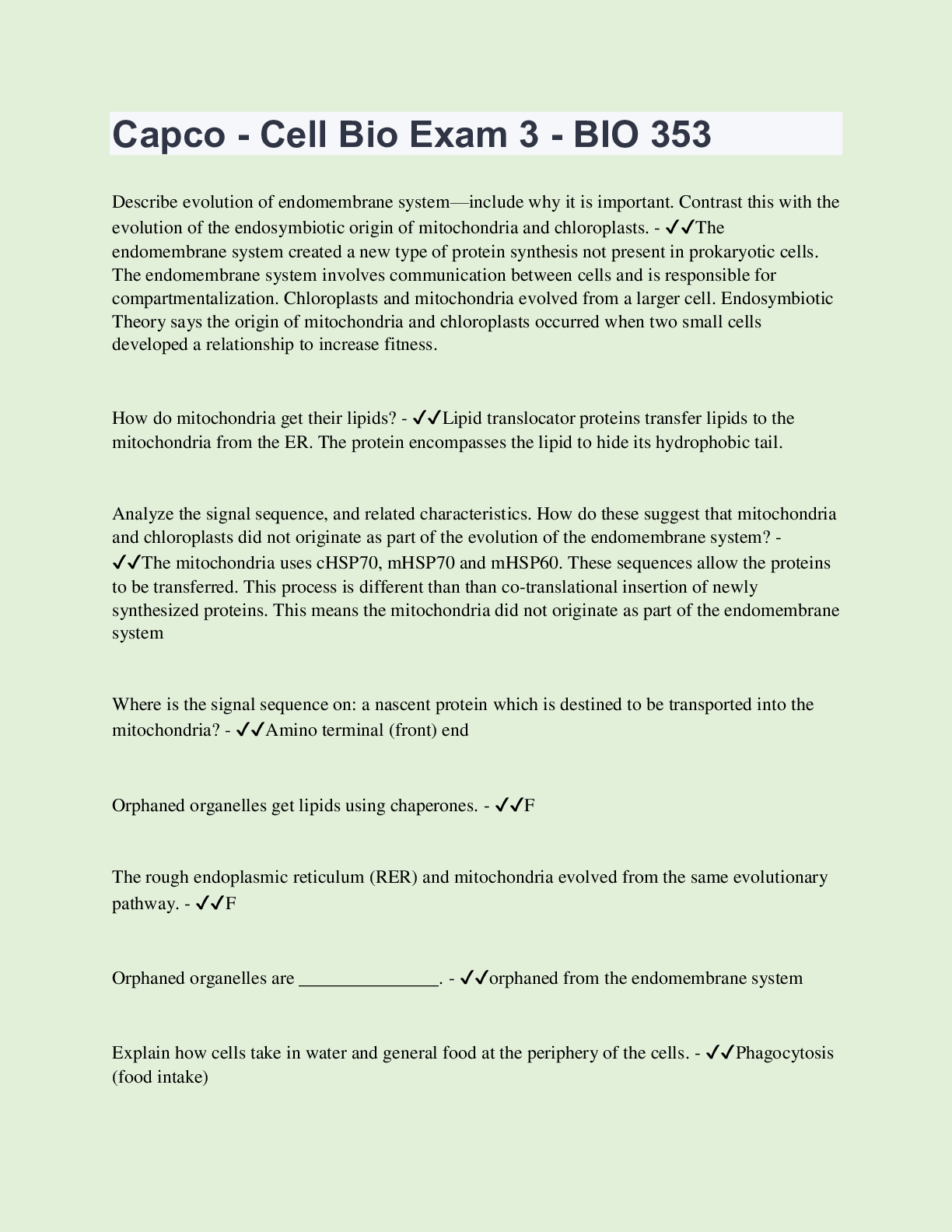
Describe evolution of endomembrane system—include why it is important. Contrast this with the
evolution of the endosymbiotic origin of mitochondria and chloroplasts. - ✔✔The
endomembrane system created a new type of protein synthesis not present in prokaryotic cells.
The endomembrane system involves communication between cells and is responsible for
compartmentalization. Chloroplasts and mitochondria evolved from a larger cell. Endosymbiotic
Theory says the origin of mitochondria and chloroplasts occurred when two small cells
developed a relationship to increase fitness.
How do mitochondria get their lipids? - ✔✔Lipid translocator proteins transfer lipids to the
mitochondria from the ER. The protein encompasses the lipid to hide its hydrophobic tail.
Analyze the signal sequence, and related characteristics. How do these suggest that mitochondria
and chloroplasts did not originate as part of the evolution of the endomembrane system? -
✔✔The mitochondria uses cHSP70, mHSP70 and mHSP60. These sequences allow the proteins
to be transferred. This process is different than than co-translational insertion of newly
synthesized proteins. This means the mitochondria did not originate as part of the endomembrane
system
Where is the signal sequence on: a nascent protein which is destined to be transported into the
mitochondria? - ✔✔Amino terminal (front) end
Orphaned organelles get lipids using chaperones. - ✔✔F
The rough endoplasmic reticulum (RER) and mitochondria evolved from the same evolutionary
pathway. - ✔✔F
Orphaned organelles are _______________. - ✔✔orphaned from the endomembrane system
Explain how cells take in water and general food at the periphery of the cells. - ✔✔Phagocytosis
(food intake)
[Show More]