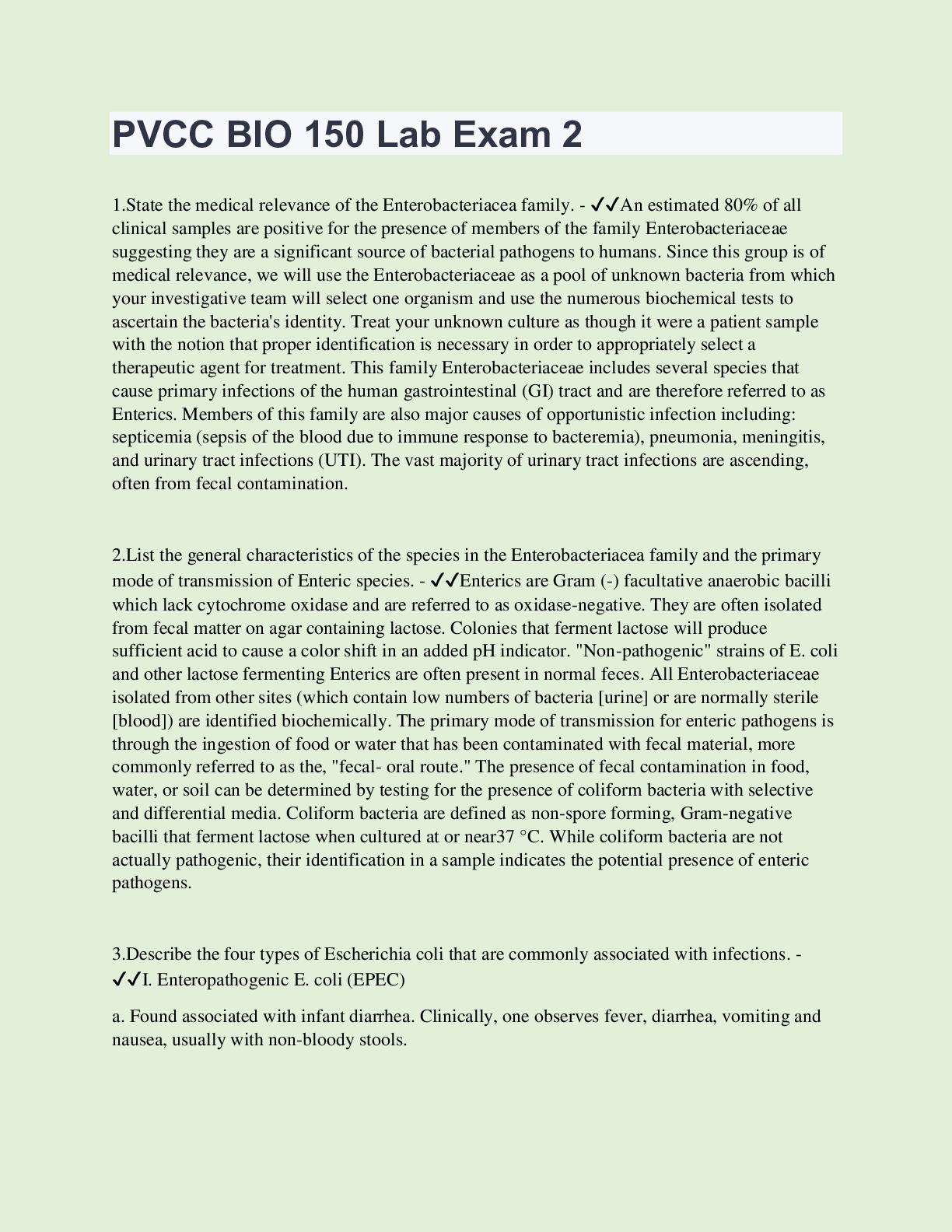
1.State the medical relevance of the Enterobacteriacea family. - ✔✔An estimated 80% of all
clinical samples are positive for the presence of members of the family Enterobacteriaceae
suggesting they are a significant so
...
1.State the medical relevance of the Enterobacteriacea family. - ✔✔An estimated 80% of all
clinical samples are positive for the presence of members of the family Enterobacteriaceae
suggesting they are a significant source of bacterial pathogens to humans. Since this group is of
medical relevance, we will use the Enterobacteriaceae as a pool of unknown bacteria from which
your investigative team will select one organism and use the numerous biochemical tests to
ascertain the bacteria's identity. Treat your unknown culture as though it were a patient sample
with the notion that proper identification is necessary in order to appropriately select a
therapeutic agent for treatment. This family Enterobacteriaceae includes several species that
cause primary infections of the human gastrointestinal (GI) tract and are therefore referred to as
Enterics. Members of this family are also major causes of opportunistic infection including:
septicemia (sepsis of the blood due to immune response to bacteremia), pneumonia, meningitis,
and urinary tract infections (UTI). The vast majority of urinary tract infections are ascending,
often from fecal contamination.
2.List the general characteristics of the species in the Enterobacteriacea family and the primary
mode of transmission of Enteric species. - ✔✔Enterics are Gram (-) facultative anaerobic bacilli
which lack cytochrome oxidase and are referred to as oxidase-negative. They are often isolated
from fecal matter on agar containing lactose. Colonies that ferment lactose will produce
sufficient acid to cause a color shift in an added pH indicator. "Non-pathogenic" strains of E. coli
and other lactose fermenting Enterics are often present in normal feces. All Enterobacteriaceae
isolated from other sites (which contain low numbers of bacteria [urine] or are normally sterile
[blood]) are identified biochemically. The primary mode of transmission for enteric pathogens is
through the ingestion of food or water that has been contaminated with fecal material, more
commonly referred to as the, "fecal- oral route." The presence of fecal contamination in food,
water, or soil can be determined by testing for the presence of coliform bacteria with selective
and differential media. Coliform bacteria are defined as non-spore forming, Gram-negative
bacilli that ferment lactose when cultured at or near37 °C. While coliform bacteria are not
actually pathogenic, their identification in a sample indicates the potential presence of enteric
pathogens.
3.Describe the four types of Escherichia coli that are commonly associated with infections. -
✔✔I. Enteropathogenic E. coli (EPEC)
a. Found associated with infant diarrhea. Clinically, one observes fever, diarrhea, vomiting and
nausea, usually with non-bloody stools.
[Show More]








.png)


.png)

