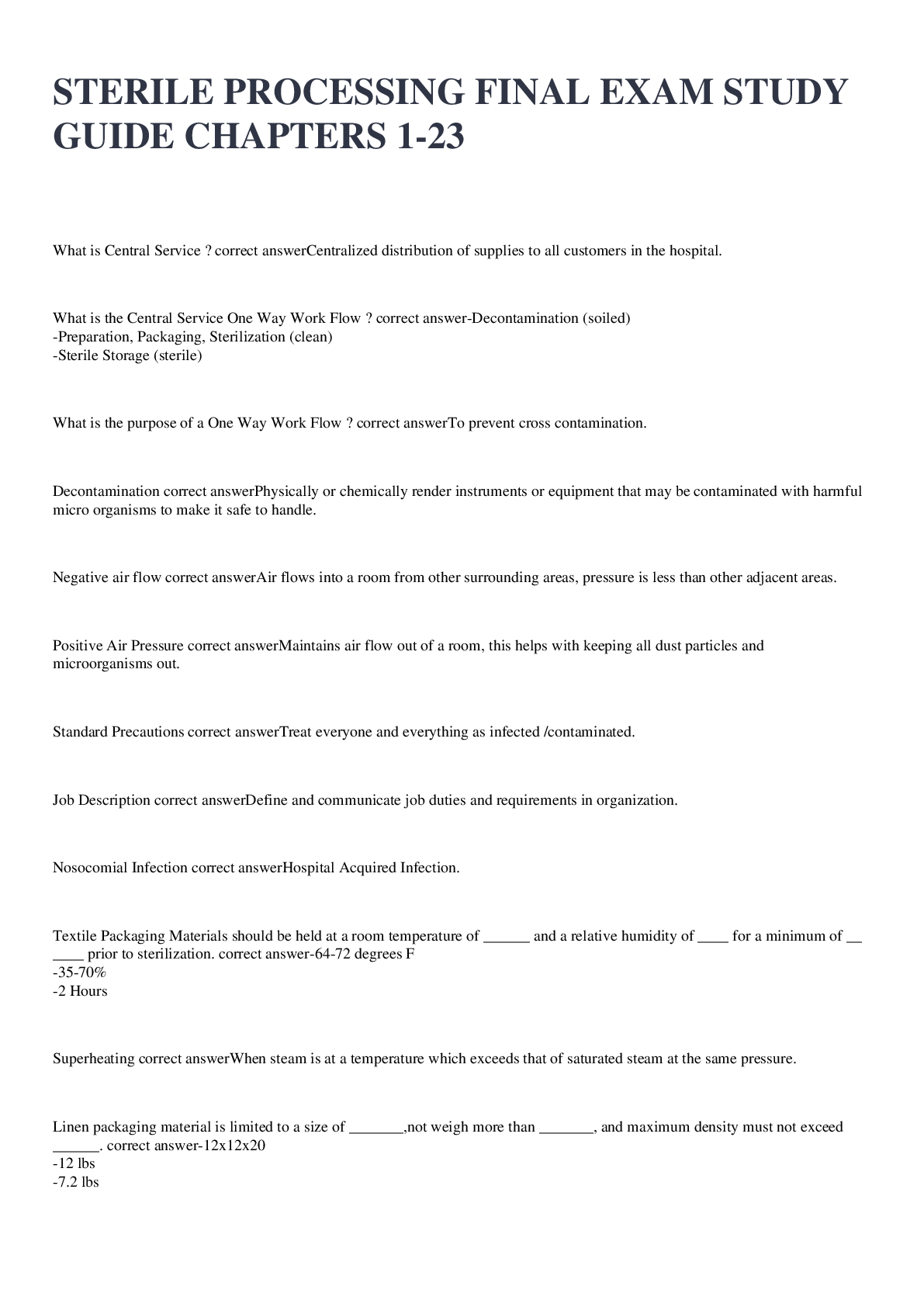
What is Central Service ? - ANSWER Centralized distribution of supplies to all customers in the hospital.
What is the Central Service One Way Work Flow ? - ANSWER -Decontamination (soiled)
-Preparation, Packaging, St
...
What is Central Service ? - ANSWER Centralized distribution of supplies to all customers in the hospital.
What is the Central Service One Way Work Flow ? - ANSWER -Decontamination (soiled)
-Preparation, Packaging, Sterilization (clean)
-Sterile Storage (sterile)
What is the purpose of a One Way Work Flow ? - ANSWER To prevent cross contamination.
Decontamination - ANSWER Physically or chemically render instruments or equipment that may be contaminated with harmful micro organisms to make it safe to handle.
Negative air flow - ANSWER Air flows into a room from other surrounding areas, pressure is less than other adjacent areas.
Positive Air Pressure - ANSWER Maintains air flow out of a room, this helps with keeping all dust particles and microorganisms out.
Standard Precautions - ANSWER Treat everyone and everything as infected /contaminated.
Job Description - ANSWER Define and communicate job duties and requirements in organization.
Nosocomial Infection - ANSWER Hospital Acquired Infection.
Textile Packaging Materials should be held at a room temperature of ______ and a relative humidity of ____ for a minimum of __ ____ prior to sterilization. - ANSWER -64-72 degrees F
-35-70%
-2 Hours
Superheating - ANSWER When steam is at a temperature which exceeds that of saturated steam at the same pressure.
Linen packaging material is limited to a size of _______,not weigh more than _______, and maximum density must not exceed ______. - ANSWER -12x12x20
-12 lbs
-7.2 lbs
What is a wet pack? - ANSWER Containers with moisture after the sterilization process is complete.
What are the 2 flat wrapping techniques and the 2 folds? - ANSWER -Sequential
-Simultaneous
-Square Fold
-Envelope Fold
Wrapped pans of instruments should not exceed ____ in weight. - ANSWER 16 lbs
What is the maximum weight for containerized instrument sets recommended by AAMI/ANSI? - ANSWER 25 lbs
Wrapped basin sets should not exceed _____. - ANSWER 7 lbs
Sterility (time-related) - ANSWER Package is considered sterile until a specific expiration date is reached.
Sterility (event-related) - ANSWER Items are considered sterile unless the integrity of the packaging is compromised or suspected of being compromised.
Name the 4 things that event-related sterility depends on. - ANSWER 1. Quality of the wrapping material.
2. Handling procedures.
3. Storage and transport conditions.
4. Number of times the package has been handled (4 times).
Name 4 concerns when it comes to packaging. - ANSWER 1. Moisture contamination.
2. Dirt, Dust, and Debris.
3. Physical damage.
4. Breakdown of packaging material due to wear of age.
Sterile Storage standards, temperatures should be at ______ and relative humidity should be less than ____. - ANSWER - 64-75 degrees F
- 75%
Sterile storage standards, sterile items should be stored at least ___ away from exterior walls, ______ above the floor and from the ceiling. - ANSWER -2 inches
-8-10 inches
What is Passivation? - ANSWER A chemical process applied during instrument manufacture that provides a corrosion-resistant finish by forming a thin transparent oxide film.
Scissors 4 1/2" and larger use a ____ test material and scissors 4" or smaller use ______ material to check blades for sharpness. - ANSWER -red
-yellow
____ ____ are tested with an index card at least 5 times. ______ should be tested using 3"x 5" index cards. - ANSWER -Bone cutters
-Rongeurs
Name at least 10 of the 15 solutions that can damage surgical instruments. - ANSWER 1. Saline
2. Betadine
3. Peroxide
4. Dish soaps
5. Soaking in water
6. Soaking in saline
7. Bleach
8. Iodine
9. Hand soaps
10. Laundry detergents.
How is an eraser test performed? Explain and be specific. - ANSWER After a stain is discovered, use the eraser to remove the discoloration, look at the metal below the discoloration to determine if there are any tiny pit marks. If pit marks are discovered, this is corrosion. Take instruments out of rotation.
Why do we use lubricants on instruments? Where is it applied? Please explain. - ANSWER -Extends the life of instruments and makes it easier for surgeon to use.
-Lubricants are applied at instruments' hinged area or any working component such as a moving/sliding area.
Name the 9 body systems. - ANSWER 1. Skeletal
2. Muscular
3. Nervous
4. Endocrine
5. Reproductive
6. Urinary/Excretory
7. Respiratory
8. Digestive
9. Circulatory
Cells reproduce by a phase called ______. - ANSWER Mitosis.
What are the 5 main functions of the skeletal system ? - ANSWER 1. Give the body shape and support.
2. Allow movement.
3. Protect vital organs.
4. Reproduce vital organs.
5. Store calcium.
What are the different types of joints? - ANSWER -Gliding joints
-Ball and socket joints
-Pivot joints
-Hinge joints
What are the 3 membranes that surround the brain and provide nourishment and protection? - ANSWER 1. Pia mater (inner)
2. Arachnoid mater (middle)
3. Dura mater (outer)
The brain is divided into 3 parts, what are they? - ANSWER 1. Cerebrum (largest portion)
2. Cerebellum
3. Brain Stem
What is the primary function of the Endocrine System? - ANSWER To secrete hormones.
The pancreas has 2 primary hormones that it produces, what are they? What is their function? - ANSWER 1. Insulin- reduces the level of sugar in the blood stream.
2. Glucagon- increases the blood sugar level.
What is the alimentary canal? What does it consists of? - ANSWER Pathway that food takes through the digestive system.
Consists of; mouth, esophagus, stomach, small intestine, large intestine, rectum, and anus.
What is plasma? - ANSWER A yellow fluid that contains dissolved proteins, glucose, clotting factors, minerals and hormones.
What are the 4 chambers of the heart? - ANSWER 1. Left Atria (upper)
2. Right Atria (upper)
3. Left Ventricle (lower)
4. Right Ventricle (lower)
Bacteria are often classified by their what? - ANSWER -Shape
-Color change
-Need for oxygen
What are the 2 common stain tests? - ANSWER -Gram stain (purple is gram positive) (pink is gram negative)
-Ziehl-Nelson (acid-fast stain) (bright red)
_______ likes cold temperatures, ______ likes moderate temperatures, and _______ likes warm temperatures. - ANSWER -Psychrophiles
-Mesophiles
-Thermophiles
What does MRSA stand for? - ANSWER Methicillin-Resistant Staphylococcus aureus
What does VRE stand for? - ANSWER Vancomycin-Resistant Eneterococcus
How do bacteria reproduce? - ANSWER By a process called Binary fission.
What is the chain of infection? Please explain. - ANSWER 1. Causative agent- microorganism that causes infection
2. Reservoir of the agent- where infectious agent stays
3. Portal of Exit- where infectious agent leaves
4. Mode of transmission- method of transfer from reservoir to a susceptible host
5. Portal of Entry- path used to enter susceptible host
6. Susceptible Host- Person fighting off infection
What does FDA regulate? - ANSWER The manufacturer of all medical devices.
What is the classification of medical devices? What is the risk? Does it require a 510k or pre-market approval? Please explain and give an example of each. - ANSWER 1. Class I Medical devices-low risk, no pre-market approval. Ex:Ultrasonic cleaners
2. Class II Medical devices- medium risk, needs 510k.
Ex: Sterilizers
3. Class III Medical devices-high risk, requires pre-market approval.
Ex: Heart valves
What is a 510k application vs Pre-market approval ? - ANSWER -510k application is used when there are changes in the product.
-Pre-market approval is done when there is a new product being released.
Due to the Safe Medical Devices Act of 1990, healthcare facilities are required to report events to the FDA and manufacturer within ___ working days. - ANSWER 10
What are the categories for FDA recalls ? What is their risk? What can it cause? - ANSWER Class I-High risk, causes serious health/death
Class II-medium risk, causes temporary health problems
Class III-low risk, low chance of causing health issues
What is the Umbrella? Please illustrate. - ANSWER (U.N.S.A.F.E.J.O.E)
CDC - ANSWER Centers for Disease Control. Federal agency that issues infection control guidelines.
EPA - ANSWER Environmental Protection Agency. Establishes in 1970 to enforce federal laws pertaining to air and water pollution and other environmentally related statues.
DOT - ANSWER Department of Transportation. Federal agency that regulates labeling and containment of hazardous waste, biohazard items and minimally processed items for transport.
OSHA - ANSWER Occupational Safety and Health Administration. Primary role is to protect workers from conditionally caused illnesses and injuries.
AAMI - ANSWER Association for the Advancement of Medical Instrumentation. Develops recommended practices and standards.
ANSI - ANSWER American National Standards Institute. Standards are submitted to ANSI for approval, such as AAMI.
AORN - ANSWER Association of Operating Room Nurses. Dedicated to providing optimal care to the surgical patient.
APIC - ANSWER Association for professionals in Infection Control and Epidemiology. Voluntary international organization dedicated to the prevention and control of infections and related outcomes.
ISO - ANSWER International Standards Organization. Globally based non-governmental standards organization.
Joint Commission - ANSWER Independent non-profit organization, sets healthcare quality standards and protects patients and visitors, conducts inspections of healthcare facilities.
NFPA - ANSWER National Fire Protection Association. International association that works to reduce the burden of fire and other hazards; sets fire safety standards.
USP-NF - ANSWER United States Pharmacopeia-National Formulary. Sets standards for packaging, labeling, bacteriological purity, pH, and mineral content.
WHO - ANSWER World Health Organization. Combats infectious diseases and promotes the general health of the people of the world.
SGNA - ANSWER Society of Gastroenterology Nurses and Associates. A non-profit organization that collects information and establishes standards and guidelines relating to the processing of flexible endoscopes.
IAHCSMM - ANSWER International Association of Healthcare Central Service Material Management
At what length should fingernails be maintained and y? - ANSWER 1/4" or less because they may harbor microorganisms.
What is the temperature, humidity, and air exchange in each area of CPD? - ANSWER -Decontamination: temp is 60-65 degrees F, humidity is 30-60%, air exchanges is 10 per hour.
-Prep and Pack: temp is 68-73 degrees F, humidity is 30-60%, air exchanges is 10 per hour.
-Sterile storage: temp is 75 degrees or lower, humidity is less than 75%, air exchanges is 4 per hour.
What do you wear in the different areas ? - ANSWER -Decon: scrubs, hair cover, shoe cover, gown, eye goggles, face shield, gloves, and face mask.
-Assembly and Sterile storage: scrubs and hair cover.
-OR: scrubs, hair cover, and face mask may be required.
-Normal traffic areas: regular street attire.
Fomites - ANSWER Inanimate objects that can transmit bacteria.
Any items brought in by the vendors should be kept in the __________. - ANSWER Breakout area
Asepsis - ANSWER The absence of microorganisms tat cause disease.
Aseptic Technique - ANSWER Any activity or procedure that prevents infection or breaks the chain of infection.
Medical Asepsis - ANSWER Procedures performed to reduce the number of microorganisms or minimize their spread.
Surgical Asepsis - ANSWER Procedures performed to eliminate the presence of all microorganisms and/or to prevent the introduction of microorganisms into an area.
What are the 5 basic principles of Asepsis? - ANSWER 1. Know what is dirty.
2. Know what is clean.
3. Know what is sterile.
4. Keep the 3 conditions seperate.
5. Remedy contamination immediately.
Conductivity - ANSWER A measurement of the ability of water to carry an electric current.
What causes hard water stains ? - ANSWER Calcium and Magnesium
What causes rainbow stains on stainless steel? - ANSWER Silicates
Purified water should have a pH of _____. - ANSWER 6.5-7.5
What is the level of Silicates in water used for cleaning ? - ANSWER 100 ppm or less
What is the level of Chloride ? - ANSWER 100 ppm
What is Reverse Osmosis? - ANSWER The diffusion of water through a semi-permeable membrane to eliminate impurities in the water.
What are enzymes ? - ANSWER Catalysts that breakdown or "digest" large organic molecules to facilitate their removal.
Protease - ANSWER Enzymes that break down proteins.
Lipase - ANSWER Enzymes that break down fats.
Amylase - ANSWER Enzymes that break down starches.
Free Rinsing - ANSWER Removal of any residue of cleaning agents and chemicals remaining after the cleaning process.
What is the preferred transportation method ? Why? - ANSWER Closed transport system to avoid cross contamination.
Please fill in the blanks on the pH table. - ANSWER -_____ _______
-_____ _______
-_____ Neutral
-_____ _______
-_____ _______
Sequestering agent - ANSWER Chemicals that remove hard water minerals.
Surfactant - ANSWER A surface-acting agent that lowers the surface tension of a liquid so it can penetrate deeper.
Chelating agent - ANSWER Chemicals that hold hard water minerals in solution and prevent soaps or detergents from reacting with minerals.
3-sink setup - ANSWER 1. Wash sink-water and detergent
[Show More]