1. Which feature of managerial accounting improves a company's ability to plan and control operations?
A. It provides earnings per share data
B. It allows comparability across business
C. It requires strict adherenc
...
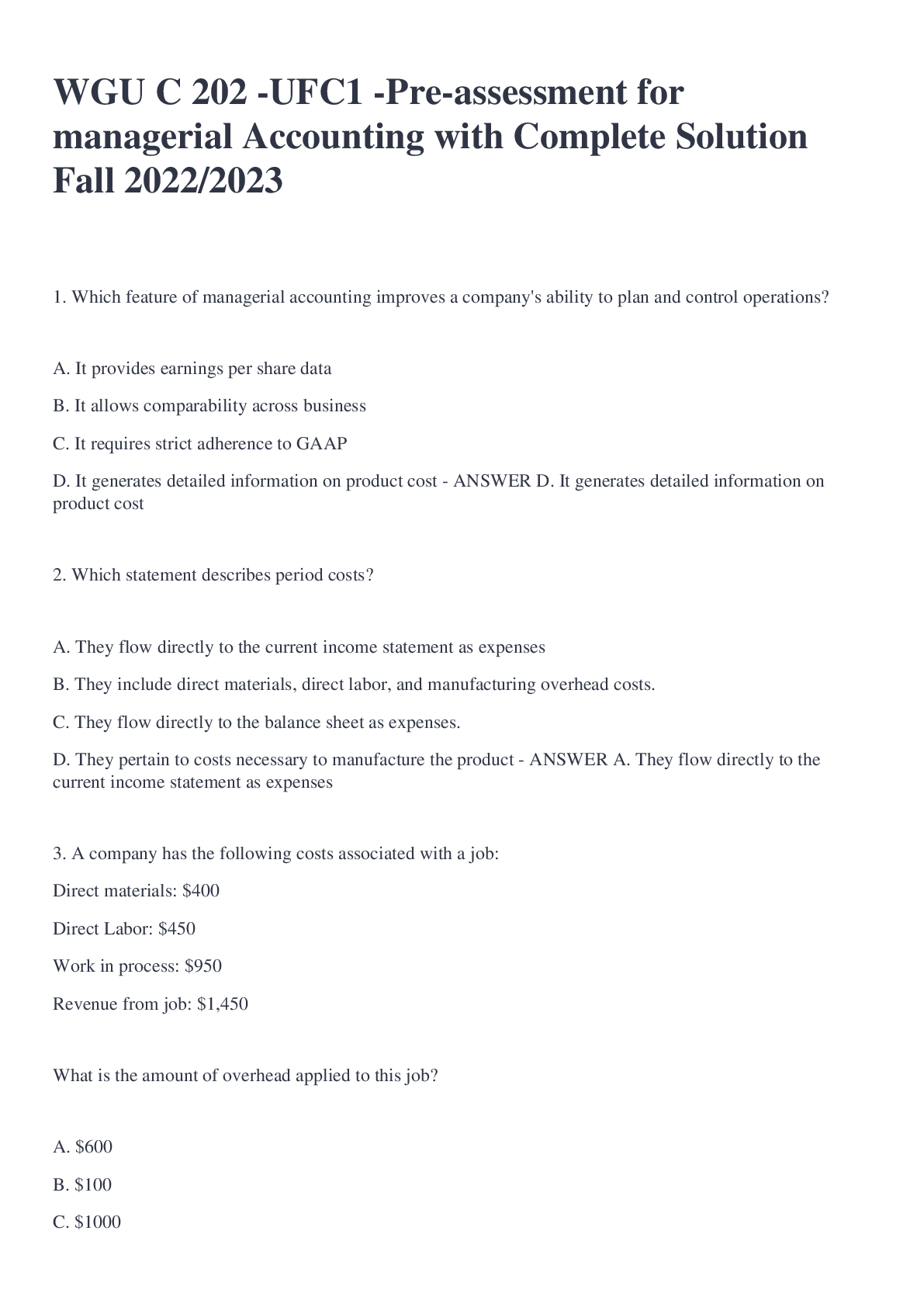
1. Which feature of managerial accounting improves a company's ability to plan and control operations?
A. It provides earnings per share data
B. It allows comparability across business
C. It requires strict adherence to GAAP
D. It generates detailed information on product cost - ANSWER D. It generates detailed information on product cost
2. Which statement describes period costs?
A. They flow directly to the current income statement as expenses
B. They include direct materials, direct labor, and manufacturing overhead costs.
C. They flow directly to the balance sheet as expenses.
D. They pertain to costs necessary to manufacture the product - ANSWER A. They flow directly to the current income statement as expenses
3. A company has the following costs associated with a job:
Direct materials: $400
Direct Labor: $450
Work in process: $950
Revenue from job: $1,450
What is the amount of overhead applied to this job?
A. $600
B. $100
C. $1000
D. $500 - ANSWER B. $100 (400+450=850 950-850=100)
4. Management wants to assess how many units must be sold to earn a profit. The most useful analysis will separate costs into which categories?
A. Fixed and variable
B. Product and period
C. Controllable and not controllable
D. Direct and indirect - ANSWER A. Fixed and variable
5. A manufacturing company budgeted for $1,240,000 in manufacturing overhead and expected 400,000 direct labor hours. Actual overhead was $1,200,000 and actual direct labor hours were 390,000.
Was manufacturing overhead over - or under applied and by how much?
A. Over applied by $9000
B. Underapplied by $9000
C. Over applied by $40000
D. Underapplied by $40000 - ANSWER A. Over applied by $9000
6. Cost of good manufactured equals $87,000 for the year. Finished good inventory is $10,000 at the beginning of the year and $4,000 at the end of the year. Beginning and ending work in progress are $4,000 and $5,000 respectively.
How much is cost of goods sold for the year?
A. $97,000
B. $83,000
C. $87,000
D. $93,000 - ANSWER COGS = Beg. Finished goods+COGM=Finished good available for sale-End. Finished goods Inventory
10,000+87,000=97,000 = Finished goods available for sale
=97,000-4,000=
D. $93,000
7. Using direct labor hours as the allocation base, what is the predetermined overhead rate?
A. $20.65 per direct labor hour
B. $24.44 per direct labor hour
C. $20.56 per direct labor hour
D. $26.09 per direct labor hour - ANSWER Predetermined Overhead Rate (POR)
Estimated Overhead Costs / Estimated Activity Base
$22,000/900
B. $24.44 per direct labor hour
8. What is the company's adjusted cost of goods sold?
A. $682,000
B. $778,000
C. $1,098,000
D. $1,050,000 - ANSWER Adjusting Cost of Goods Sold
COGS - overapplied overhead
COGS + underapplied overhead
A. $682,000
9. The company transferred $918,000 of completed goods out of the work process during the year. The overhead is under-applied by $3,000. What is the adjusted cost of goods sold for the year?
A. $946,000
B. $923,000
C. $920,000
D. $926,000 - ANSWER COGS = Beginning Finished Goods Inventory ($28,000) + Cost of Goods Manufactured ($918,000) = Finished Good Available for sale ($946,000) - Ending finished goods inventory ($23,000) = $923,000
Adjusted COGS =
COGS - overapplied overhead
COGS + underapplied overhead ($3,000)=
D. $926,000
10. What is the cost per equivalent unit for materials of the weighted cost method is used?
A. $10
B. $8
C. $3
D. $11 - ANSWER Beg Work In Process ($20,000) + Costs added this period ($80,000) = Total Costs ($100,000) divided by Total equivalent units (10,000) = $10
A. $10
11. What is the emphasis of activity-based costing systems?
A. Continuous production
B. Individual activities
C. Raw material purchase
D. Department indirect cost rates - ANSWER B. Individual activities
12. Which common activity cost pool is driven by number units of produced?
A. Order processed
B. Customers served
C. Units assembled
D. Employees engaged - ANSWER C. Units assembled
13 . Product D uses 3 setups, 3,000 direct labor hours, and 8,000 square feet. What is the total overhead cost that should be assigned to product D?
A. $520,000
B. $300,000
C. $160,000
D. $360,000 - ANSWER Step1: reduce each cost driver to 1 per units, then multiply by the # of units provided in the questions. 3/6000, 3000/300000, 8000/160000 = Add costs (denominator) = 520
A. $520,000
14. What are the relevant costs in the managerial decision-making process?
A. Depreciation costs
B. Sunk costs
C. Opportunity costs
D. Historical costs - ANSWER C. Opportunity costs
15. Which cost behavior pattern is depicted in the graph above?
A. Mixed costs
B. Sunk costs
C. Fixed costs
D. Variable Costs - ANSWER D. Variable Costs
16. The retailer sells its coats for $150 each. Selling expenses consist of commission of $5 per coat plus fixed costs. Each coat costs $62.50 from the distributor. Administrative expenses consist of a variable component equal to 5% of sales plus fixed costs. In order to increase net operating income in the coming year, management is considering increasing advertising expenses.
What would be the total contribution margin reported on this retailer's contribution format income statement?
A. $300,000
B. $550,000
C. $350,000
D. $212,000 - ANSWER Unit sold = $600000/$150=4000
Revenue = $150-$62.50 = $87.50x4000=$350,000
Selling variable = $5x4000 = $20000
Admin Variable = .05x600000=$30,000
CM = $350,000-$30000-$20000
A. $300,000
17. What is the contribution margin?
A. $140,000
B. $280,000
C. $400,000
D. $100,000 - ANSWER Contribution margin (CM) is the amount of revenue remaining after deducting variable costs.
A. $140,000
18. A company sells a product for $18 per unit. the variable cost is $6 per unit. The company has fixed costs of $42,000.
How many units must it sell in order to break even?
A. 3,500
B. 2,334
C. 7,000
D. 1,750 - ANSWER BEP $ = Fixed Costs / CMR
A. 3,500
19. If the sales price is increased to $50 per unit and nothing else changes, how much will net income increase?
A. $900,000
B. $60,000
C. $1,500,000
D. $1,050,000 - ANSWER B. $60,000
20. If fixed costs decreased to $120,000, what is the break-even point in units?
Round up to the nearest whole unit.
A. 3,125 Units
B. 2,500 Units
C. 4,546 Units
D. 3,637 Units - ANSWER (Q)sales = (Q)Variable Costs - Fixed Costs
Q48=Q15-$120,000
Q48-Q15=$120,000
Q33=$120,000
Q=$120,000/33=
D. 3,637 Units
21. Why does direct labor cost affect the make or buy decision?
A. It is an opportunity cost.
B. It is a variable cost.
C. It is a mixed cost.
D. It is an overhead cost. - ANSWER B. It is a variable cost.
22. Last year a company spent $25 per unit to make widgets. This year, however, the cost has increased to $40 per unit. The company has recently learned it can buy widgets for $38 per unit.
Which differential cost should be considered for this make or buy decision?
A. $2 per unit
B. $13 per unit
C. $25 per unit
D. $15 per unit - ANSWER A. $2 per unit
23. The company receives a request from a large buyer to purchase 12,000 feeders at a reduced price. What is the minimum price per unit that the company should charge for this order?
A. $9
B. $20
C. $15
D. $18 - ANSWER 9+6+3per unit =
D. $18
24. It costs a company $6 of variable costs to produce one flag, which normally sells for $20. A customer offers to purchase 30,000 at $10 each. The company would still incur special shipping cost of $1 per flag if the order were accepted. The company has sufficient unused capacity to produce the 30,000 flags. The company is currently profitable.
If the special order is accepted, what will the increase in net income be?
A. $120,000
B. $300,000
C. $30,000
D. $90,000 - ANSWER Revenue (30,000x$10)=$300,000
- Costs (30,000x$7) = $210,000=
D. $90,000
25. A company is deciding whether equipment currently in use should be replaced by new equipment.
Which information is relevant to this decision?
A. The net book value of the new equipment
B. The salvage value of the new equipment
C. The cost of the new equipment
D. the annual cost of depreciation - ANSWER C. The cost of the new equipment
26. Should the company eliminate or keep the segment?
A. Eliminate the segment since the contribution margin of the segment is $1,725 less than total allocated expenses.
B. Keep the segment since the segment's total avoidable expenses are $4,500
C. Eliminate the segment since unavoidable expenses are $2,250 of fixed costs.
D. Keep the segment since eliminating it will result in a $4,575 reduction in net income compare to this existing business - ANSWER D. Keep the segment since eliminating it will result in a $4,575 reduction in net income compare to this existing business
27. A company has the capacity to produce 20,000 units of its product per year. It is currently only producing 13,000 unit per year, with a sell price of $70 per unit. A customer has placed a special order for 6,500 units at $62 per unit. The incremental cost of accepting the special order is $382,000. Should the company accept the special order?
A. Yes, because the incremental contribution margin would be $21,000
B. Yes, because the incremental contribution margin would be $73,000
C. No, because the incremental contribution margin would be $53,000
D. No, because the incremental contribution margin would be $32,000 - ANSWER A. Yes, because the incremental contribution margin would be $21,000
28. A company has inventory that cost $50,000. Its scrap value is $65,000. The inventory could be sold for $150,000 if manufactured further at an additional cost of $80,000. What should the company do?
A. Hold the inventory at $50,000
B. Reclassify the inventory as a $80,000 bad debt expense
C. Sell the inventory for $65,000 scrap value
D. Manufacture further and sell it for $150,000 - ANSWER D. Manufacture further and sell it for $150,000
29. A company produces a product that currently cost $8 in variable costs and $2 in fixed costs. It sells the product for $14. If processed further, the company will spend an additional $6 in variable costs and $2 in fixed costs. Each unit would then be sold for $24. Why would the company choose to process further?
A. Incremental net income will be $6/unit
B. Incremental fixed cost income will be $4/unit
C. Incremental profit will be $2/unit
D. Incremental revenue will be $24/unit - ANSWER C. Incremental profit will be $2/unit
30. How can a reliable budgeting system be identified?
A. It provides data on earnings and savings trends.
B. It provides information on historical borrowing and spending
C. It facilitates the make or buy decision
D. It provides for effective planning and control - ANSWER D. It provides for effective planning and control
31. 20% of the sales are for cash, and 80% are on credit. 25% of the credit sales are collected in the month of the sale, and 75% are collected the next month. What are the expected cash receipts during September?
A. $287,500
B. $250,000
C. $275,000
D. $262,500 - ANSWER A. $287,500
32. The budget committee of a manufacturer has just completed its sales budget. Which budget should be prepared next?
A. Selling expense budget
B. Production budget
C. Merchandise budget
D. Cash budget - ANSWER B. Production budget
33. Which budget is the basis for all other budgets created in the budgeting process?
A. Production budget
B. Sales budget
C. Cash budget
D. Inventory purchases budget - ANSWER B. Sales budget
34. The following is a list of budgets in the master budget:
Balance sheet
Cash
Direct material
Direct labor
Ending inventory
Income statement
Manufacturing overhead
Production
Sales
General & administrative expense
Which type of budget include depreciation on factory equipment?
A. Direct labor budget
B. Manufacturing overhead budget
C. Production budget
D. Sales budget - ANSWER B. Manufacturing overhead budget
35. Which budget is designed for changes in revenue and costs?
A. Selling expense budget
B. Static budget
C. Flexible budget
D. Production budget - ANSWER C. Flexible budget
36. A budget committee for a merchandising firm has just completed its sales budget. The committee knows its budgeted beginning and ending inventory. Which additional item from the sales budget is needed to prepare the merchandise purchases budget?
A. Sales price
B. Production efficiency
C. Expected sales
D. Cash disbursements - ANSWER C. Expected sales
37. Which budget uses the results calculated in the direct labor budget?
A. Production budget
B. Cash budget
C. Sales budget
D. Manufacturing overhead budget - ANSWER B. Cash budget
38. Why is the sales budget important?
A. It drives multiple calculations in other budgets
B. It forecasts industry performance
C. It tells external analysts the company's future results
D. It demonstrates how fast the company collects its receivables - ANSWER A. It drives multiple calculations in other budgets
[Show More]

.png)
.png)
.png)

.png)