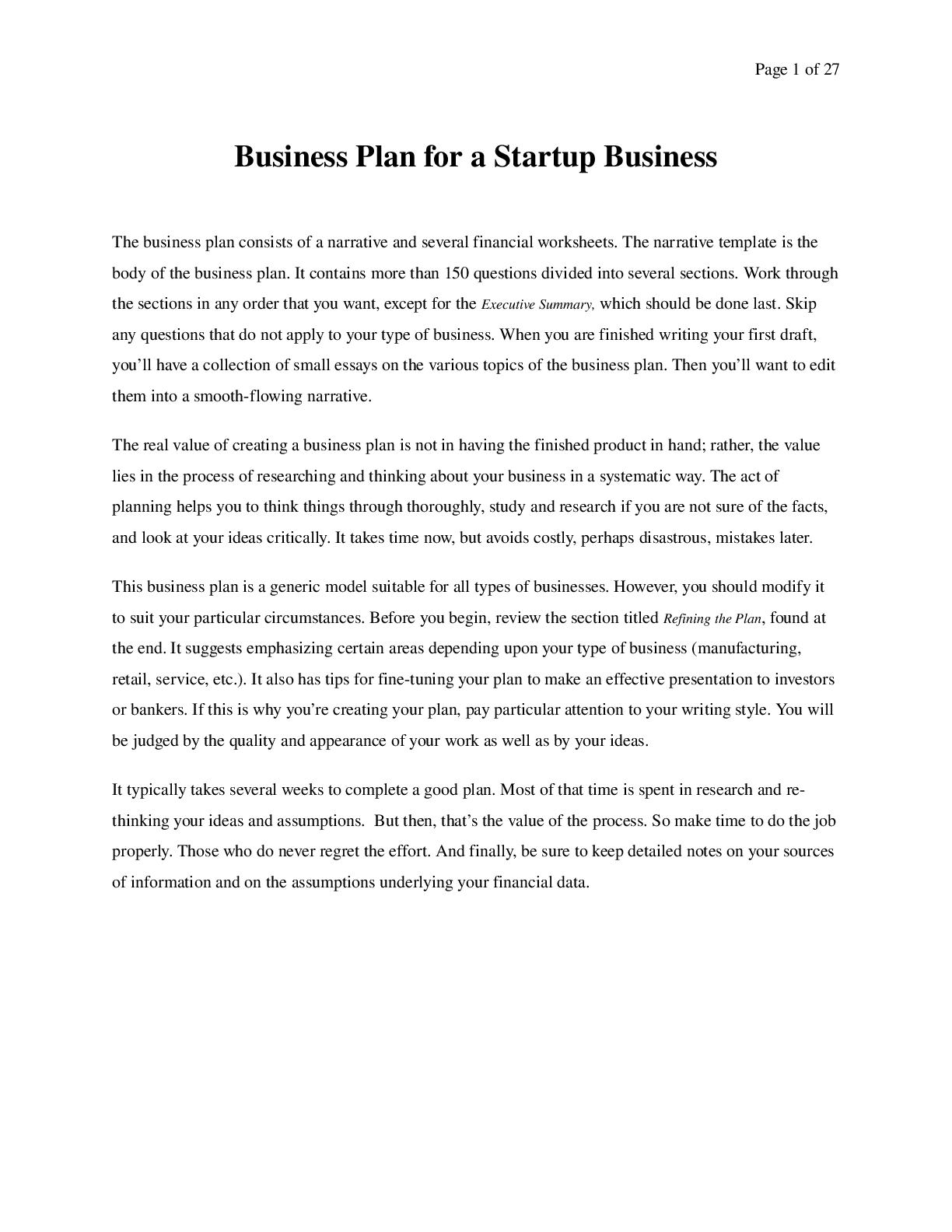
Business Plan for a Startup Business
The business plan consists of a narrative and several financial worksheets. The narrative template is the
body of the business plan. It contains more than 150 questions divided into
...
Business Plan for a Startup Business
The business plan consists of a narrative and several financial worksheets. The narrative template is the
body of the business plan. It contains more than 150 questions divided into several sections. Work through
the sections in any order that you want, except for the Executive Summary, which should be done last. Skip
any questions that do not apply to your type of business. When you are finished writing your first draft,
you’ll have a collection of small essays on the various topics of the business plan. Then you’ll want to edit
them into a smoothflowing narrative.
The real value of creating a business plan is not in having the finished product in hand; rather, the value
lies in the process of researching and thinking about your business in a systematic way. The act of
planning helps you to think things through thoroughly, study and research if you are not sure of the facts,
and look at your ideas critically. It takes time now, but avoids costly, perhaps disastrous, mistakes later.
This business plan is a generic model suitable for all types of businesses. However, you should modify it
to suit your particular circumstances. Before you begin, review the section titled Refining the Plan, found at
the end. It suggests emphasizing certain areas depending upon your type of business (manufacturing,
retail, service, etc.). It also has tips for finetuning your plan to make an effective presentation to investors
or bankers. If this is why you’re creating your plan, pay particular attention to your writing style. You will
be judged by the quality and appearance of your work as well as by your ideas.
It typically takes several weeks to complete a good plan. Most of that time is spent in research and rethinking your ideas and assumptions. But then, that’s the value of the process. So make time to do the job
properly. Those who do never regret the effort. And finally, be sure to keep detailed notes on your sources
of information and on the assumptions underlying your financial data.
Page 2 of 27
Business Plan
OWNERS
Your Business Name
Street Address
Address 2
City, ST ZIP Code
Telephone
Fax
EMail
Page 3 of 27
Table of Contents
Page 4 of 27
Summary
Write this section last.
We suggest that you make it two pages or fewer.
Include everything that you would cover in a fiveminute interview.
Explain the fundamentals of the proposed business: What will your product be? Who will your customers
be? Who are the owners? What do you think the future holds for your business and your industry?
Make it enthusiastic, professional, complete, and concise.
If applying for a loan, state clearly how much you want, precisely how you are going to use it, and how the
money will make your business more profitable, thereby ensuring repayment.
Page 5 of 27
General Company Description
What business will you be in? What will you do?
Mission Statement: Many companies have a brief mission statement, usually in 30 words or fewer,
explaining their reason for being and their guiding principles. If you want to draft a mission statement,
this is a good place to put it in the plan, followed by:
Company Goals and Objectives: Goals are destinations—where you want your business to be. Objectives
are progress markers along the way to goal achievement. For example, a goal might be to have a healthy,
successful company that is a leader in customer service and that has a loyal customer following.
Objectives might be annual sales targets and some specific measures of customer satisfaction.
Business Philosophy: What is important to you in business?
To whom will you market your products? (State it briefly here—you will do a more thorough explanation
in the Marketing Plan section).
Describe your industry. Is it a growth industry? What changes do you foresee in the industry, short term
and long term? How will your company be poised to take advantage of them?
Describe your most important company strengths and core competencies. What factors will make the
company succeed? What do you think your major competitive strengths will be? What background
experience, skills, and strengths do you personally bring to this new venture?
Legal form of ownership: Sole proprietor, Partnership, Corporation, Limited liability corporation (LLC)?
Why have you selected this form?
Page 6 of 27
Products and Services
Describe in depth your products or services (technical specifications, drawings, photos, sales brochures,
and other bulky items belong in Appendices).
What factors will give you competitive advantages or disadvantages? Examples include level of quality or
unique or proprietary features.
What are the pricing, fee, or leasing structures of your products or services?
Page 7 of 27
Marketing Plan
Market research Why?
No matter how good your product and your service, the venture cannot succeed without effective
marketing. And this begins with careful, systematic research. It is very dangerous to assume that you
already know about your intended market. You need to do market research to make sure you’re on track.
Use the business planning process a
[Show More]


.png)