NUR 2356\NUR2356 Multidimensional Care I Exam 1 MDC 1 Exam 1
Multidimensional Care I Exam 1
MDC 1 Exam 1
1. A nurse is preparing to initiate a bladder-retraining program for a client who has
incontinence. Which of th
...
NUR 2356\NUR2356 Multidimensional Care I Exam 1 MDC 1 Exam 1
Multidimensional Care I Exam 1
MDC 1 Exam 1
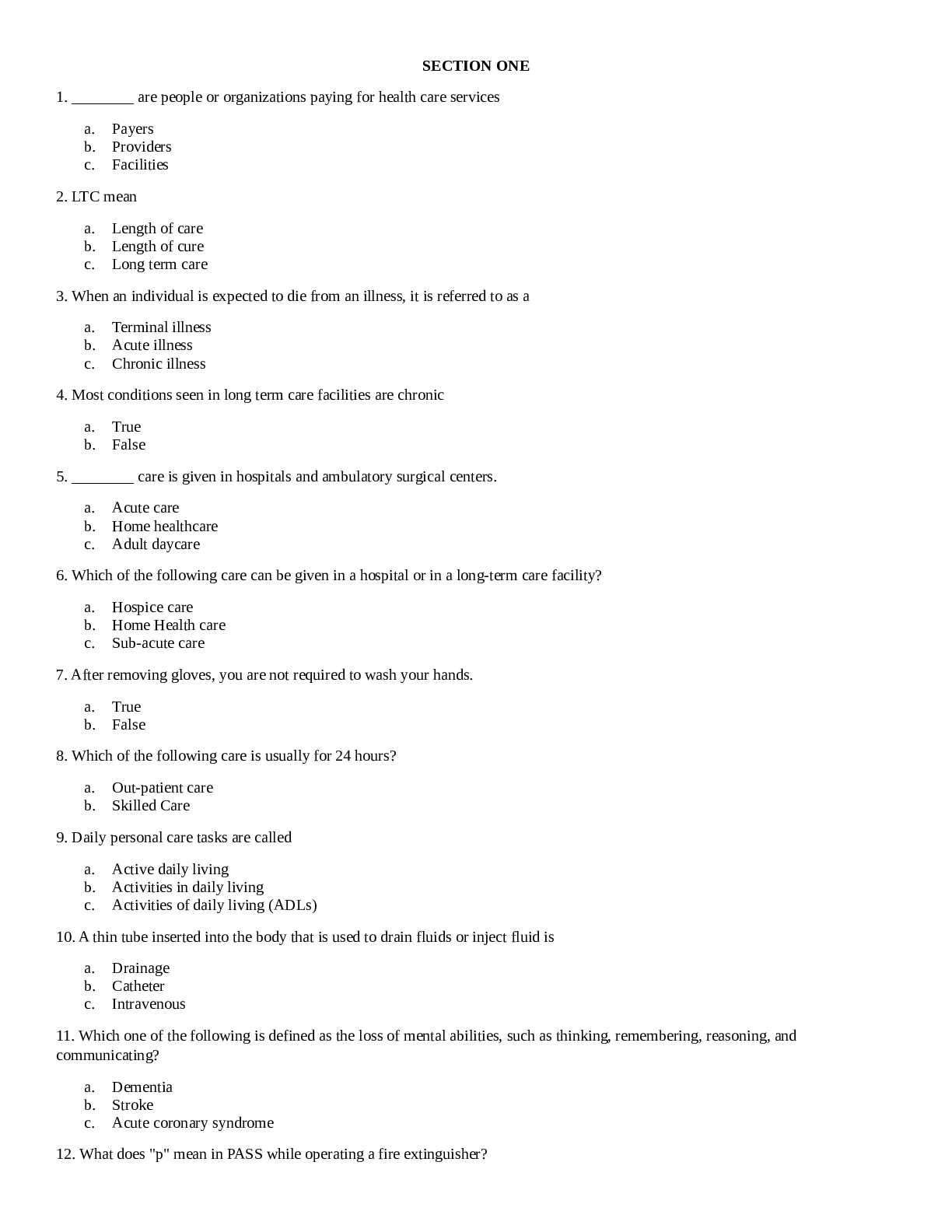
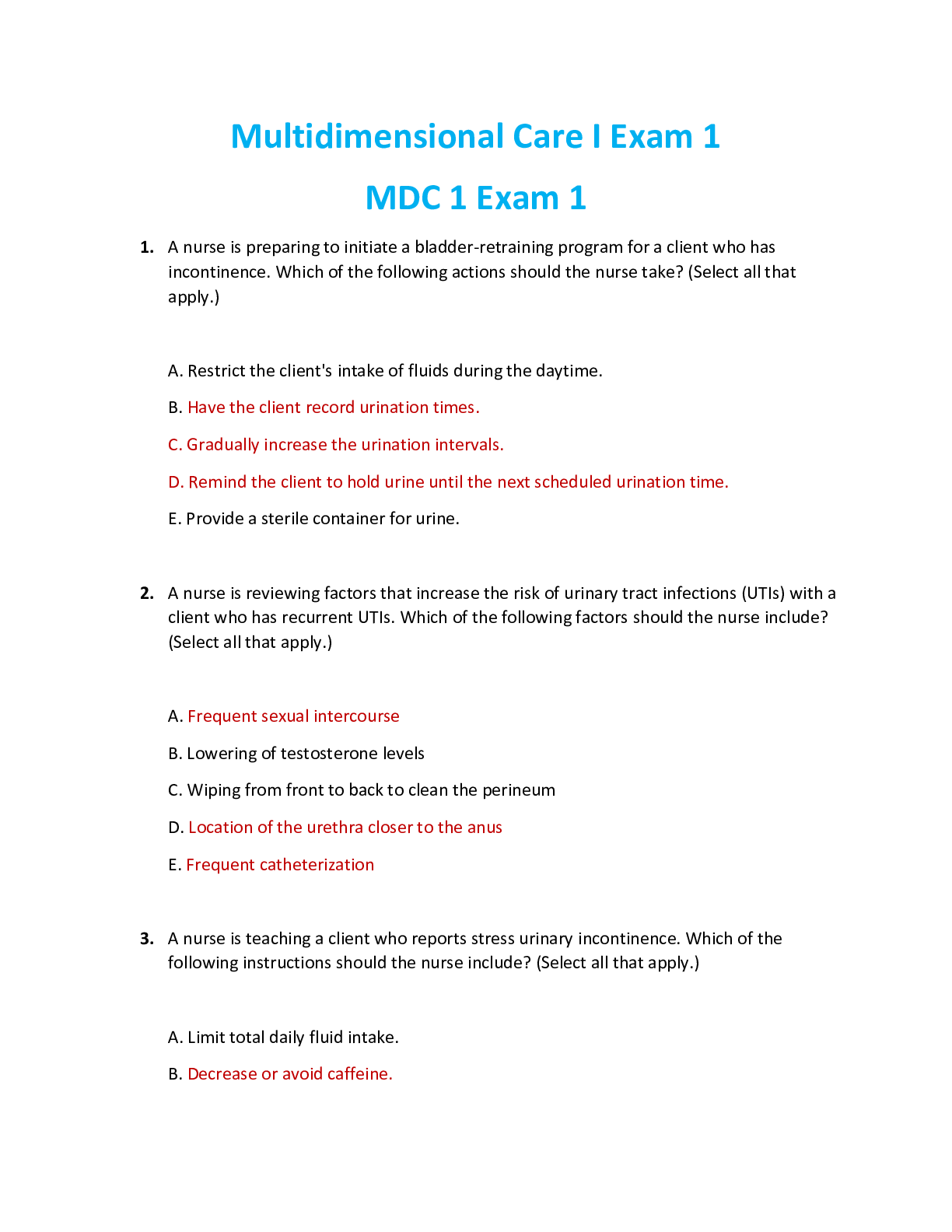
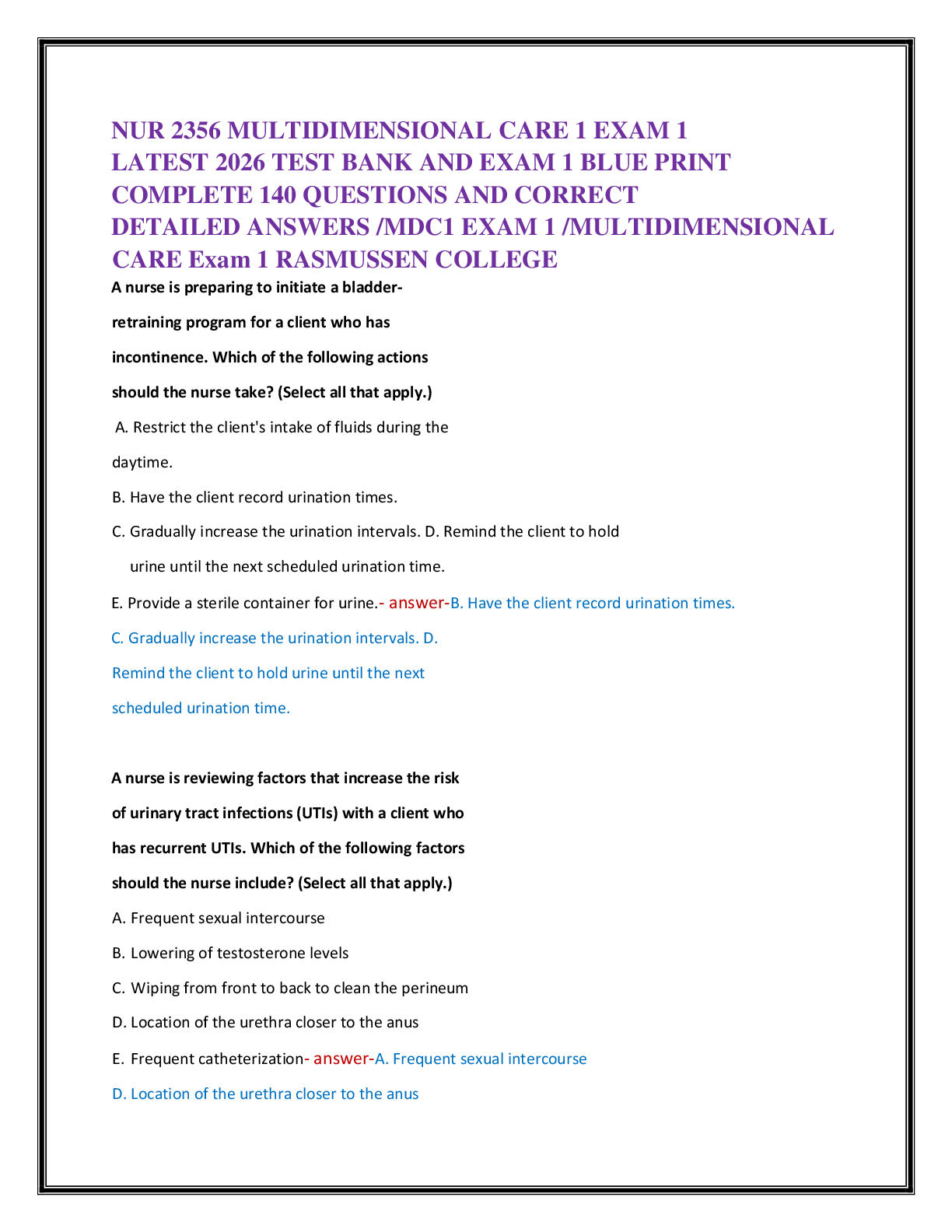
1. A nurse is preparing to initiate a bladder-retraining program for a client who has
incontinence. Which of the following actions should the nurse take? (Select all that
apply.)
A. Restrict the client's intake of fluids during the daytime.
B. Have the client record urination times.
C. Gradually increase the urination intervals.
D. Remind the client to hold urine until the next scheduled urination time.
E. Provide a sterile container for urine.
2. A nurse is reviewing factors that increase the risk of urinary tract infections (UTIs) with a
client who has recurrent UTIs. Which of the following factors should the nurse include?
(Select all that apply.)
A. Frequent sexual intercourse
B. Lowering of testosterone levels
C. Wiping from front to back to clean the perineum
D. Location of the urethra closer to the anus
E. Frequent catheterization
3. A nurse is teaching a client who reports stress urinary incontinence. Which of the
following instructions should the nurse include? (Select all that apply.)
A. Limit total daily fluid intake.
B. Decrease or avoid caffeine.C. Take calcium supplements.
D. Avoid drinking alcohol.
E. Use the Credé maneuver
4. A nurse is teaching a group of newly licensed nurses on complementary and alternative
therapies they can incorporate into their practice without the need for specialized
licensing or certification. Which of the following should the nurse encourage them to
use? (Select all that apply.)
A. Guided imagery
B. Massage therapy
C. Meditation
D. Music therapy
E. Therapeutic touch
5. A nurse is reviewing complementary and alternative therapies with a group of newly
licensed nurses. Which of the following interventions are mind-body therapies? (Select
all that apply.)
A. Art therapy
B. Acupressure
C. Yoga
D. Therapeutic touch
E. Biofeedback
6. A nurse is caring for a client who fell at a nursing home. The client is oriented to person,
place, and time and can follow directions. Which of the following actions should the
nurse take to decrease the risk of another fall? (Select all that apply.)A. Place a belt restraint on the client when they are sitting on the bedside commode.
B. Keep the bed in its lowest position with all side rails up.
C. Make sure that the client's call light is within reach.
D. Provide the client with nonskid footwear.
E. Complete a fall-risk assessment.
7. A nurse observes smoke coming from under the door of the staff's lounge. Which of the
following actions is the nurse's priority?
A. Extinguish the fire.
B. Activate the fire alarm.
C. Move clients who are nearby.
D. Close all open doors on the unit.
8. A nurse is caring for a client who has a history of falls. Which of the following actions is
the nurse's priority?
A. Complete a fall-risk assessment.
B. Educate the client and family about fall risks.
C. Eliminate safety hazards from
the client's environment.
D. Make sure the client uses assistive
aids in their possession.
A. Complete a fall-risk assessment
9. A nurse discovers a small paper fire in a trash can in a client's bathroom. The client has
been taken to safety and the alarm has been activated. Which of the following actions
should the nurse take?A. Open the windows in the client's room to allow smoke to escape.
B. Obtain a class C fire extinguisher to extinguish the fire.
C. Remove all electrical equipment from the client's room.
D. Place wet towels along the base of the door to the client's room.
D. Place wet towels along the base of the door to the client's room
10. Fire response follows the RACE sequence, what does each letter stand for?
-R- Rescue and remove all patients in immediate danger.
-A- Activate the alarm.
-C- Confine the fire by closing doors and windows and turning off oxygen and electrical
equipment; ventilate patients who are on life support with a bag-valve mask
-E- Extinguish the fire using an appropriate extinguisher
11. To use a fire extinguisher, use the PASS sequence, what does each letter stand for?
P - pull the pin
A - aim at the base of the fire
S - squeeze the handle
S - sweep the extinguisher from side to side covering the area of the fire
12. Name some nursing interventions of PREVENTING FALLS
1. complete a fall-risk assessment at admission & regular intervals
2. ensure patient has and knows how to use the call light
3. use fall-risk alerts (color-coded wristbands)
4. provide regular toileting and orientation of clients who have cognitive impairment
5. provide adequate lighting
6. place clients at risk for falls near a nurses station
7. provide hourly rounding
8. make sure personal items are within reach
9. keep bed low, lock the breaks
10. side rails up (for unconscious patients, sedated, etc.)
11. non-skid footwear
12. use gait belts and other assistive equipment when moving patients
13. keep floor clean (no clutter, cords, scatter rugs, etc.)14. electronic safety monitors (chair or bed sensors)
13. What is a nurse's concern with patients using their call lights?
That nurses respond in a timely manner...otherwise the patient may become impatient
and attempt to move themselves
14. What must be completed before performing first aid?
primary survey
15. Name the nursing interventions for BLEEDING
- apply pressure to wound site (home)
- DO NOT remove impaling objects, stabilize the object (home)
- IV volume replacement with blood or volume replacement (hospital)
16. The acronym RICE is used to manage sprains, what do the letters stand for?
R - refrain from weight bearing (also known as "rest")
I - apply ice to decrease inflammation
C - apply a compression dressing to minimalize swelling
E - elevate the affected limb
17. Name the nursing interventions for BURNS
- remove the agent
- smooth any flames present
- cover the client and maintain NPO status
- elevate the extremities
- Stop, Drop, and Roll (home)
- call 911 (home)
- perform H to T assessment (hospital)
- administer fluids and tetanus toxoid (hospital)18. A nurse educator is presenting a module on basic first aid for newly licensed home
health nurses. The client who has heat stroke will have which of the following?
A. Hypotension
B. Bradycardia
C. Clammy skin
D. Bradypnea
A. Hypotension
19. Name the nursing interventions of INFANT SUFFOCATION
- place infants on back to rest
- never leave alone in bathtub
- do not place anything in the crib; remove mobiles when baby can sit up
- keep latex balloons away
- toilet lids down, bathroom doors closed
- make sure slats on crib are a safe distance
20. Name the nursing interventions of INFANT BURNS
- test the temperature of formula and bath water
- place pots on back burner and turn handle away from the front of the stove
- supervise the use of faucets
- cover electrical outlets
- apply sunblock SPF 30 or higher
21. Name the nursing interventions of INFANT MOTOR VEHICLE INJURY
- rear-facing car seat
- car seat with 5-point harness
- forward facing seat after the age of 2 or when they meet the height/weight
requirements22. Name the nursing interventions of PRESCHOOLERS/SCHOOL AGE CHILDREN AND
FIREARMS
- keep firearms unloaded, locked up, and out of reach
- teach to never touch a gun or stay at a friend's house where a gun is accessible
- store bullets in a different location from guns
23. Name the nursing interventions of PRESCHOOLERS/SCHOOL AGE CHILDREN AND
POISON
- teach child about the hazards of alcohol, cigarettes, and prescription, non-prescription,
and illicit drugs
- keep potentially dangerous substances out of reach
- have the poison control hotline available
24. Name the nursing interventions of PRESCHOOLERS/SCHOOL AGE CHILDREN AND
MOTOR VEHICLE INJURY
- use booster seats for children under 4'9" tall and weigh less than 40 lb
- use seatbelt properly after booster seat
- teach child safety rules of the road
25. If a patient asks for "last rights" what religion is that associated with?
Catholicism
26. _______ is a challenge to belief systems or spiritual well-being. It often arises as a result
of catastrophic events. The client can display hopelessness and decreased interactions
with others.
spiritual distress
27. What are Christian scientists’ views on illness and health?
- Health care beliefs often correlate with modern medical science.- Clients often use alternative or complementary practices
28. What are the dietary considerations for Hinduism?
- vegetarians
- they have an adherence to nonviolence
29. What are the bathing considerations for Hinduism?
- free-flowing shower
- disrespectful to touch their feet or head
- do not like to remove jewelry
30. What are the dietary considerations for Islam/Muslim?
- avoid alcohol and pork
- may fast for Ramadan
31. What are the dietary considerations for Mormons?
- avoid tobacco, alcohol, caffeine
32. Name the nursing interventions for CULTURALLY RESPONSIVE CARE
- provide language assistance
- informing clients of language services verbally and in writing
- providing competent, trained interpreters
- giving the client learning materials
33. A nurse is using an interpreter to communicate with a client. Which of the following
actions should the nurse use when communicating with a client and family members?
(Select all that apply.)A. Talk to the interpreter about the family while the family is in the room.
B. Determine client understanding several times during the conversation.
C. Look at the interpreter when asking the family questions.
D. Use lay terms if possible.
E. Do not interrupt the interpreter and the family as they talk.
B. Determine client understanding several times during the conversation
D. Use lay terms if possible
E. Do not interrupt the interpreter and the family as they talk
34. A nurse is caring for two clients who report following the same religion. Which of the
following information should the nurse consider when planning care for these clients?
A. Members of the same religion share similar feelings about their religion.
B. A shared religious background generates mutual regard for one another.
C. The same religious beliefs can influence individuals differently.
D. The nurse and client should discuss the differences and commonalities in their
beliefs.
C. The same religious beliefs can influence individuals differently.
35. A nurse enters the room of a client who is crying while reading from a religious book and
asks to be left alone. Which of the following actions should the nurse take?
A. Contact the hospital's spiritual services.
B. Ask what is making the client cry.
C. Ensure no visitors or staff enter the room for a short time period.
D. Turn on the television for a distraction.
C. Ensure no visitors or staff enter the room for a short time period36. A nurse is discussing the plan of care for a client who reports following Islamic practices.
Which of the following statements by the nurse indicates culturally responsive care to
the client?
A. "I will make sure the menu includes kosher options."
B. "I will ask the client if they want to schedule some times to pray during the day."
C. "I will avoid discussing care when the client's family is around."
D. "I will make sure daily communion is available for this client."
B. "I will ask the client if they want to schedule some times to pray during the day"
37. A nurse is caring for a client who tells the nurse that based on religious values and
mandates, a blood transfusion is not an acceptable treatment option. Which of the
following responses should the nurse make?
A. "I believe in this case you should really make an exception and accept the blood
transfusion."
B. "I know your family would approve of your decision to have a blood transfusion."
C. "Why does your religion mandate that you cannot receive any blood transfusions?"
D. "Let's discuss the necessity for a blood transfusion with your religious and spiritual
leaders and come to a reasonable solution."
D. "Let's discuss the necessity for a blood transfusion with your religious and spiritual
leaders and come to a reasonable solution."
38. A nurse educator is presenting a module on basic first aid for newly licensed home
health nurses. The client who has heat stroke will have which of the following?
A. Hypotension
B. Bradycardia
C. Clammy skinD. Bradypnea
A. Hypotension
39. A nurse educator is conducting a parenting class for new guardians of infants. Which of
the following statements made by a participant indicates understanding?
A. "I will set my water heater at 130° F."
B. "Once my baby can sit up, they should be safe in the bathtub."
C. "I will place my baby on their stomach to sleep."
D. "Once my infant starts to push up, I will remove the mobile from over the crib."
D. "Once my infant starts to push up, I will remove the mobile from over the crib."
40. Name some benefits of bathing patients
- cleanse the body
- stimulate circulation
- provide relaxation
- enhance healing
41. Name some nursing considerations for bed baths
- provide privacy
- keep patient covered as much as possible
- start with face-trunk-upper extremities-lower extremities-perineal area
- move cleanest -> dirtiest
42. What are the nursing considerations for perineal cleaning?
- wipe front to back
- use a clean washcloth, clean towel, and clean water
43. How do we encourage a patient to participate in their baths?- allow them to wash their faces or perineal area if they are able to
- give them all the materials and let them do what they can control
44. Name some benefits of perineal care
- maintain skin integrity
- relieve discomfort
- prevent transmission of micro organisms (catheter care)
45. Name some patient education for foot care
- inspect daily
- use lukewarm water, and dry feet thoroughly
- apply moisturizer
- avoid over-the-counter meds with alcohol or other strong chemicals
- clean socks
- check shoes for objects, rough seams, or edges
- cut nails straight across
- avoid self-treating corns or calluses
- do not apply heat
46. Sudden attacks of sleep that are often uncontrollable often happens at inappropriate
times and increases the risk of injury
narcolepsy
47. Patient education for Narcolepsy
- exercise regularly
- eat small meals that are high in protein
- avoid activities that increase sleepiness (sitting too long, warm environments, drinking
alcohol)
- avoid activities that could cause injury to the client should they fall asleep (heights,
driving)
- take naps
- take prescribed simulants48. Factors that interfere with sleep
- Physiologic disorders: can require more sleep or disrupt sleep (sleep apnea, nocturia)
- Current life events: traveling more, change in work hours
- Emotional stress or Mental illness: anxiety, fear, grief
- Diet: caffeine, heavy meals before bedtime
- Exercise: promotes sleep if at least 2 hour before bedtime, otherwise can disrupt sleep
- Fatigue: exhausting or stressful work makes falling asleep difficult
- Sleep environment: too light, the wrong temperature, or too noisy
- Medications: some can induce sleep but interfere with restorative sleep. Others cause
insomnia (bronchodilators, antihypertensives)
- Substance use: nicotine and caffeine are simulants, caffeine and alcohol tend to cause
night awakenings
49. A nurse is performing mouth care for a client who is unconscious. Which of the
following actions should the nurse take?
A. Turn the client's head to the side.
B. Place two fingers in the client's mouth to open it.
C. Brush the client's teeth once per day.
D. Inject a mouth rinse into the center of the client's mouth.
A. Turn the client's head to the side
50. A nurse is instructing a client who has diabetes mellitus about foot care. Which of the
following guidelines should the nurse include? (Select all that apply.)
A. Inspect the feet daily.
B. Use moisturizing lotion on the feet.
C. Wash the feet with warm water and let them air dry.
D. Use over-the-counter products to treat abrasions.
E. Wear cotton socks
A. Inspect the feet dailyB. Use moisturizing lotion on the feet
E. Wear cotton socks
51. A nurse is beginning a complete bed bath for a client. After removing the client's gown
and placing a bath blanket over the body, which of the following areas should the nurse
wash first?
A. Face
B. Feet
C. Chest
D. Arms
A. Face
52. A nurse is preparing to perform denture care for a client. Which of the following actions
should the nurse plan to take?
A. Pull down and out at the back of the upper denture to remove.
B. Brush the dentures with a toothbrush and denture cleaner.
C. Rinse the dentures with hot water after cleaning them.
D. Place the dentures in a clean, dry storage container after cleaning them.
B. Brush the dentures with a toothbrush and denture cleaner
53. A nurse in a provider's office is caring for a client who states that, for the past week, "I
have felt tired during the day and cannot sleep at night." Which of the following
responses should the nurse ask when collecting data about the client's difficulty
sleeping? (Select all that apply.)
A. "Have your working hours changed recently?"
B. "Do you feel confused in the late afternoon?"C. "Do you drink coffee, tea, or other caffeinated drinks? If so, how many cups per day?"
D. "Has anyone ever told you that you seem to stop breathing for a few seconds while
you are asleep?"
E. "Tell me about any personal stress you are experiencing."
A. "Have your working hours changed recently?"
C. "Do you drink coffee, tea, or other caffeinated drinks? If so, how many cups per day?"
D. "Has anyone ever told you that you seem to stop breathing for a few seconds while
you are asleep?"
E. "Tell me about any personal stress you are experiencing."
54. A nurse is talking with a client about ways to help sleep and rest. Which of the following
recommendations should the nurse give to the client to promote sleep and rest? (Select
all that apply.)
A. Practice muscle relaxation techniques.
B. Exercise each morning.
C. Take an afternoon nap.
D. Alter the sleep environment for comfort.
E. Limit fluid intake at least 2 hr before bedtime.
A. Practice muscle relaxation techniques
B. Exercise each morning
D. Alter the sleep environment for comfort
E. Limit fluid intake at least 2 hr before bedtime.
55. A nurse is caring for a client who has been following the facility's routine and bathing in
the morning. However, at home, the client always takes a warm bath just before
bedtime. Now the client is having difficulty sleeping at night. Which of the following
actions should the nurse take first?A. Rub the client's back for 15 min before bedtime.
B. Offer the client warm milk and crackers at 2100.
C. Allow the client to take a bath in the evening.
D. Ask the provider for a sleeping medication.
C. Allow the client to take a bath in the evening
56. A nurse is instructing a client who has narcolepsy about measures that might help with
self-management. Which of the following statements should the nurse identify as an
indication that the client understands the instructions?
A. "I'll add plenty of carbohydrates to my meals."
B. "I'll take a short nap whenever I feel a little sleepy."
C. "I'll make sure I stay warm when I am at my desk at work."
D. "It's okay to drink alcohol as long as I limit it to one drink per day."
B. "I'll take a short nap whenever I feel a little sleepy."
57. Name some nursing actions for immobility
- turn patient every 2 hours
- ROM exercises
- check for sores (redness)
- pad bony prominences
58. A nurse is caring for a client who has been sitting in a chair for 1 hr. Which of the
following complications is the greatest risk to the client?
A. Decreased subcutaneous fat
B. Muscle atrophy
C. Pressure injury
D. Fecal impactionC. Pressure injury
59. A nurse is planning care for a client who is on bed rest. Which of the following
interventions should the nurse plan to implement?
A. Encourage the client to perform antiembolic exercises every 2 hr.
B. Instruct the client to cough and deep breathe every 4 hr.
C. Restrict the client's fluid intake.
D. Reposition the client every 4 hr.
A. Encourage the client to perform antiembolic exercises every 2 hr.
60. When you see indications of skin breakdown, what is your next action?
Elevate and use corrective devices (pillows, foot boots, trochanter rolls, splints, wedge
pillows)
61. What does PQRST stand for?
Palliative/Provoking
Quality
Region/Radiation
Severity
Timing
62. What are some nonverbal signs of pain?
- grimacing
- moaning
- flinching
- guarding
- decreased attention span
- restlessness, pacing63. What do vital signs look like during acute pain?
- BP increased
- Pulse increased
- RR increased
64. Before nurses give a pain medication, what should they assess?
- drug interactions
- allergies
- vital signs
- side effects
*need to find this in ATI
65. What are common side effects to pain medications?
- low BP
- low HR
- sedation
- respiratory depression
- orthostatic hypotension
- urinary retention
- nausea/vomiting
- constipation
66. After administering pain medication, what is the follow up?
- reevaluate pain level
- if given orally, follow up q 1 hour
- if given IV, follow up q 15 min
- check vital signs!
*need to find this in ATI
67. What are the complications related to pain management?- anxiety
- fear
-depression
- slower healing
- slower recovery
*need to find this in ATI
68. Superficial pain usually involving the skin or subcutaneous tissue
cutaneous pain
69. Pain in internal organs (the stomach or intestines). It can cause referred pain in other
body locations separate from the stimulus
visceral pain
70. Sensation of pain without demonstrable physiologic or pathologic substance; commonly
observed after the amputation of a limb
phantom pain*
a type of neuropathic pain
71. Arises from abnormal or damaged pain nerves. It includes phantom limb pain, pain
below the level of a spinal cord injury, and diabetic neuropathy
"pins and needles"
neuropathic pain
72. What's the difference between acute and chronic pain?
- new pain vs. old pain (> 6 months)
- chronic pain effects ADLs73. Chronic pain without identifiable physical or psychological cause
idiopathic pain
74. Non-Pharmacological Pain Management strategies
- cognitive behavioral measures: changing the way a client perceives pain, and physical
approaches to improve comfort
- cutaneous stimulation: cold, heat, therapeutic touch, massage, TENS
- distraction: ambulation, deep breathing, visitors, television, games, prayer, music
- relaxation: yoga, meditation, progressive muscle relaxation
- imagery: pleasant thought, ability to concentrate
- acupuncture/acupressure
- elevation of edematous extremities
75. What does Aloe promote?
wound healing
76. What does chamomile promote?
anti-inflammatory, calming
77. What does echinacea promote?
enhances immunity
78. What does garlic promote?
inhibits platelet aggregation (clumping)
79. What does ginger promote?
antiemetic (prevents N/V)80. What does ginko biloba promote?
improves memory
81. What does ginseng promote?
increases physical endurance
82. What does valerian promote?
Promotes sleep, reduces anxiety
83. A variety of therapeutic or preventive health care practices, such as homeopathy,
naturopathy, chiropractic, and herbal medicine, that do not follow generally accepted
medical methods and may not have a scientific explanation for their effectiveness.
used in addition to or to enhance conventional medical care
complementary therapy
84. Includes herbs and other "natural" products as often found in ancient records; these
products are not controlled or tested by the U.S. Food and Drug Administration and are
considered to be dietary supplements; however, they are often the basis for discovery
of an active ingredient that is later developed into a regulated medication
treatment approaches that are used in addition to or to enhance conventional medical
care
alternative therapy
85. A nurse is assessing a client as part of an admission history. The client reports drinking
an herbal tea every afternoon at work to relieve stress. Tea includes which of the
following ingredients?A. Chamomile
B. Ginseng
C. Ginger
D. Echinacea
A. Chamomile
86. A nurse is caring for a client scheduled for abdominal surgery. The client reports being
worried. Which of the following actions should the nurse take?
A. Offer information on a relaxation technique and ask the client if they are interested in
trying it.
B. Request a social worker see the client to discuss meditation.
C. Attempt to use biofeedback techniques with the client.
D. Tell the client many people feel the same way before surgery and to think of
something else.
A. Offer information on a relaxation technique and ask the client if they are interested in
trying it.
87. Complications of urinary elimination
UTIs
88. UTI patient education
- wipe front to back
- pee before and after sex
- cleanse beneath foreskin
- provide catheter care regularly (nurses)
89. A client who has an indwelling catheter reports a need to urinate. Which of the
following actions should the nurse take?A. Check to see whether the catheter is patent.
B. Reassure the client that it is not possible for them to urinate.
C. Recatheterize the bladder with a larger-gauge catheter.
D. Collect a urine specimen for analysis.
A. Check to see whether the catheter is patent.
90. The totality of socially trans-mitted behavior patterns, arts, beliefs, values, customs,
lifeways, and all other products of human work and thought characteristics of a
population of people that guides their worldview and decision making
**can be taught**
culture
91. Groups whose members share a common social and cultural heritage that is passed
down from generation to generation. It is also similar to subculture in that the members
of an ethnic group have some characteristics in common (e.g., race, ancestry, physical
characteristics, geographic region, lifestyle, religion) that are not shared or understood
by outsiders.
Ethnicity
92. Is a widely held but oversimplified and unsubstantiated belief that all people of a certain
racial or ethnic group are alike in certain respects.
stereotype
93. Not only language itself, but different definitions for the same thing
healthcare jargon
street talk, slang, jargon
lack of knowledgeemotional responses
Language barriers (to communication)
94. What are some health and illness beliefs among Native Americans?
Health means living in harmony with nature.
Surviving under difficult circumstances
Body treated with respect
Illness is associated with disharmony or evil spirits.
Illness is caused by an action that should not have been performed.
95. What are some health and illness beliefs among Asian/Pacific Islander?
Health is a state of physical and spiritual harmony.
Illness is disharmony of basic principles: yin and yang
96. What are some health and illness beliefs among Black or African American?
Health is harmony with nature (mind, body, and spirit). Illness is the result of
disharmony or failure to eat proper foods.
97. What are some health and illness beliefs among Hispanic or Latino?
Health is good luck or a reward for good behavior, a gift from God. Illness is body
imbalance (hot or cold, wet or dry) or punishment.
98. What are some health and illness beliefs among White or European American?
Health is a state of physical and emotional well-being. Illness is contagion or
contamination that is hereditary, psychosomatic, or supernatural
99. What are some Dominant Values among White or European American?
Independence
IndividualityWealth
Comfort
Cleanliness
Achievement
Youth and beauty
100. What are some Dominant Values among Hispanic or Latino?
Extended family
Group emphasis
Fatalistic
Faith and spirituality
101. What are some Dominant Values among Native Americans?
Bonding to family or group
Acceptance of nature (Mother Earth)
Tradition Sharing
Belief in a spiritual power
Respect of elders
102. What are some Dominant Values among Asian and Pacific Islander?
Extended family
Respect for elders
Group orientation
Subordination to authority
Conformity
Self-respect and self-control
Love of the land
103. What are some Dominant values among Black and African Americans?
Family bonding
Matrifocal
Spiritual orientation
Present-oriented104. Name some enhancing nonverbal cues
Direct eye contact
Concerned facial expression
Leaning forward
Personal space
Professional appearance
Sitting down to talk
Touch
105. Stages of Therapeutic Communication
Pre-interaction
Orientation
Working
Termination
106. Name this stage of Therapeutic Communication:
- Even before you meet the client, this phase is established.
- You begin establishing communication by gathering information about the
client, but the nurse and client do not have direct communication.
Pre-interaction phase
107. Name this stage of Therapeutic Communication:
- The phase begins when you meet the client and introduce yourself and your
role in the relationship.
- The goal of this phase is to establish rapport and trust through the use of verbal
and nonverbal communication.orientation phase
108. Name this stage of Therapeutic Communication:
- The bulk of therapeutic communication occurs in this phase
- During this phase, the nurse communicates caring, the patient expresses
thoughts and feelings, mutual respect is maintained, and honest verbal and
nonverbal expression occurs.
working phase
109. Name this stage of Therapeutic Communication:
- The conclusion of the relationship, whether at the end of the nurse's shift or on
the client's discharge from the unit, facility, or service.
- Reviewing and summarizing help to bring the relationship to a comfortable
conclusion.
termination phase
110. The 5 key characteristics of therapeutic communication
empathy
respect
genuineness
concreteness
confrontation
111. Name ways to enhance therapeutic communication
Active listening
Establishing trust
Being assertive
Restating, clarifying, and validating messages
Interpreting body language and sharing observations
Exploring issuesUsing silence
Summarizing the conversation
Process recordings
112. Name some barriers to therapeutic communication
Asking too many questions
Asking why
Fire-hosing information
Changing the subject inappropriately
Failing to probe
Expressing approval or disapproval
Offering advice
Providing false reassurance
Stereotyping
Using patronizing language
113. Name some non-verbal communication
Facial expression
Posture and gait
Personal appearance
Gestures
Touch
114. What are the 4 types of personal space?
intimate distance (patients)
personal distance (with patients and healthcare team members)
social distance (with a group)
public distance (with a group or community)
115. What factors are a part of verbal communication?
vocabulary
denotative and connotative meaning
pacingintonation
clarity and brevity
timing and relevance
credibility
humor
116. What does the SPEAKUP acronym stand for?
S - speak up if you have questions of concerns.
P - pay attention to the care you are receiving
E - educate yourself about your diagnosis
A - ask a trusted friend or family member to be your advocate
K - know your medications and why you take them
U - use a hospital, clinic, surgery center, or other type of healthcare organization that
has undergone a rigorous on-site evaluation against established state-of-the-art quality
and safety standards, such as that provided by The Joint Commission
P - participate in all decisions about your treatment
117. Who wrote the National Patient Safety Goals?
Joint Commission
118. Serious but preventable errors (that should never occur)
ex: falls, UTIs from catheters, foreign object, air embolism, administering the
wrong type of blood, severe pressure ulcers, injuries from burns, restraints, or
bed rails, infections with IVs, DVT, etc.
never events
119. Goals issued by the Joint Commission to improve patient safety in healthcare
organizations nationwide
National Patient Safety Goals (NPSGs)120. What does OSHA stand for?
Occupational Safety and Health Administration
121. What is OSHA's purpose?
to ensure safe and healthful working conditions for working men and women by setting
and enforcing standards and by providing training, outreach, education and assistance.
122. A means of documenting problem events within a hospital or other medical
facility
incident report
123. Steps of the Nursing Process
ADPIE
Assessment
Diagnosis
Planning
Intervention
Evaluation
124. What happens during the Assessment phase of the Nursing Process?
systematic collection, organization, validation, and documentation of patient data
125. What happens during the Diagnosis phase of the Nursing Process?
The nursing diagnosis is the nurse's clinical judgment about the client's response to
actual or potential health conditions or needs.
126. What happens during the Planning phase of the Nursing Process?- the nurse sets measurable and achievable short- and long-range goals for this patient.
- Assessment data, diagnosis, and goals are written in the patient's care plan so that
nurses as well as other health professionals caring for the patient have access to it.
[Show More]










_2nd_E_Completed.png)