Module 5 Exam: HESI VN TXGRP
7/19/2021 Module 5 Exam: HESI VN TXGRP 1912COHORT(VNE 39)
https://concorde.instructure.com/courses/18612/quizzes/83917?module_item_id=1519721 1/117
Question 1 1 / 1 pts
A client with le
...
Module 5 Exam: HESI VN TXGRP
7/19/2021 Module 5 Exam: HESI VN TXGRP 1912COHORT(VNE 39)
https://concorde.instructure.com/courses/18612/quizzes/83917?module_item_id=1519721 1/117
Question 1 1 / 1 pts
A client with leukemia is being considered for a bone marrow
transplant. The health care team is discussing the risks and
benefits of this treatment and other possible treatments with the
goal of inflicting the least possible harm on the client. Which
principle of health care ethics is the team practicing?
Justice
Fidelity
Autonomy
Correct! Correct! Nonmaleficence
Rationale: Nonmaleficence is the avoidance of hurt or
harm. Remember that in health care ethics, ethical
practice involves not only the will to do good but also the
equal commitment to do no harm. Health care
professionals try to balance the risks and benefits of a
plan of care while striving to do the least possible harm.
Justice refers to fairness and equity and ensuring fair
allocation of resources, such as nursing care for all clients.
Fidelity is the keeping of promises made to clients,
families, and other health care professionals. Autonomy
refers to a person’s independence and represents an
agreement to respect another’s right to determine his or
her course of action.
Test-Taking Strategy: Use knowledge of the subject to
help you with the process of elimination. Think about the
definition of each item in the options. Note the relationship
of the words “least possible harm” in the question and the
definition of nonmaleficence. Review the principles of
health care ethics if you had difficulty with this question.
Cognitive Ability: Applying
Client Needs: Safe and Effective Care Environment
Integrated Process: Nursing Process/Implementation
Content Area: Ethical/Legal7/19/2021 Module 5 Exam: HESI VN TXGRP 1912COHORT(VNE 39)
https://concorde.instructure.com/courses/18612/quizzes/83917?module_item_id=1519721 2/117
Question 2 1 / 1 pts
Which action by the nurse represents the ethical principle of
beneficence?
The nurse upholds a client’s decision to refuse chemotherapy for
lung cancer.
The nurse follows a plan of care designed to relieve pain in a
client with cancer.
The nurse administers an immunization to a child even though it
may cause discomfort.
Correct! Correct!
The nurse provides equal amounts of care to all assigned clients
on the basis of illness acuity.7/19/2021 Module 5 Exam: HESI VN TXGRP 1912COHORT(VNE 39)
https://concorde.instructure.com/courses/18612/quizzes/83917?module_item_id=1519721 3/117
Rationale: Beneficence is taking action to help others.
Although administration of a child’s immunization might
cause discomfort, the benefits of protection from disease
outweigh the temporary discomfort. Fidelity is keeping
promises made to clients, families, and other health care
professionals. Autonomy is a person’s independence.
Respecting another’s autonomy means that you are
agreeing to respect that person’s right to determine his or
her course of action. Justice refers to fairness and equity,
including fair allocation of resources, such as nursing care
for all clients.
Test-Taking Strategy: Focus on the subject, beneficence.
Recalling that beneficence refers to taking action to help
others will direct you to the correct option. Review the
principles of health care ethics if you had difficulty with this
question.
Cognitive Ability: Applying
Client Needs: Safe and Effective Care Environment
Integrated Process: Nursing Process/Implementation
Content Area: Ethical/Legal
Question 3 1 / 1 pts
The nursing instructor asks a student to name an example of
false imprisonment. Which situation reflects a violation of this
client right?
Performing a procedure without consent
Correct! Correct! Telling the client that he or she may not leave the hospital
Threatening to give a client a medication against his or her will
Observing the provision of care to the client without the client’s
permission7/19/2021 Module 5 Exam: HESI VN TXGRP 1912COHORT(VNE 39)
https://concorde.instructure.com/courses/18612/quizzes/83917?module_item_id=1519721 4/117
Rationale: Telling a client that he or she may not leave the
hospital constitutes false imprisonment. Performing a
procedure without consent is an example of battery.
Threatening to give a client a medication against his or her
will is assault. Invasion of privacy takes place with
unreasonable intrusion into an individual’s private affairs.
Observing the provision of care to a client without the
client’s permission is an example of invasion of privacy.
Test-Taking Strategy: Focus on the subject, an example of
false imprisonment. Note the relationship of the subject
and the words in the correct option. If you had difficulty
with this question, review the concept of false
imprisonment.
Cognitive Ability: Applying
Client Needs: Safe and Effective Care Environment
Integrated Process: Teaching and Learning
Content Area: Ethical/Legal
Question 4 1 / 1 pts
A nurse and a nursing assistant enter a client’s room to provide
care and find the client lying on the floor. Which action should the
nurse take first?
Ask the nursing assistant to complete an incident report
Correct! Correct! Check the client s level of consciousness and vital signs
Ask the nursing assistant to assist in getting the client back to
bed
Contact the unit secretary on the intercom and ask that the
client’s health care provider be called7/19/2021 Module 5 Exam: HESI VN TXGRP 1912COHORT(VNE 39)
https://concorde.instructure.com/courses/18612/quizzes/83917?module_item_id=1519721 5/117
Rationale: When a client sustains a fall, the nurse must
first assess the client. The nurse should check the client’s
level of consciousness and vital signs and look for any
bruises or injuries sustained in the fall. If the nurse
determines that the client has not sustained any injuries
and that it is safe to move the client, the nurse should ask
the nursing assistant to assist in getting the client into bed.
The nurse should then contact the health care provider
and file an incident report.
Test-Taking Strategy: Note the strategic word “first.” Use
the steps of the nursing process to answer the question.
The correct option is the only one that addresses
assessment. Remember to always assess the client first if
a client sustains a fall. Review client injuries and
procedures for filing incident reports if you had difficulty
with this question.
Cognitive Ability: Applying
Client Needs: Safe and Effective Care Environment
Integrated Process: Nursing Process/Implementation
Content Area: Delegating/Prioritizing
Question 5 1 / 1 pts
Which action exemplifies the use of evidence-based practice in
the delivery of client care?
Donning sterile gloves to change an abdominal wound dressing
Correct! Correct!
Encouraging a client to take an herbal substance to treat his
insomnia
Advising a client to agree to the treatment recommended by her
health care provider7/19/2021 Module 5 Exam: HESI VN TXGRP 1912COHORT(VNE 39)
https://concorde.instructure.com/courses/18612/quizzes/83917?module_item_id=1519721 6/117
Taking a rectal temperature from a client for whom bleeding
precautions have been instituted
Rationale: Evidence-based practice is an approach to
client care in which the nurse integrates the client’s
preferences, clinical expertise, and the best research
evidence to deliver quality care. Donning sterile gloves to
change an abdominal wound dressing reflects evidencebased practice because it prevents the entrance of
harmful bacteria into the wound. The remaining options do
not reflect evidence-based practice. Taking an herbal
substance could be harmful to some clients. It is
nontherapeutic for a nurse to advise a client to agree to a
treatment. Because of the risk of injury to the rectal
mucosa, rectal temperature-taking is avoided in the client
for whom bleeding precautions have been instituted.
Test-Taking Strategy: Read each option carefully, focusing
on the subject, evidence-based practice. Recall the
definition of evidence-based practice and note the words
“sterile gloves” in the correct option. Review the situations
that reflect evidence-based practice if you had difficulty
with this question.
Cognitive Ability: Understanding
Client Needs: Safe and Effective Care Environment
Integrated Process: Nursing Process/Implementation
Content Area: Leadership/Management
Question 6 1 / 1 pts
The nurse is working with the registered nurse who has accepted
a new position as case manager in a hospital. The nurse realizes
which responsibilities are part of the registered nurse’s new
role? Select all that apply.
Correct! Correct! Evaluating and updating the plan of care as needed
Prescribing treatments specific to the client s needs7/19/2021 Module 5 Exam: HESI VN TXGRP 1912COHORT(VNE 39)
https://concorde.instructure.com/courses/18612/quizzes/83917?module_item_id=1519721 7/117
Assessing the client s needs for home supplies and equipment
Correct! Correct!
Correct! Correct! Coordinating consultations and referrals to facilitate discharge
Establishing a safe and cost-effective plan of care with the client
Correct! Correct!
Rationale: A case manager is a nurse who assumes
responsibility for coordinating the client’s care from the
point of admission through, and after, discharge. Specific
responsibilities of the case manager include establishing a
safe and cost-effective plan of care with the client,
coordinating consultations and referrals, and facilitating
discharge; initiating a plan of nursing care, care map, or
clinical pathway as appropriate to guide care and
evaluating and updating the plan of care as needed;
ensuring that the plan of care is tailored to the client’s
needs, taking into account the client’s diagnosis, self-care
ability, and prescribed treatments; assessing the client’s
need for equipment such as oxygen or wound care
supplies and exploring available resources to provide the
client with these supplies; providing resources that will
assist the client in maintaining independence as much as
possible; and providing the client with information on
discharge procedures and the plan of care. The nurse
does not prescribe treatments.
Test-Taking Strategy: Focus on the subject, the
responsibilities of the case manager. Note the word
“prescribing” in the incorrect option. It is not within the role
of the nurse to prescribe. Review the responsibilities of the
case manager if you have difficulty with this question.
Cognitive Ability: Understanding
Client Needs: Safe and Effective Care Environment
Integrated Process: Nursing Process/Implementation
Content Area: Leadership/Management
Question 7 1 / 1 pts7/19/2021 Module 5 Exam: HESI VN TXGRP 1912COHORT(VNE 39)
https://concorde.instructure.com/courses/18612/quizzes/83917?module_item_id=1519721 8/117
The nurse manager of a quality improvement program asks a
nurse in the neurological unit to conduct a retrospective audit.
Which action should the auditing nurse plan to perform in this
type of audit?
Checking the documentation written by a new nursing graduate
on her assigned clients at the end of the shift
Checking the crash cart to ensure that all needed supplies are
readily available should an emergency arise
Reviewing neurological assessment checklists for all clients on
the unit to ensure that these assessments are being conducted
as prescribed
Obtaining the assigned medical record from the hospital’s
medical record room to review documentation made during a
client’s hospital stay
Correct! Correct!7/19/2021 Module 5 Exam: HESI VN TXGRP 1912COHORT(VNE 39)
https://concorde.instructure.com/courses/18612/quizzes/83917?module_item_id=1519721 9/117
Rationale: Quality improvement, also known as
performance improvement, is focused on processes or
systems that significantly contribute to client safety and
effective client care outcomes. Criteria are used to assess
outcomes of care and determine the need for changes
improve the quality of care. In a retrospective, or “lookingback,” audit, the medical record is inspected after the
client’s discharge for documentation of compliance with
standards. In a concurrent, or “at the same time,” audit,
the nursing staff’s compliance with predetermined
standards and criteria is assessed as the nurses are
providing care during the client’s stay. In this type of audit,
a peer review approach in which members of the nursing
staff are involved in data collection may be implemented.
Obtaining the a client’s medical record from the medical
record room for the purpose of reviewing documentation
made during the client’s hospital stay is an example of a
retrospective audit. The incorrect options are examples of
concurrent audits.
Test-Taking Strategy: Focus on the subject, a
retrospective audit. Note the relationship of the word
“retrospective” in the question and the description in the
correct option. Review the procedures for quality
improvement and retrospective and concurrent audits if
you have difficulty with this question.
Cognitive Ability: Applying
Client Needs: Safe and Effective Care Environment
Integrated Process: Nursing Process/Planning
Content Area: Leadership/Management
Question 8 1 / 1 pts
A nurse preparing a client for a bronchoscopy notes that the
client is wearing a gold necklace. What should the nurse do to
safeguard the client’s necklace?
Ask the client whether the necklace is gold.7/19/2021 Module 5 Exam: HESI VN TXGRP 1912COHORT(VNE 39)
https://concorde.instructure.com/courses/18612/quizzes/83917?module_item_id=1519721 10/117
Ask the client for permission to lock the necklace in the hospital
safe.
Correct! Correct!
Ask the client to remove the necklace and place it in the top
drawer of the bedside table.
Ask the client to sign a release to free the hospital of
responsibility if the necklace is damaged or lost during the
procedure.
Rationale: When a client has valuables, the nurse should
give them to a family member or secure them for
safekeeping. Most health care institutions require that a
client sign a release form that frees the institution of
responsibility if a valuable item (e.g., jewelry, money) is
lost, but this does not safeguard the client’s necklace.
Valuables may be locked in a designated location such as
the hospital’s safe. Removing the necklace and putting it
in a drawer does not safeguard it. Asking the client
whether the necklace is gold is inappropriate and
unrelated to the subject.
Test-Taking Strategy: Use the process of elimination and
focus on the subject, safeguarding the client’s necklace.
Focusing on the subject and noting the word “lock” in the
correct option will help you answer correctly. Review the
procedures for safeguarding a client’s valuables if you had
difficulty with this question.
Cognitive Ability: Applying
Client Needs: Safe and Effective Care Environment
Integrated Process: Nursing Process/Implementation
Content Area: Ethical/Legal
Question 9 1 / 1 pts
A nurse providing preoperative care to a client who is scheduled
for a left mastectomy and axillary lymph node dissection notes7/19/2021 Module 5 Exam: HESI VN TXGRP 1912COHORT(VNE 39)
https://concorde.instructure.com/courses/18612/quizzes/83917?module_item_id=1519721 11/117
that the client is wearing a wedding band on her left ring finger.
The nurse should take which action?
Tape the wedding band in place.
Correct! Correct! Explain to the client why the wedding band must be removed.
Ask the client whether she would like to remove the wedding
band or wear it to surgery.
Ask the client to sign a release to free the hospital of
responsibility if the wedding band is lost during surgery.
Rationale: In most situations a wedding band may be
taped in place and worn during a surgical procedure.
However, if the possibility exists that the client will
experience swelling of the hand or fingers, the wedding
band should be removed. On admission to a health care
facility, the client is asked to sign a form that frees the
agency from responsibility if a client’s valuable is lost.
After mastectomy with axillary lymph node dissection, the
client is at risk for lymphedema, which results in swelling
of the arm and hand on the affected side. Therefore the
appropriate nursing action is to ask the client to remove
the wedding band and explain why.
Test-Taking Strategy: Use the process of elimination and
focus on the data in the question. Eliminate the
comparable or alike options that indicate that the client
may wear the wedding band during the surgical
procedure. Next, recall the complications associated with
mastectomy, which will direct you to the correct option.
Review preoperative procedures for a client’s valuables if
you had difficulty with this question.
Cognitive Ability: Applying
Client Needs: Safe and Effective Care Environment
Integrated Process: Nursing Process/Implementation
Content Area: Perioperative Care7/19/2021 Module 5 Exam: HESI VN TXGRP 1912COHORT(VNE 39)
https://concorde.instructure.com/courses/18612/quizzes/83917?module_item_id=1519721 12/117
Question 10 1 / 1 pts
A nurse preparing a client to go to the radiology department for a
neck x-ray notes that the client is wearing a religious medal on a
chain around the neck. The client, a Catholic, expresses a
concern about removing the medal. What is the most appropriate
action for the nurse to take?
Asking the client to remove the medal until the x-ray has been
completed
Assisting the client in pinning the medal and chain to the
waistband of the client’s pajama bottoms
Correct! Correct!
Asking the client to place the medal in the top drawer of the
bedside stand just before leaving for the radiology department
Telling the client that the medal and chain will be kept at the
nurses’ station for safekeeping while the client is undergoing the
x-ray7/19/2021 Module 5 Exam: HESI VN TXGRP 1912COHORT(VNE 39)
https://concorde.instructure.com/courses/18612/quizzes/83917?module_item_id=1519721 13/117
Rationale: A client undergoing a neck x-ray must remove
all metal objects to help prevent artifacts on the x-ray. If
the client expresses concern about removing the medal,
the nurse should help the client pin the medal and chain to
the hospital gown or in another area where it will not
appear on the x-ray image. The nurse should also alert
staff in the radiology department that this has been done.
If the client is expressing concern about removing the
medal, asking the client to remove it or leave it with the
nurse or in the bedside stand is inappropriate. Each of
these actions also increases the likelihood that the medal
and chain will be lost.
Test-Taking Strategy: Use the process of elimination and
note that the client is expressing concern about removing
the religious medal. Eliminate the comparable or alike
options that indicate that the client should remove the
medal. Also note that the correct option is the only option
that addresses the client’s concern. Review care of clients’
valuables if you had difficulty with this question.
Cognitive Ability: Applying
Client Needs: Safe and Effective Care Environment
Integrated Process: Nursing Process/Implementation
Content Area: Safety
Question 11 1 / 1 pts
A health care provider writes a medication prescription in a
client’s record. While transcribing the prescription, the nurse
notes that the prescribed dose is three times higher than the
recommended dose. The nurse calls the health care provider,
who states that this is the dose that the client takes at home and
that it is acceptable for this client’s condition. What is the
appropriate action for the nurse to take?
Correct! Correct! Contacting the nursing supervisor
Continuing to transcribe the prescription7/19/2021 Module 5 Exam: HESI VN TXGRP 1912COHORT(VNE 39)
https://concorde.instructure.com/courses/18612/quizzes/83917?module_item_id=1519721 14/117
Asking the nurse assigned to care for the client to administer the
medication
Verifying the prescribed dose with the client before administering
the medication
Rationale: A nurse must follow a health care provider’s
prescription unless he or she believes that the prescription
is in error or that it would harm the client. If a prescription
is found to be incorrect or harmful, further clarification from
the health care provider is necessary. If the health care
provider confirms the prescription and the nurse still
believes that it is inappropriate, the nurse should contact
the nursing supervisor. The nurse should not continue
transcribing the prescription or ask another nurse to
implement the prescription. The nurse might ask the client
about the medication and the dose taken at home but
would not administer the medication.
Test-Taking Strategy: Use the process of elimination.
Eliminate the comparable or alike options that indicate that
the medication would be administered. Review the nurse’s
responsibilities in regard to a health care provider’s
prescriptions if you had difficulty with this question.
Cognitive Ability: Applying
Client Needs: Safe and Effective Care Environment
Integrated Process: Nursing Process/Implementation
Content Area: Ethical/Legal
Question 12 1 / 1 pts
nurse monitoring a client with a chest tube notes that there is no
tidaling of fluid in the water seal chamber. After further
assessment, the nurse suspects that the client’s lung has
reexpanded and notifies the health care provider. The health care
provider verifies with the use of a chest x-ray that the lung has
reexpanded, then calls the nurse to asks that the chest tube be
removed. Which action should the nurse take first?7/19/2021 Module 5 Exam: HESI VN TXGRP 1912COHORT(VNE 39)
https://concorde.instructure.com/courses/18612/quizzes/83917?module_item_id=1519721 15/117
Call the nursing supervisor.
Explain the procedure to the client, then remove the chest tube.
Inform the health care provider that removal of a chest tube is not
a nursing procedure.
Correct! Correct!
Obtain petrolatum-impregnated gauze and ask another nurse to
assist in removing the chest tube.
Rationale: Actual removal of a chest tube is the duty of a
health care provider. Therefore the nurse would first inform
the health care provider that this is not a nursing
procedure. If the health care provider insists that the nurse
remove the tube, the nurse must contact the nursing
supervisor. Some agencies’ policies and procedures may
permit an advanced practice nurse (a nurse with a
master’s degree in a specialized area of nursing) to
remove a chest tube. However, there is no information in
the question to indicate that the nurse is an advanced
practice nurse.
Test-Taking Strategy: Use the process of elimination.
Eliminate the comparable or alike options that indicate that
the nurse would remove the chest tube. To select from the
remaining options, note the strategic word “first.” The
nurse should discuss the prescription with the health care
provider. Review nursing responsibilities with regard to
removal of a chest tube and standards of care if you had
difficulty with this question.
Cognitive Ability: Applying
Client Needs: Safe and Effective Care Environment
Integrated Process: Nursing Process/Implementation
Content Area: Ethical/Legal
Question 13 1 / 1 pts7/19/2021 Module 5 Exam: HESI VN TXGRP 1912COHORT(VNE 39)
https://concorde.instructure.com/courses/18612/quizzes/83917?module_item_id=1519721 16/117
A nurse calls a health care provider to report that a client with
congestive heart failure (CHF) is exhibiting dyspnea and
worsening of wheezing. The health care provider, who is in a
hurry because of a situation in the emergency department, gives
the nurse a telephone prescription for furosemide (Lasix) but
does not specify the route of administration. What is the
appropriate action on the part of the nurse?
Calling the health care provider who gave the telephone
prescription to clarify the prescription
Correct! Correct!
Calling the nursing supervisor for assistance in determining the
route of administration
Administering the medication intravenously because this route is
generally used for clients with CHF
Administering the medication orally and clarifying the prescription
once the health care provider has finished caring for the client in
the emergency department7/19/2021 Module 5 Exam: HESI VN TXGRP 1912COHORT(VNE 39)
https://concorde.instructure.com/courses/18612/quizzes/83917?module_item_id=1519721 17/117
Rationale: Telephone prescriptions involve a health care
provider’s dictating a prescribed therapy over the
telephone to the nurse. The nurse must clarify the
prescription by repeating the prescription clearly and
precisely to the health care provider. The nurse then writes
the prescription on the health care provider’s prescription
sheet or enters it into the electronic medical record. Under
no circumstances should the nurse try to interpret an
unclear prescription or administer a medication by a route
that has not been expressly prescribed. The nurse must
call the health care provider who gave the telephone
prescription and clarify the prescription.
Test-Taking Strategy: Use the process of elimination.
Eliminate the comparable or alike options that indicate that
the nurse should administer the medication without
clarifying the health care provider’s prescription. Review
the procedures for accepting telephone prescriptions if you
had difficulty with this question.
Cognitive Ability: Applying
Client Needs: Safe and Effective Care Environment
Integrated Process: Nursing Process/Implementation
Content Area: Ethical/Legal
Question 14 1 / 1 pts
A nurse is assisting a health care provider in assessing a
hospitalized client. During the assessment, the health care
provider is paged to report to the recovery room. The health care
provider leaves the client’s bedside after giving the nurse a verbal
prescription to change the solution and rate of the intravenous
(IV) fluid being administered. What is the most appropriate
nursing action in this situation?
Calling the nursing supervisor to obtain permission to accept the
verbal prescription
Changing the solution and rate of the IV fluid per the health care
provider’s verbal prescription7/19/2021 Module 5 Exam: HESI VN TXGRP 1912COHORT(VNE 39)
https://concorde.instructure.com/courses/18612/quizzes/83917?module_item_id=1519721 18/117
Asking the health care provider to write the prescription in the
client’s record before leaving the nursing unit
Correct! Correct!
Telling the health care provider that the prescription will not be
implemented until it is documented in the client’s record
Rationale: The health care provider should write all
prescriptions. Verbal prescriptions are not recommended
because they increase the risk for error. If a verbal
prescription is necessary, such as during an emergency, it
should be written and signed by the health care provider
as soon as possible, usually within 24 hours. The nurse
must follow agency policies and procedures regarding
verbal prescriptions. The appropriate nursing action would
be to ask the health care provider to write the prescription
in the client’s record before leaving the nursing unit.
Changing the solution in keeping with the verbal
prescription and contacting the supervisor to obtain
permission to accept the verbal prescription each imply
that the nurse accepts the verbal prescription. Telling the
health care provider that the prescription will not be
implemented until it is documented in the client’s record
delays necessary treatment.
Test-Taking Strategy: Use the process of elimination and
note the strategic words “most appropriate.” Eliminate the
comparable or alike options that imply acceptance of the
verbal prescription by the nurse. To select from the
remaining options, recall the guidelines and principles for
implementing health care provider prescriptions. This will
direct you to the correct option. Review nursing
responsibilities related to verbal prescriptions if you had
difficulty with this question.
Cognitive Ability: Applying
Client Needs: Safe and Effective Care Environment
Integrated Process: Nursing Process/Implementation
Content Area: Ethical/Legal
Question 15 1 / 1 pts7/19/2021 Module 5 Exam: HESI VN TXGRP 1912COHORT(VNE 39)
https://concorde.instructure.com/courses/18612/quizzes/83917?module_item_id=1519721 19/117
A client scheduled for surgery tells the nurse that he signed an
informed consent for the surgical procedure but was never told
about the risks of the surgery. The nurse serves as the client’s
advocate by undertaking which action?
Reassuring the client that the risks are minimal
Calling the surgeon and asking that the risks be explained to the
client
Correct! Correct!
Noting in the client’s record that the client was not told about the
risks of the surgery
Writing a note on the front of the client’s record so that the
surgeon will see it when the client arrives in the operating room
Rationale: A nurse serves as a client advocate by
protecting the right of the client to be informed and to
participate in decisions regarding care. The only option
that ensures that the client will be informed of the risks of
the surgery is contacting the surgeon and asking that the
risks be explained to the client. Telling the client that the
risks are minimal is false reassurance. Putting a note on
the client’s chart or documenting that the client was not
informed about the risks does ensure that the client will be
informed.
Test-Taking Strategy: Use the process of elimination and
guidelines and principles of obtaining informed consent.
Focusing on the data in the question, the words “never
told about the risks of the surgery,” will direct you to the
correct option, the only option that ensures that the client
will be told about the risks. Review the role of a nurse as a
client advocate if you had difficulty with this question.
Cognitive Ability: Applying
Client Needs: Safe and Effective Care Environment
Integrated Process: Nursing Process/Implementation
Content Area: Ethical/Legal7/19/2021 Module 5 Exam: HESI VN TXGRP 1912COHORT(VNE 39)
https://concorde.instructure.com/courses/18612/quizzes/83917?module_item_id=1519721 20/117
Question 16 1 / 1 pts
A nurse is planning to administer an oral antibiotic to a client with
a communicable disease. The client refuses the medication and
tells the nurse that the medication causes abdominal cramping.
The nurse responds, “The medication is needed to prevent the
spread of infection, and if you don’t take it orally I will have to give
it to you in an intramuscular injection.” Which statement
accurately describes the nurse’s response to the client?
The nurse could be charged with battery.
Correct! Correct! The nurse could be charged with assault.
The nurse is justified in administering the medication by way of
the intramuscular route, because the client has a communicable
disease.
The nurse will be justified in administering the medication by the
intramuscular route once a prescription has been obtained from
the health care provider.7/19/2021 Module 5 Exam: HESI VN TXGRP 1912COHORT(VNE 39)
https://concorde.instructure.com/courses/18612/quizzes/83917?module_item_id=1519721 21/117
Rationale: Assault is an intentional threat to bring about
harmful or offensive contact. If a nurse threatens to give a
client a medication that the client refuses or threatens to
give a client an injection without the client’s consent, the
nurse may be charged with assault. Therefore the nurse is
not justified in administering the medication. Battery is any
intentional touching without the client’s consent.
Test-Taking Strategy: Focus on the data in the question
and the nurse’s statement. Note that the nurse threatens
the client. Next, recall the definition of assault, which will
direct you to the correct option. Review violations of client
rights if you had difficulty with this question.
Cognitive Ability: Applying
Client Needs: Safe and Effective Care Environment
Integrated Process: Nursing Process/Implementation
Content Area: Ethical/Legal
Question 17 1 / 1 pts
A nurse discovers that another nurse has administered an enema
to a client even though the client told the nurse that he did not
want one. Which is the most appropriate action for the nurse to
take?
Contact the client’s health care provider.
Correct! Correct! Report the incident to the nursing supervisor.
Tell the client that the nurse did the right thing in giving the
enema.
Confront the nurse who gave the enema and tell the nurse that
she is going to be charged with battery.7/19/2021 Module 5 Exam: HESI VN TXGRP 1912COHORT(VNE 39)
https://concorde.instructure.com/courses/18612/quizzes/83917?module_item_id=1519721 22/117
Rationale: Battery is any intentional touching of a client
without the client’s consent. Such contact may be harmful
to the client, or it may merely be offensive to the client’s
dignity. If a nurse discovers that battery of a client has
occurred, the nurse should report the situation to the
nursing supervisor. Telling the client that the nurse did the
right thing in giving the enema is incorrect because the
other nurse has violated the client’s rights. Confronting the
nurse and telling her that she is going to be charged with
battery would likely result in unnecessary conflict.
Although the health care provider may need to be notified,
the nurse should first report the situation to the nursing
supervisor.
Test-Taking Strategy: Use the process of elimination, and
note the strategic words “most appropriate.” Next, focus
on the subject, client rights. Recalling that any situation
that constitutes a violation of a client’s rights needs to be
reported and remembering the organizational channels of
reporting will direct you to the correct option. Review the
issues surrounding violation of client rights and nursing
responsibilities when a client’s rights have been violated if
you had difficulty with this question.
Cognitive Ability: Applying
Client Needs: Safe and Effective Care Environment
Integrated Process: Nursing Process/Implementation
Content Area: Ethical/Legal
Question 18 1 / 1 pts
A nurse calls a health care provider to question a prescription
written for a higher-than-normal dosage of morphine sulfate. The
health care provider changes the prescription to a dosage within
the normal range, and the nurse documents the new telephone
prescription in accordance with the agency’s guidelines in the
client’s record. Which other statement does the nurse document
in the nursing notes?
The health care provider was called to clarify the prescription for
morphine sulfate.
Correct! Correct!7/19/2021 Module 5 Exam: HESI VN TXGRP 1912COHORT(VNE 39)
https://concorde.instructure.com/courses/18612/quizzes/83917?module_item_id=1519721 23/117
The health care provider made an error in the written prescription
for morphine sulfate.
The health care provider was called to correct an error in the
dosage of morphine sulfate.
An incorrect dosage of morphine sulfate was prescribed and the
health care provider was notified.
Rationale: The nurse needs to document a factual,
descriptive, and objective statement that does not include
words indicating that an individual made an error or
performed an incorrect action or procedure. If a health
care provider’s prescription must be questioned, the nurse
should record that clarification regarding the prescription
was sought.
Test-Taking Strategy: Use the process of elimination.
Eliminate the comparable or alike options that indicate that
the health care provider made an error in writing a
prescription. These options contain the words “error” or
“incorrect.” Review the principles of documentation if you
had difficulty with this question.
Cognitive Ability: Applying
Client Needs: Safe and Effective Care Environment
Integrated Process: Nursing Process/Implementation
Content Area: Ethical/Legal
Question 19 1 / 1 pts
A nurse at the long-term care unit on the 11 p.m. to 7 a.m. shift is
gathering the nursing staff together to listen to the 3 to 11 p.m.
intershift report. The nurse notes that a staff member has an odor
of alcohol on her breath, slurred speech, and an unsteady gait
and suspects alcohol intoxication. Which action is most
appropriate for the nurse to take?7/19/2021 Module 5 Exam: HESI VN TXGRP 1912COHORT(VNE 39)
https://concorde.instructure.com/courses/18612/quizzes/83917?module_item_id=1519721 24/117
Correct! Correct! Contact the nursing supervisor.
Ask the staff member how much alcohol she has consumed.
Tell the staff member that she is not allowed to administer
medications.
Ask the staff member to rest in the nurses’ lounge until the
effects of the alcohol wear off.7/19/2021 Module 5 Exam: HESI VN TXGRP 1912COHORT(VNE 39)
https://concorde.instructure.com/courses/18612/quizzes/83917?module_item_id=1519721 25/117
Rationale: When a staff member reports to work in a state
of alcohol intoxication, the nurse notes the signs
objectively and asks a second person to validate these
observations. The nurse also contacts the nursing
supervisor. An odor of alcohol, slurred speech, unsteady
gait, and errors in judgment are symptoms of intoxication.
Client safety is the primary concern. The intoxicated nurse
is removed from the situation. The incident is recorded
and the nurse describes the observations, states the
action taken, indicates future plans, and has the staff
member sign and date the memo of the recorded incident.
Refusal to sign and date the memo should be noted by the
nurse and a witness. Neither asking the staff member to
rest in the nurses’ lounge until the effects of the alcohol
wear off nor telling the staff member that he or she will not
be allowed to administer medications removes the staff
member from the client care area, jeopardizing client
safety. Asking the staff member how much alcohol she has
consumed is confrontational and irrelevant.
Test-Taking Strategy: Use the process of elimination,
keeping in mind that client safety is the priority. Asking the
staff member how much alcohol she has consumed is
irrelevant, so eliminate this option. Next eliminate the
comparable or alike options that do not involve removal of
the staff member from the client care area. Review nursing
responsibilities when substance abuse is suspected in a
staff member if you had difficulty with this question.
Cognitive Ability: Applying
Client Needs: Safe and Effective Care Environment
Integrated Process: Nursing Process/Implementation
Content Area: Leadership/Management
Question 20 1 / 1 pts
A client asks a nurse about the procedure for becoming an organ
donor. The nurse provides the client with which information?
That anatomic gifts must be made in writing and signed by the
client
Correct! Correct!7/19/2021 Module 5 Exam: HESI VN TXGRP 1912COHORT(VNE 39)
https://concorde.instructure.com/courses/18612/quizzes/83917?module_item_id=1519721 26/117
To speak with the chaplain about the psychosocial aspects of
becoming a donor
That this decision must be made by the next of kin at the time of
the client’s death
To let the health care provider know about the request so that it
may be documented in the client’s record
Rationale: An individual who is at least 18 years old may
make an anatomic gift of all or part of the human body.
The gift must be made in writing and signed by the donor.
If the client cannot sign, the document must be signed by
another individual and two witnesses. The health care
provider is informed of the client’s wishes, and the client
may wish to speak to a chaplain, but the specific
procedure requires a written document that is signed by
the client. The family of a deceased client may be asked
about organ donation, but this is not the procedure when a
living person wishes to become a donor.
Test-Taking Strategy: Use the process of elimination, and
focus on the subject, a client requesting information about
organ donation. Eliminate the option using the closedended word “must.” To select from the remaining options,
remember that an anatomic gift must be made in writing
and signed by the client. Review the procedure for organ
donation if you had difficulty with this question.
Cognitive Ability: Applying
Client Needs: Safe and Effective Care Environment
Integrated Process: Nursing Process/Implementation
Content Area: Ethical/Legal
Question 21 1 / 1 pts
A nurse enters a client’s room to administer a medication that has
been prescribed by the health care provider. The client asks the7/19/2021 Module 5 Exam: HESI VN TXGRP 1912COHORT(VNE 39)
https://concorde.instructure.com/courses/18612/quizzes/83917?module_item_id=1519721 27/117
nurse about the medication. Which response by the nurse is
appropriate?
“It’s to help get rid of the swelling in your feet.”
“You need to discuss this medication with your health care
provider.”
“I know that it’s for fluid buildup, and I think you’ve taken it
before.”
“It’s called furosemide (Lasix), and it will promote urination and
rid your body of the excess fluid. It can cause an alteration in
electrolyte levels, so we’ll need to increase the potassium in your
diet.”
Correct! Correct!
Rationale: A client has the right to be informed of the
medication name, purpose, action, and potential
undesirable effects of a prescribed medication. The nurse
should provide adequate information to the client.
Therefore the appropriate response is the one that is
thorough and complete. Referring the client to the health
care provider places the client’s question on hold. The
remaining options are incomplete.
Test-Taking Strategy: Note the strategic word
“appropriate.” Eliminate the option that refers the client to
the health care provider because it places the client’s
question on hold. To select from the remaining choices,
find the option that is most complete and thorough.
Review client rights in regard to the provision of
information about medication if you had difficulty with this
question.
Cognitive Ability: Applying
Client Needs: Safe and Effective Care Environment
Integrated Process: Teaching and Learning
Content Area: Ethical/Legal7/19/2021 Module 5 Exam: HESI VN TXGRP 1912COHORT(VNE 39)
https://concorde.instructure.com/courses/18612/quizzes/83917?module_item_id=1519721 28/117
Question 22 1 / 1 pts
A nursing student is assigned to care for a client who requires a
total bed bath. When the student explains to the client that she is
going to gather supplies to administer the bath, the client states,
“I don’t want a bath. I’ve been up all night, and I’m clean enough.”
The student reports the client’s refusal to the nurse. Which action
by the nurse is appropriate?
Correct! Correct! Telling the nursing student to allow the client to rest
Telling the nursing student to give the client the bath anyway
Telling the client that the health care provider will be informed of
the refusal of care
Telling the nursing student to persuade the client to have a bath
so that the evening shift staff will not have to do it
Rationale: The client has the right to refuse a treatment or
procedure, and if the client does refuse, the nurse must
respect the client’s decision. Therefore the nurse would
allow the client to rest. Persuading the client to have a
bath and giving the bath anyway are both inappropriate
and represent violations of the client’s rights. Telling the
client that the health care provider will be informed of the
refusal of care is a threatening action on the nurse’s part.
Test-Taking Strategy: Use knowledge of the subject, client
rights. Eliminate the options that present a threat to the
client or indicate that the bath will be given regardless of
the client’s wishes. Review client rights if you had difficulty
with this question.
Cognitive Ability: Applying
Client Needs: Safe and Effective Care Environment
Integrated Process: Nursing Process/Implementation
Content Area: Ethical/Legal7/19/2021 Module 5 Exam: HESI VN TXGRP 1912COHORT(VNE 39)
https://concorde.instructure.com/courses/18612/quizzes/83917?module_item_id=1519721 29/117
Question 23 1 / 1 pts
A client with cancer is transported to the radiology department for
a bone scan to determine whether the cancer has metastasized
to bone. While the client is in the radiology department, the
client’s wife arrives for a visit and asks what test is being
performed on the client. What should the nurse tell the wife?
A bone scan is being performed.
Correct! Correct! She will have to discuss the prescribed test with the client.
The radiology department is not clear as to which test has been
prescribed.
She can read the client’s medical record to determine what the
health care provider prescribed.
Rationale: Unless a client consents, a nurse may not
disclose confidential information to anyone else. Therefore
the appropriate response is to tell the client’s wife that she
will have to discuss the test with the client. Likewise, a
client’s medical record is confidential and cannot be given
to the wife for reading. Telling the client’s wife that the
radiology department is unclear as to what test has been
prescribed is inappropriate. The nurse must not place the
responsibility or accountability for a prescribed test on
another department.
Test-Taking Strategy: Use the process of elimination.
Focusing on the subject, confidentiality, and recalling the
issues surrounding confidentiality will direct you to the
correct option. Review the issues surrounding
confidentiality if you had difficulty with this question.
Cognitive Ability: Applying
Client Needs: Safe and Effective Care Environment
Integrated Process: Nursing Process/Implementation
Content Area: Ethical/Legal7/19/2021 Module 5 Exam: HESI VN TXGRP 1912COHORT(VNE 39)
https://concorde.instructure.com/courses/18612/quizzes/83917?module_item_id=1519721 30/117
Question 24 1 / 1 pts
A married couple is attending a hospital program about in vitro
fertilization. During the program, a crew from a local television
station arrives to film the proceedings because the station is
publicizing a series on hospital services. The nurse conducting
the program should take which action?
Allow the television crew to videotape the program.
Correct! Correct! Explain to the television crew that videotaping is not allowed.
Ask the television crew to interview the individuals attending the
program individually.
Allow the television crew to videotape the program as long as
they do not publicize that the program is about in vitro
fertilization.
Rationale: Privacy is a client’s right to be free from
unwanted intrusion into his or her private affairs.
Videotaping constitutes an invasion of a client’s privacy,
and written permission is required from the client for an
action such as photographing or videotaping. Therefore
the nurse must explain to the television crew that
videotaping is not allowed. The other options are incorrect
and constitute invasions of client privacy.
Test-Taking Strategy: Focus on the subject, client privacy.
Eliminate the comparable or alike options that represent
invasions of client privacy. Review violations of client
privacy if you had difficulty with this question.
Cognitive Ability: Applying
Client Needs: Safe and Effective Care Environment
Integrated Process: Nursing Process/Implementation
Content Area: Ethical/Legal7/19/2021 Module 5 Exam: HESI VN TXGRP 1912COHORT(VNE 39)
https://concorde.instructure.com/courses/18612/quizzes/83917?module_item_id=1519721 31/117
Question 25 1 / 1 pts
A nurse is taking a morning break with the unit secretary in the
nurses’ lounge. The unit secretary says to the nurse, “I read in
Mr. Gage’s medical record that he has gonorrhea.” How should
the nurse respond to the secretary?
“Oh, really? I didn’t see that!”
Correct! Correct! “We can’t discuss a client’s medical condition.”
“Yes, that’s why we’ve imposed contact precautions.”
“Yes, he does, but be sure not to discuss this with anyone else.”
Rationale: A client’s medical condition is confidential and
should never be discussed with anyone other than the
client and the client’s health care provider. Therefore the
nurse must tell the unit secretary that the client’s condition
is not to be discussed. The statements “Yes, he does, but
be sure not to discuss this with anyone else” and “Yes,
that’s why we’ve imposed contact precautions” both
confirm the client’s disease and are therefore
inappropriate. Responding, “Oh, really? I didn’t see that!”
promotes further discussion of the client’s condition and is
inappropriate.
Test-Taking Strategy: Use the process of elimination, and
recall the issues surrounding confidentiality. This will help
you eliminate the option that promotes further discussion
of the client’s condition. Next, eliminate the comparable or
alike options that confirm the client’s illness. Review the
issues surrounding confidentiality if you had difficulty with
this question.
Cognitive Ability: Applying
Client Needs: Safe and Effective Care Environment
Integrated Process: Nursing Process/Implementation
Content Area: Ethical/Legal7/19/2021 Module 5 Exam: HESI VN TXGRP 1912COHORT(VNE 39)
https://concorde.instructure.com/courses/18612/quizzes/83917?module_item_id=1519721 32/117
Question 26 1 / 1 pts
A nurse on the night shift is making client rounds. When the
nurse checks a client who is 97 years old and has successfully
been treated for heart failure, he notes that the client is not
breathing. If the client does not have a do-not-resuscitate (DNR)
order, the nurse should take which action?
Call the client’s health care provider.
Contact the nursing supervisor for directions.
Correct! Correct! Administer cardiopulmonary resuscitation (CPR).
Administer oxygen to the client and call the health care provider.
Rationale: CPR is an emergency treatment that is
provided without client consent unless a DNR order is part
of the client’s record. Calling the nursing supervisor for
directions, administering oxygen to the client, and calling
the health care provider are all inappropriate actions that
would delay necessary treatment.
Test-Taking Strategy: Use the process of elimination.
Eliminate the comparable or alike options that delay
necessary treatment. Review procedures related to CPR
and DNR orders if you had difficulty with this question.
Cognitive Ability: Applying
Client Needs: Safe and Effective Care Environment
Integrated Process: Nursing Process/Implementation
Content Area: Ethical/Legal
Question 27 1 / 1 pts7/19/2021 Module 5 Exam: HESI VN TXGRP 1912COHORT(VNE 39)
https://concorde.instructure.com/courses/18612/quizzes/83917?module_item_id=1519721 33/117
A health care provider informs a nurse that the husband of an
unconscious client with terminal cancer will not grant permission
for a do-not-resuscitate (DNR) order. The health care provider
tells the nurse to perform a “slow code” and let the client “rest in
peace” if she stops breathing. How should the nurse respond?
Telling the health care provider that “slow codes” are not
acceptable
Correct! Correct!
Telling the health care provider that the client would probably
want to die in peace
Telling the health care provider that all of the nurses on the unit
agree with this plan
Telling the health care provider that if the client stops breathing,
the health care provider will be called before any other actions
are taken7/19/2021 Module 5 Exam: HESI VN TXGRP 1912COHORT(VNE 39)
https://concorde.instructure.com/courses/18612/quizzes/83917?module_item_id=1519721 34/117
Rationale: The nurse may not violate a family’s request
regarding the client’s treatment plan. A “slow code” is not
acceptable, and the nurse should state this to the health
care provider. The definition of a “slow code” varies among
health care facilities and personnel and could be
interpreted as not performing resuscitative procedures as
quickly as a competent person would. Resuscitative
procedures that are performed more slowly than
recommended by the American Heart Association are
below the standard of care and could therefore serve as
the basis for a lawsuit. The other options are therefore
inappropriate.
Test-Taking Strategy: Focus on the data in the question—
specifically, that the spouse will not grant permission for a
DNR order. Recalling the procedures for CPR and the
ethical/legal guidelines for a DNR order will direct you to
the correct option. Review the nurse’s responsibility
regarding DNR orders and standards of care if you had
difficulty with this question.
Cognitive Ability: Applying
Client Needs: Safe and Effective Care Environment
Integrated Process: Nursing Process/Implementation
Content Area: Ethical/Legal
Question 28 1 / 1 pts
A 51-year-old client with amyotrophic lateral sclerosis (Lou
Gehrig disease) is admitted to the hospital because his condition
is deteriorating. The client tells the nurse that he wants a do-notresuscitate (DNR) order. The nurse should provide the client with
which information?
Consent must be obtained from the family.
The health care provider makes the final decision about a DNR
request.7/19/2021 Module 5 Exam: HESI VN TXGRP 1912COHORT(VNE 39)
https://concorde.instructure.com/courses/18612/quizzes/83917?module_item_id=1519721 35/117
The DNR request should be discussed with the health care
provider, who will write the order.
Correct! Correct!
Oral consent is sufficient, and the client’s request will be honored
by all health care providers.
Rationale: A client may request a DNR order after being
given the appropriate information by the health care
provider. Therefore, if a client requests a DNR order, the
nurse should contact the health care provider so that the
health care provider may discuss the request with the
client. A DNR order should be written, not verbal. The
pertinent agency and state guidelines must be followed
with regard to when a verbal DNR order is acceptable.
Therefore the other options are incorrect.
Test-Taking Strategy: Use the process of elimination and
your knowledge of the subject, issues related to DNR
orders. Eliminate the options that contain the closedended words “must” and “all.” Next, recall that the client
has the right to request a DNR order, which will direct you
to the correct option from those remaining. Review the
issues related to DNR orders if you had difficulty with this
question.
Cognitive Ability: Applying
Client Needs: Safe and Effective Care Environment
Integrated Process: Nursing Process/Implementation
Content Area: Ethical/Legal
Question 29 1 / 1 pts
A man who is visiting his wife in a long-term care facility for
people with Alzheimer disease collapses and is transported to a
hospital. The client remains unconscious, and testing reveals that
he has cancer that has metastasized to bone, brain, and liver.
The nursing staff at the wife’s care facility report to the hospital
health care provider that the client has no other family members
and that his wife is mentally incompetent. What information7/19/2021 Module 5 Exam: HESI VN TXGRP 1912COHORT(VNE 39)
https://concorde.instructure.com/courses/18612/quizzes/83917?module_item_id=1519721 36/117
regarding do-not-resuscitate (DNR) orders does the nurse
remember?
That a DNR order may be written by a client’s health care
provider
Correct! Correct!
That everything possible must be done if the client stops
breathing
That medications only may be given to the client if the client
stops breathing
That life support measures will have to be implemented if the
client stops breathing
Rationale: In a situation in which a client has no family
members who can provide permission for treatment, the
health care provider may write a DNR order if he or she is
reasonably and medically certain that resuscitation would
be futile. Therefore the other options are inaccurate.
Test-Taking Strategy: Focus on the data in the question,
and note that the client is terminally ill and has no family
members other than a wife who is mentally incompetent.
Eliminate the comparable or alike options that indicate that
resuscitation measures will be instituted. Next eliminate
the option containing the closed-ended word “only.”
Review the ethical and legal issues related to DNR orders
if you had difficulty with this question.
Cognitive Ability: Understanding
Client Needs: Safe and Effective Care Environment
Integrated Process: Nursing Process/Planning
Content Area: Ethical/Legal
Question 30 1 / 1 pts7/19/2021 Module 5 Exam: HESI VN TXGRP 1912COHORT(VNE 39)
https://concorde.instructure.com/courses/18612/quizzes/83917?module_item_id=1519721 37/117
A client admitted to the hospital has a do-not-resuscitate (DNR)
order in his medical record. The nurse understands which
information about DNR orders?
The DNR order may not be changed once it is in effect
The DNR order requires frequent review as specified by state or
agency policy
Correct! Correct!
The only people who may change the DNR order are members of
the client s immediate family
The DNR order, as written on admission, must remain in effect
for the duration of the client s hospitalization
Rationale: If the client’s condition changes, the DNR order
may need to be changed. For this reason, DNR orders
require frequent review as specified by state or agency
policy. A DNR order may be changed at any time and
does not remain in effect for the duration of the client’s
hospitalization. The client’s request regarding DNR status
is the priority.
Test-Taking Strategy: Use the process of elimination.
Eliminate the options that use the closed-ended words
“may not” and “only.” To select from the remaining options,
recall that a DNR status may be changed at any time.
Review the ethical and legal issues regarding DNR orders
if you had difficulty with this question.
Cognitive Ability: Understanding
Client Needs: Safe and Effective Care Environment
Integrated Process: Nursing Process/Planning
Content Area: Ethical/Legal
Question 31 1 / 1 pts7/19/2021 Module 5 Exam: HESI VN TXGRP 1912COHORT(VNE 39)
https://concorde.instructure.com/courses/18612/quizzes/83917?module_item_id=1519721 38/117
A nurse is planning task assignments for the day. Which task
should the nurse assign to the nursing assistant?
Suctioning a client who requires periodic suctioning
Performing colostomy irrigation on a client with an ostomy
Assisting a client who needs frequent ambulation with a walker
Correct! Correct!
Assessing a client who has undergone an arteriogram and
requires close monitoring7/19/2021 Module 5 Exam: HESI VN TXGRP 1912COHORT(VNE 39)
https://concorde.instructure.com/courses/18612/quizzes/83917?module_item_id=1519721 39/117
Rationale: When a nurse assigns tasks of a client’s care to
another staff member, the nurse is responsible for
appropriately assigning tasks on the basis of the
educational level and competency of the staff member.
Noninvasive interventions such as ambulating a client with
a walker may be assigned to a nursing assistant. A client
who requires suctioning or one who needs a colostomy
irrigation should be assigned to a licensed nurse because
these staff members can perform certain invasive
procedures. The client who has undergone an arteriogram
should be assigned to a licensed nurse because these
personnel have the knowledge and education to detect
changes in the client’s status that require attention.
Test-Taking Strategy: Use the process of elimination,
focusing on the subject of the question, assignment to a
nursing assistant. Eliminate the comparable or alike
options that involve invasive procedures. To select from
the remaining options, think about the education that a
nursing assistant receives. The nursing assistant is trained
to ambulate a client with an assistive device but does not
have the knowledge and education to detect changes in a
client’s status. Review the guidelines for assignment of
tasks if you had difficulty with this question.
Cognitive Ability: Applying
Client Needs: Safe and Effective Care Environment
Integrated Process: Nursing Process/Planning
Content Area: Delegating/Prioritizing
Question 32 1 / 1 pts
A licensed practical nurse (LPN) in the long-term care unit who
has another LPN and a nursing assistant on the nursing team is
planning task assignments for the day. Which task should the
nurse assign to the LPN?
Feeding a client on bedrest who needs assistance with feeding7/19/2021 Module 5 Exam: HESI VN TXGRP 1912COHORT(VNE 39)
https://concorde.instructure.com/courses/18612/quizzes/83917?module_item_id=1519721 40/117
Turning a client who must be turned and repositioned every 2
hours
Monitoring a client receiving oxygen who requires frequent pulse
oximetry monitoring and respiratory treatments
Correct! Correct!
Assisting a client who is wearing eye patches and requires
assistance with hygiene measures
Rationale: When a nurse assigns tasks for a client’s care
to another staff member, the nurse is responsible for
appropriately assigning tasks on the basis of the
educational level and competency of the staff member. A
client receiving oxygen who requires pulse oximetry
monitoring and respiratory treatments should be assigned
to the LPN, because this staff member can perform these
tasks and is competent to note changes in the client’s
condition. Feeding a client, turning and repositioning a
client, and assisting with hygiene measures, all
noninvasive interventions, may be assigned to a nursing
assistant.
Test-Taking Strategy: Use the process of elimination,
focusing on the subject of the question, assignment of
tasks to an LPN. Think about the activities that the LPN is
able to perform. Next, eliminate the comparable or alike
options that are noninvasive procedures. Review the
principles of assigning tasks if you had difficulty with this
question.
Cognitive Ability: Applying
Client Needs: Safe and Effective Care Environment
Integrated Process: Nursing Process/Planning
Content Area: Delegating/Prioritizing
Question 33 0.5 / 1 pts7/19/2021 Module 5 Exam: HESI VN TXGRP 1912COHORT(VNE 39)
https://concorde.instructure.com/courses/18612/quizzes/83917?module_item_id=1519721 41/117
nurse in charge of a long-term care facility who is working with a
nursing assistant on the night shift prepares to take a break. To
ensure client safety during the break, which actions should the
nurse take? Select all that apply.
Correct! Correct! Conducting client rounds before taking the break
Taking the break in the staff lounge located on the nursing unit
Correct Answer Correct Answer
Asking the nursing assistant to administer a medication placed at
the client s bedside if the client awakens
Asking the nursing assistant to monitor a client s tube feeding
and to contact the nurse when the feeding bag is empty
Asking the nursing assistant to contact the health care provider
during the nurse’s break if a client’s pain medication is not
effective
Informing the nursing assistant that she is leaving the nursing
unit to get a cup of coffee from a vending machine in the lobby
Question 34 1 / 1 pts
A nurse is providing a change-of-shift report on the assigned
clients using an audiotape. Which pieces of information should
the nurse include in the report about each assigned
client? Select all that apply.
Family history
Correct! Correct! Client needs and priorities of care
Correct! Correct! Current diagnosis and any secondary diagnoses
Correct! Correct! Results of laboratory studies conducted that day7/19/2021 Module 5 Exam: HESI VN TXGRP 1912COHORT(VNE 39)
https://concorde.instructure.com/courses/18612/quizzes/83917?module_item_id=1519721 42/117
Correct! Correct! Client response to treatments implemented that day
The steps used to perform the procedure for changing the client’s
sterile dressing at the gastrostomy tube site
Rationale: A change-of-shift report ensures continuity of
care among nurses caring for a client and informs the
nurse on the next shift about the client's needs and
priorities for care. It may be given written, orally, by
audiotape or while the nurses are walking rounds at a
client’s bedside. The report should describe the client’s
health status, current and secondary diagnoses, results of
laboratory or diagnostic studies done that day, and the
client’s response to treatments implemented that day. The
client’s family history does not need to be described in a
change-of shift report, and doing so would take time. If
such information is needed by the oncoming nurse, it may
be obtained from the client’s medical record. There is no
useful reason for describing a routine procedure; this
would also take time, and the information is available in
the agency procedure manual.
Test-Taking Strategy: Focus on the subject, what to
include in the change-of-shift report. Read each option
carefully and eliminate family history because it is not
directly related to the client’s current status. Next eliminate
the option that involves describing the steps in performing
a procedure because this is routine information. Also note
that the correct options are client focused. Review the
components of a change-of-shift report if you had difficulty
with this question.
Cognitive Ability: Applying
Client Needs: Safe and Effective Care Environment
Integrated Process: Communication and Documentation
Content Area: Leadership/Management
Question 35 1 / 1 pts7/19/2021 Module 5 Exam: HESI VN TXGRP 1912COHORT(VNE 39)
https://concorde.instructure.com/courses/18612/quizzes/83917?module_item_id=1519721 43/117
A nurse working the 7 a.m. to 3 p.m. shift is reviewing the records
of the assigned clients. Which client should the nurse assess
first?
Correct! Correct! A client scheduled for hemodialysis at 10 a.m.
A client scheduled for a nuclear scanning procedure at 10 a.m.
A client scheduled for contrast computed tomography (CT) at
noon
A client scheduled for hydrotherapy for treatment of a burn injury
at 10:30 a.m.7/19/2021 Module 5 Exam: HESI VN TXGRP 1912COHORT(VNE 39)
https://concorde.instructure.com/courses/18612/quizzes/83917?module_item_id=1519721 44/117
Rationale: A client scheduled for hemodialysis has needs
that must be met before the procedure. The nurse must
ensure that the client is physically and emotionally ready
for the treatment, which may take as long as 5 hours.
Before the treatment, the nurse must assess the client,
including looking for fluid overload by checking the client’s
weight and lung sounds. The nurse must also assess the
client’s predialysis vital signs and the results of laboratory
tests for comparison in the postdialysis period. Although
the clients described in the other options have needs, they
are not immediate. A client scheduled for a nuclear
scanning procedure at 10 a.m. may require reinforcement
of information about the procedure and will need to
increase fluid intake before the procedure. A client
scheduled for hydrotherapy for treatment of a burn injury
at 10:30 a.m. may require pain medication, but the
medication should be administered approximately 30
minutes before the hydrotherapy. A client scheduled for
contrast CT at noon may require reinforcement of
information about the procedure and may need to drink a
special contrast preparation just before the procedure.
Test-Taking Strategy: Use Maslow’s Hierarchy of Needs
theory, and think about the needs of each client and what
pretesting or preprocedure preparation involves. Although
all of the clients have physiological needs, the client
scheduled for hemodialysis has the priority need, that
being the risk of fluid overload. Review the principles of
prioritizing if you had difficulty with this question.
Cognitive Ability: Applying
Client Needs: Safe and Effective Care Environment
Integrated Process: Nursing Process/Planning
Content Area: Delegating/Prioritizing
Question 36 1 / 1 pts
A nurse has assigned several nursing tasks to staff members.
Which is the nurse’s primary responsibility after assigning tasks?
Documenting completion of each task7/19/2021 Module 5 Exam: HESI VN TXGRP 1912COHORT(VNE 39)
https://concorde.instructure.com/courses/18612/quizzes/83917?module_item_id=1519721 45/117
Assigning any tasks that were not completed to the next nursing
shift
Allowing each staff member to make judgments when performing
the tasks
Following up with each staff member regarding the performance
of the task and the outcomes related to implementation of the
task.
Correct! Correct!
Rationale: The ultimate responsibility for a task lies with
the person who assigned it. Therefore it is the nurse’s
primary responsibility to follow up with each staff member
regarding the performance of the task and the outcomes
related to implementation of the task. Not all staff
members have the education, knowledge, and ability to
make judgments about the tasks being performed. The
nurse would document that the task was completed, but
this would not be done until follow-up had been conducted
and outcomes identified. It is not appropriate to assign the
tasks that have not been completed to the next nursing
shift; this action does not ensure that client needs will be
met and also increases the workload for the next shift.
Test-Taking Strategy: Use the process of elimination,
noting the strategic words “primary responsibility.”
Recalling that the ultimate responsibility for a task lies with
the person who delegated it will direct you to the correct
option. Review the guidelines for delegation if you had
difficulty with this question.
Cognitive Ability: Applying
Client Needs: Safe and Effective Care Environment
Integrated Process: Nursing Process/Implementation
Content Area: Leadership/Management
Question 37 1 / 1 pts7/19/2021 Module 5 Exam: HESI VN TXGRP 1912COHORT(VNE 39)
https://concorde.instructure.com/courses/18612/quizzes/83917?module_item_id=1519721 46/117
A case manager is reviewing progress notes in a client’s medical
record. Which notation indicates the need for follow-up?
S.
No
Client Condition Notation
1. Client 1
Status postmastectomy:
18 hours
Five milliliters of bloody drainage
was emptied from the JacksonPratt drain.
2. Client 2
Heart Failure
Crackles were heard in the lower
lung lobes bilaterally on
auscultation.
3. Client 3
Status postappendectomy:
24 hours
The surgical dressing is clean
and dry.
4. Client 4
Diabetes mellitus
Blood glucose level is 124
mg/dL.
1 2
Correct! Correct!
3 47/19/2021 Module 5 Exam: HESI VN TXGRP 1912COHORT(VNE 39)
https://concorde.instructure.com/courses/18612/quizzes/83917?module_item_id=1519721 47/117
Rationale: A case manager is a nurse who assumes
responsibility for coordinating a client’s care from the point
of admission through, and after, discharge. This nurse
initiates a nursing plan of care, care map, or clinical
pathway as appropriate to guide care, evaluating and
updating the plan of care as needed. The case manager
monitors the client for expected and unexpected outcomes
and provides follow-up and revises the plan of care if an
unexpected outcome is noted. Crackles heard in the lower
lobes of the lungs in a client with heart failure are an
unexpected and unwanted outcome requiring follow-up
because they could indicate the development of
pulmonary edema. The notations made for the other
clients listed represent expected outcomes.
Test-Taking Strategy: Think about the role of the case
manager and read each notation carefully. Next, focus on
the subject, the need for follow-up. This will direct you to
the notation that represents an unexpected or unwanted
outcome. Crackles heard in the lower lobes of the lungs
on auscultation are a matter of concern. Review the role of
the case manager and the expected and unexpected
findings for the client conditions noted in the options if you
had difficulty with this question.
Cognitive Ability: Evaluating
Client Needs: Safe and Effective Care Environment
Integrated Process: Nursing Process/Evaluation
Content Area: Leadership/Management
Question 38 0 / 1 pts
The nurse reviewing a client’s record for the 7 a.m. to 7 p.m. work
shift sees that the following medications are prescribed. Which
medication should the nurse plan to administer first?
Client Medications
1. Atorvastatin 10 mg orally
2. Zolpidem 5 mg orally daily7/19/2021 Module 5 Exam: HESI VN TXGRP 1912COHORT(VNE 39)
https://concorde.instructure.com/courses/18612/quizzes/83917?module_item_id=1519721 48/117
3. Ferrous sulfate 1 tablet orally
4. Levothyroxine 137 mg orally
Y You Answered ou Answered 1
2 3 4
Correct Answer Correct Answer
Rationale: For adequate absorption, levothyroxine must be
administered with water on an empty stomach as soon as
the client awakens and at least 1 hour apart from other
fluids (e.g., coffee or tea), food, and other medications.
Therefore this medication should be administered first.
Atorvastatin (Lipitor), an HMG-CoA reductase inhibitor
used to lower cholesterol, is administered at bedtime
because cholesterol synthesis is increased during the
night. Zolpidem, a benzodiazepine-like medication used to
enhance sleep, is administered at bedtime. Ferrous sulfate
is an iron supplement that is administered with water
between meals.
Test-Taking Strategy: Note the strategic word “first.” Think
about the classification of each medication to determine its
action. This will help you answer correctly. Also note that
atorvastatin and zolpidem are comparable or alike in that
they are administered at bedtime. Next, recalling the
action of levothyroxine will direct you to this option.
Review the medications in the options and their method of
administration if you had difficulty with this question.
Cognitive Ability: Applying
Client Needs: Safe and Effective Care Environment
Integrated Process: Nursing Process/Implementation
Content Area: Delegating/Prioritizing
Question 39 1 / 1 pts7/19/2021 Module 5 Exam: HESI VN TXGRP 1912COHORT(VNE 39)
https://concorde.instructure.com/courses/18612/quizzes/83917?module_item_id=1519721 49/117
A director of nursing at a long-term care center has announced a
change to computerized documentation of nursing care. A
certified nursing assistant (CNA) on the team, resistant to the
change, is not taking an active part in facilitating implementation
of the new procedure. Which strategy would be the best
approach to dealing with the conflict?
Ignoring the resistance
Telling the CNA that noncompliance will be documented in the
personnel record
Meeting with the CNA and encouraging him to express his
feelings regarding the change
Correct! Correct!
Telling the CNA that a licensed practical nurse (LPN) will perform
all of the computer documentation if he will document all intake
and output and vital signs7/19/2021 Module 5 Exam: HESI VN TXGRP 1912COHORT(VNE 39)
https://concorde.instructure.com/courses/18612/quizzes/83917?module_item_id=1519721 50/117
Rationale: Face-to-face meetings to confront the issue at
hand allow verbalization of feelings, identification of
problems and issues, and development of strategies to
solve the problem. Ignoring the resistance does not
address the problem. Providing a temporary solution to the
resistance by having the LPN do all of the computer work
and having the CNA perform only specific documentation
will not specifically address the concern. Telling the CNA
that the noncompliance will be documented in his
personnel record may produce additional resistance.
Test-Taking Strategy: Focus on the subject, the best
approach to dealing with a conflict. Use the process of
elimination and eliminate the options that are comparable
or alike in that they represent direct avoidance of the
conflict. If you had difficulty with this question, review the
best approaches to with dealing with conflict.
Cognitive Ability: Applying
Client Needs: Safe and Effective Care Environment
Integrated Process: Nursing Process/Implementation
Content Area: Leadership/Management
Question 40 1 / 1 pts
A licensed practical nurse (LPN) is planning client assignments
for the day. Which tasks should the nurse assign to a nursing
assistant (unlicensed assistive personnel)? Select all that apply.
Changing the dressing of a client with a permanent tracheostomy
Changing the gastrostomy tube dressing on a client
Transporting a client to the radiology department in a wheelchair
Correct! Correct!
Recording the urine output for a client with a Foley catheter for
whom a 24-hour urine collection is in progress
Correct! Correct!7/19/2021 Module 5 Exam: HESI VN TXGRP 1912COHORT(VNE 39)
https://concorde.instructure.com/courses/18612/quizzes/83917?module_item_id=1519721 51/117
Listening to bowel sounds for a client who underwent surgery an
hour earlier and has a nasogastric tube and a Foley catheter
Rationale: The nurse must base assignments on the basis
of the skills of the staff member and the needs of the
client. The nursing assistant is capable of recording the
urine output for the client with a Foley catheter for whom a
24-hour urine collection is in progress and transporting a
client to the radiology department in a wheelchair. The
nursing assistant is skilled in such tasks. The client who
has just undergone surgery will require specific monitoring
in addition to recording of vital signs. Dressing changes
and tracheostomy care are not performed by unlicensed
personnel.
Test-Taking Strategy: Focus on the subject, assignments
for the nursing assistant. Think about the skills that the
nursing assistant can perform and remember that the
nursing assistant may perform tasks that are noninvasive.
Review the principles of delegation and assignmentmaking if you had difficulty with this question.
Cognitive Ability: Applying
Client Needs: Safe and Effective Care Environment
Integrated Process: Nursing Process/Planning
Content Area: Delegating/Prioritizing
Question 41 1 / 1 pts
A licensed practical nurse (LPN) is planning task assignments for
five clients on the skilled nursing unit in a long-term care facility.
The team includes another licensed practical nurse (LPN) and a
nursing assistant. Which tasks should the nurse assign to the
LPN? Select all that apply.
Bathing a client who is confused and requires assistance with a
shower7/19/2021 Module 5 Exam: HESI VN TXGRP 1912COHORT(VNE 39)
https://concorde.instructure.com/courses/18612/quizzes/83917?module_item_id=1519721 52/117
Assisting a client requiring a bed bath and frequent ambulation
with a cane
Transporting a client who must be accompanied to physical
therapy twice during the shift
Providing teaching for a client with a colostomy who requires
reinforcement regarding the procedure for irrigation
Correct! Correct!
Administering regular insulin in accordance with a sliding-dosage
scale every 4 hours to a client with diabetes mellitus
Correct! Correct!
Rationale: When assigning tasks, the nurse must consider
the skills and educational level of the nursing staff. The
nursing assistant may be assigned the tasks of caring for
a confused client, assisting with a shower or a bed bath,
ambulating a client with a cane, and accompanying a
client to physical therapy. The LPN is educated to
reinforce teaching regarding the colostomy irrigation (the
RN is responsible for the initial teaching) and
administering regular insulin in accordance with a sliding
scale.
Test-Taking Strategy: Focus on the subject, the client
assignment for the LPN. Use the process of elimination to
eliminate the clients whose needs are noninvasive
because a nursing assistant may perform these tasks.
This will help you identify the clients who may be assigned
to the LPN. If you had difficulty with this question, review
the principles of delegation and assignment-making.
Cognitive Ability: Applying
Client Needs: Safe and Effective Care Environment
Integrated Process: Nursing Process/Planning
Content Area: Delegating/Prioritizing
Question 42 0 / 1 pts7/19/2021 Module 5 Exam: HESI VN TXGRP 1912COHORT(VNE 39)
https://concorde.instructure.com/courses/18612/quizzes/83917?module_item_id=1519721 53/117
A nurse has received the assignment for the day shift. Once the
nurse has made initial rounds and checked all of the assigned
clients, which client should be cared to first?
Correct Answer Correct Answer A client who is scheduled for surgery at 1 p.m.
A client scheduled for physical therapy at 11 a.m.
A client in skeletal traction who has just received pain medication
A client who is able to perform activities of daily living
independently
Y You Answered ou Answered
Rationale: For the client assignment presented, the nurse
would plan to care for the client who is scheduled for
surgery at 1 p.m. first. Several items need to be addressed
before surgery, including client preparation (physical and
emotional) and health care provider prescriptions, all of
which will take time. Also, many times the operating room
will make late changes in the schedule, depending on
room and health care provider availability, and will request
an earlier surgical time. Therefore it is best to ensure that
this client is prepared. It is best to wait for pain medication
to take effect before providing care to a client. The needs
of the client who is independent and the client scheduled
for physical therapy later in the morning are not high
priorities.
Test-Taking Strategy: Use the process of elimination and
principles related to prioritization. Focus on the subject,
the client for whom the nurse will care first. Noting that an
assigned client is scheduled for surgery and recalling the
many needs of a client about to undergo surgery will direct
you to the correct option. Review the principles of
prioritizing if you had difficulty with this question.
Cognitive Ability: Applying
Client Needs: Safe and Effective Care Environment
Integrated Process: Nursing Process/Planning
Content Area: Delegating/Prioritizing7/19/2021 Module 5 Exam: HESI VN TXGRP 1912COHORT(VNE 39)
https://concorde.instructure.com/courses/18612/quizzes/83917?module_item_id=1519721 54/117
Question 43 1 / 1 pts
A case manager is reviewing the records of the clients in the
nursing unit. Which note(s) in a client’s record indicate an
unexpected outcome and the need for follow-up? Select all that
apply.
A client is performing his own colostomy irrigations.
A client with a central venous catheter has a temperature of
100.6°F.
Correct! Correct!
A client with a new diagnosis of diabetes mellitus is selfadministering insulin.
A client who has just undergone surgery has a urine output of
more than 30 mL/hr.
A client who has just undergone surgery is getting relief from the
prescribed pain medication.7/19/2021 Module 5 Exam: HESI VN TXGRP 1912COHORT(VNE 39)
https://concorde.instructure.com/courses/18612/quizzes/83917?module_item_id=1519721 55/117
Rationale: A case manager is a nurse who assumes
responsibility for coordinating a client’s care from the point
of admission through, and after, discharge. This nurse
initiates a plan of nursing care, care map, or clinical
pathway as appropriate to guide care and evaluates and
updates the plan of care as needed. The case manager
monitors the client for expected and unexpected outcomes
and provides follow-up and revises the plan of care if an
unexpected outcome is noted. A temperature of 100.6°F in
a client with a central venous catheter is an unexpected
and unwanted outcome, requiring the need for follow-up
because it may indicate the development of an infection.
The other options all represent expected outcomes.
Test-Taking Strategy: Think about the role of the case
manager, and read each client description carefully. Next,
focus on the subject, an unexpected outcome and the
need for follow-up. This will direct you to the outcome that
is unexpected or unwanted. An increased temperature is a
concern because it is a sign of infection. Review the role
of the case manager and information on these expected
and unexpected outcomes if you had difficulty with this
question.
Cognitive Ability: Evaluating
Client Needs: Safe and Effective Care Environment
Integrated Process: Nursing Process/Evaluation
Content Area: Leadership/Management
Question 44 1 / 1 pts
A case manager is serving on a community task force on violence
in schools. The members of the task force are planning to
develop interventions to help prevent violence. According to the
nursing process, which is the first activity that the nurse would
suggest to the task force?
Teaching schoolchildren about the dangers of school violence7/19/2021 Module 5 Exam: HESI VN TXGRP 1912COHORT(VNE 39)
https://concorde.instructure.com/courses/18612/quizzes/83917?module_item_id=1519721 56/117
Looking at what other communities are doing about school
violence
Distributing fliers that identify the causes of school violence to
families in the community
Conducting a community survey to assess community
perceptions regarding school violence
Correct! Correct!
Rationale: An assessment activity is always the first step
in the nursing process. Conducting a community survey on
school violence addresses assessment of community
perceptions. Teaching schoolchildren about the dangers of
violence and distributing fliers that identify the cause of
school violence are implementation measures. Looking at
what other communities are doing is part of the analysis of
a variety of assessment data but is not specific to the
subject of the question.
Test-Taking Strategy: Use the steps of the nursing process
to answer the question. Eliminate the options that are
implementation actions. To select from the remaining
options, note the word “assess” in the correct option.
Review the various roles of the nurse and the process of
assessment if you had difficulty with this question.
Cognitive Ability: Applying
Client Needs: Safe and Effective Care Environment
Integrated Process: Nursing Process/Planning
Content Area: Leadership/Management
Question 45 1 / 1 pts
A nurse planning care for her assigned clients understands that
which aspect is the purpose of the hospital’s standards of care?7/19/2021 Module 5 Exam: HESI VN TXGRP 1912COHORT(VNE 39)
https://concorde.instructure.com/courses/18612/quizzes/83917?module_item_id=1519721 57/117
Identify methods of treatment.
Correct! Correct! Provide direction for the practice of nursing.
Provide direction for care on the basis of the client’s diagnosis.
Identify new care methods on the basis of current medical
research.
Rationale: The purpose of standards of care is to provide
a broad direction for the overall practice of nursing that
applies to all nursing situations, across specialty areas,
across the country. Standards of care include the provision
of competent care on the basis of current practice.
Methods of treatment are individualized to the care of a
specific client. Providing direction of care on the basis of
the client’s diagnosis is a matter of medical interventions.
New care methods are a matter of research.
Test-Taking Strategy: Focus on the subject, standards of
care. Note the relationship of the subject and the
information in the correct option. The correct option is also
the umbrella option. Review the purpose of standards of
care if you had difficulty with this question.
Cognitive Ability: Understanding
Client Needs: Safe and Effective Care Environment
Integrated Process: Nursing Process/Planning
Content Area: Leadership/Management
Question 46 1 / 1 pts
A nurse is supervising a nursing assistant ambulating a client with
right-sided weakness. The nurse would conclude that the nursing
assistant is performing the procedure incorrectly after observing
the nursing assistant taking which action?7/19/2021 Module 5 Exam: HESI VN TXGRP 1912COHORT(VNE 39)
https://concorde.instructure.com/courses/18612/quizzes/83917?module_item_id=1519721 58/117
Correct! Correct! Stands behind the client
Stands on the right side of the client
Positions the free hand on the client s shoulder
Grasps the security belt in the midspine area of the small of the
client s back
Rationale: When walking with a client, the nurse should
stand on the affected side and grasp the security belt in
the midspine area of the small of the client’s back. The
nurse should position the free hand at the shoulder area
so that the client may be pulled toward the nurse in the
event that there is a forward fall.
Test-Taking Strategy: Note the strategic word “incorrectly.”
This word indicates a negative event query and the need
to select the unsafe action by the nursing assistant.
Visualizing the action in each option will direct you to the
unsafe and incorrect action. Review the procedure for
assisting ambulation of a client with weakness if you had
difficulty with this question.
Cognitive Ability: Evaluating
Client Needs: Safe and Effective Care Environment
Integrated Process: Teaching and Learning
Content Area: Leadership/Management
Question 47 1 / 1 pts
A nurse is watching as a new nurse employee administers an
intramuscular (IM) injection in a client’s deltoid muscle. The nurse
determines that the new employee is performing the procedure
correctly if the new employee uses which technique?
Administers the injection in the thigh7/19/2021 Module 5 Exam: HESI VN TXGRP 1912COHORT(VNE 39)
https://concorde.instructure.com/courses/18612/quizzes/83917?module_item_id=1519721 59/117
Places the client in the Sims position
Positions the client in a prone toe-in position
Administers the injection 2 inches below the acromion process
Correct! Correct!
Rationale: The nurse may be responsible for supervising
certain procedures performed by a new employee to
ensure that client safety is maintained. The deltoid muscle
is located in the upper arm area. Administration of an
injection into this muscle is done 2 inches below the
acromion process (the bony structure on top of the
shoulder blade). Therefore the injection is not given in the
thigh (vastus lateralis or rectus femoris muscle). The Sims
position is not the correct position for an injection into the
deltoid muscle. A prone toe-in position is used for injection
into the dorsogluteal site or gluteus medius muscle
because it will promote internal rotation of the hips, which
relaxes the muscle and makes the injection less painful.
Test-Taking Strategy: Note the strategic words “deltoid
muscle.” Visualize each description in the options and use
your knowledge of the anatomical locations of the various
muscles to find the correct option. If you are unfamiliar
with the administration of IM medications in the deltoid
muscle, review the correct procedure.
Cognitive Ability: Evaluating
Client Needs: Safe and Effective Care Environment
Integrated Process: Nursing Process/Evaluation
Content Area: Leadership/Management
Question 48 0 / 1 pts
A graduate nurse hired to work in a medical unit of a hospital is
attending an orientation session. The nurse educator, discussing
care maps, asks the graduate nurse whether she understands
how a care map is used. Which response indicates
understanding?7/19/2021 Module 5 Exam: HESI VN TXGRP 1912COHORT(VNE 39)
https://concorde.instructure.com/courses/18612/quizzes/83917?module_item_id=1519721 60/117
“The care map is developed by a nurse and identifies nursing
diagnoses.”
“The care map is a plan that is used only by the nurse to provide
client care.”
“The care map outlines the day-to-day expected outcomes of
care and the outcomes anticipated at discharge.”
Correct Answer Correct Answer
“The care map is a standard plan, rather than an individualized
one, that is developed strictly by a nurse and used for a client
with a particular diagnosis.”
Y You Answered ou Answered
Rationale: The care map is a type of critical pathway that
incorporates expected day-to-day client outcomes and
those anticipated at discharge or at the end of a treatment
phase. It outlines clinical assessments, treatments and
procedures, dietary interventions, activity and exercise
therapies, client education, and discharge planning. It may
identify nursing diagnoses but is developed by members
of all disciplines that normally care for the particular client
type and is used by all members of the interdisciplinary
team. Continuity of care can be achieved with the use of a
care map.
Test-Taking Strategy: Eliminate the comparable or alike
options that refer to the care map as a nursing tool only.
Also note that the correct option is the umbrella option.
Review the purpose and use of the care map if you had
difficulty with this question.
Level of Cognitive Ability: Evaluation
Client Needs: Safe and Effective Care Environment
Integrated Process: Nursing Process/Evaluation
Content Area: Leadership/Management
Question 49 1 / 1 pts7/19/2021 Module 5 Exam: HESI VN TXGRP 1912COHORT(VNE 39)
https://concorde.instructure.com/courses/18612/quizzes/83917?module_item_id=1519721 61/117
The nurse is preparing task assignments for the day. Which task
should the nurse assign to a nursing assistant?
Completing the preoperative checklist for a client scheduled for a
liver biopsy
Providing oral care to an unconscious client who requires oral
care
Correct! Correct!
Monitoring for bleeding for a client who has just undergone
cardiac catheterization
Assisting a client who is getting up to ambulate for the first time
after surgery7/19/2021 Module 5 Exam: HESI VN TXGRP 1912COHORT(VNE 39)
https://concorde.instructure.com/courses/18612/quizzes/83917?module_item_id=1519721 62/117
Rationale: The nurse is legally responsible for client
assignments and must assign tasks on the basis of the
guidelines of the state nursing practice act and the job
descriptions set forth by the employing agency. Oral care
may be assigned to a nursing assistant. The nurse would
provide instructions to the nursing assistant regarding the
task, how to adapt the procedure for the client at risk for
aspiration, and the signs of complications that must be
reported immediately (e.g., bleeding gums, excessive
coughing). A client who has just undergone cardiac
catheterization requires monitoring for complications, and
a client scheduled for liver biopsy requires preparation for
the test and client teaching. A client who is getting up to
ambulate for the first time after surgery is at risk for
orthostatic hypotension and should be assisted by a
licensed nurse.
Test-Taking Strategy: Note that the question asks for the
assignment to be assigned to the nursing assistant. When
asked questions related to delegation, think about the role
description of the employee and the needs of the client.
For the nursing assistant, select the client who has needs
that do not require a high skill level, meaning that
assessment, teaching, and monitoring are not appropriate.
Note that two of the incorrect comparable or alike options
that identify clients who have undergone invasive
procedures. Review the guidelines related to delegation to
a nursing assistant if you had difficulty with this question.
Cognitive Ability: Applying
Client Needs: Safe and Effective Care Environment
Integrated Process: Nursing Process/Planning
Content Area: Delegating/Prioritizing
Question 50 1 / 1 pts
A licensed practical nurse tells the certified nursing assistant
(CNA) staff that they will need to comply with the mandatory
overtime policy that the long-term care facility has implemented.
Later that day, the nurse overhears a CNA complaining about the
policy and telling other CNAs that she will not work the overtime if
she has made other plans after her regular shift. What is the best
approach for the nurse to use in dealing with the conflict?7/19/2021 Module 5 Exam: HESI VN TXGRP 1912COHORT(VNE 39)
https://concorde.instructure.com/courses/18612/quizzes/83917?module_item_id=1519721 63/117
Ignoring the complaints
Avoiding assigning the CNA mandatory overtime
Meeting with the CNA regarding her behavior regarding the
overtime policy
Correct! Correct!
Providing a positive reward system for the CNA so that the CNA
will agree to work the mandatory overtime
Rationale: Initiating a discussion is an important strategy
for addressing resistance by a staff member who is
complaining about an agency protocol. Face-to-face
meetings to discuss the issue at hand will allow
verbalization of feelings and identification of problems and
issues, and give the nurse manager the opportunity to
develop strategies to solve the problem. Ignoring the
complaints and avoiding assigning the nurse mandatory
overtime are inappropriate strategies that do not address
the problem. Providing a positive reward system might
provide a temporary solution to the resistance but will not
specifically address the problem.
Test-Taking Strategy: Note the strategic word “best” in the
query of the question, and focus on the subject, dealing
with conflict. Eliminate the options that ignore the CNA’s
complaints. To select from the remaining options, look for
the option that specifically addresses the subject and
provides problem-solving measures. If you had difficulty
with this question, review the strategies associated with
dealing with conflict.
Cognitive Ability: Applying
Client Needs: Safe and Effective Care Environment
Integrated Process: Nursing Process/Implementation
Content Area: Leadership/Management
Question 51 1 / 1 pts7/19/2021 Module 5 Exam: HESI VN TXGRP 1912COHORT(VNE 39)
https://concorde.instructure.com/courses/18612/quizzes/83917?module_item_id=1519721 64/117
A nurse is planning client assignments for the day. Which task
should the nurse assign to the nursing assistant (unlicensed
assistive personnel)?
Preprocedural teaching for a client scheduled for a cardiac stress
test
Dressing change instructions for client who had a mastectomy 2
days ago
Reporting abnormal lab values the health care provider for a
client scheduled for a laparoscopic cholecystectomy
Recording the urinary output for a client with renal calculi whose
urine must be strained
Correct! Correct!7/19/2021 Module 5 Exam: HESI VN TXGRP 1912COHORT(VNE 39)
https://concorde.instructure.com/courses/18612/quizzes/83917?module_item_id=1519721 65/117
Rationale: The nurse is legally responsible for client
assignments and must assign tasks on the basis of the
guidelines of the state nursing practice act and the job
descriptions set forth by the employing agency. The
nursing assistant has been trained to measure, collect,
and strain urine. The nurse would provide instructions to
the nursing assistant regarding the task, but the task is
within the role description of a nursing assistant. A client
scheduled for a cardiac stress test requires preprocedure
preparation for the test, which is not a task within the role
description for a nursing assistant. The nursing assistant
cannot provide dressing change instructions to a client
who has had a mastectomy. It is not within the role
description of the nursing assistant to report abnormal
laboratory values to the health care provider.
Test-Taking Strategy: Note that the question asks for the
tasks to be assigned to the nursing assistant. When asked
questions related to delegation, think about the role
description of the employee and the needs of the client.
Eliminate the comparable or alike options that are invasive
and require higher level of skill. For the nursing assistant,
select the tasks that are noninvasive and do not require a
high skill level, meaning that assessment, teaching, and
monitoring are inappropriate tasks. Review the guidelines
related to delegation to a nursing assistant if you had
difficulty with this question.
Cognitive Ability: Applying
Client Needs: Safe and Effective Care Environment
Integrated Process: Nursing Process/Planning
Content Area: Delegating/Prioritizing
Question 52 1 / 1 pts
The registered nurse (RN) has made client assignments for the
licensed practical nurse (LPN). Which assignment should the
LPN question as being beyond the scope of the LPN?
The LPN is assigned to care for a woman with newly diagnosed
leukemia who will be receiving her initial dose of chemotherapy.
Correct! Correct!7/19/2021 Module 5 Exam: HESI VN TXGRP 1912COHORT(VNE 39)
https://concorde.instructure.com/courses/18612/quizzes/83917?module_item_id=1519721 66/117
The LPN is assigned to reinforce discharge teaching about
dressing changes and medications to a 35-year-old man.
The LPN is assigned to care for a client with diabetes mellitus
who will need to have instructions reinforced on how to selfadminister insulin.
The LPN is assigned to care for a 75-year-old woman,
hospitalized for dehydration, who is being discharged home
today with no medications.
Rationale: To determine what may and may not be
delegated to the various co-workers, the RN making the
assignment must take into account several factors: the
level of care required by each client, both immediately and
in the future; the competencies possessed by the
coworkers; and the legal limitations on the practice of
those coworkers. The LPN should be able to recognize
when an assignment is beyond the scope of practice.
Administering chemotherapy for leukemia is not within the
scope of practice for the LPN, and this assignment should
be questioned. Reinforcing teaching on self-administration
of insulin and discharge instructions on dressing changes
is within the scope of an LPN. It is also within the scope of
practice for the LPN to assist with discharge for a client
who is going home with no new medications.
Test-Taking Strategy: Use the process of elimination,
noting the strategic word “question.” Eliminate the options
in which the LPN is assigned to a client requiring
chemotherapy. To select from the remaining options, focus
on each client and think about his or her actual and
potential needs. The RN is best assigned to the client who
will be receiving chemotherapy. Review the guidelines for
delegation and assignment-making if you had difficulty
with this question.
Cognitive Ability: Applying
Client Needs: Safe and Effective Care Environment
Integrated Process: Nursing Process/Planning
Content Area: Delegating/Prioritizing7/19/2021 Module 5 Exam: HESI VN TXGRP 1912COHORT(VNE 39)
https://concorde.instructure.com/courses/18612/quizzes/83917?module_item_id=1519721 67/117
Question 53 1 / 1 pts
A client who had a stroke has left-side weakness and is having
difficulty holding utensils while eating. To which of these services
does the nurse suggest a referral?
Home care
Social services
Physical therapy
Correct! Correct! Occupational therapy
Rationale: An occupational therapist assists a client who
experiences impairment in performing activities of daily
living such as feeding himself or herself with the use of an
adaptive device. Home care provides a variety of support
services for the client and family, but the specific
assistance needed for this client would be provided by the
occupational therapist. A social worker is educated to
counsel clients in a variety of areas and may assist with
the financial aspects of care. A physical therapist assists
in examining, testing, and treating the physically disabled
or handicapped through the use of exercises and other
techniques.
Test-Taking Strategy: Use the process of elimination and
focus on the subject, the need for assistance in eating.
Recalling the functions and roles of the occupational
therapist and the other health care workers in the options
will help you answer correctly. Review the roles of the
various health care team members if you had difficulty with
this question.
Cognitive Ability: Applying
Client Needs: Safe and Effective Care Environment
Integrated Process: Nursing Process/Implementation
Content Area: Leadership/Management7/19/2021 Module 5 Exam: HESI VN TXGRP 1912COHORT(VNE 39)
https://concorde.instructure.com/courses/18612/quizzes/83917?module_item_id=1519721 68/117
Question 54 1 / 1 pts
A case manager is reviewing notations made in clients’ records.
Which note indicates an unexpected outcome and the need for
immediate follow-up?
A client who has sustained a stroke dresses herself.
A client exhibits signs of increased intracranial pressure after a
craniotomy.
Correct! Correct!
Normal neurological findings are noted in a client with a cerebral
aneurysm.
A client with a spinal cord injury transfers himself from a bed to a
wheelchair.7/19/2021 Module 5 Exam: HESI VN TXGRP 1912COHORT(VNE 39)
https://concorde.instructure.com/courses/18612/quizzes/83917?module_item_id=1519721 69/117
Rationale: A case manager is a nurse who assumes
responsibility for coordinating a client’s care from the point
of admission through, and after, discharge. This nurse
initiates a plan of nursing care, care map, or clinical
pathway as appropriate to guide care and evaluates and
updates the plan of care as needed. The case manager
monitors the client for expected and unexpected outcomes
and provides follow-up and revises the plan of care if an
unexpected outcome is noted. A client who exhibits signs
of increased intracranial pressure after a craniotomy,
indicating a deterioration of the client’s condition, requires
immediate follow-up. The descriptions in the other options
are expected outcomes..
Test-Taking Strategy: Think about the role of the case
manager, and read each client description carefully. Next,
focus on the subject, an unexpected outcome and the
need for immediate follow-up. This will direct you to the
description that is unexpected or unwanted. Signs of
increased intracranial pressure are an immediate concern,
indicating deterioration in the client’s condition. Review the
role of the case manager and expected and unexpected
outcomes if you had difficulty with this question.
Cognitive Ability: Evaluating
Client Needs: Safe and Effective Care Environment
Integrated Process: Nursing Process/Evaluation
Content Area: Leadership/Management
Question 55 1 / 1 pts
A client with diabetes mellitus who takes a daily dose of NPH
insulin has a hard time drawing the insulin into a syringe because
he has difficulty seeing the markings on the syringe. To which
services does the nurse suggest a referral?
Correct! Correct! Home care
Social services
Physical therapy7/19/2021 Module 5 Exam: HESI VN TXGRP 1912COHORT(VNE 39)
https://concorde.instructure.com/courses/18612/quizzes/83917?module_item_id=1519721 70/117
Occupational therapy
Rationale: Home care provides a variety of support
services for the client and family, including assistance with
the administration of insulin. For the client who has
difficulty drawing insulin into a syringe, the home care
nurse would prefill a week’s supply of syringes containing
the required dose. These syringes would be placed in the
client’s refrigerator for self-administration by the client. A
social worker is educated to counsel clients in a variety of
areas and may assist with the financial aspects of care. A
physical therapist assists in examining, testing, and
treating the physically disabled or handicapped through
the use of exercises and other techniques. An
occupational therapist assists a client who experiences
impairment in performing activities of daily living such as
feeding himself or herself with the use of an adaptive
device.
Test-Taking Strategy: Use the process of elimination and
focus on the subject, the need for assistance with insulin
administration. Recalling the functions and roles of the
home care nurse and the health care workers in the other
options will help you answer correctly. Review the roles of
various health care team members if you had difficulty with
this question.
Cognitive Ability: Applying
Client Needs: Safe and Effective Care Environment
Integrated Process: Nursing Process/Implementation
Content Area: Leadership/Management
Question 56 1 / 1 pts
A nurse is planning task assignments for the day. Which
assignment is the least appropriate for the nursing assistant?
Correct! Correct! Assisting a client with dysphagia in eating
Providing hygiene to a client with dementia7/19/2021 Module 5 Exam: HESI VN TXGRP 1912COHORT(VNE 39)
https://concorde.instructure.com/courses/18612/quizzes/83917?module_item_id=1519721 71/117
Ambulating a client with Parkinson disease
Assisting a client with an above-the-knee amputation in
showering
Rationale: The nurse must determine the most appropriate
assignment on the basis of the skills of the staff member
and the needs of the client. In this case, the least
appropriate assignment for a nursing assistant would be
assisting a client with dysphagia with eating because of
the risk of complications such as choking and aspiration.
The remaining three situations include no data to indicate
that these tasks carry any unforeseen risk.
Test-Taking Strategy: Note the strategic words “least
appropriate.” Use the ABCs—airway, breathing, and
circulation—and recall the principles of delegation and
supervision of tasks in answering the question.
Remember, delegation of work must be consistent with the
individual’s level of expertise and licensure or lack of
licensure. Review the principles of assignments and
delegation if you had difficulty with this question.
Cognitive Ability: Applying
Client Needs: Safe and Effective Care Environment
Integrated Process: Nursing Process/Planning
Content Area: Delegating/Prioritizing
Question 57 1 / 1 pts
A nurse is assigned to care for four clients. Which client should
the nurse assess first?
A client scheduled for a colonoscopy
A client preparing for discharge after surgery
A client requiring a tube feeding through a gastrostomy tube7/19/2021 Module 5 Exam: HESI VN TXGRP 1912COHORT(VNE 39)
https://concorde.instructure.com/courses/18612/quizzes/83917?module_item_id=1519721 72/117
A client with a tracheostomy who is receiving humidified oxygen
by way of a tracheostomy mask
Correct! Correct!
Rationale: Airway is always the priority, so the nurse would
attend to the client who has a condition related to airway
first. The other clients do not have conditions related to the
airway and represent intermediate priorities.
Test-Taking Strategy: Use the ABCs—airway, breathing,
and circulation—to answer the question. The client with a
tracheostomy is the only client with an airway problem.
Remember that airway is always the first priority. Review
the guidelines for prioritization if you had difficulty with this
question.
Cognitive Ability: Applying
Client Needs: Safe and Effective Care Environment
Integrated Process: Nursing Process/Planning
Content Area: Delegating/Prioritizing
Question 58 1 / 1 pts
A nurse is planning the assignments for the shift. Which task
should the nurse assign to the nursing assistant?
Monitoring the vital signs for a client who needs a blood
transfusion
Performing hygiene for a client with diarrhea on whom contact
precautions have been imposed
Correct! Correct!
Ambulating a client with angina who needs to be ambulated for
the first time since admission7/19/2021 Module 5 Exam: HESI VN TXGRP 1912COHORT(VNE 39)
https://concorde.instructure.com/courses/18612/quizzes/83917?module_item_id=1519721 73/117
Performing a dressing change on a client with a draining
abdominal wound that requires frequent dressing changes
Rationale: Assignment of tasks must be based the job
description of the nursing assistant, the assistant’s level of
clinical competence, and state law. Blood transfusions,
dressing changes, and ambulation of a client with angina
require the skill of a licensed nurse. A client under contact
precautions is the most appropriate assignment for the
nursing assistant because the nursing assistant is
educated to provide hygiene care and to care for clients
under specific precautions.
Test-Taking Strategy: Use the process of elimination and
knowledge of the subject, tasks that may be safely
assigned to the nursing assistant. Read each client
description, and think about the needs of the client.
Recalling that clients requiring invasive procedures or
close monitoring must be assigned to a licensed nurse will
assist you in answering correctly. Review the principles of
delegation and assignment-making if you had difficulty
with this question.
Cognitive Ability: Applying
Client Needs: Safe and Effective Care Environment
Integrated Process: Nursing Process/Planning
Content Area: Delegating/Prioritizing
Question 59 1 / 1 pts
A nurse is assisting a new nursing graduate with organizational
skills in delivering client care. The nurse determines that the new
nursing graduate needs assistance with time management if the
new graduate takes which action?
Allows time for unexpected tasks
Prioritizes client needs and daily tasks7/19/2021 Module 5 Exam: HESI VN TXGRP 1912COHORT(VNE 39)
https://concorde.instructure.com/courses/18612/quizzes/83917?module_item_id=1519721 74/117
Gathers supplies before beginning a task
Documents task completion and client information at the end of
the day
Correct! Correct!
Rationale: The nurse should document task completion
and client information throughout the day. Allowing time for
unexpected tasks, prioritizing needs and tasks, and
gathering supplies before beginning a task are all
components of time management.
Test-Taking Strategy: Note the strategic words “needs
assistance.” These words indicate a negative event query
and the need to select the incorrect action by the nursing
graduate. Read each option carefully, and recall the
guidelines for time management to answer the question. If
you had difficulty with this question, review the principles
of time management and documentation.
Cognitive Ability: Evaluating
Client Needs: Safe and Effective Care Environment
Integrated Process: Teaching and Learning
Content Area: Leadership/Management
Question 60 1 / 1 pts
A new nurse employed at a community hospital is reading the
organization’s mission statement. The new nurse understands
that this statement is written for which purpose?
To describe the benefits available to employees
Correct! Correct! To outline what the organization plans to accomplish
To identify the policies and procedures of the organization7/19/2021 Module 5 Exam: HESI VN TXGRP 1912COHORT(VNE 39)
https://concorde.instructure.com/courses/18612/quizzes/83917?module_item_id=1519721 75/117
To define the rules of the organization that the employees must
follow
Rationale: All organizations have a purpose or reason for
existing. This purpose is often expressed in the form of a
mission statement. The mission statement outlines what
the organization plans to accomplish. Sometimes mission
statements incorporate statements of philosophy (beliefs),
purpose, and goals or objectives into a single statement;
other times the philosophy, purposes, and goals are
addressed in addition to the mission statement. These
statements serve as a benchmark against which an
organization’s performance may be evaluated. The
mission statement does not describe the benefits available
to the employee; this is usually done by the human
resources department. The rules of the organization are
identified in policies and procedures, which are usually
maintained in manuals kept in the nursing units or online.
Test-Taking Strategy: Use the process of elimination,
focusing on the subject, a mission statement. Note the
relationship between the definition of a mission statement
and the correct option. Review the description of an
organization’s mission statement if you had difficulty with
this question.
Cognitive Ability: Understanding
Client Needs: Safe and Effective Care Environment
Integrated Process: Nursing Process/Planning
Content Area: Leadership/Management
Question 61 1 / 1 pts
A nurse, newly employed by a home health agency, is told that
the organization’s decision-making process is centralized. The
nurse determines that this means that the authority to make
decisions is vested in whom?
Every employee7/19/2021 Module 5 Exam: HESI VN TXGRP 1912COHORT(VNE 39)
https://concorde.instructure.com/courses/18612/quizzes/83917?module_item_id=1519721 76/117
Correct! Correct! A few individuals, such as the board of directors
All nursing employees, pharmacists, and hospital health care
providers
Many individuals, with decisions filtering down to the individual
employee
Rationale: Organizations may be described as having a
centralized or decentralized structure in regard to the
decision-making process. An organization is depicted as
centralized when the authority to make decisions is vested
in a few individuals. Conversely, when the decisionmaking involves a number of individuals, with decisions
filtering down to the individual employee, the organization
is said to operate in a decentralized fashion.
Test-Taking Strategy: Use the process of elimination.
Eliminate the comparable or alike options that indicate that
several people associated with the organization make
decisions. Review the differences between centralized and
decentralized organizations if you had difficulty with this
question.
Cognitive Ability: Understanding
Client Needs: Safe and Effective Care Environment
Integrated Process: Nursing Process/Planning
Content Area: Leadership/Management
Question 62 1 / 1 pts
A nurse is employed in a community hospital as a staff nurse and
is supervised by a nurse manager. The nurse understands that in
this position, the term authority most appropriately refers to which
description?
Being responsible for what staff members do7/19/2021 Module 5 Exam: HESI VN TXGRP 1912COHORT(VNE 39)
https://concorde.instructure.com/courses/18612/quizzes/83917?module_item_id=1519721 77/117
Accepting the responsibility for the actions of others
Carrying the legal responsibility for others’ performance of tasks
The official power to see that an organizational decision is
enforced
Correct! Correct!
Rationale: The term authority refers to the official power of
an individual to approve or command an action or to see
that a decision is enforced. Being responsible for what
staff members do, accepting responsibility for the action of
others, and carrying legal responsibility for others are not
related to the description of a position of authority.
Test-Taking Strategy: Use the process of elimination and
knowledge regarding the subject, the description of a
position of authority. Note the relationship between the
word “authority” in the question and “power” in the correct
option. Also note the incorrect comparable or alike options
that involve responsibility. Review the description of
authority if you had difficulty with this question.
Cognitive Ability: Understanding
Client Needs: Safe and Effective Care Environment
Integrated Process: Nursing Process/Planning
Content Area: Leadership/Management
Question 63 1 / 1 pts
A nursing instructor asks a nursing student to describe
accountability. Which statement(s) by the student indicate(s) an
accurate description of accountability? Select all that apply.
“Accountability can be delegated.”
Correct! Correct! “You are responsible for your own actions.”7/19/2021 Module 5 Exam: HESI VN TXGRP 1912COHORT(VNE 39)
https://concorde.instructure.com/courses/18612/quizzes/83917?module_item_id=1519721 78/117
Correct! Correct! “It carries legal implications for task performance.”
“You must answer for the care that you ask others to complete.”
Correct! Correct!
“It refers to the process of answering or being responsible for
what occurs.”
Correct! Correct!
Rationale: Accountability, the process of answering or
being responsible for what occurs, carries legal
implications for task performance. Accountability cannot
be delegated; one is responsible for one’s own actions
and must answer for the care given, as well as for the care
one asks others to complete.
Test-Taking Strategy: Focus on the subject, the definition
of accountability. Recalling this definition will easily direct
you to the correct options. Review the definition of
accountability if you had difficulty with this question.
Cognitive Ability: Understanding
Client Needs: Safe and Effective Care Environment
Integrated Process: Teaching and Learning
Content Area: Ethical/Legal
Question 64 1 / 1 pts
A nurse is working in an urgent care center during the night shift.
A client arrives at the center for treatment after a sexual assault.
The nurse has never cared for anyone who has been raped. To
determine the necessary actions in regard to this client’s injury,
the nurse should take which action?
Ask a medical assistant.
Call the nurse in charge of the day shift.
Ask the police officers who brought the client to the center.7/19/2021 Module 5 Exam: HESI VN TXGRP 1912COHORT(VNE 39)
https://concorde.instructure.com/courses/18612/quizzes/83917?module_item_id=1519721 79/117
Check the unit policy for the protocol for the care of clients who
have been sexually assaulted.
Correct! Correct!
Rationale: A policy or procedure is a designated plan or
course of action to be taken in a specific situation. Written
copies of all policies are usually placed in a policy manual
that is available in each department or may be available
online. Specific unit policies are sometimes referred to as
protocols. The policy or protocol for a client who has been
raped will describe the physical, psychosocial, and legal
responsibilities of the nurse. Calling the nurse in charge
during the day shift or asking an medical assistant or the
police officers who brought the client into the center is
inappropriate. If the nurse needs additional information
after reviewing the policy or protocol, it would be most
appropriate to contact the agency nursing supervisor of
the night shift.
Test-Taking Strategy: Use the process of elimination,
recalling the legal implications related to providing care.
Note the incorrect comparable or alike options that
suggest obtaining information from other individuals.
Review the purpose of organizational policies, procedures,
or protocols if you had difficulty with this question.
Cognitive Ability: Applying
Client Needs: Safe and Effective Care Environment
Integrated Process: Nursing Process/Implementation
Content Area: Leadership/Management
Question 65 0.67 / 1 pts
A nurse educator describes the standards of care formulated by
the American Nurses Association to a group of new nursing
graduates hired by the hospital. Which options are accurate
descriptions of these standards of care? Select all that apply.
Are specific guidelines7/19/2021 Module 5 Exam: HESI VN TXGRP 1912COHORT(VNE 39)
https://concorde.instructure.com/courses/18612/quizzes/83917?module_item_id=1519721 80/117
Correct! Correct! Define professional practice
Correct! Correct! Have some similarity to policies and procedures
Are statements that relate only to the agency in which the nurse
is employed
Y You Answered ou Answered
Are authoritative statements that describe a common or
acceptable level of client care or performance
Correct! Correct!
Question 66 1 / 1 pts
In which situation is the nurse upholding the ethical principle of
fidelity?
Allowing a client to decide when to receive daily hygiene care
Inserting a 19-gauge intravenous catheter into a client requiring a
blood transfusion
Providing complete information regarding treatment options to a
client with newly diagnosed cancer
Contacting the health care provider about the client’s request to
incorporate complementary therapies for pain into the treatment
plan
Correct! Correct!7/19/2021 Module 5 Exam: HESI VN TXGRP 1912COHORT(VNE 39)
https://concorde.instructure.com/courses/18612/quizzes/83917?module_item_id=1519721 81/117
Rationale: Fidelity is the keeping of promises made to
clients, families, and other health care professionals.
Contacting the health care provider about the client’s
request that complementary therapies be used to relieve
pain is an example of fidelity. Respect for a person’s
autonomy, or independence, involves respecting that
person’s right to determine his or her own course of
action. Allowing a client to decide when he or she would
like to have daily hygiene care is an example of respecting
a client’s autonomy. Beneficence is taking action to help
others. Inserting a 19-gauge intravenous catheter into a
client requiring a blood transfusion is an example of
beneficence. Although insertion of an intravenous catheter
might cause discomfort, the benefits of receiving the
transfusion outweigh the temporary discomfort. Justice
refers to fairness and equity; in the health care arena, this
involves ensuring fair allocation of resources, such as
nursing care, to all clients. Providing complete information
regarding treatment options to each client with a cancer
diagnosis is an example of justice.
Test-Taking Strategy: Use the process of elimination and
think about the subject, the definition of each item in the
options. Note the relationship of the definition of fidelity
and the correct option. Review the principles of health
care ethics if you had difficulty with this question
.
Cognitive Ability: Understanding
Client Needs: Safe and Effective Care Environment
Integrated Process: Nursing Process/Implementation
Content Area: Ethical/Legal
Question 67 1 / 1 pts
Which situation is an example of the use of evidence-based
practice in the delivery of client care?7/19/2021 Module 5 Exam: HESI VN TXGRP 1912COHORT(VNE 39)
https://concorde.instructure.com/courses/18612/quizzes/83917?module_item_id=1519721 82/117
Encouraging a client who has had a stroke to consume thin
liquids and foods
Blowing on a fingerstick site to dry it after cleaning the site with
an alcohol swab
Immediately picking up a dislodged radiation implant with gloved
hands and placing it in a lead container
Pouring 1 to 2 mL of sterile solution that will be used for wound
cleansing into a plastic-lined waste receptacle before pouring the
solution into a sterile basin
Correct! Correct!7/19/2021 Module 5 Exam: HESI VN TXGRP 1912COHORT(VNE 39)
https://concorde.instructure.com/courses/18612/quizzes/83917?module_item_id=1519721 83/117
Rationale: Evidence-based practice is an approach to
client care in which the nurse integrates the client’s
preferences, clinical expertise, and the best research
evidence to deliver quality care. Pouring 1 to 2 mL of
sterile solution that will be used for wound cleansing into a
plastic-lined waste receptacle before pouring the solution
into the sterile basin reflects evidence-based practice
because this action cleans the lip of the bottle, thus
preventing the entrance of harmful bacteria into the
wound. The remaining options do not reflect evidencebased practice. Encouraging a client with a stroke to
consume thin liquids and foods could cause harm because
of the risk for choking; instead, such a client should
receive thickened liquids. A dislodged radiation implant
should be picked up with the use of long-handled forceps,
not gloved hands, to be placed in a lead container to
minimize radiation exposure. Blowing on a fingerstick site
to dry it after cleaning the site with an alcohol swab
recontaminates the stick site.
Test-Taking Strategy: Read each option carefully, focusing
on the subject, evidence-based practice. Recall the
definition of evidence-based practice and note that the
correct option prevents the entrance of harmful bacteria
into the wound. Review the concept of evidence-based
practice if you had difficulty with this question.
Cognitive Ability: Understanding
Client Needs: Safe and Effective Care Environment
Integrated Process: Nursing Process/Implementation
Content Area: Leadership/Management
Question 68 1 / 1 pts
A nurse is preparing for the admission of a client with pulmonary
tuberculosis. Which action reflects the use of evidence-based
practice in the care of the client?
Correct! Correct! Keeping the door to the client’s room closed
Using a surgical mask when entering the client’s room7/19/2021 Module 5 Exam: HESI VN TXGRP 1912COHORT(VNE 39)
https://concorde.instructure.com/courses/18612/quizzes/83917?module_item_id=1519721 84/117
Placing the client in a semiprivate room with a cohort client
Fitting the client for an N95 or HEPA (high-efficiency particulate
air) mask to be worn at all times
Rationale: Evidence-based practice is an approach to
client care in which the nurse integrates the client’s
preferences, clinical expertise, and the best research
evidence to deliver quality care. Pulmonary tuberculosis is
a respiratory infection that is transmitted to others by way
of the airborne route. The door to the client’s room must
be kept closed to prevent the transmission of the infection
via the airborne route. The remaining options do not reflect
evidence-based practice. An N95 or HEPA respirator (not
a surgical mask) must be worn by the nurse on entering
the room. It is not necessary for the client to wear a mask.
Airborne precautions require the use of a private room.
Test-Taking Strategy: Read each option carefully, focusing
on the subject, evidence-based practice. Recall the
definition of evidence-based practice and recall that
tuberculosis is transmitted by way of the airborne route.
This will direct you to the correct option. Review the
concept of evidence-based practice if you had difficulty
with this question.
Cognitive Ability: Applying
Client Needs: Safe and Effective Care Environment
Integrated Process: Nursing Process/Planning
Content Area: Leadership/Management
Question 69 1 / 1 pts
A nurse manager asks a nurse to work overtime because of a
short-staffing problem. The nurse has made plans to do
Christmas shopping after work and does not want to work
overtime. What is the most assertive response by the nurse to
her nurse manager?7/19/2021 Module 5 Exam: HESI VN TXGRP 1912COHORT(VNE 39)
https://concorde.instructure.com/courses/18612/quizzes/83917?module_item_id=1519721 85/117
“I’m not working overtime today.”
“You know how I hate to work overtime.”
“I will if you need me, but I am not happy about this.”
“I have plans after work and will not be able to work overtime.”
Correct! Correct!
Rationale: The most assertive response in dealing with
this conflict is the one that is direct and conveys a clear
message in a positive manner. The nurse responds
aggressively by stating, “I'm not working overtime today”
or “You know how I hate to work overtime.” The statement
“I will if you need me, but I am not happy about this” is a
passive-aggressive response.
Test-Taking Strategy: Use the process of elimination,
focusing on the subject, the most assertive response. Note
the relationship between the data in the question and the
correct option. Review assertive communication
techniques if you had difficulty with this question.
Cognitive Ability: Applying
Client Needs: Safe and Effective Care Environment
Integrated Process: Communication and Documentation
Content Area: Leadership/Management
Question 70 1 / 1 pts
A licensed practical nurse arrives at work at the long-term care
center and is immediately faced with several activities that require
attention. Which activity will the nurse attend to first?
Stocking the medication closet
Correct! Correct! Task assignments for the day7/19/2021 Module 5 Exam: HESI VN TXGRP 1912COHORT(VNE 39)
https://concorde.instructure.com/courses/18612/quizzes/83917?module_item_id=1519721 86/117
A phone message from a client’s wife
A phone message from employee health services
Rationale: The nurse must attend to task assignments first
because client care is the priority. Also, the nursing staff
need their assignments so that they may begin client care.
The nurse should next check the medication supply to
ensure that needed medications are available. The nurse
would next return the phone calls.
Test-Taking Strategy: Note the strategic word “first,” and
use the process of elimination and prioritization skills.
Remember that the client is the priority. Eliminate the
options that are not directly related to immediate client
needs. This will direct you to the correct option. Review
the principles of prioritization and time management if you
had difficulty with this question.
Cognitive Ability: Applying
Client Needs: Safe and Effective Care Environment
Integrated Process: Nursing Process/Implementation
Content Area: Leadership/Management
Question 71 0 / 1 pts
A nursing assistant who has been employed in the long-term care
center for 8 weeks is consistently taking extended lunch breaks.
The nursing assistant’s behavior has caused problems with client
care during lunch hours. What is the appropriate way for the
nurse to deal with this situation?
Ignoring the situation
Asking other staff members to cover for the nursing assistant
Documenting the problem in the nursing assistant’s personnel
file
Y You Answered ou Answered7/19/2021 Module 5 Exam: HESI VN TXGRP 1912COHORT(VNE 39)
https://concorde.instructure.com/courses/18612/quizzes/83917?module_item_id=1519721 87/117
Meeting with the nursing assistant to discuss the behavior and
initiate problem-solving measures
Correct Answer Correct Answer
Rationale: Taking extended lunch breaks is an
unacceptable behavior, mainly because the behavior
affects client care. The nurse must meet with the nursing
assistant to discuss the behavior and initiate problemsolving measures to ensure that the behavior does not
continue. Ignoring the situation, asking other staff
members to cover for the nursing assistant, and
documenting the problem in the nursing assistant’s
personnel file are all inappropriate because none of these
actions will resolve the problem.
Test-Taking Strategy: Use the process of elimination and
your knowledge of the subject, the principles of dealing
with conflict and unacceptable behavior. Remember that it
is most appropriate to address a problem when it occurs.
Also note that the comparable or alike options are
incorrect in that they avoid the problem. Review the
principles of dealing with conflict if you had difficulty with
this question.
Cognitive Ability: Applying
Client Needs: Safe and Effective Care Environment
Integrated Process: Nursing Process/Implementation
Content Area: Leadership/Management
Question 72 1 / 1 pts
A health care provider repeatedly asks a nurse to write his verbal
prescriptions in his clients’ charts after he makes his rounds. The
nurse is uncomfortable with writing the prescriptions and explains
this to the health care provider, but the health care provider tells
the nurse that she will be reported if she does not write the
prescriptions. How should the nurse manage this conflict?
Fulfilling the health care provider’s request7/19/2021 Module 5 Exam: HESI VN TXGRP 1912COHORT(VNE 39)
https://concorde.instructure.com/courses/18612/quizzes/83917?module_item_id=1519721 88/117
Correct! Correct! Discussing the situation with the nurse manager
Reporting the health care provider to the chief of medicine at the
hospital
Stating to the health care provider, “I don’t really care whether
you report me. I am not writing your prescriptions.”
Rationale: When a conflict arises, it is most appropriate to
try resolving the conflict directly. In this situation, the nurse
has tried to explain why she is uncomfortable with the
health care provider’s request but has been unable to
resolve the conflict. The nurse would then most
appropriately use organizational channels of
communication and discuss the issue with the nurse
manager, who would then proceed to resolve the conflict.
The nurse manager may attempt to discuss the situation
with the health care provider or seek assistance from the
nursing supervisor. Fulfilling the health care provider’s
request and writing the prescriptions in the clients’ charts
ignores the issue. Reporting the health care provider to
the chief of medicine is inappropriate because the nurse
should use the appropriate organizational channels of
communication to resolve the conflict. Stating “I don’t care
whether you report me. I am not writing your prescriptions”
is an inappropriate statement and will result in further
conflict between the nurse and health care provider.
Test-Taking Strategy: Use your knowledge of the subject,
conflict management, and the process of elimination. First
eliminate the option that ignores the subject. Next
eliminate the option that will result in further conflict
between the nurse and health care provider. To select
from the remaining options, think about the appropriate
use of the organizational channels of communication; this
will direct you to the correct option. Review the principles
of managing conflict if you had difficulty with this question.
Cognitive Ability: Applying
Client Needs: Safe and Effective Care Environment
Integrated Process: Nursing Process/Implementation
Content Area: Leadership/Management7/19/2021 Module 5 Exam: HESI VN TXGRP 1912COHORT(VNE 39)
https://concorde.instructure.com/courses/18612/quizzes/83917?module_item_id=1519721 89/117
Question 73 1 / 1 pts
A nurse in a long-term care center notes that an employee is
constantly calling in sick. Which action should the nurse take
initially to handle this problem?
Reporting the employee to administration
Documenting the employee s behavior in the personnel file
Telling the employee that she will be fired if she calls in sick again
Reminding the employee of the employment standards of the
agency
Correct! Correct!7/19/2021 Module 5 Exam: HESI VN TXGRP 1912COHORT(VNE 39)
https://concorde.instructure.com/courses/18612/quizzes/83917?module_item_id=1519721 90/117
Rationale: When an employee demonstrates an
unacceptable level of absenteeism, the nurse must first
remind the employee of the employment standards of the
agency. Sometimes an employee does not know or has
forgotten the existing standards, and a reminder with no
threats or discipline is all that is needed. When the oral
reminder does not result in a change in behavior, the
reminder should be placed in writing. If the written
reminder fails, the employee should be granted a day of
decision to determine whether to accept the standards for
work attendance. Pay may be given for this day
(depending on the agency protocol) so that it is not
interpreted as punishment, and the employee must return
to work with a written decision. If the employee decides
not to adhere to standards, her employment with the
agency is terminated. Reporting the employee to
administration, documenting the employee’s behavior in
her personnel file, and telling the employee that she will be
fired if she calls in sick again are not appropriate initial
actions.
Test-Taking Strategy: Use the process of elimination,
noting the strategic word “initially.” Focusing on the data in
the question and noting that there is no information to
indicate that this employee has been approached about
his or her behavior in the past will direct you to the correct
option. Review the procedure for handling unacceptable
behavior related to employment standards if you had
difficulty with this question.
Cognitive Ability: Applying
Client Needs: Safe and Effective Care Environment
Integrated Process: Nursing Process/Implementation
Content Area: Leadership/Management
Question 74 1 / 1 pts
The nurse is working with a newly employed nurse in the clinic. A
nursing staff member approaches the nurse and announces that
the newly employed nurse is not using alcohol swabs to clean
skin before administering intramuscular medications. What is the
appropriate way for the nurse to handle this situation?7/19/2021 Module 5 Exam: HESI VN TXGRP 1912COHORT(VNE 39)
https://concorde.instructure.com/courses/18612/quizzes/83917?module_item_id=1519721 91/117
Telling the nurse that it is inappropriate to report other nurses
Providing an in-service educational session on aseptic technique
for everyone in the clinic
Informing the nurse who reported the occurrence that the skin
does not need to be cleaned with alcohol before medication
administration
Reviewing the skills checklist of the nurse who is not using
aseptic technique to determine whether the nurse has ever
performed this skill and had her technique validated
Correct! Correct!
Rationale: The skin must be cleaned with alcohol (or
another antiseptic as designated by agency policy) before
administering an intramuscular injection. The nurse should
handle this problem directly with the nurse who is using
incorrect technique by first reviewing the nurse’s skills
checklist to determine whether this skill has ever been
performed by the nurse and validated. There is no
information in the question to indicate that an in-service
educational session is needed for everyone in the clinic.
As a part of professional responsibility to maintain quality
care, nurses are required to report instances of clinical
incompetence.
Test-Taking Strategy: Use the process of elimination and
your knowledge of the subject, the principles of ensuring
quality care for clients. Remember that it is best for the
nurse to deal directly with the employee who is exhibiting
unacceptable behavior. Review the principles of handling
clinical incompetence if you had difficulty with this
question.
Cognitive Ability: Applying
Client Needs: Safe and Effective Care Environment
Integrated Process: Nursing Process/Implementation
Content Area: Leadership/Management7/19/2021 Module 5 Exam: HESI VN TXGRP 1912COHORT(VNE 39)
https://concorde.instructure.com/courses/18612/quizzes/83917?module_item_id=1519721 92/117
Question 75 1 / 1 pts
A nurse who recently learned she is pregnant has just received
client assignments for the day. Which client assignment should
the nurse question as being inappropriate?
Correct! Correct! A client with a solid sealed cervical radiation implant
A client with diarrhea for whom enteric precautions are in effect
A client with metastatic cancer who is receiving a continuous
infusion of intravenous morphine sulfate
A client for whom contact precautions have been implemented
and who requires frequent wound irrigations7/19/2021 Module 5 Exam: HESI VN TXGRP 1912COHORT(VNE 39)
https://concorde.instructure.com/courses/18612/quizzes/83917?module_item_id=1519721 93/117
Rationale: Brachytherapy involves the implantation of a
sealed radiation source within the targeted tumor tissue. A
client who is wearing a solid implant emits radiation as
long as the implant is in place; however, the client’s
excreta is not radioactive. Pregnant nurses should not
care for such clients. There are no contraindications to
having a pregnant nurse care for a client under enteric
precautions, a client with cancer who is receiving a
continuous infusion of intravenous therapy, or a client who
requires frequent wound irrigation.
Test-Taking Strategy: Use the process of elimination,
noting the strategic word “question.” This word indicates a
negative event query and the need to select the client
situation that could present a risk to a pregnant client.
Thinking about the risks associated with each client listed
in the options will direct you to the correct one. Review the
guidelines associated with caring for a client with a sealed
radiation implant if you had difficulty with this question.
Cognitive Ability: Applying
Client Needs: Safe and Effective Care Environment
Integrated Process: Nursing Process/Planning
Content Area: Delegating/Prioritizing
Question 76 1 / 1 pts
A client has signed the informed consent for mastectomy of the
left breast. On the morning of the surgical procedure, the client
asks the nurse several questions about the procedure that make
it obvious that she has does not have an adequate
comprehension of the procedure. What is the most appropriate
response by the nurse?
Telling the client that it is her surgeon’s responsibility to explain
the procedure
Contacting the surgeon and requesting that she visit the client to
answer her questions
Correct! Correct!7/19/2021 Module 5 Exam: HESI VN TXGRP 1912COHORT(VNE 39)
https://concorde.instructure.com/courses/18612/quizzes/83917?module_item_id=1519721 94/117
Informing the client that she has the right to cancel the surgical
procedure if she wishes
Telling the client that she needed to ask these questions before
signing the informed consent for surgery
Rationale: Informed consent is the authorization by a client
or a client’s legal representative to do something to the
client. The surgeon is primarily responsible for explaining
the surgical procedure and obtaining informed consent. If
the client asks questions that alert the nurse to an
inadequacy of comprehension on the client’s part, the
nurse has the obligation to contact the surgeon. Telling the
client that she needs to ask questions before signing the
consent for surgery is incorrect. Although the client should
be thoroughly informed before signing consent, the client
has the right to ask questions thereafter. It is the surgeon’s
responsibility to explain the procedure, and, if the client
wishes, she has the right to cancel the surgical procedure.
Although these are correct statements, they are not the
most appropriate and do not address the client’s concerns.
Additionally, they do not address the legal ramifications
associated with informed consent.
Test-Taking Strategy: Use the process of elimination.
Noting the strategic words “does not have an adequate
comprehension of the procedure” and recalling that the
health care provider is primarily responsible for explaining
the surgical procedure to the client will direct you to the
correct option. Review the issues surrounding informed
consent if you had difficulty with this question.
Cognitive Ability: Applying
Client Needs: Safe and Effective Care Environment
Integrated Process: Nursing Process/Implementation
Content Area: Ethical/Legal
Question 77 0 / 1 pts7/19/2021 Module 5 Exam: HESI VN TXGRP 1912COHORT(VNE 39)
https://concorde.instructure.com/courses/18612/quizzes/83917?module_item_id=1519721 95/117
A nurse sees another nurse changing an intravenous (IV) solution
because the wrong solution is infusing into the client. The nurse
who changed the IV solution does not report the error. What
should the nurse who observed the error do first?
Call the client’s health care provider.
Y You Answered ou Answered Document the error in the client s chart.
Report the nurse who changed the IV solution.
Correct Answer Correct Answer Ask the nurse whether she intends to report the error.
Rationale: The first thing the nurse who observed the error
should do is ask the nurse whether she intends to report
the error. As means of helping ensure client safety, all
errors must be reported to the health care provider, but
this is not the initial action. The client also needs to be
assessed immediately. An incident report should be
completed by the nurse who discovered the error (the
nurse who changed the IV solution). The appropriate
documentation also must be made in the client’s record by
the nurse who discovered the error. If the nurse who
discovered the error indicates that the error will not be
reported, it may be necessary for the other nurse to
contact the supervisor.
Test-Taking Strategy: Use the process of elimination,
noting the strategic words “do first.” Eliminate the
comparable or alike options that involve reporting the
error. To select from the remaining options, think about the
principles of dealing with conflict. This will direct you to the
direct option. Review nursing responsibilities when an
error occurs if you had difficulty with this question.
Cognitive Ability: Applying
Client Needs: Safe and Effective Care Environment
Integrated Process: Nursing Process/Implementation
Content Area: Leadership/Management7/19/2021 Module 5 Exam: HESI VN TXGRP 1912COHORT(VNE 39)
https://concorde.instructure.com/courses/18612/quizzes/83917?module_item_id=1519721 96/117
Question 78 1 / 1 pts
A nurse in a medical-surgical unit overhears the nursing staff
openly discussing a client and stating that the client is
“uncooperative and a real pain to care for.” The nurse would most
appropriately manage this issue by taking which action?
Correct! Correct! Discouraging the judgmental comments
Ignoring the comments made about the client
Reporting the nurses comments to administration
Leaving articles about judgmental opinions in the nurses report
room7/19/2021 Module 5 Exam: HESI VN TXGRP 1912COHORT(VNE 39)
https://concorde.instructure.com/courses/18612/quizzes/83917?module_item_id=1519721 97/117
Rationale: Nurses must discuss clients in a professional
manner and avoid using judgmental language such as
“uncooperative” or “difficult.” When such comments and
language are discouraged, fewer comments will be made.
Ignoring the comments is an inappropriate option because
the concern will not addressed. Leaving articles about
judgmental opinions in the nurse’s report room indirectly
addresses the issue. Additionally, the nurse cannot ensure
that the nursing staff will read the articles. Likewise,
reporting the nurses’ comments to administration does not
directly address the issue. The best approach that the
nurse can take is to directly discuss the issue with the staff
members. This action is not identified in the options.
Therefore, of the options presented, discouraging
judgmental comments is the most appropriate way to
manage this concern.
Test-Taking Strategy: Use the process of elimination.
Eliminate the comparable or alike options that do not
directly address the staff’s unprofessional behavior.
Review methods of discouraging judgmental comments if
you had difficulty with this question.
Cognitive Ability: Applying
Client Needs: Safe and Effective Care Environment
Integrated Process: Nursing Process/Implementation
Content Area: Leadership/Management
Question 79 1 / 1 pts
A client receives cefazolin sodium (Ancef) via the intravenous
route. During the infusion, the client begins exhibiting signs of an
allergic reaction. The client states that his skin is itchy, and the
nurse notes that the skin is warm and flushed, with a red rash on
the arms, chest, and back. The nurse immediately discontinues
the medication, further assesses the client, contacts the health
care provider, and begins to document the reaction in an incident
report. The nurse most accurately documents with which
statement?
The client had an allergy to cefazolin sodium.7/19/2021 Module 5 Exam: HESI VN TXGRP 1912COHORT(VNE 39)
https://concorde.instructure.com/courses/18612/quizzes/83917?module_item_id=1519721 98/117
The health care provider was notified because a rash developed
while the client was receiving cefazolin sodium.
The client is apparently allergic to cefazolin sodium, as indicated
by warm, flushed skin and a rash on the arms, chest, and back.
During an infusion of cefazolin sodium, the client complained that
his skin was itchy. The client’s skin was warm and flushed, with a
red rash on the arms, chest, and back. The health care provider
was notified.
Correct! Correct!
Rationale: The nurse should document relevant
information in an accurate, complete, and objective form.
Noting the client had an allergy to cefazolin sodium does
not identify objective data. Assuming that the client is
allergic to cefazolin sodium because of warm and flushed
skin makes an interpretation about the occurrence.
Documenting that the health care provider was notified
because the client developed a rash while receiving the
medication identifies accurate data but is incomplete.
Test-Taking Strategy: Use knowledge of the subject,
accuracy with documentation, and recall that
documentation should include relevant information in an
accurate, complete, and objective form. This will direct you
to the correct option. Also note the relationship of the data
in the question and in the correct option. Review the
principles related to documentation if you had difficulty
with this question.
Cognitive Ability: Applying
Client Needs: Safe and Effective Care Environment
Integrated Process: Communication and Documentation
Content Area: Leadership/Management
Question 80 1 / 1 pts7/19/2021 Module 5 Exam: HESI VN TXGRP 1912COHORT(VNE 39)
https://concorde.instructure.com/courses/18612/quizzes/83917?module_item_id=1519721 99/117
A nurse who works in a medical care unit is told that she must
float to the intensive care unit because of a short-staffing problem
on that unit. The nurse reports to the unit and is assigned to three
clients. The nurse is angry with the assignment because she
believes that the assignment is more difficult than the assignment
delegated to other nurses on the unit and because the intensive
care unit nurses are each assigned only one client. The nurse
should most appropriately take which action?
Refuse to do the assignment.
Tell the nurse manager to call the nursing supervisor.
Ask the nurse manager of the intensive care unit to discuss the
assignment.
Correct! Correct!
Return to the medical care unit and discuss the assignment with
the nurse manager on that unit.7/19/2021 Module 5 Exam: HESI VN TXGRP 1912COHORT(VNE 39)
https://concorde.instructure.com/courses/18612/quizzes/83917?module_item_id=1519721 100/117
Rationale: A nurse who feels that the assignment is more
difficult than the assignments delegated to other nurses on
the unit would most appropriately discuss the assignment
with the nurse manager of the intensive care unit. This will
help the nurse identify the rationale for the assignment or
determine whether the assignment is actually more
difficult. A nurse would not refuse an assignment. The
nurse would not return to the medical care unit, which
would constitute client abandonment. Additionally, this
action does not address the conflict directly. Telling the
nurse manager to call the nursing supervisor is an
aggressive action that does not address the conflict
directly.
Test-Taking Strategy: Focus on the subject, dealing with
conflict. Refusing to perform the assignment is unethical
and could be grounds for dismissal. Leaving the nursing
unit constitutes client abandonment and could also result
in dismissal. From the remaining options, select the option
in which the conflict is dealt with directly. Review the
appropriate methods of dealing with a conflict if you had
difficulty with this question.
Cognitive Ability: Applying
Client Needs: Safe and Effective Care Environment
Integrated Process: Nursing Process/Implementation
Content Area: Leadership/Management
Question 81 1 / 1 pts
A client with a left arm fracture complains of severe diffuse pain
that is unrelieved by pain medication. On further assessment, the
nurse notes that the client experiences increased pain during
passive motion, compared with active motion, of the left arm. On
the basis of these assessment findings, which action should the
nurse take first?
Correct! Correct! Contacting the health care provider
Reassessing the client in 30 minutes7/19/2021 Module 5 Exam: HESI VN TXGRP 1912COHORT(VNE 39)
https://concorde.instructure.com/courses/18612/quizzes/83917?module_item_id=1519721 101/117
Checking to see whether it is time for more pain medication
Encouraging the client to continue active range of motion
exercises of the left arm
Rationale: The client with early acute compartment
syndrome typically complains of severe diffuse pain that is
unrelieved by pain medication. The affected client also
complains that pain during passive motion is greater than
that during active motion. The nurse must notify the health
care provider immediately. The other options are incorrect
because they delay necessary interventions.
Test-Taking Strategy: Focus on the assessment data
presented in the question. Recall that these signs indicate
early acute compartment syndrome. Remember, if this is
suspected, the health care provider needs to be notified.
Also note that the incorrect options are comparable or
alike options that delay necessary intervention. Review the
complications associated with a fracture of an extremity
and the associated priority nursing interventions if you had
difficulty with this question.
Cognitive Ability: Applying
Client Needs: Safe and Effective Care Environment
Integrated Process: Nursing Process/Implementation
Content Area: Delegating/Prioritizing
Question 82 1 / 1 pts
A client with terminal cancer is receiving a continuous
intravenous infusion of morphine sulfate. On assessment of the
client, what does the nurse check first?
Pulse
Urine output7/19/2021 Module 5 Exam: HESI VN TXGRP 1912COHORT(VNE 39)
https://concorde.instructure.com/courses/18612/quizzes/83917?module_item_id=1519721 102/117
Temperature
Correct! Correct! Respiratory status
Rationale: Morphine sulfate depresses respiration, so the
nurse must monitor the client’s respiratory status closely.
Although the incorrect options may be components of the
assessment, checking respiratory status is the priority
nursing action.
Test-Taking Strategy: Use the process of elimination,
noting the strategic word “first.” Use the ABCs—airway,
breathing, and circulation—to guide you to the correct
option. Review priority nursing interventions in the care of
a client receiving morphine sulfate if you had difficulty with
this question.
Cognitive Ability: Applying
Client Needs: Safe and Effective Care Environment
Integrated Process: Nursing Process/Implementation
Content Area: Leadership/Management
Question 83 1 / 1 pts
A nurse is preparing to administer medications to a client by way
of a nasogastric (NG) tube. Before administering the medication,
the nurse must first take which action?
Check the client s apical pulse
Correct! Correct! Check the placement of the tube
Check when the last feeding was given
Check when the last medications were given7/19/2021 Module 5 Exam: HESI VN TXGRP 1912COHORT(VNE 39)
https://concorde.instructure.com/courses/18612/quizzes/83917?module_item_id=1519721 103/117
Rationale: To help prevent aspiration, the nurse checks
the placement of the tube by aspirating gastric contents
and measuring the pH. Checking when a feeding or
medication was last given and checking the client’s apical
pulse are not directly related to the subject of the question.
Test-Taking Strategy: Note the strategic word “first.” Use
the ABCs—airway, breathing, and circulation. To help
prevent the complication of aspiration when administering
medications to a client with an NG tube, the nurse must
first assess accurate placement of the tube. Review the
principles of administering medications through an NG
tube if you had difficulty with this question.
Cognitive Ability: Applying
Client Needs: Safe and Effective Care Environment
Integrated Process: Nursing Process/Implementation
Content Area: Delegating/Prioritizing
Question 84 1 / 1 pts
An nurse is assisting with data collection of a client who has
sustained circumferential burns of both legs. What should the
nurse examine first?
Heart rate
Radial pulse rate
Correct! Correct! Peripheral pulses
Blood pressure (BP)7/19/2021 Module 5 Exam: HESI VN TXGRP 1912COHORT(VNE 39)
https://concorde.instructure.com/courses/18612/quizzes/83917?module_item_id=1519721 104/117
Rationale: The client who has sustained circumferential
burns to the extremities is at risk for altered peripheral
circulation. The priority assessment is to check the
peripheral pulses to ensure that circulation is adequate.
Although the heart rate and BP would also be assessed,
the priority with a circumferential extremity burn is the
assessment of peripheral pulses.
Test-Taking Strategy: Eliminate the comparable or alike
options first (heart rate and radial pulse rate). To select
from the remaining options, focus on the strategic words
“first” and “circumferential burns of both legs.” If you had
difficulty with this question or are unfamiliar with the
priority assessment in a client who has sustained a
circumferential burn of an extremity, review this content.
Cognitive Ability: Applying
Client Needs: Safe and Effective Care Environment
Integrated Process: Nursing Process/Implementation
Content Area: Delegating/Prioritizing
Question 85 1 / 1 pts
A nurse employed at a hospital is asked by a nurse manager to
review the organizational chart. The nurse reviews the chart for
which reason?
To understand the organization’s reason for existence
Correct! Correct! To be familiar with the organization’s line of authority
To be familiar with the beliefs and values of the organization
To be aware of the geographic area that the organization serves7/19/2021 Module 5 Exam: HESI VN TXGRP 1912COHORT(VNE 39)
https://concorde.instructure.com/courses/18612/quizzes/83917?module_item_id=1519721 105/117
Rationale: An organizational chart depicts and
communicates how activities are arranged, how authority
relationships are defined, and how communication
channels are established. Understanding the
organization’s reason for existence, geographic area, and
the beliefs and values of the organization are all
components of the organization’s mission statement.
Test-Taking Strategy: Use the process of elimination and
your knowledge of the subject, components of an
organizational chart, to answer this question. Note the
relationship of the words “organizational” in the question
and “lines of authority” in the correct option. Review the
purpose of an organizational chart if you had difficulty with
this question.
Cognitive Ability: Understanding
Client Needs: Safe and Effective Care Environment
Integrated Process: Nursing Process/Implementation
Content Area: Leadership/Management
Question 86 1 / 1 pts
A health care provider asks the nurse who is caring for a client
with a new colostomy to ask the hospital’s stoma nurse to visit
the client and assist the client with care of the colostomy. The
nurse initiates the consultation, understanding that the stoma
nurse will be able to influence the client because of which type of
power?
Correct! Correct! Expert power
Reward power
Referent power
Coercive power7/19/2021 Module 5 Exam: HESI VN TXGRP 1912COHORT(VNE 39)
https://concorde.instructure.com/courses/18612/quizzes/83917?module_item_id=1519721 106/117
Rationale: Power is the ability to influence others to
achieve goals. Expert power results from knowledge and
skills that one possesses that is needed by others.
Reward power is based on the ability to be able to grant
rewards and favors. Coercive power is based on fear and
the ability to punish. Referent power results from followers’
desire to identify with a powerful person.
Test-Taking Strategy: Focus on the data in the question,
and note that a consultation is being sought from another
health care team member in the care of a client. This will
direct you to the correct option. Review the types of power
and the purpose of consultations if you had difficulty with
this question.
Cognitive Ability: Understanding
Client Needs: Safe and Effective Care Environment
Integrated Process: Nursing Process/Implementation
Content Area: Leadership/Management
Question 87 1 / 1 pts
A nurse discusses staff empowerment with the nursing team. The
nurse explains that staff empowerment has which function?
Allows the staff to make every decision regarding employee
scheduling
Fosters the growth of others so that they are less dependent on
the leader
Correct! Correct!
Means that the staff has the power to reprimand and punish any
individual who is not meeting the standards of care delivery7/19/2021 Module 5 Exam: HESI VN TXGRP 1912COHORT(VNE 39)
https://concorde.instructure.com/courses/18612/quizzes/83917?module_item_id=1519721 107/117
Indicates that the nurse leader will make decisions regarding the
nursing unit and expects that the staff will comply with the
changes
Rationale: Staff empowerment fosters the growth of others
and facilitates their development so that they are less
dependent on their leader. Staff do not have the power to
reprimand and punish or make decisions regarding
scheduling or the nursing unit.
Test-Taking Strategy: Think about the subject, the
definition of the term “empowerment,” and use the process
of elimination. Note the relationship of this definition and
its relationship to the information in the correct option.
Review the description of empowerment if you had
difficulty with this question.
Cognitive Ability: Applying
Client Needs: Safe and Effective Care Environment
Integrated Process: Nursing Process/Implementation
Content Area: Leadership/Management
Question 88 1 / 1 pts
A client who has undergone a total hip replacement is told that
she will need to go to an extended care rehabilitation facility for
therapy before going home. Which member of the health care
team does the nurse ask to plan the discharge and transition from
the hospital to the rehabilitation facility?
Clergy
Correct! Correct! Social worker
Physical therapist
Occupational therapist7/19/2021 Module 5 Exam: HESI VN TXGRP 1912COHORT(VNE 39)
https://concorde.instructure.com/courses/18612/quizzes/83917?module_item_id=1519721 108/117
Rationale: A social worker is educated to counsel clients in
a variety of areas. Counseling services may include
providing emotional support for clients and families during
severe and terminal illnesses, arranging placement in
extended care facilities, and locating financial resources.
Clergy (pastoral care) offer spiritual support and guidance
to clients and families. A physical therapist assists in
examining, testing, and treating the physically disabled or
handicapped through the use of exercises and other
techniques. An occupational therapist assists a client who
experiences impairment in performing activities of daily
living such as feeding himself or herself with the use of an
adaptive device.
Test-Taking Strategy: Use the process of elimination and
focus on the subject, discharge planning. Recalling the
functions and roles of the social worker and the other
members of the health care team presented in the options
will direct you to the correct option. Review the roles of the
various health care team members if you had difficulty with
this question.
Cognitive Ability: Applying
Client Needs: Safe and Effective Care Environment
Integrated Process: Nursing Process/Implementation
Content Area: Leadership/Management
Question 89 1 / 1 pts
The nurse notes that a health care provider has documented the
following prescription in a client’s record: Furosemide (Lasix) 40
mg stat once. What action should the nurse take?
Correct! Correct! Contacting the health care provider
Administering the medication
Drawing up the medication in a syringe7/19/2021 Module 5 Exam: HESI VN TXGRP 1912COHORT(VNE 39)
https://concorde.instructure.com/courses/18612/quizzes/83917?module_item_id=1519721 109/117
Planning to have the nurse on the next shift administer the
medication
Rationale: The medication prescription must include the
medication name, dose, route of administration, time, and
frequency of the administration. The nurse would contact
the health care provider and ask about the route of the
medication. The nurse would not prepare the medication
or administer it without first checking with the health care
provider. A stat prescription must be administered
immediately. Therefore it is inappropriate to plan to have
the nurse on the next shift administer the medication.
Test-Taking Strategy: Read the prescription and think
about the subject, the procedure for fulfilling a prescription.
This will reveal that the route of administration is not
specified. Review components of a medication
prescription if you had difficulty with this question.
Cognitive Ability: Applying
Client Needs: Safe and Effective Care Environment
Integrated Process: Nursing Process/Implementation
Content Area: Medication Administration
Question 90 1 / 1 pts
A 17-year-old client arrives at the clinic and asks to be examined
because she believes that she has contracted a sexually
transmitted infection. In regard to informed consent, the nurse
provides the client with which information?
Correct! Correct! She will need to sign an informed consent form.
Her mother or father will need to be contacted for permission to
treat her.7/19/2021 Module 5 Exam: HESI VN TXGRP 1912COHORT(VNE 39)
https://concorde.instructure.com/courses/18612/quizzes/83917?module_item_id=1519721 110/117
Anyone over the age of 18 years may sign a consent form for her
treatment.
A consent form is not needed if the problem is a sexually
transmitted infection.
Rationale: Informed consent is a person’s agreement to
allow something, such as a treatment, to be performed. A
consent form is needed if the problem is a sexually
transmitted infection. If the client is a minor, he or she may
sign the informed consent in the following situations: if the
client is an emancipated minor; if the client is seeking birth
control services or is pregnant; if the client is seeking
treatment for a sexually transmitted infection, drug or
substance abuse, or psychiatric services; or if a court
order or other legal authorization has been obtained.
Test-Taking Strategy: Eliminate the comparable or alike
options that indicate that the consent form must be signed
by another individual. To select from the remaining
options, recall that a consent form is required for
treatment. Review the issues related to informed consent
if you had difficulty with this question.
Cognitive Ability: Applying
Client Needs: Safe and Effective Care Environment
Integrated Process: Nursing Process/Implementation
Content Area: Ethical/Legal
Question 91 1 / 1 pts
An 18-year-old client is brought to the emergency department
(ED) by emergency medical services after sustaining lifethreatening injuries in an automobile accident. The client is
unconscious and requires an emergency splenectomy. A nurse in
the ED assists in quickly preparing the client for surgery and tries
to contact the client’s parents but is unsuccessful. What action is
necessary with regard to informed consent for the surgery?7/19/2021 Module 5 Exam: HESI VN TXGRP 1912COHORT(VNE 39)
https://concorde.instructure.com/courses/18612/quizzes/83917?module_item_id=1519721 111/117
Correct! Correct! The nurse understands that consent is not needed.
The nurse will contact the hospital clergy to provide informed
consent.
The nurse will sign informed consent on behalf of the client and
ask another nurse to witness the signature.
The nurse will prepare the client to undergo mechanical
ventilation until the client’s parents can be contacted.
Rationale: In an emergency situation, if it is impossible to
obtain consent from the client or an authorized person, the
procedure required to benefit the client or save his or her
life may be undertaken without informed consent. In such
cases the law assumes that the client would wish to be
treated. Contacting the hospital clergy to provide the
informed consent and having the nurse sign on behalf of
the client with another nurse to witness the signature are
both incorrect. Also, having the client undergo mechanical
ventilation until his parents can be contacted will delay
treatment of a life-threatening injury.
Test-Taking Strategy: Use the process of elimination.
Noting the strategic words “life-threatening injuries” will
direct you to the correct option. Review the issues
regarding informed consent if you had difficulty with this
question.
Cognitive Ability: Applying
Client Needs: Safe and Effective Care Environment
Integrated Process: Nursing Process/Implementation
Content Area: Ethical/Legal
Question 92 0 / 1 pts
A nurse is supervising a new nursing graduate in various
procedures. Which action by the new nursing graduate7/19/2021 Module 5 Exam: HESI VN TXGRP 1912COHORT(VNE 39)
https://concorde.instructure.com/courses/18612/quizzes/83917?module_item_id=1519721 112/117
constitutes a negligent act?
Giving a verbal report to the nurse on the oncoming shift
Y You Answered ou Answered Checking neurological signs in a client with a head injury
Correct Answer Correct Answer Using clean gloves to change a gastrostomy tube dressing
Contacting a health care provider about a change in a client’s
blood pressure
Rationale: Common negligent acts include medication
errors that result in injury to the client; intravenous therapy
errors resulting in infiltrations or phlebitis; burns caused by
equipment, bathing, or spills of hot liquids and foods; falls
resulting in an injury; failure to use aseptic technique
where required; failure to give report or giving an
incomplete report to an oncoming shift; failure to
adequately monitor a client’s condition; and failure to notify
a health care provider of a significant change in a client’s
condition. Using clean gloves is a negligent act. The nurse
would use sterile gloves to change a dressing over broken
skin.
Test-Taking Strategy: Use the process of elimination and
focus on the subject, a negligent act. Read each option
carefully; note the word “clean” in the correct option.
Review the concept of negligence if you had difficulty with
this question.
Cognitive Ability: Evaluating
Client Needs: Safe and Effective Care Environment
Integrated Process: Teaching and Learning
Content Area: Leadership/Management
Question 93 1 / 1 pts7/19/2021 Module 5 Exam: HESI VN TXGRP 1912COHORT(VNE 39)
https://concorde.instructure.com/courses/18612/quizzes/83917?module_item_id=1519721 113/117
A nurse is reviewing the notes written by a nurse on a previous
shift. Which note in the client’s record reflects the correct use of
guidelines for documentation?
The client seems anxious.
Correct! Correct! The client’s intake was 360 mL.
The client’s wound is healing well.
The client is voiding large amounts.
Rationale: Quality documentation and reporting have five
important characteristics: factual, accurate, complete,
current, and organized. Using an accurate measurement
of intake is correct. The use of the word “seems” indicates
that the nurse did not know the facts. Using the word “well”
is also incorrect, because it does not provide an accurate
observation. Likewise, using the word “large” does not
provide an accurate measurement.
Test-Taking Strategy: Recall the characteristics of quality
documentation and reporting. Also note that the correct
option is the only one that is specific. Eliminate the
comparable or alike options that are nonspecific. Review
the guidelines for documentation if you had difficulty with
this question.
Cognitive Ability: Evaluating
Client Needs: Safe and Effective Care Environment
Integrated Process: Nursing Process/Evaluation
Content Area: Communication and Documentation
Question 94 1 / 1 pts
A nurse is reading the nurse practice act for the state in which
she is employed. The nurse uses the information in this act for
which purpose?7/19/2021 Module 5 Exam: HESI VN TXGRP 1912COHORT(VNE 39)
https://concorde.instructure.com/courses/18612/quizzes/83917?module_item_id=1519721 114/117
To identify health care policies in her state
To know how to perform certain procedures
Correct! Correct! To be aware of the role of the licensed nurse
To be aware of hospital and long-term care facilities policies
Rationale: A nurse practice act regulates the licensure and
practice of nursing. Nurse practice acts describe in
general terms what constitutes nursing practice. Actions
that are considered unprofessional conduct are usually
identified. Guidelines for procedures and policies are
formulated by the specific health care agency. The health
care policies of the state in question are not identified in a
nurse practice act.
Test-Taking Strategy: Use the process of elimination. Use
knowledge of the subject, the purpose of the nurse
practice act. Note the relationship between the words
“nurse practice act” in the question and “role of the
licensed nurse” in the correct option. Review the purpose
of the nurse practice act if you had difficulty with this
question.
Cognitive Ability: Applying
Client Needs: Safe and Effective Care Environment
Integrated Process: Nursing Process/Implementation
Content Area: Ethical/Legal
Question 95 1 / 1 pts
A client whose right leg is in skeletal traction complains of pain in
the leg. Which action should the nurse take first?
Correct! Correct! Realigning the client
Asking the client to wiggle her toes7/19/2021 Module 5 Exam: HESI VN TXGRP 1912COHORT(VNE 39)
https://concorde.instructure.com/courses/18612/quizzes/83917?module_item_id=1519721 115/117
Removing some of the traction weights
Medicating the client with the prescribed analgesic
Rationale: A client who complains of severe pain may
need realignment or may have traction weights that are
too heavy. The nurse would first realign the client and
then, if this is ineffective, call the health care provider.
Asking the client to wiggle her toes serves no useful
purpose. The nurse never removes traction weights unless
this has been specifically prescribed by the health care
provider. The client should be medicated only after an
effort has been made to determine and treat the cause of
her pain.
Test-Taking Strategy: Note the strategic word “first.” Recall
the causes of pain in a client with skeletal traction and
remember that the nurse first determines and treats the
cause. Review care of the client in traction if you had
difficulty with this question.
Cognitive Ability: Applying
Client Needs: Safe and Effective Care Environment
Integrated Process: Nursing Process/Implementation
Content Area: Delegating/Prioritizing
Question 96 1 / 1 pts
A nurse is performing suctioning through an adult client’s
tracheostomy tube. The nurse notes that the client’s oxygen
saturation is 89% and terminates the procedure. Which action
would the nurse take next?
Calling the health care provider
Calling the respiratory therapist
Rechecking the pulse oximetry reading7/19/2021 Module 5 Exam: HESI VN TXGRP 1912COHORT(VNE 39)
https://concorde.instructure.com/courses/18612/quizzes/83917?module_item_id=1519721 116/117
Correct! Correct! Oxygenating the client with 100% oxygen
Rationale: The nurse should monitor the client’s heart rate
and pulse oximetry during suctioning to assess the client’s
tolerance of the procedure. Oxygen desaturation to below
90% indicates hypoxemia. If hypoxia occurs during
suctioning, the nurse must terminate the procedure and
oxygenate the client with 100% oxygen. Although the
nurse would monitor the client’s pulse oximetry, an
improvement would not be expected until the client is
reoxygenated. It is not necessary to contact the health
care provider or the respiratory therapist at this time.
Test-Taking Strategy: Use the ABCs—airway, breathing,
and circulation—to answer the question. This will direct
you to the correct option. Review the complications
associated with suctioning and the appropriate nursing
interventions if you had difficulty with this question.
Cognitive Ability: Applying
Client Needs: Safe and Effective Care Environment
Integrated Process: Nursing Process/Implementation
Content Area: Delegating/Prioritizing
Question 97 1 / 1 pts
A nurse is assisting a client with a closed chest tube drainage
system in bathing. As the nurse is turning the client onto his side,
the chest tube is disconnected. What should the nurse do first?
Call the health care provider.
Clamp the chest tube with a Kelly clamp.
Instruct the client to inhale and hold his breath.
Submerge the end of the chest tube in a bottle of sterile water.
Correct! Correct!7/19/2021 Module 5 Exam: HESI VN TXGRP 1912COHORT(VNE 39)
https://concorde.instructure.com/courses/18612/quizzes/83917?module_item_id=1519721 117/117
Rationale: If the tube becomes disconnected, it is best to
immediately reattach it to the drainage system or to
submerge the end in a bottle of sterile water or saline
solution to reestablish a water seal. The health care
provider must be notified, but this is not the first action.
The client would not be instructed to inhale because this
would cause atmospheric air to enter the pleural space. In
most situations, clamping of chest tubes is
contraindicated. When the client has a residual air leak or
pneumothorax, clamping the chest tube may precipitate a
tension pneumothorax because the air has no escape
route.
[Show More]
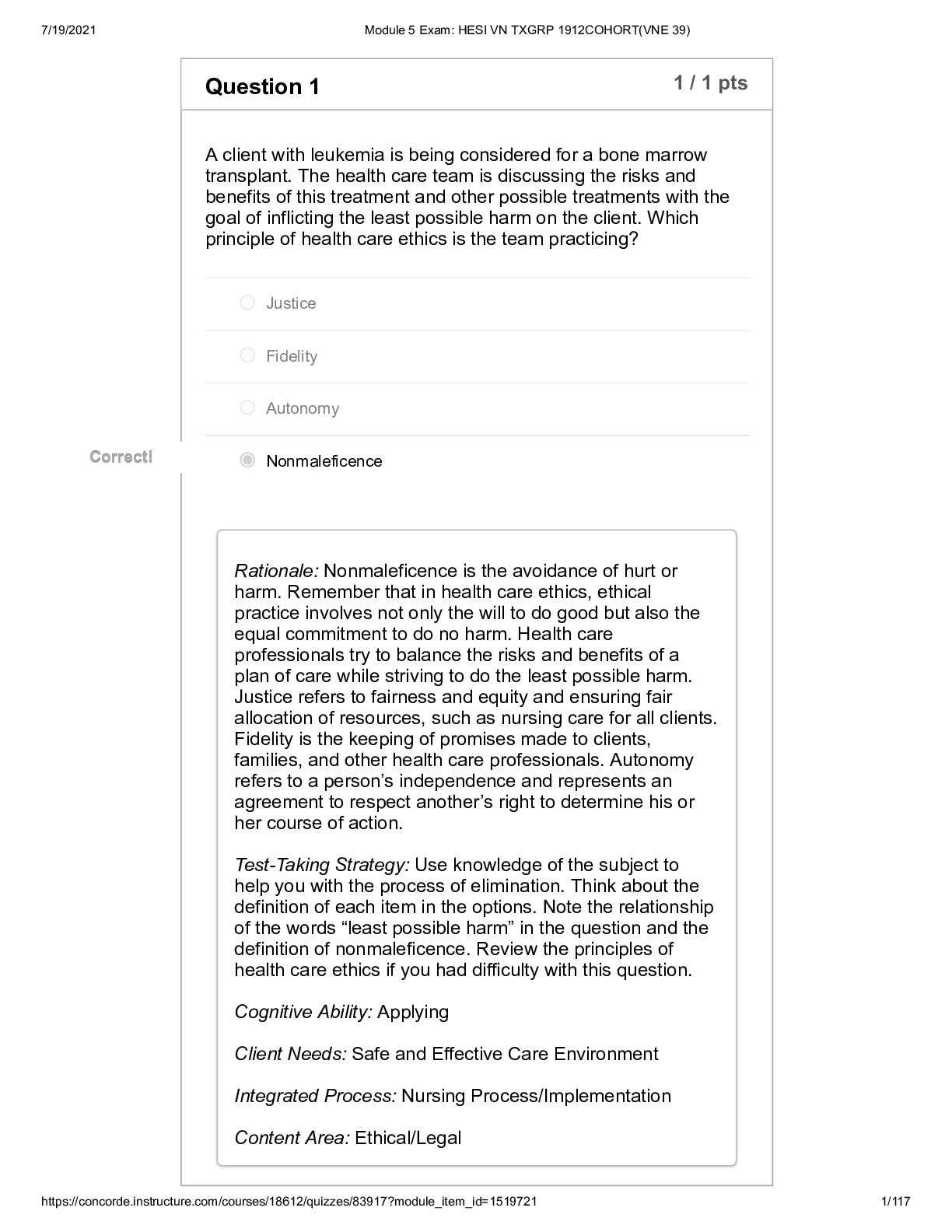


.png)
.png)
.png)
.png)


 Questions, Answers & Rationale, A+ Guide.png)