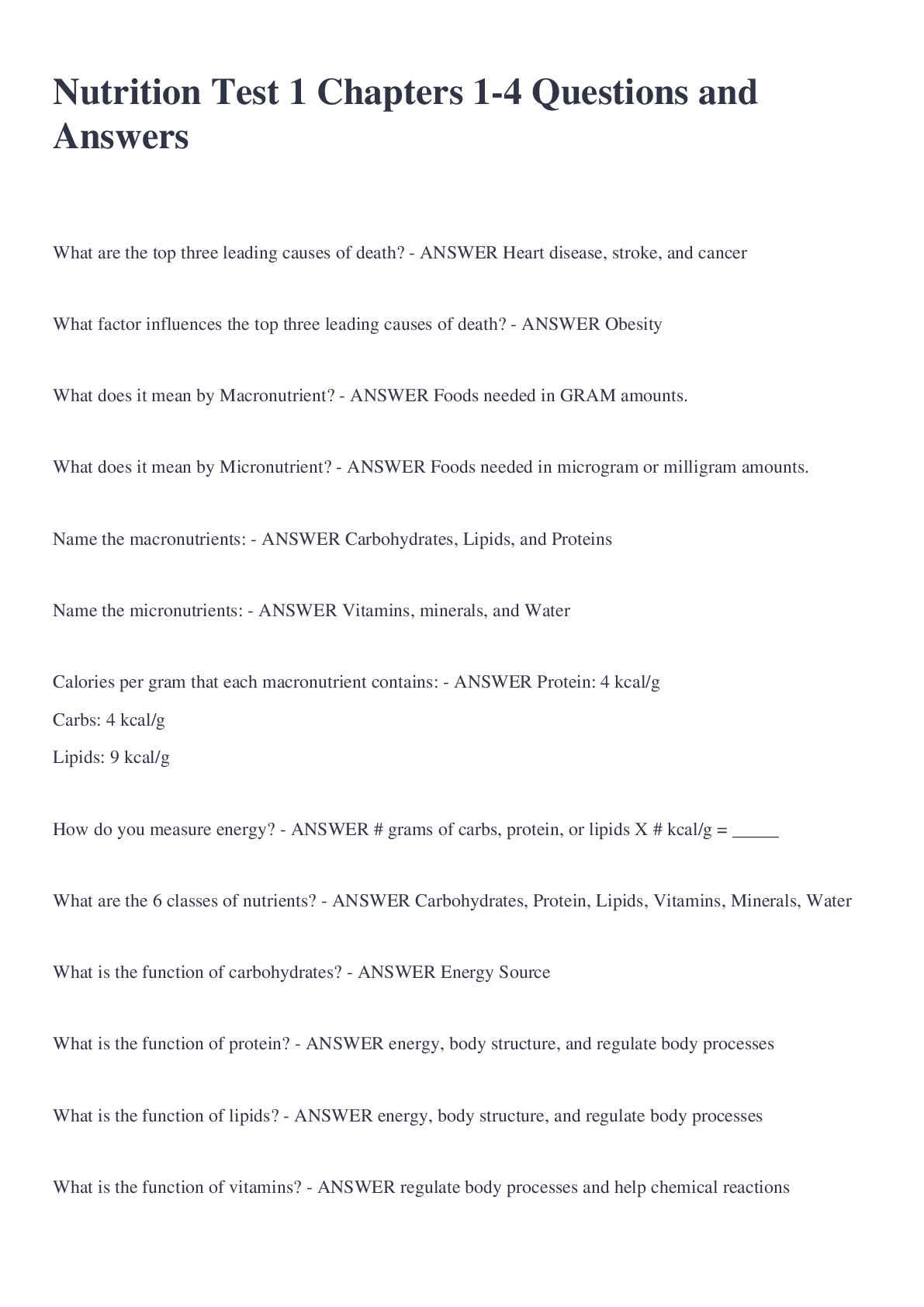
What are the top three leading causes of death? - ANSWER Heart disease, stroke, and cancer
What factor influences the top three leading causes of death? - ANSWER Obesity
What does it mean by Macronutrient? - ANSWER
...
What are the top three leading causes of death? - ANSWER Heart disease, stroke, and cancer
What factor influences the top three leading causes of death? - ANSWER Obesity
What does it mean by Macronutrient? - ANSWER Foods needed in GRAM amounts.
What does it mean by Micronutrient? - ANSWER Foods needed in microgram or milligram amounts.
Name the macronutrients: - ANSWER Carbohydrates, Lipids, and Proteins
Name the micronutrients: - ANSWER Vitamins, minerals, and Water
Calories per gram that each macronutrient contains: - ANSWER Protein: 4 kcal/g
Carbs: 4 kcal/g
Lipids: 9 kcal/g
How do you measure energy? - ANSWER # grams of carbs, protein, or lipids X # kcal/g = _____
What are the 6 classes of nutrients? - ANSWER Carbohydrates, Protein, Lipids, Vitamins, Minerals, Water
What is the function of carbohydrates? - ANSWER Energy Source
What is the function of protein? - ANSWER energy, body structure, and regulate body processes
What is the function of lipids? - ANSWER energy, body structure, and regulate body processes
What is the function of vitamins? - ANSWER regulate body processes and help chemical reactions
What is the function of minerals? - ANSWER body structure (e.g. calcium for bone) and regulate body processes
What is the function of water? - ANSWER lubricant for joints (structure), regulate body temp, transporter for the body--blood and waste (urine)
Principles of a healthy diet: - ANSWER Variety, balance, and moderation, nutrient density, energy density
What is the "Continuum of Nutrition Status?" - ANSWER UNDERNUTRITION -- *subclinical *biochemical evidence *deficiency symptoms
DESIRABLE NUTRITION -- *body tissues have enough *proper functioning
OVERNUTRITION -- *too much consumption *too many calories (most common)
What is Nutrient Density? - ANSWER The number of nutrients in a food compared to the number of calories (good!)
What is Energy Density? - ANSWER The number of calories compared to the gram weight of the food. --affect kcal intake --high energy density is bad.
Risk of consuming too much saturated fat and choloesterol: - ANSWER Too much sat. fat, trans. fat, & cholesterol increases blood chol/lipid levels & increases risk of heart disease.
Risk of consuming too much sodium: - ANSWER High sodium intake increases risk of high BP (hypertension). High BP increases risk of: stroke, heart failure and kidney failure.
What influences what we eat? - ANSWER *flavor, texture, appearance *education/income
*availability of foods *food costs
*health & nutrition *lifestyle
*routines/habits *customs/culture
*social network *psychological factors (anxiety)
What are the key recommendations of the Dietary Guidelines for Americans? - ANSWER 1) prevent or reduce overweight & obesity through improved eating & physical activity
2) control total kcal intake to manage weight
3) increase physical activity & decrease sendentary behaviors
4) maintain kcal balance in each stage of life
MyPlate--pupose - ANSWER replaces MyPyramid
MyPlate--information provided and what it is based on: - ANSWER number of servings from each food group based on calorie needs of (1) age, (2) weight, (3) gender, and (4) activity level.
MyPlate--information provided and what it is based on: - ANSWER translates nutrition advice of DG using the image of a plate to convey nutritional recommendations to the public.
MyPlate--food groups - ANSWER choose low-fat & fat-free items, include plant sources of proteins, incorporate dark green veg & vit C-rich fruits, choose whole grains, include plant oils daily & fish oils at least twice weekly
MyPlate--portions and size - ANSWER veg--measure in cups
fruits--measure in cups
grains measured in ounces
meats measured in ounces
Define fortified: - ANSWER adding nutrients not normally present
Define enriched: - ANSWER replacing nutrients lost in processing
Daily values: what are they? - ANSWER amount of nutrients in a food as a percentage of the daily value recommended for a 2000 kcal diet. --simple standard for all consumers --may be an over/under est. (pregnancy, children)
Define enzymes: - ANSWER proteins that speed up the rate of chemical reactions but are not altered in the process.
Two processes of digestion and examples: - ANSWER 1) Mechanical (physical)--(a) chewing (b) muscular contractions
2) Chemical--(a) enzymes (b) hydrolysis
Understand absorption and the main site for it: - ANSWER When nutrients enter the cells of the GI tract and enter the BLOOD or LYMPH.
What two systems control the GI tract? - ANSWER (1) Vascular system: network of veins & arteries--transport nutrients to tissues.
(2) Lymphatic system: network of vessels that carry lymph (fluid that builds up around cells).
Define metabolism: - ANSWER sum of all chemical processes necessary to sustain life.
The 2 basic processes of metabolism: - ANSWER Anabolism: building or synthesizing
Catabolism: breaking down
Immune function of the GI tract:
How does GI bacteria influence your health? - ANSWER barrier to foreign invaders such as bacteria in the gut
BAD--pathogenic GOOD--beneficial
Define HORMONES: - ANSWER produced in one location and act in another location (travel through the blood). -- control muscle contractions and secretions.
Prebiotics: - ANSWER improve the growth of benefical bacteria.
Probiotics: - ANSWER beneficial bacteria in the gut
(e.g. lactobacillus acidophilus)
Define Hydrolysis: - ANSWER the breaking apart by water. (chemical reaction of digestions occurs through).
What is the function of carbs: - ANSWER energy
Name sources of carbs: - ANSWER *milk/milk products *fruit
*grains *starchy veg (potatoes,corn)
*legumes (peas/beans) *added sugars
What is the difference between starch and glycogen? - ANSWER Starch is plant storage form of glucose and glycogen is the animal storage form of glucose.
What are amylose and amylopectin? - ANSWER Amylose: linear chain of starch
Amylopectin: branched chain of starch
What is the difference between monosccharides and disaccharides? - ANSWER Both are carbohydrates--mono is a simple carb; di- is two monos linked together
Can excess glucose by converted to fat? - ANSWER Glucose can be converted to fat ONLY when calorie needs are exceeded.
Where is excess glucose stored? What is it stored as? - ANSWER Excess glucose is stored in the liver as glycogen and can also be stored in muscle.
Name the parts of the GI tract: - ANSWER mouth, esophagus, stomach, small intestine, large intestine
Name the assisting organs of the GI tract: - ANSWER liver, gallbladder, pancreas
Function and secretions of mouth for GI tract: - ANSWER chew and grind food; secretions--saliva (salivary enzymes)
Function and secretions of esophagus for GI tract: - ANSWER epiglottis is the flap of tissue that prevents food from entering the wind pipe/airway and moves by peristalisis --secretes mucus for lubrication
Function and secretions of stomach th for GI tract: - ANSWER enters through esophageal sphincter. Muscle contractions mix and churn. secretes--(1)hydrochloric acid to sterilize and begin digestion of protein; (2) mucus to protect walls, (3) enzymes to assist w/digestion.
Function and secretions of small intestine for GI tract: - ANSWER the main site for digestion and absorption. secretes--enzymes , mucus and some hormones.
Function and secretions of large intestine for GI tract: - ANSWER No digestion occurs here. Theere is some absorption but not much. --fecal material here.
Function and secretions of assisting organ, pancreas, for GI tract: - ANSWER secretes--enzymes, bicarbonate which neutrolyzes acid from the stomach, hormones. These secretions go into the duodenum thru the bile duct.
Function and secretions of assisting organ, liver, for GI tract: - ANSWER produces bile (emulsifies fat in the GI tract).
Function and secretions of assisting organ, gallbladder, for GI tract: - ANSWER stores bile produced in the liver.
Lipids consumption: - ANSWER *saturated fat 1 kcal or less
*trans fat as little as possible
*cholesterol--300 mg or less
SODIUM reduction: - ANSWER less than 230 mg/day; less that 1500 mg/day if person has kidney disease, diabetes, or hypertension
Added sugar reduction: - ANSWER sugar
high fructose corn syrup
Reduce refined grains: - ANSWER limit consumption if they have added sodium, fat, or sugar. 1/2 of all grains consumed should be WHOLE grains.
RDA - ANSWER Recommended Daily Allowance: meets the needs of 97% of all healthy ind. in a part. age and gender group.
EAR - ANSWER Estimated Average Requirement: Am't of a nutrient that meets the needs of 50% of a part. population (used to set RDA)
[Show More]