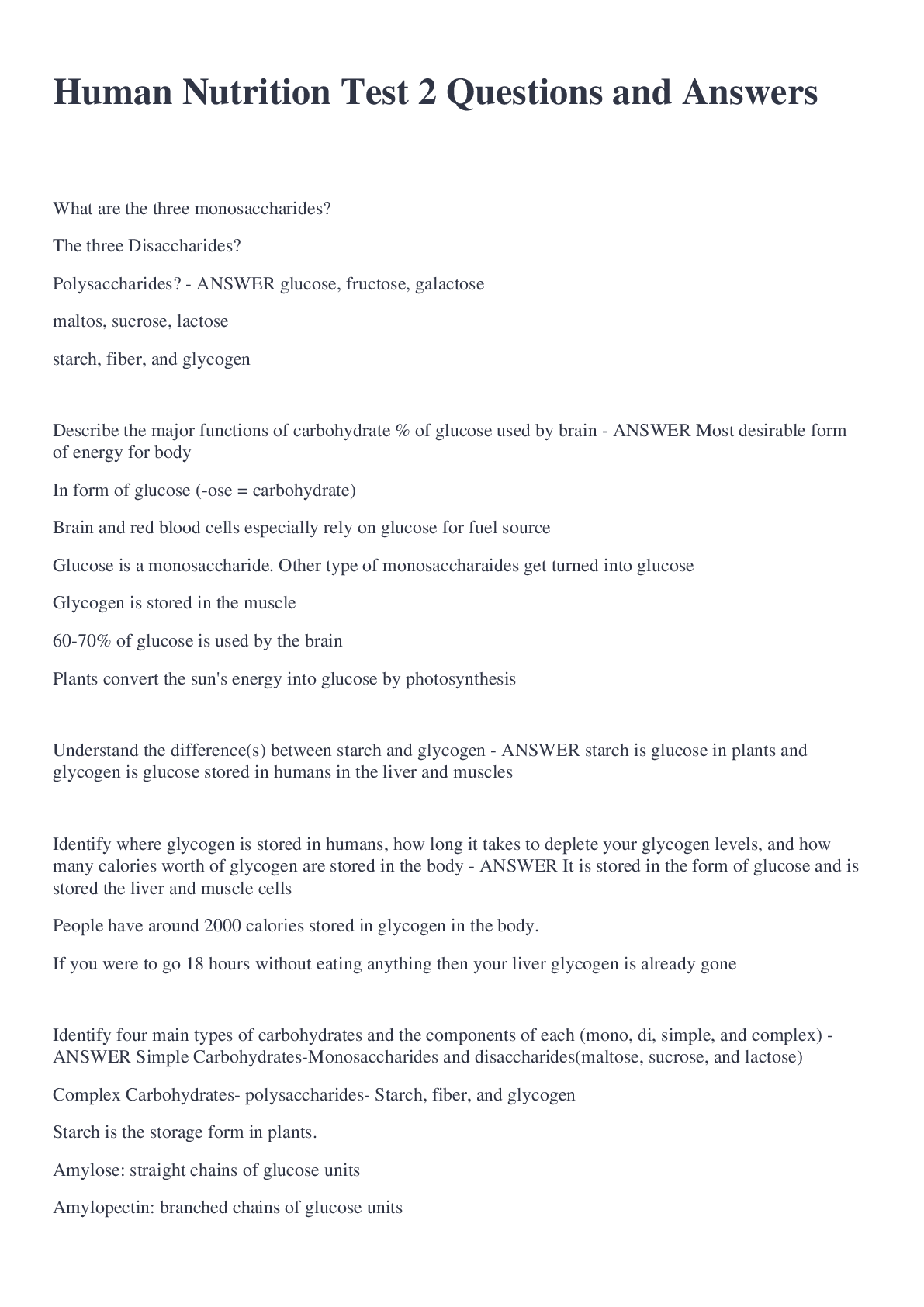
What are the three monosaccharides?
The three Disaccharides?
Polysaccharides? - ANSWER glucose, fructose, galactose
maltos, sucrose, lactose
starch, fiber, and glycogen
Describe the major functions of carbohydrate
...
What are the three monosaccharides?
The three Disaccharides?
Polysaccharides? - ANSWER glucose, fructose, galactose
maltos, sucrose, lactose
starch, fiber, and glycogen
Describe the major functions of carbohydrate % of glucose used by brain - ANSWER Most desirable form of energy for body
In form of glucose (-ose = carbohydrate)
Brain and red blood cells especially rely on glucose for fuel source
Glucose is a monosaccharide. Other type of monosaccharaides get turned into glucose
Glycogen is stored in the muscle
60-70% of glucose is used by the brain
Plants convert the sun's energy into glucose by photosynthesis
Understand the difference(s) between starch and glycogen - ANSWER starch is glucose in plants and glycogen is glucose stored in humans in the liver and muscles
Identify where glycogen is stored in humans, how long it takes to deplete your glycogen levels, and how many calories worth of glycogen are stored in the body - ANSWER It is stored in the form of glucose and is stored the liver and muscle cells
People have around 2000 calories stored in glycogen in the body.
If you were to go 18 hours without eating anything then your liver glycogen is already gone
Identify four main types of carbohydrates and the components of each (mono, di, simple, and complex) - ANSWER Simple Carbohydrates-Monosaccharides and disaccharides(maltose, sucrose, and lactose)
Complex Carbohydrates- polysaccharides- Starch, fiber, and glycogen
Starch is the storage form in plants.
Amylose: straight chains of glucose units
Amylopectin: branched chains of glucose units
Many saccharides linked together. Amylopectin is more similar to glycogen because it is branched. It is digested easily because there is more surface area to break it down
Identify health effects associated with dietary fiber intake, fiber recommendations, # grams for men and women, avg grams americans eat / day - ANSWER Examples of fiber- cellulose, hemicellulose, lignins, gums, pectin
Fiber recommendations are- (14 grams of fiber/ 100 calories you eat)
38 grams form men
25 grams for women
Average Americans get about 15 grams per day
Where do added sugars come from in the American diet? - ANSWER Added sugars are added by manufacturers and are often "empty calories" (provide little nutrition).
Examples: soda, candy
Taste buds can't distinguish between naturally occurring and added sugars
39 percent soda, sports drinks
15 percent grain-ed based desserts and fruit drinks such as lemonade
13 percent candy
7 percent dairy desserts
5 percent ready to eat cereals
Discuss the relationship between carbohydrates and chronic diseases such as, obesity, diabetes, lactose intolerance, triglycerides and cholesterol. - ANSWER Fiber helps lower risk of developing:
Constipation
Diverticulosis, diverticulitis
Obesity: high-fiber foods add to satiation
Heart disease: soluble fibers lower elevated blood cholesterol levels
Colorectal cancer
Diabetes mellitus: slow digestion and absorption of glucose
Lactose intolerance when lactose maldigestion results in nausea, cramps, bloating, diarrhea, and flatulence
Excess glucose is stored as triglycerides and soluble fiber lowers your cholesterol
Relate carbohydrate processing to nutrient deficiencies (refined versus whole grains)- how can you tell if a product is whole grain when reading the label? - ANSWER Grains: important staple and source of nutrition
Three edible parts: bran, endosperm, germ
Refined grains: milling removes bran and germ
Some B vitamins, iron, phytochemicals, and dietary fiber lost as a result
Examples: wheat or white bread, white rice
Enriched grains: folic acid, thiamin, niacin, riboflavin and iron added to restore some of the lost nutrition
Whole grain foods contain all three parts of kernel
Examples: brown rice, oatmeal, whole-wheat bread
Make sure there is no die in it, first product is whole grains
Without glucose, fat can't be broken down completely and ___ are produced,
which are acidic. - ANSWER ketone bodies
Understand how, under normal conditions, insulin response to an elevation in your blood glucose level after a meal. - ANSWER Insulin is released by pancreas in response to high blood glucose levels after a carbohydrate-heavy meal
Directs conversion of glucose in excess of immediate energy needs into glycogen (glycogenesis) in liver and muscle cells (limited capacity)
Rest of excess glucose converted to fat
Understand how your body responds when your blood glucose levels start to fall (under normal, healthy conditions)- the role of glucagon - ANSWER When blood glucose begins to drop, pancreas releases the hormone glucagon to raise blood glucose levels
Directs release of glucose from stored glycogen in liver = glycogenolysis
Signals liver to start gluconeogenesis = making glucose from noncarbohydrate sources, mostly protein
Epinephrine (breakdown of glucagon in exercise, adrenaline) also stimulates glycogenolysis and increases blood glucose levels
"Fight or flight" hormone: stress, bleeding, low blood glucose levels trigger its release
Identify where insulin is produced (what organ) and where glucagon is produced (what organ) - ANSWER pancreas
Define Diabetes Mellitus, Type 1 Diabetes, Type 2 Diabetes, and Gestational Diabetes - ANSWER Diabetes mellitus: individual has high blood glucose levels due to insufficient insulin or insulin resistance
Glucose can't enter cells, which burn fat for fuel
Without glucose, acidic ketone bodies build up, causing life-threatening diabetic ketoacidosis: untreated can result in coma, death
Type 1 diabetes: 5 to 10 percent of cases
Autoimmune disease: insulin-producing cells in pancreas destroyed—insulin injections required
Develops in childhood, early adult years
Type 2 diabetes: 90 to 95 percent of cases
Cells are resistant to insulin, eventually insulin-producing cells are exhausted, pancreas decreases and medication and/or insulin is required
People 45 and older or at risk for diabetes should
be tested.
Prediabetes: impaired glucose tolerance
Blood glucose higher than normal but not yet high enough to be classified as diabetes
Damage to heart and circulatory system can occur.
Pregnant women who have never had diabetes before but who have high blood glucose (sugar) levels during pregnancy are said to have gestational diabetes.
Define gluconeogenesis - ANSWER liver starts making glucose from noncarbohydrate sources, mostly protein
Be able to interpret glycemic index and glycemic response - ANSWER Glycemic index (GI) and glycemic load (GL) classify effects of carbohydrate-containing foods on blood glucose
GI: ranks foods' effects on blood glucose compared with equal amount of pure glucose
GL: adjusts GI to take into account the amount of carbohydrate consumed
Eating carbohydrate-heavy foods with protein, fat lowers GI
Sugar is not prohibited; starch causes same rise in blood glucose levels
Total calories important for weight management
Glycemic index doesn't give room for higher response
It gives you peak and duration for food that gives you 50 grams carbohydrate
Glycemic load take glycemic index multiply it by grams of carbs in food you are eating and then multiply it by 100
55 or less is a low glycemic food
Name the three major types of lipids in our body - ANSWER Triglyceride (fat), phospholipids, and sterols
List at least three major functions of lipids in our bodies - ANSWER 1- energy storage,
2- protection
3- insulation
4- hormone production
5- structure (in cell membrane)
Discuss where cholesterol comes from and whether or not it is an essential nutrient- also what cholesterol important for in the body (it is a precursor for....) - ANSWER Important role in cell membrane structure
Precursor of important compounds in body
Not required in diet since body makes all cholesterol needed
Define hydrogenation - ANSWER Trans fats are created by food manufacturers through the process of hydrogenation (process of converting an unsaturated alkene into a saturated alkane by adding hydrogen to the double bond)
trans-fatty acids - ANSWER Shown to increase LDL and decrease HDL; Stick margarine; Shortening; Fried Foods; Fast Food; Many baked goods and pastries
State the AMDR for fat - ANSWER 20%-35% of your calories
Identify the four major types of (lipoproteins) in the body
Describe the characteristic features of each (size, density, proportion of cholesterol and triglycerides). Be able to describe what each lipoprotein does in the body - ANSWER Look at Diagram in Chapter 5
lipoproteins transport fat through the lymph and into the blood
Chylomicrons: carry digested fat through lymph into bloodstream (it is the largest of the lipoproteins and contains the greatest amount of triglycerides)
Very low-density lipoproteins (VLDL): deliver fat made in liver to cells
Low-density lipoproteins (LDL, "bad" cholesterol): deposit cholesterol on walls of arteries (mostly cholesterol)
High-density lipoproteins (HDL, "good" cholesterol): remove cholesterol from body and deliver to liver for excretion (mostly protein) most dense lipoproteins
Identify cis and trans fatty acids - ANSWER Cis fat: hydrogens on same side (like sisters) cause a bend in the carbon chain. are natural polyunsaturated fats
Trans fat: hydrogens are across (like a transcontinental flight goes across the US) make the carbon chain straighter, similar to the shape of a saturated fatty acid. are industrialized polyunsaturated fats
Atherosclerosis (what factors we talked about increasing risk for atherosclerosis) - ANSWER LDL is seen as associated with disease risk
narrowing of arteries due to buildup of plaque (hardened debris of cholesterol-laden foam cells, platelets, calcium, cellular waste products)
Thought to begin with injury to lining of arteries, contributed by high blood pressure, high cholesterol levels, and smoking
Increases chance of blood clots blocking the vessel, causing heart attack or stroke
Myocardial infraction - ANSWER heart attack; occurs when a blockage in the coronary arteries cuts off the supply of blood to the heart
Stroke - ANSWER A sudden attack of weakness or paralysis that occurs when blood flow to an area of the brain is interrupted
What is lecithin and what role does it play in food and in the body? - ANSWER Lecithin is an emulsifying agent found in eggs and soy products. Because it is soluble in both water and fat, it coats the surface of the dispersed liquids and separates those molecules from one another preventing surface tension from joining them again.
Identify the basic compound that differentiates proteins from lipids and carbohydrates - ANSWER Lipids are fats, they contain C,H, O, they are fatty acids attached to a glycerol
carbohydrates are sugars and starch, containing C,H,O in a ratio of C(H2O). Starch is a polymer of sugars
Proteins contain C,H,O, N, they are polymers of amino acids
peptide bonds - ANSWER Bonds between amino acids
R group - ANSWER used to represent one of 20 possible side chains found in amino acids of living systems
Limiting amino acid - ANSWER The essential amino acid found in the shortest supply relative to the amounts needed for protein synthesis in the body
How are amino acids absorbed? - ANSWER Active and facilitated diffusion
Identify the biological functions of protein (use the table included in the lecture powerpoint) - ANSWER Proteins help maintain acid-base balance
Proteins transport substances throughout the body
Proteins contribute to a healthy immune system
Proteins can provide energy
Protein improves satiety and appetite control
What is the amino acid pool and how does it compare to carbohydrate or fat storage in the body. Where is it located? - ANSWER Amino acids can come from the body, some from the free amino acid pool circulating the body, when we get some in excess we can use those proteins to convert to glucose
Compare and contrast positive nitrogen balance and negative nitrogen balance - ANSWER Positive, we are taking in more nitrogen than we are excreting
Equilibrium, same
Negative, we are taking in less nitrogen than we are excreting
How is protein quality determined? - ANSWER PDCAAS- focus on this one. It is the most widely used and it is the one used to evaluate DV on nutritional labels
PDCAAS- Chemical and Digestibility Score-highest value for this is 1. For most proteins and soy and egg whites
define Kwashiorkor and marasmus describe the characteristic features. Discuss who is at risk - ANSWER Kwashiorkor is lack of protein
Signs: edema (fluid balance), muscle loss, skin rashes, hair changes, water and electrolyte imbalances
Marasmus: severe deficiency of calories
Signs: emaciation, lack of growth, loss of fat stores
State the DRI for protein for healthy adults and also know the AMDR. Be able to perform calculations using a food label and indicating whether or not someone is meeting protein guidelines - ANSWER 10-35% of calories 0.8 g of protein*kg of body weight needed daily 2.2 lbs = 1 kg
Hexosis means? - ANSWER they contain 6 carbohydrates
Maltose
Sucrose (table sugar)
Lactose (milk sugar) - ANSWER Maltose = glucose + glucose
Sucrose (table sugar) = glucose + fructose
Lactose (milk sugar) = glucose + galactose
Soluble vs insoluble fiber - ANSWER Soluble is dissolvable by water- lowering cholesterol
Insoluble- just increases the speed of digestion
Soluble fiber: dissolves in water and is fermented by intestinal bacteria
Many are viscous, have thickening properties
Move more slowly through GI tract
Examples: Pectin in fruits and vegetables, beta-gl
[Show More]