1. A nurse places a client in a seclusion room until he admits to starting a fight in the day room
earlier. What does the nurse’s behavior constitute?
a. Assault
b. Battery
c. False improvement
d. Malpractice
2. Du
...
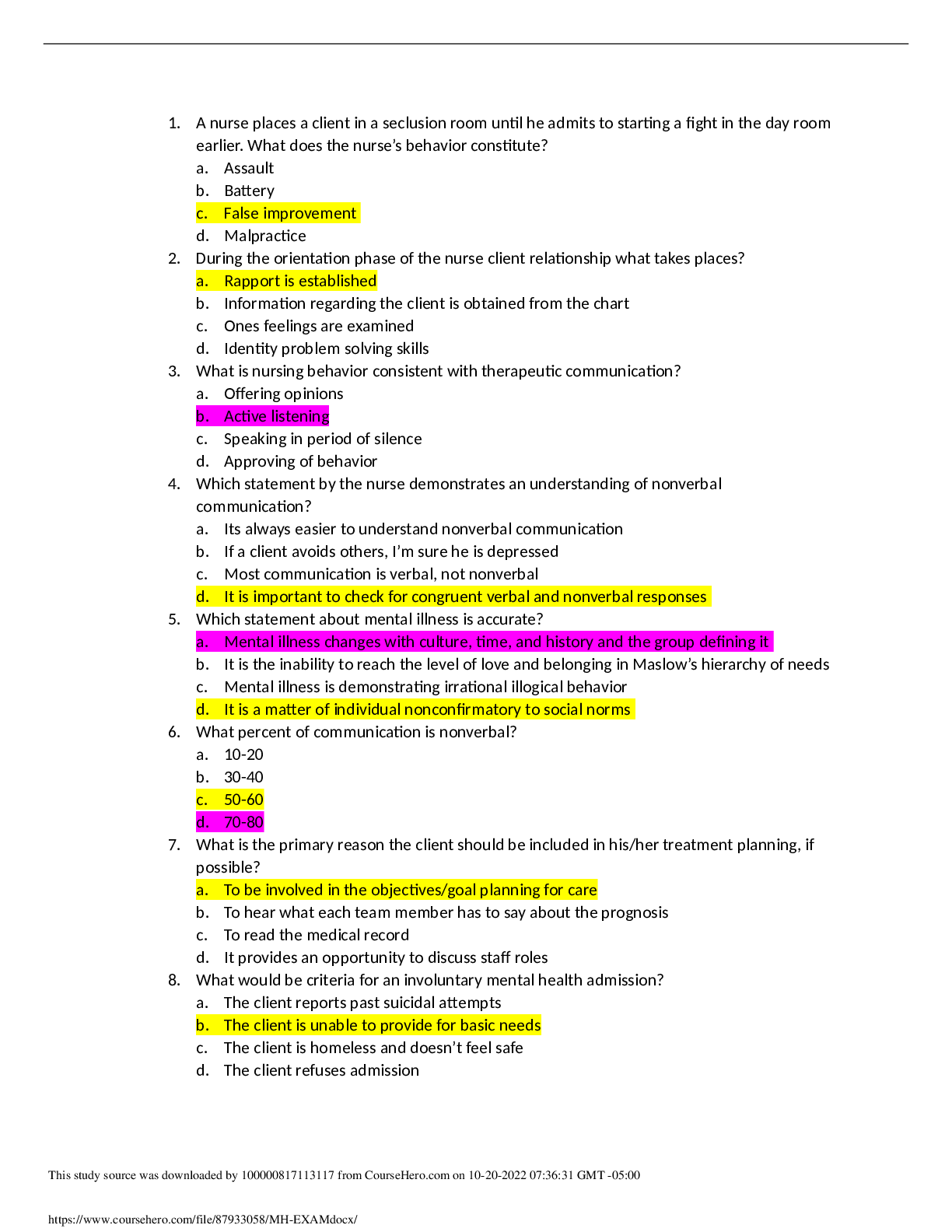
1. A nurse places a client in a seclusion room until he admits to starting a fight in the day room
earlier. What does the nurse’s behavior constitute?
a. Assault
b. Battery
c. False improvement
d. Malpractice
2. During the orientation phase of the nurse client relationship what takes places?
a. Rapport is established
b. Information regarding the client is obtained from the chart
c. Ones feelings are examined
d. Identity problem solving skills
3. What is nursing behavior consistent with therapeutic communication?
a. Offering opinions
b. Active listening
c. Speaking in period of silence
d. Approving of behavior
4. Which statement by the nurse demonstrates an understanding of nonverbal
communication?
a. Its always easier to understand nonverbal communication
b. If a client avoids others, I’m sure he is depressed
c. Most communication is verbal, not nonverbal
d. It is important to check for congruent verbal and nonverbal responses
5. Which statement about mental illness is accurate?
a. Mental illness changes with culture, time, and history and the group defining it
b. It is the inability to reach the level of love and belonging in Maslow’s hierarchy of needs
c. Mental illness is demonstrating irrational illogical behavior
d. It is a matter of individual nonconfirmatory to social norms
6. What percent of communication is nonverbal?
a. 10-20
b. 30-40
c. 50-60
d. 70-80
7. What is the primary reason the client should be included in his/her treatment planning, if
possible?
a. To be involved in the objectives/goal planning for care
b. To hear what each team member has to say about the prognosis
c. To read the medical record
d. It provides an opportunity to discuss staff roles
8. What would be criteria for an involuntary mental health admission?
a. The client reports past suicidal attempts
b. The client is unable to provide for basic needs
c. The client is homeless and doesn’t feel safe
d. The client refuses admission
[Show More]





.png)
.png)
.png)
.png)