Chapter 4
1.The periodicity assumption states that:
a. a transaction can only affect one period of time.
b. estimates should not be made if a transaction affects more than one time
period.
c. adjustments to the ente
...
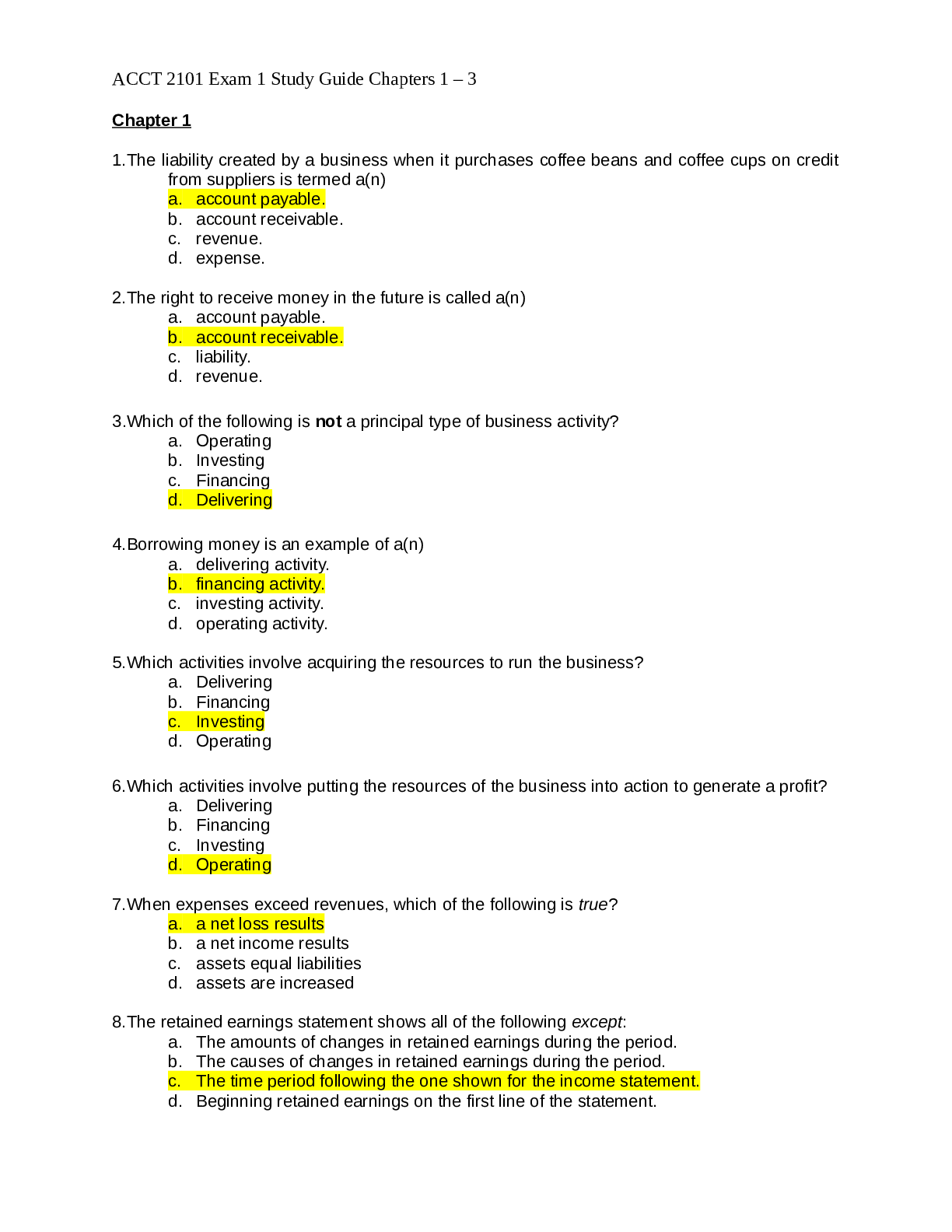
Chapter 4
1.The periodicity assumption states that:
a. a transaction can only affect one period of time.
b. estimates should not be made if a transaction affects more than one time
period.
c. adjustments to the enterprise's accounts can only be made in the time period
when the business terminates its operations.
d. the economic life of a business can be divided into artificial time periods.
2.One of the accounting concepts upon which adjustments for prepayments and
accruals are based is:
a. expense recognition.
b. cost.
c. monetary unit.
d. economic entity.
3.An accounting time period that is one year in length is called:
a. a fiscal year.
b. an interim period.
c. the time period assumption.
d. a reporting period.
4.Expenses are recognized when:
a. they contribute to the production of revenue.
b. they are paid.
c. they are billed by the supplier.
d. the invoice is received.
5.The revenue recognition principle dictates that revenue should be recognized in the
accounting records:
a. when cash is received.
b. when it is earned.
c. at the end of the month.
d. in the period that income taxes are paid.
6.A flower shop makes a large sale for $1,000 on November 30. The customer is sent a
statement on December 5 and a check is received on December 10. The flower
shop follows GAAP and applies the revenue recognition principle. When is the
$1,000 considered to be earned?
a. December 5
b. December 10
c. November 30
d. December 1
ACCT 2101 EXAM 2 STUDY GUIDE CHAPTER 4-6
7.Under the cash basis of accounting:
a. Revenue is recognized when services are performed.
b. Expenses are matched with the revenue that is produced.
c. cash must be received before revenue is recognized.
d. a promise to pay is sufficient to recognize revenue.
8.Under the accrual basis of accounting:
a. cash must be received before revenue is recognized.
b. net income is calculated by matching cash outflows against cash inflows.
c. events that change a company's financial statements are recognized in the
period they occur rather than in the period in which cash is paid or received.
d. the ledger accounts must be adjusted to reflect a cash basis of accounting
before financial statements are prepared under generally accepted
accounting principles.
9.The following is selected information from L Corporation for the fiscal year ending
October 31, 2011.
Cash received from customers $300,000
Revenue earned 370,000
Cash paid for expenses 170,000
Cash paid for computers on November 1, 2010 that will
be used for 3 years 48,000
Expenses incurred including any depreciation 216,000
Proceeds from a bank loan, part of which was used to
pay for the computers 100,000
Based on the accrual basis of accounting, what is L Corporation’s net income for
the year ending October 31, 2011?
a. $184,000
b. $154,000 (370000 – 216000)
c. $152,000
d. $170,000
10.La More Company had the following transactions during 2011:
• Sales of $4,500 on account
• Collected $2,000 for services to be performed in 2012
• Paid $1,375 cash in salaries for 2011
• Purchased airline tickets for $250 in December for a trip to take place in
2012
What is La More’s 2011 net income using accrual accounting?
a. $3,375
b. $5,375
c. $5,125
d. $3,125 (4500 – 1375)
11.La More Company had the following transactions during 2011.
• Sales of $4,500 on account
• Collected $2,000 for services to be performed in 2012
• Paid $1,125 cash in salaries
• Purchased airline tickets for $250 in December for a trip to take place in
2012
What is La More’s 2011 net income using cash basis accounting?
a. $5,375
b. $875
c. $5,125
d. $625 (2000 – 1125 – 250)
12.Given the data below for a firm in its first year of operation, determine net income
under the cash basis of accounting.
Revenue earned $14,000
Accounts receivable 3,000
Expenses incurred 7,250
Accounts payable (related to expenses) 750
Supplies purchased with cash 1,800
a. $4,500
b. $9,000
c. $2,700 (11000 – 6500 – 1800)
d. $4,950
13.Given the data below for a firm in its first year of operation, determine net income
under the accrual basis of accounting.
Revenue earned $14,000
Accounts receivable 3,000
Expenses incurred 7,250
Accounts payable (related to expenses) 750
Supplies purchased with cash 1,800
a. $6,750 (14000 – 7250)
b. $9,000
c. $4,500
d. $7,200
14.Adjusting entries are made to ensure that:
a. expense are recognized in the period in which they are incurred.
b. revenues are recorded in the period in which they are earned.
c. balance sheet and income statement accounts have correct balances at the
end of an accounting period.
d. All of the above.
15.An adjusting entry:
a. affects two balance sheet accounts.
b. affects two income statement accounts.
c. affects a balance sheet account and an income statement account.
d. is always a compound entry.
16.Accrued expenses are:
a. incurred but not yet paid or recorded.
b. paid and recorded in an asset account after they are used or consumed.
c. paid and recorded in an asset account before they are used or consumed.
d. incurred and already paid or recorded.
17.Accrued revenues are:
a. received and recorded as liabilities before they are earned.
b. earned and recorded as liabilities before they are received.
c. earned but not yet received or recorded.
d. earned and already received and recorded.
18.Greese Company purchased office supplies costing $4,000 and debited Office
Supplies for the full amount. At the end of the accounting period, a physical count
of office supplies revealed $1,100 still on hand. The appropriate adjusting journal
entry to be made at the end of the period would be:
a. debit Office Supplies Expense, $1,100; credit Office Supplies, $1,100.
b. debit Office Supplies, $2,900; credit Office Supplies Expense, $2,900.
c. debit Office Supplies Expense, $2,900; credit Office Supplies, $2,900.
d. debit Office Supplies, $1,100; credit Office Supplies Expense, $1,100.
19.Walton Company collected $7,200 in May of 2010 for 4 months of service which
would take place from October of 2010 through January of 2011. The revenue
reported from this transaction during 2010 would be:
a. $0
b. $5,400 (7200 / 4 = 1800, 1800 * 3 = 5400)
c. $7,200
d. $1,800
20.The closing entry process consists of closing:
a. all asset and liability accounts.
b. out the Retained Earnings account.
c. all permanent accounts.
d. all temporary accounts.
Chapter 5
21.Gross profit equals the difference between
a. net income and operating expenses.
b. net sales revenues and cost of goods sold.
c. net sales revenues and operating expenses.
d. net sales revenues and cost of goods sold plus operating expenses.
22.Under a perpetual inventory system
a. accounting records continuously disclose the amount of inventory.
b. increases in inventory resulting from purchases are debited to purchases.
c. there is no need for a year-end physical count.
d. the account purchase returns and allowances is credited when goods are
returned to vendors.
23.Under a perpetual inventory system, acquisition of merchandise for resale is debited
to
a. the Inventory account.
b. the Purchases account.
c. the Supplies account.
d. the Cost of Goods Sold account.
24.A company using a perpetual inventory system that returns goods previously
purchased on credit would
a. debit Accounts Payable and credit Inventory.
b. debit Sales and credit Accounts Payable.
c. debit Cash and credit Accounts Payable.
d. debit Accounts Payable and credit Purchases.
25.Conway Company purchased merchandise inventory with an invoice price of $8,000
and credit terms of 2/10, n/30. What is the net cost of the goods if Conway
Company pays within the discount period?
a. $8,000
b. $7,840 (8000 * .02 = 160, 8000 – 160 = 7840)
c. $7,200
d. $7,360
26.The journal entry to record a credit sale is
a. Cash
Sales Revenue
b. Cash
Service Revenue
c. Accounts Receivable
Sales Returns and Allowances
d. Accounts Receivable
Sales Revenue
27.Under the perpetual inventory system, in addition to making the entry to record a
sale, a company would
a. debit Inventory and credit Cost of Goods Sold.
b. debit Cost of Goods Sold and credit Purchases.
c. debit Cost of Goods sold and credit Inventory.
d. make no additional entry until the end of the period.
28.The entry to record a sale of $900 with terms of 2/10, n/30 will include a
a. debit to Sales Discounts for $18.
b. debit to Sales Revenue for $882.
c. credit to Accounts Receivable for $900.
d. credit to Sales Revenue for $900.
29.The collection of an $800 account within the 2 percent discount period will result in a
a. debit to Sales Discounts for $16.
b. debit to Accounts Receivable for $784.
c. credit to Cash for $784.
d. credit to Accounts Receivable for $784.
30.The credit terms offered to a customer by a business firm were 2/10, n/30, which
means
a. the customer must pay the bill within 10 days.
b. the customer can deduct a 2% discount if the bill is paid between the 10th
and 30th day from the invoice date.
c. the customer can deduct a 2% discount if the bill is paid within 10 days of the
invoice date.
d. two sales returns can be made within 10 days of the invoice date and no
returns thereafter.
31.Aber Company sells merchandise on account for $1,500 to Borth Company with
credit terms of 2/10, n/30. Borth Company returns $250 of merchandise that was
damaged, along with a check to settle the account within the discount period.
What is the amount of the check?
a. $1,220
b. $1,230
c. $1,225 (1500 – 250 = 1250, 1250 * .02 = 25, 1250 – 25 = 1225)
d. $1,125
32.Which sales accounts normally have a debit balance?
a. Sales discounts
b. Sales returns and allowances.
c. both (a) and (b).
d. Neither (a) and (b).
33.Piper Company sells merchandise on account for $1,800 to Morton Company with
credit terms of 2/10, n/30. Morton Company returns $600 of merchandise that
was damaged, along with a check to settle the account within the discount
period. What entry does Piper Company make upon receipt of the check?
a. Cash 1,200
Accounts Receivable 1,200
b. Cash 1,176
Sales Returns and Allowances 624
Accounts Receivable . 1,800
c. Cash 1,176
Sales Returns and Allowances 600
Sales Discounts 24
Accounts Receivable 1,800
[Show More]
.png)

.png)


 (1).png)