Computer Science > EXAM > WGU C175 - PA Questions and Answers With Multiple Choices (All)
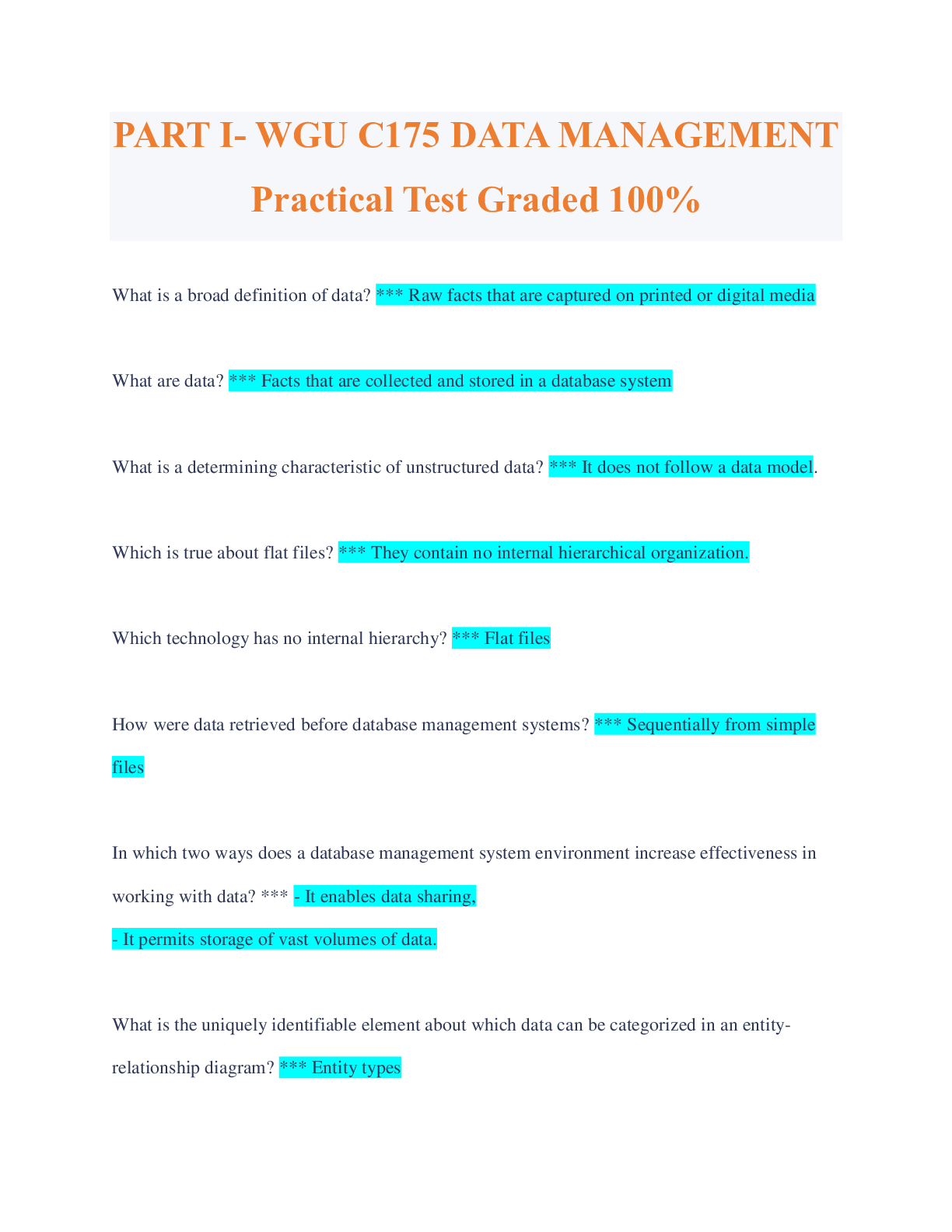
WGU C175 - PA Questions and Answers With Multiple Choices
Document Content and Description Below
Last updated: 4 years ago
Preview 1 out of 13 pages
Instant download

Buy this Document to get the Full Access Instantly
Provided by Students Who Aced it
We Verify Document Content to Gurantee Accuracy
Reviews( 0 )
Document information
Connected school, study & course
About the document
Uploaded On
Nov 11, 2022
Number of pages
13
Written in
All

Additional information
This document has been written for:
Uploaded
Nov 11, 2022
Downloads
0
Views
131
Topic Tags
Recommended For You
Get more on EXAM ».png)
WGU C175 Data Management Foundation Questions and Answers 100%...
.png)
WGU C175 Pre-Assessment Questions and Answers Already Passed
.png)
WGU C175 Data Management Foundations Questions and Answers Alr...

WGU C175 OBJECTIVE ASSESSMENT PRACTICE TEST ANSWERS| IT CIS111...
.png)
WGU C175: OBJECTIVE ASSESSMENT PRACTICE TEST ANSWERS| IT CIS11...
.png)
WGU C175 OBJECTIVE ASSESSMENT PRACTICE TEST ANSWERS| IT CIS111...

WGU C175 Pre Assessment Exam Data Management Foundations Co...

WGU C175 OBJECTIVE ASSESSMENT PRACTICE TEST ANSWERS| IT CIS111...

WGU C175 QUIZZES Data Management Foundations Complete Soluti...

eBook Environment, Agency, and Technology in Urban Life since...

EEC 1752 Preschoolers HESI IMP- Miami Dade College, Miami

EEC 1752 Maternity Midterm Review- Miami Dade College, Miami
FINAL WGU C175 Study Guide DATA MANAGEMENT FOUNDATIONS Already...
.png)
Solution Manual for Artificial Intelligence A Modern Approach,...
Western Governors University, WashingtonIT C175C175 Objective...