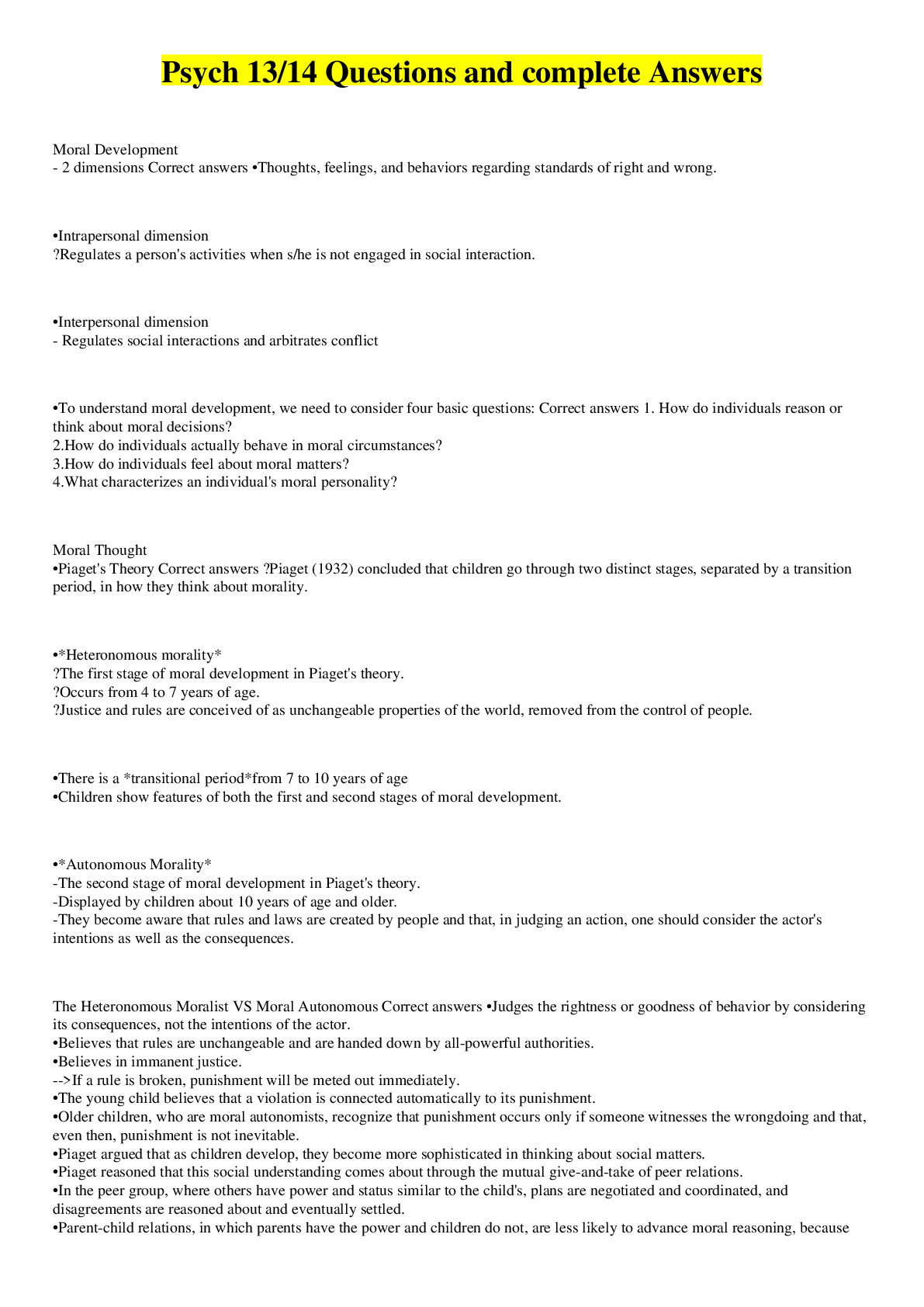
Psych 13/14 Questions and complete Answers
Moral Development
- 2 dimensions Correct answers •Thoughts, feelings, and behaviors regarding standards of right and wrong.
•Intrapersonal dimension
―Regulates a person'
...
Psych 13/14 Questions and complete Answers
Moral Development
- 2 dimensions Correct answers •Thoughts, feelings, and behaviors regarding standards of right and wrong.
•Intrapersonal dimension
―Regulates a person's activities when s/he is not engaged in social interaction.
•Interpersonal dimension
- Regulates social interactions and arbitrates conflict
•To understand moral development, we need to consider four basic questions: Correct answers 1. How do individuals reason or think about moral decisions?
2.How do individuals actually behave in moral circumstances?
3.How do individuals feel about moral matters?
4.What characterizes an individual's moral personality?
Moral Thought
•Piaget's Theory Correct answers ―Piaget (1932) concluded that children go through two distinct stages, separated by a transition period, in how they think about morality.
•*Heteronomous morality*
―The first stage of moral development in Piaget's theory.
―Occurs from 4 to 7 years of age.
―Justice and rules are conceived of as unchangeable properties of the world, removed from the control of people.
•There is a *transitional period*from 7 to 10 years of age
•Children show features of both the first and second stages of moral development.
•*Autonomous Morality*
-The second stage of moral development in Piaget's theory.
-Displayed by children about 10 years of age and older.
-They become aware that rules and laws are created by people and that, in judging an action, one should consider the actor's intentions as well as the consequences.
The Heteronomous Moralist VS Moral Autonomous Correct answers •Judges the rightness or goodness of behavior by considering its consequences, not the intentions of the actor.
•Believes that rules are unchangeable and are handed down by all-powerful authorities.
•Believes in immanent justice.
-->If a rule is broken, punishment will be meted out immediately.
•The young child believes that a violation is connected automatically to its punishment.
•Older children, who are moral autonomists, recognize that punishment occurs only if someone witnesses the wrongdoing and that, even then, punishment is not inevitable.
[Show More]