Nur-100 Foundations of Nursing Exam 2, Questions & Answers-The pt recently had a cast applied to his L lower leg after a football injury in which he broke his tibia. After the application of the cast, the nurse felt the
...
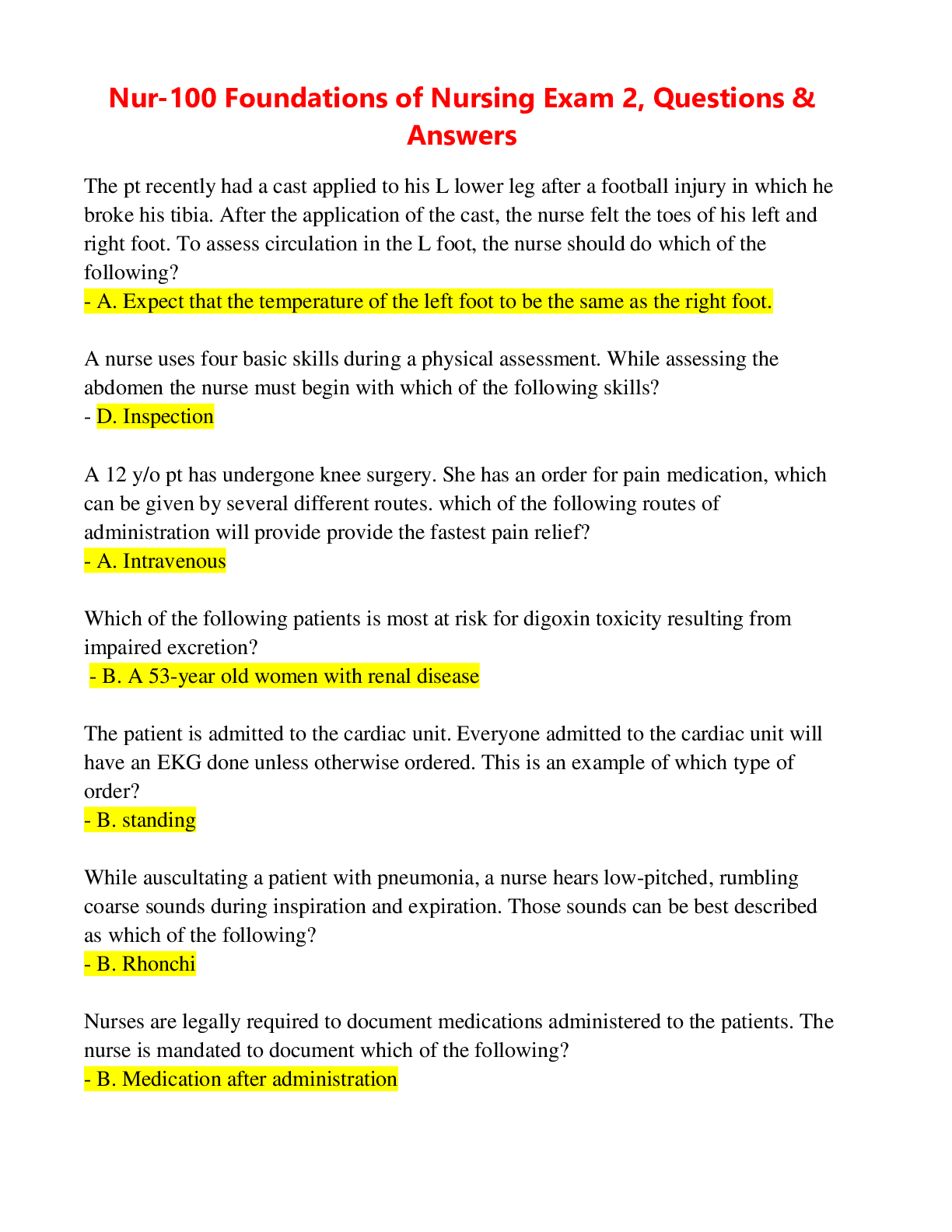
Nur-100 Foundations of Nursing Exam 2, Questions & Answers-The pt recently had a cast applied to his L lower leg after a football injury in which he broke his tibia. After the application of the cast, the nurse felt the toes of his left and right foot. To assess circulation in the L foot, the nurse should do which of the following?
- A. Expect that the temperature of the left foot to be the same as the right foot.
A nurse uses four basic skills during a physical assessment. While assessing the abdomen the nurse must begin with which of the following skills?
- D. Inspection
A 12 y/o pt has undergone knee surgery. She has an order for pain medication, which can be given by several different routes. which of the following routes of administration will provide provide the fastest pain relief?
- A. Intravenous
Which of the following patients is most at risk for digoxin toxicity resulting from impaired excretion?
- B. A 53-year old women with renal disease
The patient is admitted to the cardiac unit. Everyone admitted to the cardiac unit will have an EKG done unless otherwise ordered. This is an example of which type of order?
- B. standing
While auscultating a patient with pneumonia, a nurse hears low-pitched, rumbling coarse sounds during inspiration and expiration. Those sounds can be best described as which of the following?
- B. Rhonchi
Nurses are legally required to document medications administered to the patients. The nurse is mandated to document which of the following?
- B. Medication after administration
A patient states that aspirin upsets her stomach. This is known as a(n):
- D. side effect
A postoperative patient is undergoing antibiotic therapy. she has never had any problems taking medications in the past. When the nurse hung the second does of IV antibiotics, the patient suddenly develpoed SOB and had difficulty breathing. The nurse recognized this was most likely a(n):
- B. anaphylactic reaction
A nurse is preparing to perform a physical exam on a patient. She has found that it is best to perform the physical with a head-to-toes approach. Why is this important?
- B. It is a methodical way to include all body systems.
The assistive personnel reports that an older patient is complaining of SOB and palpitations. The nurse connects the patient to and electrocardiogram monitor and analyzes the rhythm with normal P wave and normal QRS and T waves. The rate is 116 per minutes and regular. Th nurse identifies this rhythm as which of the following?
- B. Sinus tachycardia
On examination of an 18-month-old child, the nurse found that right eardrum pink and bulging. How should a normal eardrum appear?
- Pearly gray
A 58 year old caucasion women is at the clinic for her annual check up. she tekks the nurse that she noticed her blood pressure is higher than it was when she was younger. She asks the nurse why this would happen. What is the nurse's best response?
- B. "As we age, our blood vessels become less elastic, which causes higher blood pressure."
A nurse can best auscultate the point of maximum impulse (PMI) in a teenager at the ________ intercostal space, __________ midclavicular line.
- C. fifth; left
The nursing student is formulating a nursing care plan for a patient with pneumonia. The care plan is directed toward meeting the potential oxygenation needs of the patient. Which of the following examples would be the best way for the nursing student to write and expected outcome for the care plan?
- B."The patient's pulse oximetry reading will remain greater than 92%."
A 17 year old was taken to the ED when his mother found him unresponsive. Upon examination, his pupils were found to be pinpoints. This is a common sign of which of the following?
- C. Opioid intoxication
A patient has been admitted to the pulmonary unit of the hospital with right lower lobe pneumonia and history of COPD. During the initial assessment the nurse notes that the patient has a respiration rate of 18 with retractions, tachycardia, and complains of dyspena and dizziness. The nurse identifies that these are clinical signs of which condition?
- B. Hypoxia
The intend or desired physiological response of a mediation is known as a(n) _________ effect.
- A. Therapeutic
A nurse is caring for a patient who is to be discharged with a prescription for eye drops. The nurse know that the patient understand how to administer the eye drops correctly when the patient states that the eye drops should e instilled on the:
- C. conjunctival sac
The nurse is education a patient who has recently been diagnosed with COPD. The nurse explains how the gasses in the lungs move between the air spaces and the bloodstream. which process is the nurse describing?
- B. Diffusion
The RN is precepting a firs-year nursing student. She is demonstrating how to appropriately auscultate. Auscultation is defined as which of the following?
- B. Listening with a stethoscope to sounds produced by the body.
A patient is complaining of nonspecific abdominal pain. What is the technique the nurse uses to assess tenderness?
- D. Palpation
The patient is experiencing SOB. Which of the following lab test indirectly indicates the oxygen level in the blood system?
- D. Hemoglobin
A patient has been admitted to the cardiac unit with the diagnosis of bradycardia. The patient states "I am confused about what the doctor said is wrong with me, he said my pacemaker is not working. I don't have pacemaker." What is the nurse's best response?
- C. "The sinoatrial nod is the 'pacemaker' of your heart."
The nurse is preparing to give and IM injection of pain medication. The nurse prepares this medication knowing which of the following?
- IM medications are absorbed faster than subcutaneous medications.
[Show More]