Jean Berko-Gleason (1958) WUG Test Correct answers Devised the WUG Test to demonstrate the notion that children have a more sophisticated understanding of morphology than they have been taught.
Berko found that child
...
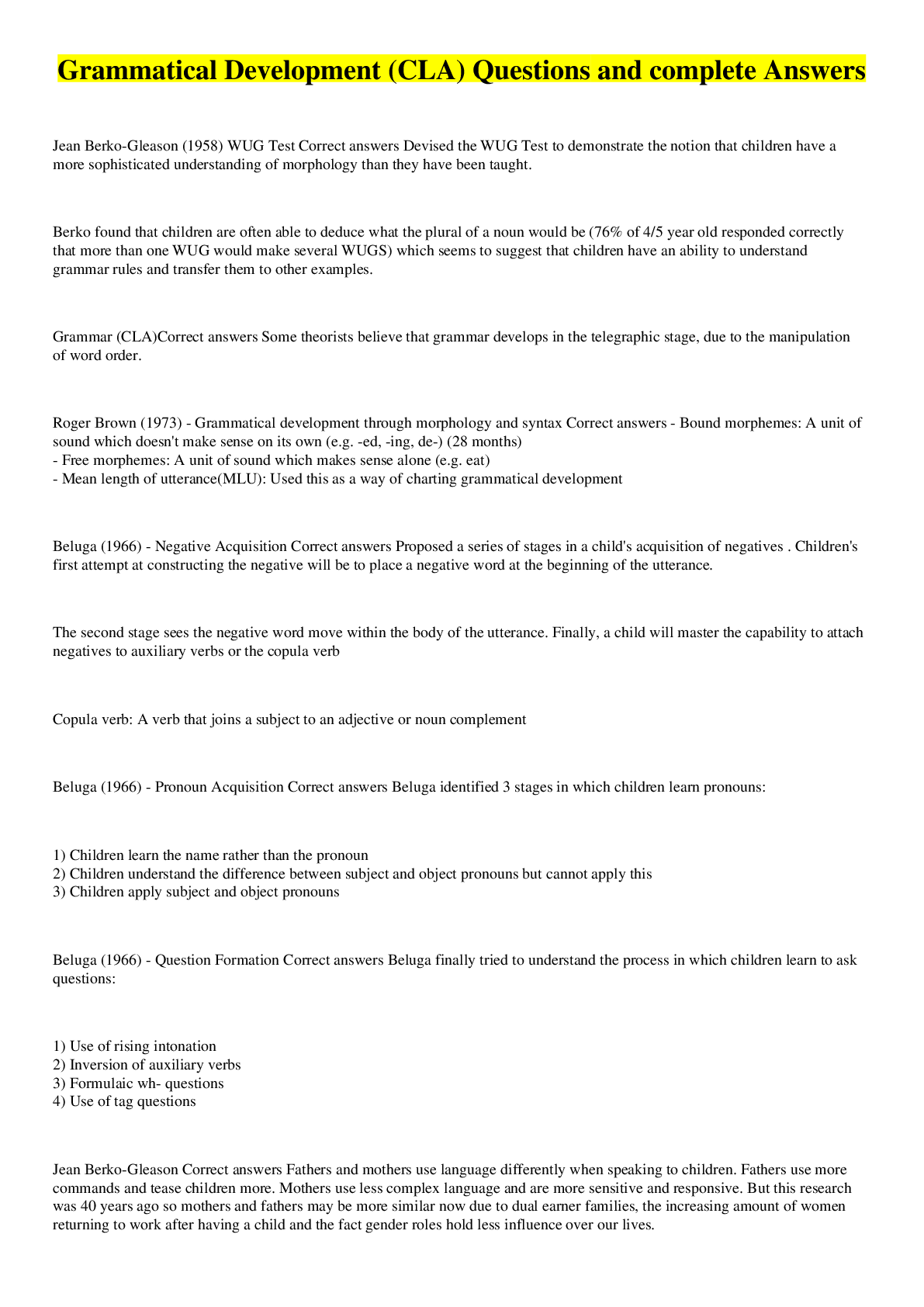
Jean Berko-Gleason (1958) WUG Test Correct answers Devised the WUG Test to demonstrate the notion that children have a more sophisticated understanding of morphology than they have been taught.
Berko found that children are often able to deduce what the plural of a noun would be (76% of 4/5 year old responded correctly that more than one WUG would make several WUGS) which seems to suggest that children have an ability to understand grammar rules and transfer them to other examples.
Grammar (CLA)Correct answers Some theorists believe that grammar develops in the telegraphic stage, due to the manipulation of word order.
Roger Brown (1973) - Grammatical development through morphology and syntax Correct answers - Bound morphemes: A unit of sound which doesn't make sense on its own (e.g. -ed, -ing, de-) (28 months)
- Free morphemes: A unit of sound which makes sense alone (e.g. eat)
- Mean length of utterance(MLU): Used this as a way of charting grammatical development
Beluga (1966) - Negative Acquisition Correct answers Proposed a series of stages in a child's acquisition of negatives . Children's first attempt at constructing the negative will be to place a negative word at the beginning of the utterance.
The second stage sees the negative word move within the body of the utterance. Finally, a child will master the capability to attach negatives to auxiliary verbs or the copula verb
Copula verb: A verb that joins a subject to an adjective or noun complement
Beluga (1966) - Pronoun Acquisition Correct answers Beluga identified 3 stages in which children learn pronouns:
1) Children learn the name rather than the pronoun
2) Children understand the difference between subject and object pronouns but cannot apply this
3) Children apply subject and object pronouns
Beluga (1966) - Question Formation Correct answers Beluga finally tried to understand the process in which children learn to ask questions:
1) Use of rising intonation
2) Inversion of auxiliary verbs
3) Formulaic wh- questions
4) Use of tag questions
[Show More]