You note in the chart of a patient's who is receiving volume control ventilation that the plateau
pressure has been increasing over the last 6 hours, while the PEEP levels remains constant.
Which of the following w
...
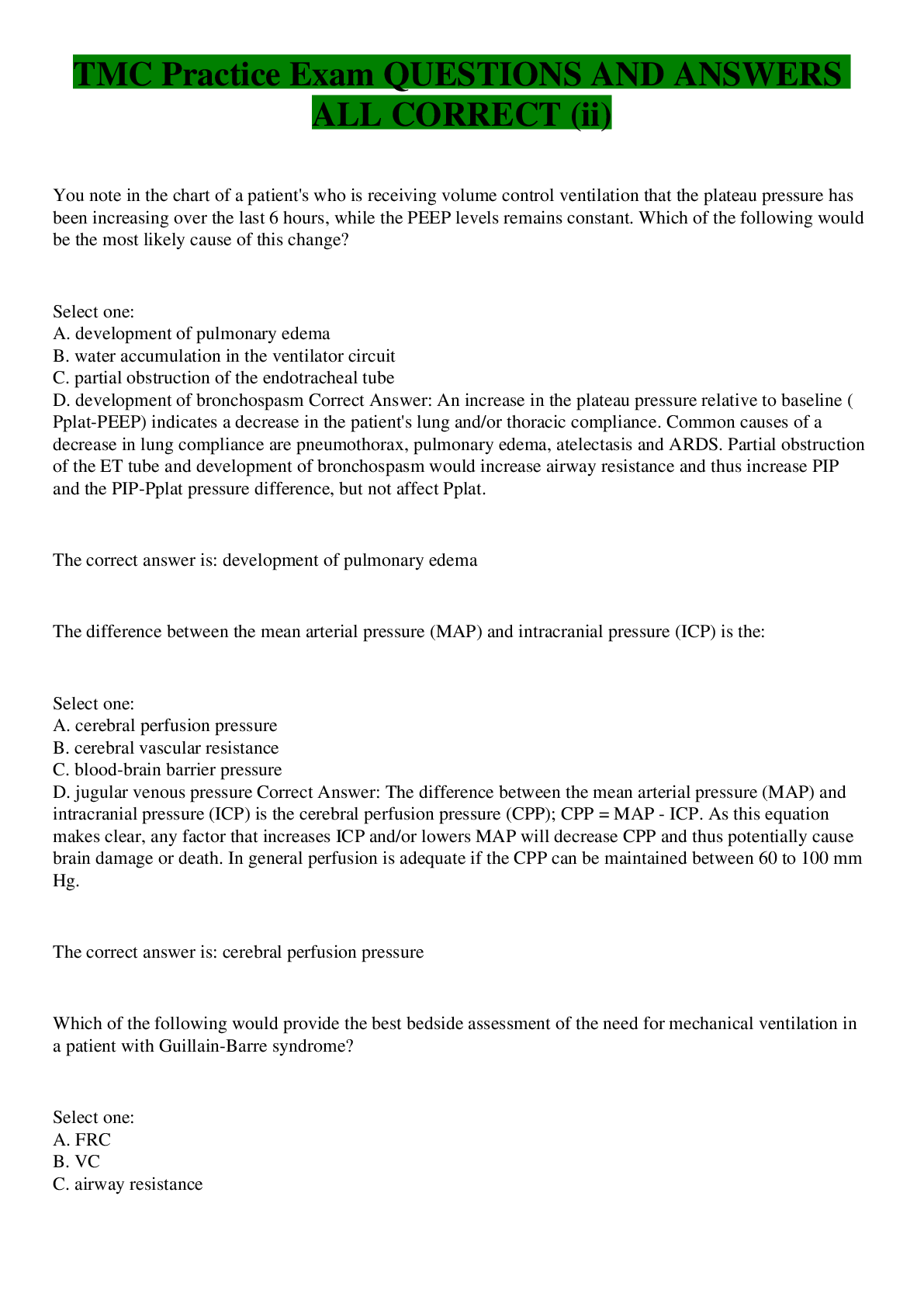
You note in the chart of a patient's who is receiving volume control ventilation that the plateau
pressure has been increasing over the last 6 hours, while the PEEP levels remains constant.
Which of the following would be the most likely cause of this change?
Select one:
A. development of pulmonary edema
B. water accumulation in the ventilator circuit
C. partial obstruction of the endotracheal tube
D. development of bronchospasm Correct Answer: An increase in the plateau pressure relative
to baseline (Pplat-PEEP) indicates a decrease in the patient's lung and/or thoracic compliance.
Common causes of a decrease in lung compliance are pneumothorax, pulmonary edema,
atelectasis and ARDS. Partial obstruction of the ET tube and development of bronchospasm
would increase airway resistance and thus increase PIP and the PIP-Pplat pressure difference, but
not affect Pplat.
The correct answer is: development of pulmonary edema
The difference between the mean arterial pressure (MAP) and intracranial pressure (ICP) is the:
Select one:
A. cerebral perfusion pressure
B. cerebral vascular resistance
C. blood-brain barrier pressure
D. jugular venous pressure Correct Answer: The difference between the mean arterial pressure
(MAP) and intracranial pressure (ICP) is the cerebral perfusion pressure (CPP); CPP = MAP -
ICP. As this equation makes clear, any factor that increases ICP and/or lowers MAP will
decrease CPP and thus potentially cause brain damage or death. In general perfusion is adequate
if the CPP can be maintained between 60 to 100 mm Hg.
The correct answer is: cerebral perfusion pressure
Which of the following would provide the best bedside assessment of the need for mechanical
ventilation in a patient with Guillain-Barre syndrome?
Select one:
A. FRC
B. VC
C. airway resistance
D. TLC Correct Answer: Guillain-Barre syndrome is a restrictive neuromuscular disorder that
results in hypoventilation. Airway resistance measures are not useful in diagnosing restrictive
ventilatory impairments. Restrictive ventilatory impairments are characterized by low lung
volumes. Of the volumes listed, only the vital capacity (VC) can be measured at bedside
[Show More]