A 48 year-old female is admitted to the ED with diaphoresis, jugular venous distension, and 3+
pitting edema in the ankles. These findings are consistent with
A. liver failure.
B. pulmonary embolism.
C. heart failu
...
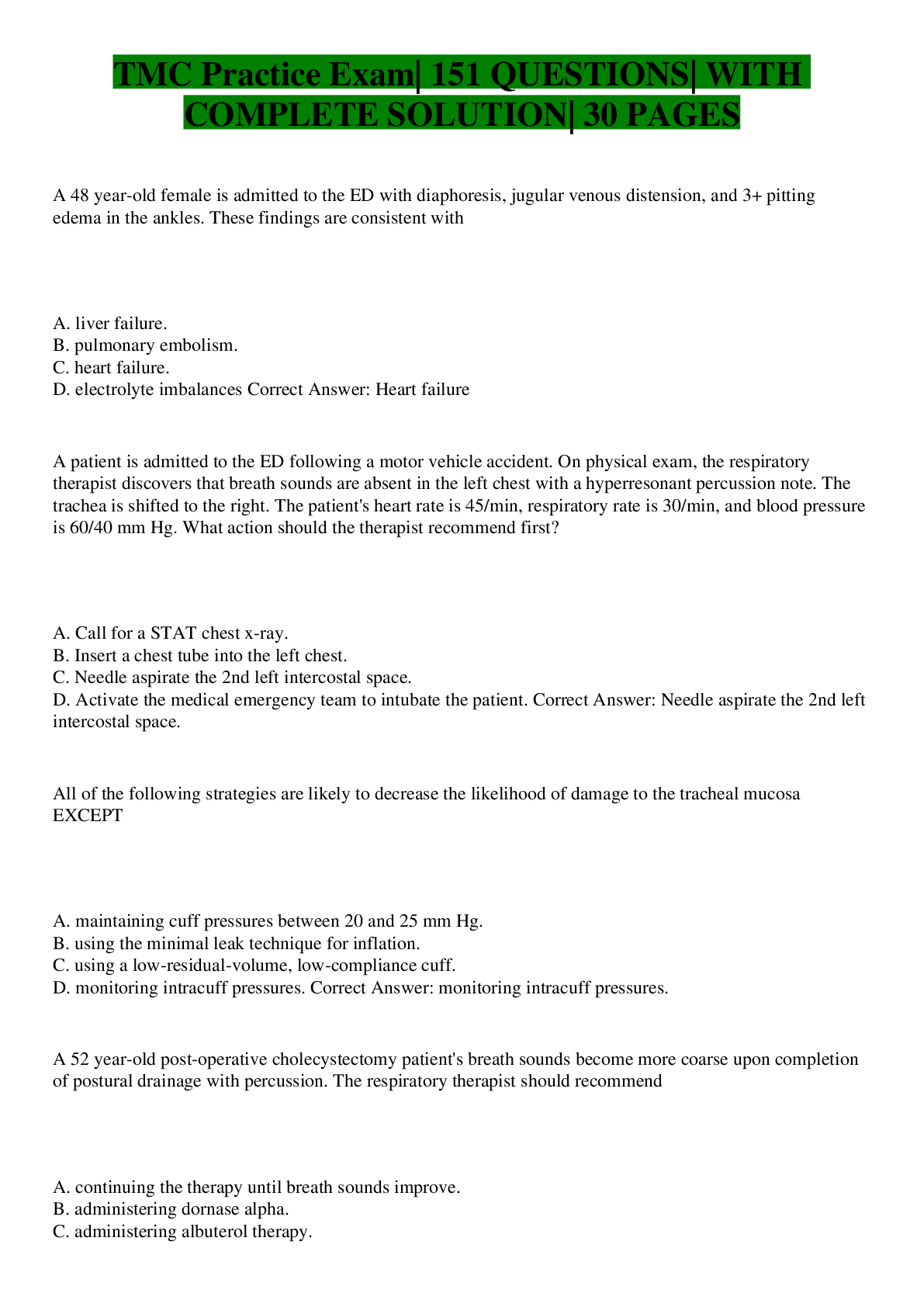
A 48 year-old female is admitted to the ED with diaphoresis, jugular venous distension, and 3+
pitting edema in the ankles. These findings are consistent with
A. liver failure.
B. pulmonary embolism.
C. heart failure.
D. electrolyte imbalances Correct Answer: Heart failure
A patient is admitted to the ED following a motor vehicle accident. On physical exam, the
respiratory therapist discovers that breath sounds are absent in the left chest with a hyperresonant
percussion note. The trachea is shifted to the right. The patient's heart rate is 45/min, respiratory
rate is 30/min, and blood pressure is 60/40 mm Hg. What action should the therapist recommend
first?
A. Call for a STAT chest x-ray.
B. Insert a chest tube into the left chest.
C. Needle aspirate the 2nd left intercostal space.
D. Activate the medical emergency team to intubate the patient. Correct Answer: Needle
aspirate the 2nd left intercostal space.
All of the following strategies are likely to decrease the likelihood of damage to the tracheal
mucosa EXCEPT
A. maintaining cuff pressures between 20 and 25 mm Hg.
B. using the minimal leak technique for inflation.
C. using a low-residual-volume, low-compliance cuff.
D. monitoring intracuff pressures. Correct Answer: monitoring intracuff pressures.
A 52 year-old post-operative cholecystectomy patient's breath sounds become more coarse upon
completion of postural drainage with percussion. The respiratory therapist should recommend
A. continuing the therapy until breath sounds improve.
B. administering dornase alpha.
C. administering albuterol therapy.
D. deep breathing and coughing to clear secretions. Correct Answer: deep breathing and
coughing to clear secretions.
[Show More]