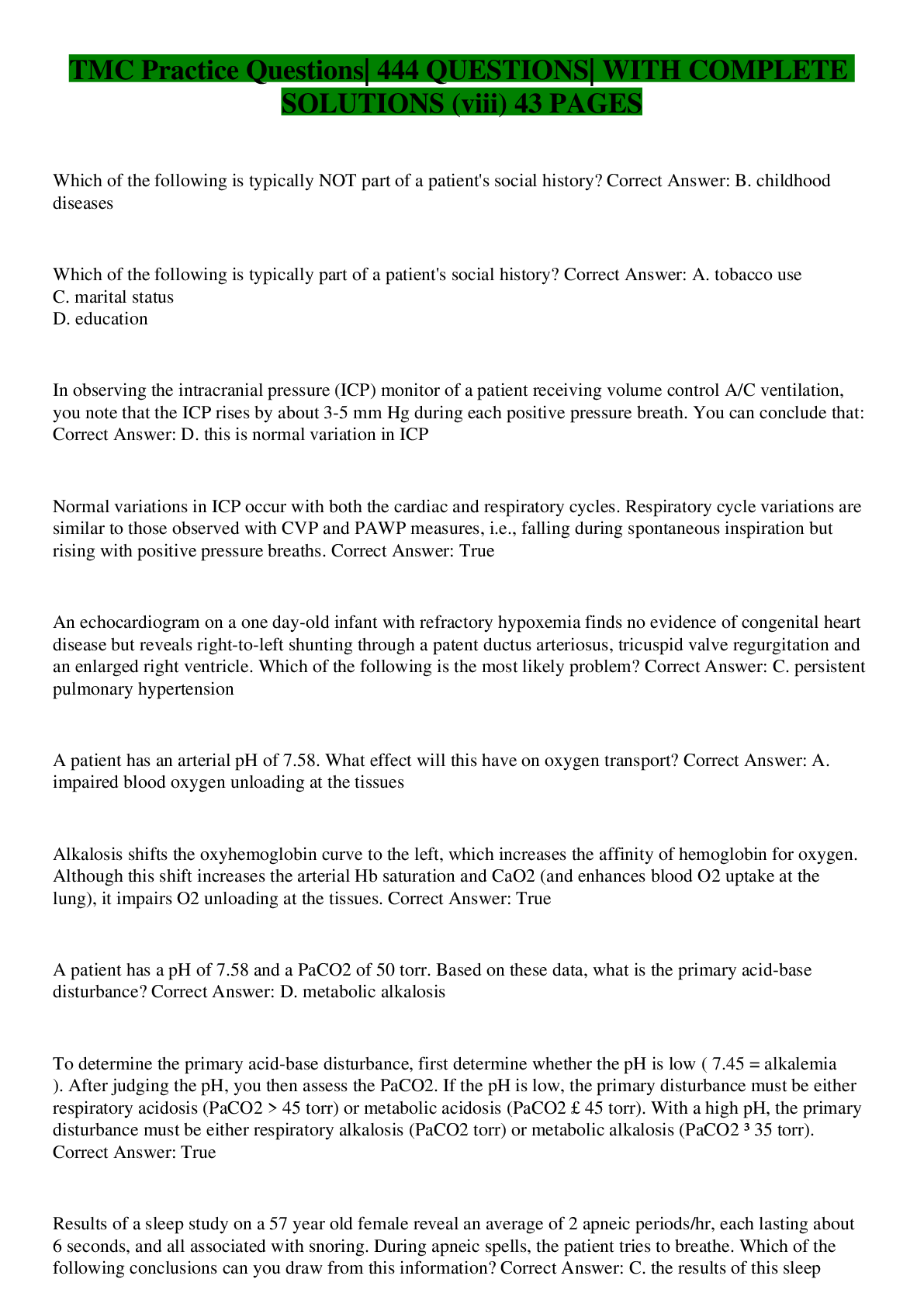
Which of the following is typically NOT part of a patient's social history? Correct Answer: B.
childhood diseases
Which of the following is typically part of a patient's social history? Correct Answer: A. tobac
...
Which of the following is typically NOT part of a patient's social history? Correct Answer: B.
childhood diseases
Which of the following is typically part of a patient's social history? Correct Answer: A. tobacco
use
C. marital status
D. education
In observing the intracranial pressure (ICP) monitor of a patient receiving volume control A/C
ventilation, you note that the ICP rises by about 3-5 mm Hg during each positive pressure breath.
You can conclude that: Correct Answer: D. this is normal variation in ICP
Normal variations in ICP occur with both the cardiac and respiratory cycles. Respiratory cycle
variations are similar to those observed with CVP and PAWP measures, i.e., falling during
spontaneous inspiration but rising with positive pressure breaths. Correct Answer: True
An echocardiogram on a one day-old infant with refractory hypoxemia finds no evidence of
congenital heart disease but reveals right-to-left shunting through a patent ductus arteriosus,
tricuspid valve regurgitation and an enlarged right ventricle. Which of the following is the most
likely problem? Correct Answer: C. persistent pulmonary hypertension
A patient has an arterial pH of 7.58. What effect will this have on oxygen transport? Correct
Answer: A. impaired blood oxygen unloading at the tissues
Alkalosis shifts the oxyhemoglobin curve to the left, which increases the affinity of hemoglobin
for oxygen. Although this shift increases the arterial Hb saturation and CaO2 (and enhances
blood O2 uptake at the lung), it impairs O2 unloading at the tissues. Correct Answer: True
A patient has a pH of 7.58 and a PaCO2 of 50 torr. Based on these data, what is the primary acid-
base disturbance? Correct Answer: D. metabolic alkalosis
To determine the primary acid-base disturbance, first determine whether the pH is low (< 7.35 =
academia) or high (> 7.45 = alkalemia). After judging the pH, you then assess the PaCO2. If the
pH is low, the primary disturbance must be either respiratory acidosis (PaCO2 > 45 torr) or
metabolic acidosis (PaCO2 £ 45 torr). With a high pH, the primary disturbance must be either
respiratory alkalosis (PaCO2 < 35 torr) or metabolic alkalosis (PaCO2 ³ 35 torr). Correct
Answer: True
Results of a sleep study on a 57 year old female reveal an average of 2 apneic periods/hr, each
lasting about 6 seconds, and all associated with snoring. During apneic spells, the patient tries to
breathe. Which of the following conclusions can you draw from this information? Correct
Answer: C. the results of this sleep study are within normal limits
[Show More]