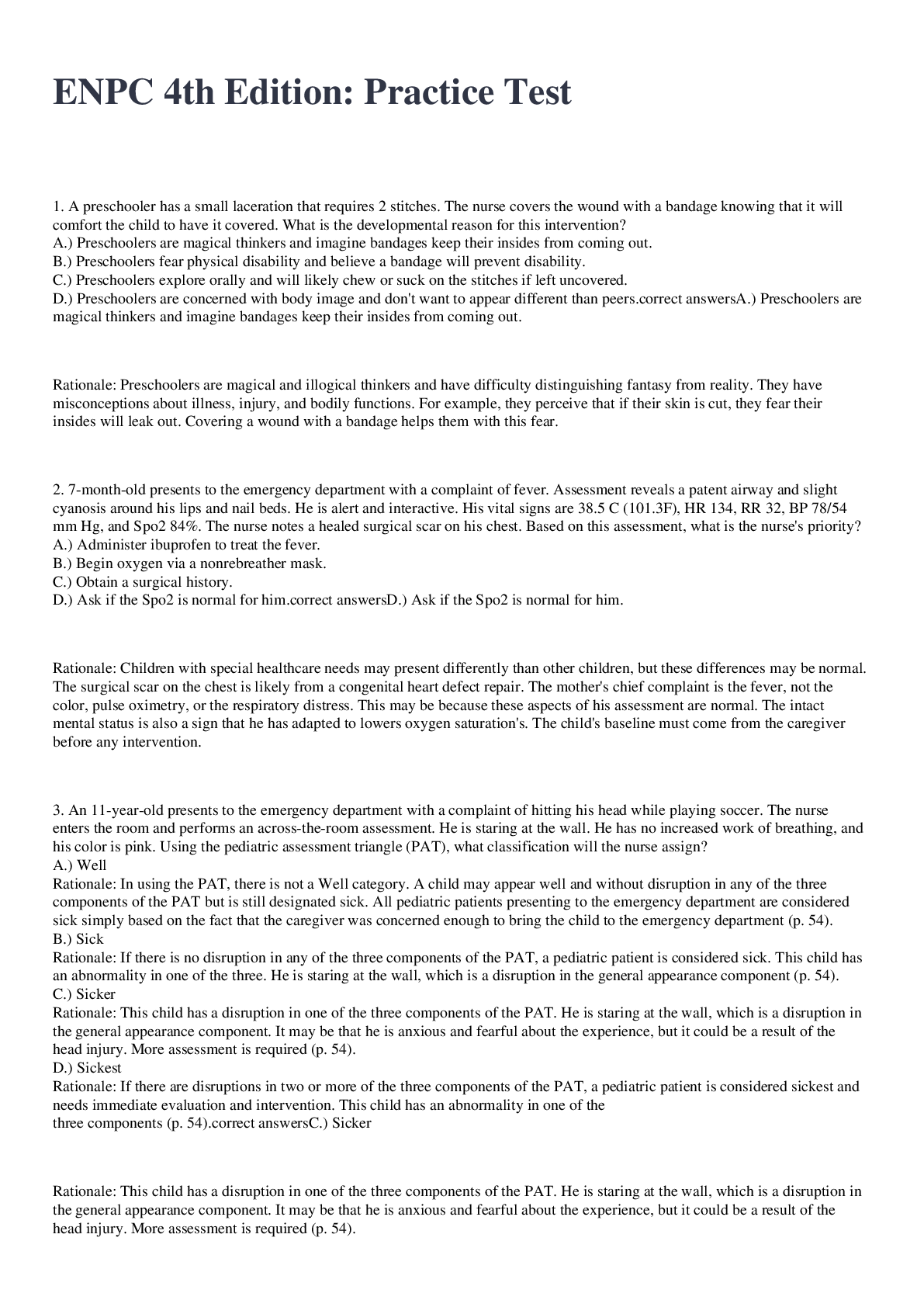
. A preschooler has a small laceration that requires 2 stitches. The nurse covers the wound with a bandage knowing that it will comfort the child to have it covered. What is the developmental reason for this intervention
...
. A preschooler has a small laceration that requires 2 stitches. The nurse covers the wound with a bandage knowing that it will comfort the child to have it covered. What is the developmental reason for this intervention?
A.) Preschoolers are magical thinkers and imagine bandages keep their insides from coming out.
B.) Preschoolers fear physical disability and believe a bandage will prevent disability.
C.) Preschoolers explore orally and will likely chew or suck on the stitches if left uncovered.
D.) Preschoolers are concerned with body image and don't want to appear different than peers.
A.) Preschoolers are magical thinkers and imagine bandages keep their insides from coming out.
Rationale: Preschoolers are magical and illogical thinkers and have difficulty distinguishing fantasy from reality. They have misconceptions about illness, injury, and bodily functions. For example, they perceive that if their skin is cut, they fear their insides will leak out. Covering a wound with a bandage helps them with this fear.
2. 7-month-old presents to the emergency department with a complaint of fever. Assessment reveals a patent airway and slight cyanosis around his lips and nail beds. He is alert and interactive. His vital signs are 38.5 C (101.3F), HR 134, RR 32, BP 78/54 mm Hg, and Spo2 84%. The nurse notes a healed surgical scar on his chest. Based on this assessment, what is the nurse's priority?
A.) Administer ibuprofen to treat the fever.
B.) Begin oxygen via a nonrebreather mask.
C.) Obtain a surgical history.
D.) Ask if the Spo2 is normal for him.
D.) Ask if the Spo2 is normal for him.
Rationale: Children with special healthcare needs may present differently than other children, but these differences may be normal. The surgical scar on the chest is likely from a congenital heart defect repair. The mother's chief complaint is the fever, not the color, pulse oximetry, or the respiratory distress. This may be because these aspects of his assessment are normal. The intact mental status is also a sign that he has adapted to lowers oxygen saturation's. The child's baseline must come from the caregiver before any intervention.
3. An 11-year-old presents to the emergency department with a complaint of hitting his head while playing soccer. The nurse enters the room and performs an across-the-room assessment. He is staring at the wall. He has no increased work of breathing, and his color is pink. Using the pediatric assessment triangle (PAT), what classification will the nurse assign?
A.) Well
Rationale: In using the PAT, there is not a Well category. A child may appear well and without disruption in any of the three components of the PAT but is still designated sick. All pediatric patients presenting to the emergency department are considered sick simply based on the fact that the caregiver was concerned enough to bring the child to the emergency department (p. 54).
B.) Sick
Rationale: If there is no disruption in any of the three components of the PAT, a pediatric patient is considered sick. This child has an abnormality in one of the three. He is staring at the wall, which is a disruption in the general appearance component (p. 54).
C.) Sicker
Rationale: This child has a disruption in one of the three components of the PAT. He is staring at the wall, which is a disruption in the general appearance component. It may be that he is anxious and fearful about the experience, but it could be a result of the head injury. More assessment is required (p. 54).
D.) Sickest
Rationale: If there are disruptions in two or more of the three components of the PAT, a pediatric patient is considered sickest and needs immediate evaluation and intervention. This child has an abnormality in one of the
three components (p. 54).
C.) Sicker
Rationale: This child has a disruption in one of the three components of the PAT. He is staring at the wall, which is a disruption in the general appearance component. It may be that he is anxious and fearful about the experience, but it could be a result of the head injury. More assessment is required (p. 54).
[Show More]