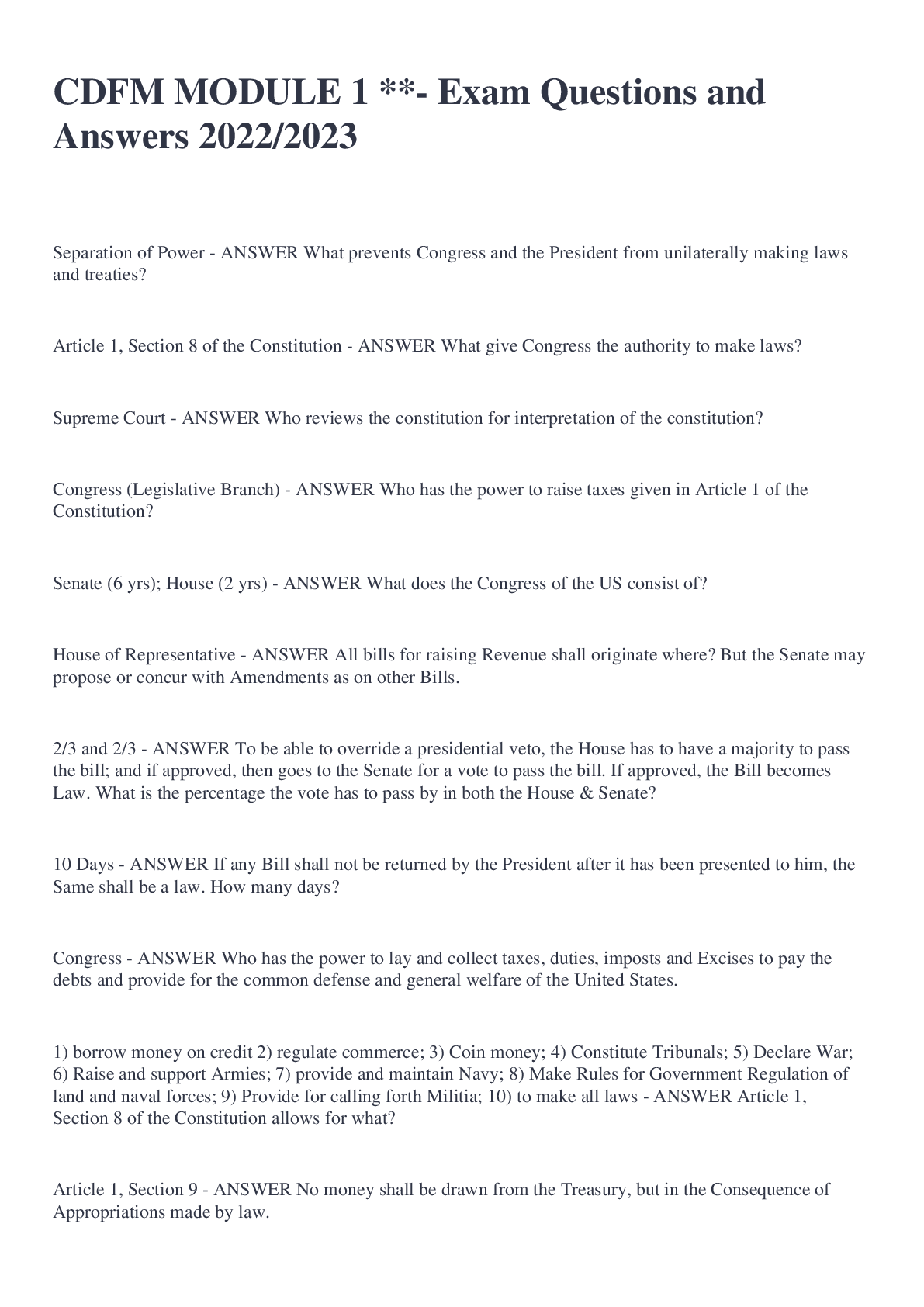
Separation of Power - ANSWER What prevents Congress and the President from unilaterally making laws and treaties?
Article 1, Section 8 of the Constitution - ANSWER What give Congress the authority to make laws?
Sup
...
Separation of Power - ANSWER What prevents Congress and the President from unilaterally making laws and treaties?
Article 1, Section 8 of the Constitution - ANSWER What give Congress the authority to make laws?
Supreme Court - ANSWER Who reviews the constitution for interpretation of the constitution?
Congress (Legislative Branch) - ANSWER Who has the power to raise taxes given in Article 1 of the Constitution?
Senate (6 yrs); House (2 yrs) - ANSWER What does the Congress of the US consist of?
House of Representative - ANSWER All bills for raising Revenue shall originate where? But the Senate may propose or concur with Amendments as on other Bills.
2/3 and 2/3 - ANSWER To be able to override a presidential veto, the House has to have a majority to pass the bill; and if approved, then goes to the Senate for a vote to pass the bill. If approved, the Bill becomes Law. What is the percentage the vote has to pass by in both the House & Senate?
10 Days - ANSWER If any Bill shall not be returned by the President after it has been presented to him, the Same shall be a law. How many days?
Congress - ANSWER Who has the power to lay and collect taxes, duties, imposts and Excises to pay the debts and provide for the common defense and general welfare of the United States.
1) borrow money on credit 2) regulate commerce; 3) Coin money; 4) Constitute Tribunals; 5) Declare War; 6) Raise and support Armies; 7) provide and maintain Navy; 8) Make Rules for Government Regulation of land and naval forces; 9) Provide for calling forth Militia; 10) to make all laws - ANSWER Article 1, Section 8 of the Constitution allows for what?
Article 1, Section 9 - ANSWER No money shall be drawn from the Treasury, but in the Consequence of Appropriations made by law.
Write a Law - ANSWER Once the money officially and legally gets into the Treasury, to be able to use the money, what does Congress have to do?
Article 2 Executive Branch - ANSWER Gives executive power to the President to be the Commander in Chief and to execute the laws
Ambassadors & Supreme Court Judges - ANSWER The President has the power to nominate and with the advice and consent of the Senate, shall appoint these officials. Name 2?
Once year - ANSWER How often does the President give to Congress the State of the Union (Jan/Feb) time frame.
President (Executive Branch) - ANSWER Who and what branch is responsibly for faithfully executing the laws enacted by Congress (Legislative Branch)?
State Laws - ANSWER The Supreme Court does not deal in the matter of what?
2 sessions; 1 year duration - ANSWER A new Congress convenes for two years following the November general elections, it consists of how many sessions, and each in what duration?
Joint Resolution - ANSWER This may originate either in the House of Representatives or in the Senate. There is little practice difference between a bill and a " ", once agree, it goes to the President for signature.
Concurrent Resolution - ANSWER Matters affecting the operation of the House & Senate and both chambers agree, does not go to the President for signature.
Simple Resolution - ANSWER The House and Senate can each write an matter concerning the operation on its own. Applies to the chamber that created it. Knows as the H.Res & S.Res
State of Union, recommend measures necessary and expedient - ANSWER During the State of The Union, what message is the President giving?
Yes, but must be approved by OMB - ANSWER Can an Executive Branch Department pass legislation with the approval of OMB and on Behalf of the president, to a congressional committee or subcommittee
Conference Committee (Third Chamber) - ANSWER Who resolves differences between the HR and the Senate?
Public Hearing - ANSWER What is usually the first step in the process for consideration by committee?
Only deal with matters in disagreement; cannot insert new matter or leave out matter agreed on - ANSWER When a Conference Committee is convened dealing with an amendment, what can the conferees do and not do?
"Enrolled" (then sent to the president) - ANSWER The final step after the Conference Committee Resolution after a measure has been passed in identical form by both the House andSenate, it is considered to be what?
Line Item Veto - ANSWER What was declared unconstitutional in 1998 with respect to Presidential Veto?
The next house has to pass it with a 2/3 vote to become law. - ANSWER If the President Veto a Bill, it is returned to the house of original acting first. If the Bill does not receive 2/3 vote, it is sustained and the bill fails to become law. If it receives the required 2/3 vote, an endorsement to the effect is made on the back of the bill and it is then transmitted, with the accompany message, the to the second house for its action. What has to happen for the Bill to become Law?
OMB - ANSWER Who is responsible for the 3 phases of the Budget Cycle?
Budget Formulation, Congressional Action and Budget Execution - ANSWER What are the 3 Phases of the Budget Cycle?
The President - ANSWER Who does the Federal budget belong to?
OMB Circular A-11 - ANSWER The Budget Formulation processed is governed by this?
Presidential Priorities - ANSWER OMB Circular A-11 sets out the promises of the president
1) OMB Issues guidance; 2) Organization develops draft; 3) Agency submit budget estimates to OMB; 4) OMB hold hearings on Agency Budgets; 5) President makes final decisions on Agency budgets; 6) President transmits the budget to Congress. - ANSWER What are the six major steps in the budget formulation process laid out in OMB Circular A-11?
Additional OMB Duties - ANSWER What organization is responsible for helping the President with spending policy, managing the executive budget, and providing advice an dangles on a broad range of topics?
1st Monday in February each year - ANSWER The President is responsible to transmit the budget of the US government to congress NLT when?
Congressional Action Phase - ANSWER Congress she process authorization legislation, which authorizes or allows programs to exist. They also pass appropriations, which provide funding for programs
Appropriation - ANSWER The President signs the bills into law that provides legal budget authority to incur obligations and make payments out of the Treasury for specified purposes.
Budget Committees - ANSWER In the Congressional Action Phase, who holds hearing in January in preperation for drafting the concurrent resolution of the budget?
Concurrent Resolution - April of each year - ANSWER Budget Committees this to their respective houses. The resolution sets spending revenue and other budget targets for the upcoming fiscal year.
Scorekeeping - ANSWER This is the process of estimating the budgetary effects of pending legislation and comparing them to a baseline such as a budget resolution or to any limits that may be set in law.
budget authority, receipts, outlays, surplus or deficit, and the public debt - ANSWER What data does scorekeeping track?
Budget Resolution - ANSWER This resolution fixes new budget authority and outlay target and establishes target for the Gross National Debt, revenues, and surplus/deficit.
Concurrent Budget Resolution - ANSWER This resolution does not require the signature of the President. It is the first step in the Congressional Budget Process.
Annual Appropriation Bill - ANSWER This Bill may not exceed the ceilings set in the CBR w/out a 60% majority vote of the entire congress & CBO monitors for compliance.
Defense Relates Appropriations Acts - ANSWER Defense, Military Construction/Veterans Affairs & Energy and Water
Legislative History - ANSWER When a statutes language is not clear as written, the best place to go for interpretation of the law is where?
SECDEF - ANSWER Who will provide DoDs position on appeal items?
Budget Amendments - ANSWER Amends the budgets submission prior to completion of a congressional act....they have been submitted but not yet processed by congress
Supplmental Requests - ANSWER Normally transmitted to Congress as requests to provide funds in addition to amounts already appropriated for the ongoing fiscal year.
Continuing Resolution (CR) - ANSWER What provides budget authority for specific ongoing activities for a specific period of time?
Time, Purpose & Amount - ANSWER Budget authority and the availability of budgetary resources for obligation and expenditure are limited by the following elements.
Time - ANSWER The period of time of that the budget resources may incur new obligations is different from the period of time during which budgetary resources may be used to insure expenditures.
Budget Authority - ANSWER This is distributed by OMB as part of the apportionment process.
Budget Execution Process - ANSWER This process begins with the President's signature on the appropriations bill.
SF-132 - ANSWER What is the Form that OSD has to send to OMB to request apportionment within 10 days of the Presenting signing the appropriations bill?
Obligation Authority - ANSWER What does the apportionment provide to the Federal agencies?
Within 10 days of the appropriations Act - ANSWER OSD/OMB negotiates apportionments (OSD must request apportionment via form SF-132). OMB has 30 days after the appropriations act passage to effect apportionment.
Appropriation Warrant - ANSWER Financial control document issued by the Treasury Department
Apportionment - ANSWER What devices up the appropriation?
31 USC 1512 - ANSWER Apportionment is required by what USC?
Available Funds - ANSWER Apportionment helps to achieve the cost effective and economical use of what?
the amount apportioned - ANSWER It is a violation of law for an agency to incur obligations or make expenditures in excess of what?
Deferred (2 USC 684) - ANSWER The President is required to send a notice to the appropriate commitment. If
Congress does not notify the President within 45 days to release the funds, the funds may be what?
Rescission - ANSWER Funds that are cancelled by congressional action.
31 USC 1514 - ANSWER Required the system of administrative controls
Commitment Accounting - ANSWER is not required for the operation and maintenance appropriation accounts, revolving funds accounts, or military personnel appropriation accounts, but may be used if cost effective.
Obligations - ANSWER Legal reservation of funds are the amounts of orders places, contracts awarded, services received, and similar transactions during an accounting period that will require payment during the same or future periods.
Fiduciary - ANSWER certification that certifies to the KO purpose, time and amount. The basis for a commitment
Certifying Officers - ANSWER Certifies vouchers for payments
Congress - ANSWER Appropriates the funds and sends to OMB for apportionment
OMB - ANSWER Apportions the funds to the Agencies for execution
Agency - ANSWER Responsible for Allots, commits, obligates and outlays the funding
Outlays - ANSWER funds that have actually been moved from the federal treasury
HAC & SAC - ANSWER Who is the primary oversight committee for the DoD programs?
Government Accountability Office (GAO) - ANSWER Who's is the head of the Comptroller General?
Federal Budget Process - ANSWER 1) Budget Formulation, 2) Congressional Review 3) Budget Execution
Government Performance and Results Act (GPRA) - ANSWER The budget formulation is based on performance planning/reporting as required by what?
Budget Deficit - ANSWER Government budget outlays exceed its budget receipts for any given period
Budget totals - ANSWER the transactions of Government entities that laws exclude from the on-budget totals (those of SSA, Trust Fund, and Postal Service are not included in the budget deficit)
Contract authority - ANSWER Specific statutory authority to incur obligations
Cost - ANSWER Cash value of the resources allocated to a particular program
Discretionary Spending - ANSWER Budgetary resources provided in an appropriations act.
Entitle Authority - ANSWER Authority to make payments
Expenditure - ANSWER Occurs when a check is issued
Mandatory Spending - ANSWER Spending that is controlled by laws.
Outlay - ANSWER Primary measure of government spending
34% - ANSWER How large is discretionary spending, budget authority that is indefinite
Non-Discretionary - ANSWER This spending is mandatory for entitlement programs such as SS, corporate income taxes, excise taxes, etc. This is a "permanent appropriation"
Individual Income Taxes - ANSWER What makes up the greatest revenue source?
1921 Budget and Accounting Act - ANSWER Requires the President to submit an annual budget proposal to congress and established the OMB and the GAO.
1974 Congressional Budget Impoundment Control Act - ANSWER Established House and Senate Budget Committees. Changed FY to 1 Oct - 30 Sep from 1 Jul - 30 Jun
1987 Balanced Budget and Emergency Deficit Control Reaffirmation Act - ANSWER Pay as you go on any spending outside the appropriation that would increase the deficit. Often referred to as the Gramm-Rudman Hollings Act
1990 Budget Enforcement Act - ANSWER Discretionary Spending is the budget authority controlled by annual appropriations acts and the outlays that result from the BA. Established Pay-as-you-go entitlements (can't add a new one without getting rid of an old one)
1996 Line Item Veto Act - ANSWER Authority was briefly granted in 1996 and used by President Bill Clinton until it was declared unconstitutional in 1998.
Congress - ANSWER Military departments are responsible of recruiting, training, and equipping their forces, but operational control of those forces is assigned to one of the Combatant Commands. Who sets the End Strength?
Manpower Management - ANSWER The process for determining requirements for budgetary purposes and reporting strengths to OMB
Actual Strength - ANSWER Number of personnel in, or projected to be in, an organization or account at a specified point in time. Seats filled.
Assigned Strength - ANSWER Actual strength of an entire service, not necessarily equal to combined unit actual strengths because individuals may be assigned but not joined.
DoD Civilian Workforce - ANSWER US Citizens or foreign national hired directly or indirectly to work for DoD, paid from appropriated or non-appropriated funds under permanent or temporary assignment. Specifically excluded are all Government contractor employees.
Peacetime Strength - ANSWER Authorized and programmed strength at the end of the fiscal year for active forces, selected reserve, and appropriated-fund civilian employees in the FYDP.
DoD Manpower Utilization Policy - ANSWER Terminating or differing activities not essential to the war effort in order to permit the reallocation of personnel to higher priority tasks. Assigning military personnel only to those jobs that contribute to the war (exceptions apply)
Military incumbency is required by law, possessing military unique skills or experience, military authority or discipline is requisite of the position, alternative manpower is not availble - ANSWER What jobs cannot be reassigned to non-military personnel during war effort?
Increase in Civilian workforce - ANSWER An expansion of military members through mobilization may require an increase in what workforce?
Master Mobilization Plan (MMP) - ANSWER Mobilization is the process of assembling, organizing and using manpower and material resources in preparation for war or other emergency. The mobilization process can help deter war as well as enhance war fighting capability.
10 USC 12304 - ANSWER Gives the President authority to order to active duty Selected Reserve and Ready Reserves w/o the consent of Congress for no more than 365 days.
Emergency Essential - ANSWER A position based designation stating that a person occupying an E-E position could be deployed to a crisis area.
OMB Circular A-11 - ANSWER Personnel budget estimates are prepared in terms of full-time equivalent (Fee) employment, as required by..
5 USC 9902(i) - ANSWER DoD Separation Incentives - requires that buyout payments be paid from amounts available for the employee's pay, and generally, be fully repaid if the employee rejoins the Federal Government within fiver years of separation
Federal Activities Inventory Reform Act of 1998 (FAIR Act) - ANSWER Requires annual list of activities performed by executive agency that are not inherently government functions. These are lists of positions that are not considered to be inherently governmental
Non-inherently governmental - ANSWER Positions that can be done by contractor personnel
Public Availability of Lists - ANSWER The head of the Executive agency shall promptly transmit a copy of the list to Congress to make the list available to the public. The director OMB shall promptly publish in the Federal Register a notice that the list is available to the public.
Competition Required - ANSWER Executive agency shall use a process to select the source (except where except by law)
OMB Circular A-76 - ANSWER This defines activities in two categories, commercial activity, and inherently governmental activity
[Show More]






.png)