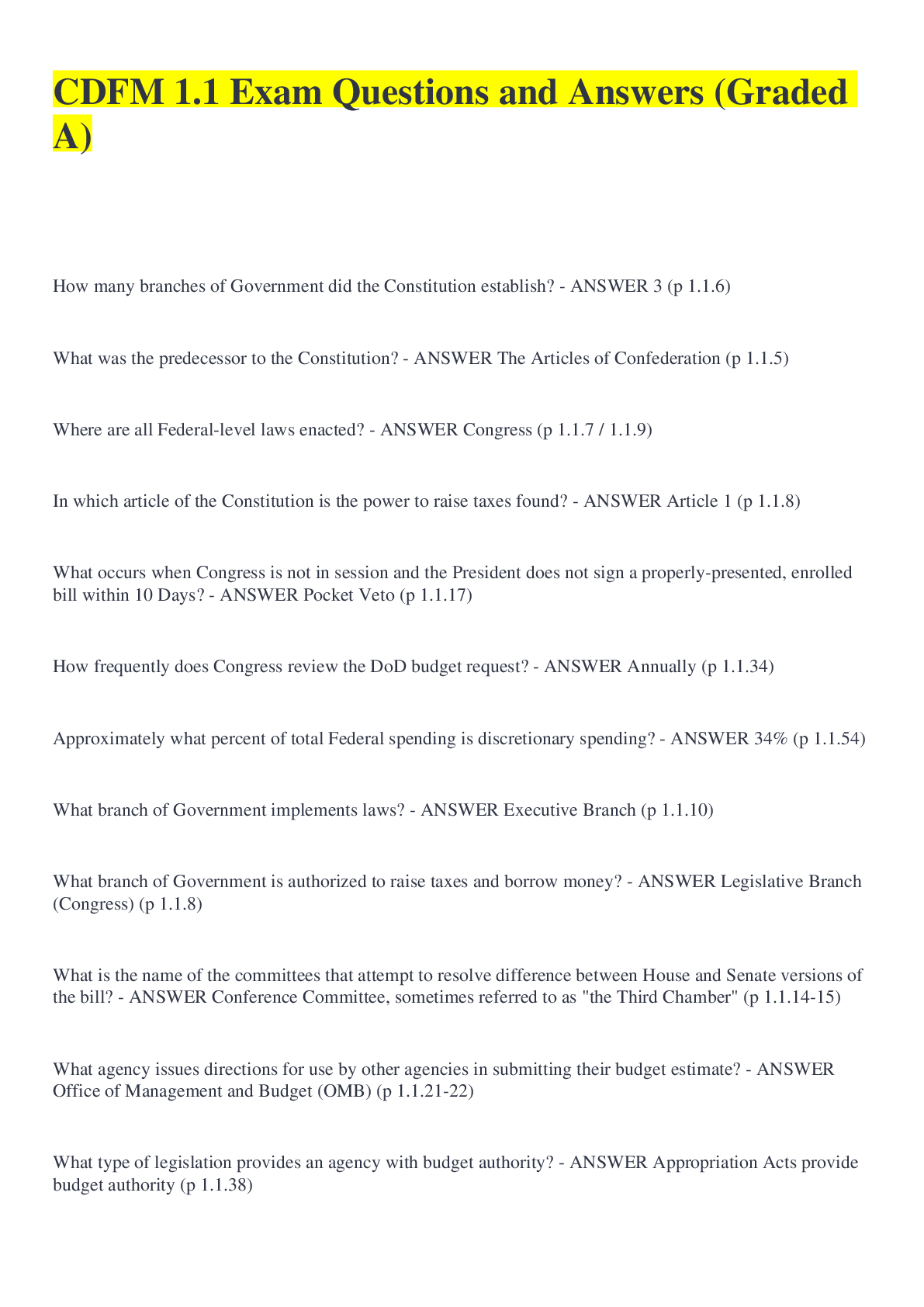
How many branches of Government did the Constitution establish? - ANSWER 3 (p 1.1.6)
What was the predecessor to the Constitution? - ANSWER The Articles of Confederation (p 1.1.5)
Where are all Federal-level laws e
...
How many branches of Government did the Constitution establish? - ANSWER 3 (p 1.1.6)
What was the predecessor to the Constitution? - ANSWER The Articles of Confederation (p 1.1.5)
Where are all Federal-level laws enacted? - ANSWER Congress (p 1.1.7 / 1.1.9)
In which article of the Constitution is the power to raise taxes found? - ANSWER Article 1 (p 1.1.8)
What occurs when Congress is not in session and the President does not sign a properly-presented, enrolled bill within 10 Days? - ANSWER Pocket Veto (p 1.1.17)
How frequently does Congress review the DoD budget request? - ANSWER Annually (p 1.1.34)
Approximately what percent of total Federal spending is discretionary spending? - ANSWER 34% (p 1.1.54)
What branch of Government implements laws? - ANSWER Executive Branch (p 1.1.10)
What branch of Government is authorized to raise taxes and borrow money? - ANSWER Legislative Branch (Congress) (p 1.1.8)
What is the name of the committees that attempt to resolve difference between House and Senate versions of the bill? - ANSWER Conference Committee, sometimes referred to as "the Third Chamber" (p 1.1.14-15)
What agency issues directions for use by other agencies in submitting their budget estimate? - ANSWER Office of Management and Budget (OMB) (p 1.1.21-22)
What type of legislation provides an agency with budget authority? - ANSWER Appropriation Acts provide budget authority (p 1.1.38)
What term is used to describe a subdivision of an apportionment? - ANSWER Allotment (p 1.1.40)
What agency issues apportionments? - ANSWER Office of Management and Budget (OMB) (p 1.1.38)
What branch of Government conducts hearings on the effectiveness of Government programs? - ANSWER Legislative Branch (Congress) (p 1.1.49)
In the Federal budget process, which organizations actually prepare budget estimates? - ANSWER Federal Agencies (p 1.1.21)
What is the largest single source of Federal Government tax revenues? - ANSWER Individual Income Taxes (43%) (p 1.1.53)
What are requests for funds in addition to amounts already appropriated called? - ANSWER Supplemental (p 1.1.35)
What financial control document is issued by the Treasury Department following signature of the Appropriations Act? - ANSWER Appropriation Warrant (p 1.1.40)
What term describes a postponement in the use of appropriated funds? - ANSWER Deferral (p 1.1.43)
What term describes a cancellation of appropriated funds? - ANSWER Rescission (p 1.1.43-44)
After the DoD Appropriations Bill is signed into law, what does DoD request from OMB? - ANSWER Apportionment (p 1.1.39 / 1.1.42)
An administrative reservation of funds is known as what? - ANSWER Commitment (p 1.1.45)
What gives a Federal agency the legal authority to operate a program? - ANSWER Authorization Legislation (p 1.1.29)
Article 1, Section 8, Clause 1, of the U.S. Constitution empowers which element of the Federal Government to collect taxes? - ANSWER The Legislative Branch (p 1.1.9)
What does the principle of separation of powers do? - ANSWER Prevents Congress and the President from unilaterally making laws and treaties (p 1.1.5)
What is the genesis of the Federal Legislative Process? - ANSWER The Declaration of Independence (July 4, 1776), Article of Confederation (March 1, 1781), Constitution ratified by nine states (June 1788), and the Constitution took effect (March 4, 1789) (p 1.1.5)
What is the essential principle of the Constitution? - ANSWER Government must be confined to the rule of law (p 1.1.6)
What are the powers of Congress? - ANSWER Article 1. Congress has the power to raise taxes, borrow money, regulate commerce, conscript forces, declare war, and raise and support armies (p 1.1.8)
What are the executive powers of the President? - ANSWER Commander-in-chief and execute laws (p 1.1.10)
What are the judicial powers to the Courts? - ANSWER Supreme Court, Inferior Courts established by Congress, and interpret laws (p 1.1.11)
What is a bill? - ANSWER A legislative proposal of a general nature (1.1.12)
What is a joint resolution? - ANSWER There's little difference between a joint resolution and a bill, may originate in either house. Used to consider amendments to the Constitution, which is not presented to the President for approval, instead it's sent to the Administrator of General Services for submission to the individual states. (p 1.1.12)
What is a Concurrent Resolution? - ANSWER Used for matters affecting the operations of both the House of Representatives and Senate. They are not presented to the President for action. (p 1.1.13)
What is a Simple Resolution? - ANSWER Used for matters concerning the operation of either the House of Representatives or Senate alone. They are not presented to the President for action. (p 1.1.13)
In what ways is legislation originated? - ANSWER Recommended by the President, introduced by Members, and Introduced by Committees. (p 1.1.13)
How does an Appropriations bill become law? - ANSWER 1. Bill introduced in the House
2. Referred to Appropriations Committee
3. Committee hearings
4. Committee adopts bill
5. House hearings (optional)
6. House adopts bill
7. Similar process takes place in the Senate
8. Conference Committee resolves differences between the House and Senate versions of the bill
9. House and Senate pass bill in identical form (bill is then considered "enrolled"
10. President signs the bill into law (p 1.1.14)
What are the 4 Presidential actions when presented with a bill? - ANSWER 1. Approval and Signature
2. Does not sign but allows the bill to become law by not returning it within 10 days
3. Pocket veto - if Congress is adjourned and the President fails to sign a bill during the 10-day period, the bill does not become law
4. Veto - President returns the bill to Congress without approval. The bill can still become law with a 2/3 vote of both the House and Senate (p 1.1.17)
What are the phases of the Budget Cycle? - ANSWER Budget Formulation, Congressional Action, Budget Execution (p 1.1.18)
What are the six major steps in the Budget Formulation phase? - ANSWER 1. OMB issues guidance
2. Organization develops a draft
3. Agency submits budget estimates to OMB
4. OMB holds hearings on Agency budgets
5. President makes final decisions on Agency budgets
6. President transmits the budget to Congress (p 1.1.19)
What is Planning, Programming, Budgeting, and Execution (PPBE)? - ANSWER It is the process that DoD uses to formulate the DoD Budget portion of the President's Budget. Budget formulation is based on performance plans, formulation forms the basis for execution, and execution provides the results to be used in formulating the next budget cycle (p 1.1.19)
What is the Agencies role in the Budget Formulation phase? - ANSWER Prepare plans, programs, and budget estimates; and defend plans and estimates before OMB (p 1.1.21)
What is the internal OSD review known as? - ANSWER The "Fall Review" (p 1.1.21)
What is OMB's role in the Budget Formulation phase? - ANSWER 1. Establish the format for the budget and guidance for submitting budget estimates (OMB Circular A-11)
2. Reviews and holds hearings on agency budget estimates
3. Makes recommendations to the President on each agency's budget (p 1.1.22)
What is the OMB Passback? - ANSWER * Results of the OMB review of the agency provided via letter
* Passback can change funding or add funding
* Can be appealed by agency head to the President
What is the President's role in the Budget Formulation phase? - ANSWER * Makes final decision on each agency's budget
* Transmits "The Budget of the United States Government" to Congress NLT 1st Monday in February (p 1.1.23)
What is Congress' role in the Congressional Action phase? - ANSWER * Conducts budget hearings
* Passes concurrent budget resolution, which sets a ceiling for each of the appropriations bills
* Processes authorizing legislation, which authorizes or allows programs to exist
* Passes appropriations, which provide funding for programs (p 1.1.24)
What are DoD and other Agencies role in the Congressional Action phase? - ANSWER Testify at Congressional budget hearings (p 1.1.24)
What is the President's role in the Congressional Action phase? - ANSWER Signs appropriations bills into law (an appropriation provides budget authority - the legal authority to incur obligations and make payments out of the Treasury for specified purposes) (p 1.1.24)
What are the 3 processes that occur in Congress in the Congressional Action phase? - ANSWER 1. The Budget Resolution Process
2. The Authorization Process
3. The Appropriation Process
What is scorekeeping? - ANSWER Occurs during the Budget Resolution Process. It is the process of estimating the budgetary effects of pending legislation and comparing them to a baseline such as a budget resolution or to any limits that may be set in law. (p 1.1.28)
What is the Budget Resolution Process? - ANSWER The House and Senate budget committees draft a budget resolution for review, debate, and ultimate passage by the House and Senate. The end product is the Concurrent Budget Resolution (CBR) (p 1.1.28)
What is the Authorization Process? - ANSWER The second step in the enactment process. The output is "enabling" or "organic" legislation, which also provides "appropriation authorization." Do not give an agency the authority to obligate funds or permit the withdrawal of funds from the Treasury. (p 1.1.29)
What is "enabling" or "organic" legislation? - ANSWER Legislation that creates an agency, establishes a program, or prescribes a function. (p 1.1.29)
What is the Appropriation Process? - ANSWER The 3rd step in the enactment process. The House Appropriations Committee (HAC) and the Senate Appropriations Committee (SAC) manage the appropriation process for the entire Federal Government. Each committee has 12 sub-committees responsible for determining the 12 annual appropriations bills. Once the sub-committees agree on their respective appropriations, they send their recommendations to the respective full committees for action. Once the House appropriations committee has completed their review, it is passed to the full House for approval, which is then passed to the Senate where the same process occurs. If the two houses disagree, a conference committee consisting of members of both houses meet to resolve the issues, which is ten returned to each house for a vote. Once passed, it is then presented to the President for approval. (p 1.1.32-33)
What is a Budget Amendment? - ANSWER An amendment to the budget submission prior to completion of Congressional action. (p 1.1.35)
What is a Supplemental Request? - ANSWER A request transmitted to Congress to provide funds in addition to amounts already appropriated. (p 1.1.35)
What is a Continuing Resolution? - ANSWER A temporary appropriations act that allows agencies to continue to operate if the appropriations bill isn't passed by the 1st day of the new fiscal year. A CR must be passed by both houses and signed by the President. If a CR is not passed by the 1st day of the new fiscal year, agencies must start the process of shutdown to avoid violating the Antideficiency Act. A CR provides budget authority for specific ongoing activities for a specific period of time. Portions may continue for the entire fiscal year. The regular appropriation, when enacted, supersedes the CR. Generally, an agency's authority to obligate funds under a CR is an amount equal to the current year's authority or the requested authority, whichever is less. (p 1.1.36)
What are the committees and their roles in the Budget Resolution process? - ANSWER House Budget Committee and Senate Budget Committee, who prepares the Concurrent Budget Resolution (p 1.1.37)
What are the committees and their roles in the Authorization process? - ANSWER House Armed Services Committee (HASC) and Senate Armed Services Committee (SASC), who conducts hearings, and drafts and submits the National Defense Authorization Bills that authorize programs to exist. (p 1.1.37)
What are the committees and their roles in the Appropriations process? - ANSWER House Appropriations Committee (HAC) and Senate Appropriations Committee (SAC), who conducts hearings, and drafts and submits the Appropriations Bills that provide budget authority for the Government. (p 1.1.37)
What does the appropriations act provide agencies with? - ANSWER Budget authority (p 1.1.38)
What are budget authority and the availability of budgetary resources for obligation and expenditure limited by? - ANSWER Purpose, Time, and Amount (p 1.1.38)
Purpose - ANSWER Funds may be obligated and expended only for the purposes authorized in appropriations acts or other laws. (p 1.1.38)
Time - ANSWER The period of time that budgetary resources may incur new obligations (i.e. order new goods or services) is different from the period of time during which the budgetary resources may be used to incur expenditures (i.e. pay bills) (p 1.1.38)
Amount - ANSWER Obligations and expenditures may not exceed the amounts established by law. (p 1.1.38)
What is budgetary authority? - ANSWER Authority to obligate (aka obligation authority). Budgetary authority is distributed by OMB as part of the apportionment process. Once the Treasury Appropriation Warrant is posted in the agency's accounting system and the agency receives the Apportionment (SF-132), the agency and its components may obligate the Government to pay for goods and services as authorized in the appropriation. (p 1.1.38)
What are the key events in the Budget Execution phase? - ANSWER * The Department of Treasury issues Appropriation Warrants as soon as possible after the President signs the appropriation bill
* Within 10 days of the appropriations act, OSD/OMB negotiates apportionments. OMB has 30 days after the appropriations act passage to effect apportionment
* As soon as practical after apportionment, OSD allots to military departments
* Ongoing during the fiscal year, OSD and military departments obligate for goods and services
* Ongoing, but especially quarterly, OSD monitors/reports financial activity and assesses performance against objectives. Agency controls obligations within allotted budget authority.
* Quarterly, OSD reports to OMB the status of expenditures using SF-133
* Mid-year, comprehensive reviews of all performance indicators are conducted throughout DoD and programs are adjusted as required.
* Ongoing, programs are adjusted to meet emerging conditions. Agencies/DoD reprograms/transfers funds with proper approval.
* End of FY, OSD through Services completes Year-End Closeout (p 1.1.40)
What is an Appropriation Warrant? - ANSWER Establishes the amount of monies authorized to be withdrawn from the central account. Basis for recording appropriations on the books of the Treasury Department and DoD. Under a Continuing Resolution, temporary warrants are prepared by the Agency and submitted to the Treasury Department. (p 1.1.41)
What is Apportionment? - ANSWER A distribution of an amount available for obligation and/or commitment in an appropriation or fund account into amounts available for specified time periods, activities, projects, or combinations thereof as approved by OMB and the agency. Intended to achieve the most effective and economical use of the funds available; and prevent the necessity for supplemental or deficiency appropriations. Limit the obligations that may be incurred. (p 1.1.42)
What is a Reapportionment? - ANSWER A revision to a previous apportionment to reflect changes in the amount of financial resources previously authorized by legislation. (p 1.1.42)
What is the Impoundment Control Act? - ANSWER Prohibits the President from withholding funds without sufficient reason. He can, however, do so for programmatic or technical reasons. Gives the President two options for withholding funds when there are not sufficient programmatic or technical reasons: deferrals and rescissions. (p 1.1.43)
What is a Deferral? - ANSWER A postponement of funds. (p 1.1.43)
What is a Rescission? - ANSWER A cancellation of funds. (p 1.1.44)
31 USC 1514 - ANSWER Requires the official having administrative control of an appropriation to prescribe by regulation a system of administrative control not inconsistent with accounting procedures prescribed under law. The system shall be designed to:
* Restrict obligations or expenditures from each appropriation to the amount of apportionments or reapportionments of the appropriation
* Enable the official or head of the executive agency to fix responsibility for an obligation or expenditure exceeding an apportionment or reapportionment (p 1.1.45)
What is an Allotment or Sub-Allotment? - ANSWER How agencies distribute funds within the agency. The concept behind allotment is to place operational and obligational authority at the lowest practical level to increase the likelihood of effective management. (p 1.1.45)
What is a Commitment? - ANSWER Administrative reservation of funds. Based on firm procurement requests, orders, directives, and equivalent instruments. Reduces the uncommitted/unobligated balance. Helps to ensure subsequent entry of an undelivered order or accrued expenditure will not exceed available funds. (p 1.1.46)
What is an Obligation? - ANSWER Legal reservation of funds. The amounts of orders placed, contracts awarded, services recieved, and similar transactions during an accounting period that will require payment during the same or future periods. An amount can only be recorded as obligated when supported by documentary evidence of the transaction.
What is an Outlay? - ANSWER Funds that have actually been moved from the Federal Treasury (p 1.1.47)
What does monitoring requirements in budget execution involve? - ANSWER * Administrative control of funds
* Reporting of actual results
* Assessment of applicability of those results to the preparation of future plans, programs, and budgets
* Supply financial information to DoD managers (p 1.1.48)
What does GPRA require? - ANSWER Strategic planning, performance planning and goal setting, and performance reporting (p 1.1.50)
What is Mandatory Spending? - ANSWER Spending that is controlled by laws other than appropriation acts (including spending for entitlement programs and spending for the food stamp program). (p 1.1.52)
What is Discretionary Spending? - ANSWER Budgetary resources (except those provided to fund direct spending programs) provided in appropriatio
[Show More]